With AI, Yongqianbao Hit One Million Monthly Transactions

A monthly transaction volume of 1 million means roughly over 30,000 transactions per day — a new loan is originated on the Yongqianbao platform every three seconds. And many of the people initiating these loans have no credit cards and no access to traditional financial services...

Author: Xi You
Source: PBOC Watch
One million transactions per month means roughly 30,000 per day, one every three seconds on the Yongqianbao platform. The people initiating these loans are often those without credit cards, unable to access traditional financial services...
1
Monthly Transaction Volume Breaks 1 Million
At noon on December 30, 2016, Yongqianbao employees, their families, and investors gradually arrived at the conference room on the fourth floor of the Beijing Liyuan Huating Hotel next to the company, waiting for the milestone moment when the platform's monthly transaction count would break one million.
The celebration venue had been meticulously arranged. In the center stood a blue ice sculpture marked with "1,000,000." In front of it sat a large cake decorated with six Dragon Balls, with champagne and glasses arranged behind it. To the left of the venue were several claw machines; to the right, a VR gaming console. Fried shrimp, popcorn, sausages, and orange juice were placed around the room for guests.
Yet the most eye-catching feature was the LED display on the north wall. Yongqianbao's December 2016 transaction count updated in real time there. It was 12:09 p.m., and the screen showed 999,970 transactions — just a hair's breadth from one million. The crowd began to stir, blowing horns and waving balloon sticks, everyone unconsciously gathering toward the center of the stage.

Yongqianbao employees and families celebrating one million monthly transactions
One minute later, Yongqianbao would collect its "six Dragon Balls." CEO Jiao Ke, a post-80s entrepreneur, had used the Dragon Ball manga trope "collect all seven Dragon Balls to summon Shenron" to motivate his team. He told them that reaching ten million monthly transactions would complete their "small goal" of gathering all seven balls.
After more than a year of effort, monthly transactions had reached this million mark. In these final minutes, Jiao Ke stood quietly among the crowd, reflecting on the company's rapid growth over the past year. Since the system went live in July 2015, monthly transaction growth had never stopped: October 2015, surpassing 1,000; January 2016, breaking 10,000; April 2016, exceeding 100,000. And now, they were about to cross the one million threshold.
One million transactions per month meant industry-leading position. It meant roughly 30,000 per day, one every three seconds. The people initiating these loans were mostly young people without credit cards, unable to access traditional financial services — white-collar workers, clerks, secretaries, receptionists, from all walks of life.
Currently, Yongqianbao provided them with small, short-term consumer credit: loan terms of 7–30 days, amounts between RMB 500–5,000, with first-time borrowers limited to RMB 1,000.
When Yongqianbao was founded, many questioned this customer positioning. Who still lacks RMB 1,000 these days? Does this market even exist? At the time, Jiao Ke asked everyone around him: Have you ever borrowed money from relatives, acquaintances, or friends? Something like, "Hey buddy, lend me a thousand, I'll pay you back next month." If so, you might be Yongqianbao's target user. It turned out such demand not only existed but was substantial.
This was user-centric thinking. Jiao Ke's first job after graduation was at Baidu. He remembered that in Baidu's early days, every product manager held one principle: be responsible to users. He still savored that feeling. Back then, Jiao Ke had taken a product from zero to 100 million users in less than a year.
"With a mindset of responsibility to users, you can't make bad products," he'd say with satisfaction whenever recounting this. "Users would send us songs they recorded themselves, and we'd listen to them in the conference room. Off-key, but we enjoyed it."
Yongqianbao emerged from this same ethos. Jiao Ke and his team's goal was "smart finance for everyone" — using AI and big data risk control to meet young people's consumer finance needs, giving them convenient access to small loans.
When the LED screen finally froze at one million, the atmosphere peaked. Amid the cheers, Jiao Ke and two other partners — CTO Qi Peng and VP of Operations Zhao Bo — together smashed the "1,000,000" ice sculpture.
Yongqianbao had collected six Dragon Balls!
2
The Birth of Yongqianbao
After finishing his speech to employees at the celebration, Jiao Ke calmed down. Watching the scene before him, his thoughts drifted back a year and a half.
It was May 2015. Though long anticipated, when there was truly not a single yuan left in the company account, Jiao Ke felt somewhat uneasy.
His first venture, "Dai Xiaomi," had never found a viable business model. In the five months prior, he'd visited 50 investment institutions without securing funding. Forced to borrow from friends, he later heard from one: "If it were me, I wouldn't have slept during that time." But Jiao Ke was fine. This Pisces man called himself a rational optimist — when facing difficulties and dilemmas, he always habitually looked at the positive side.
Jiao Ke first analyzed why "Dai Xiaomi" couldn't continue. The key problem, he concluded, was insufficient supply of financial products. With severe homogenization in domestic financial products, a search engine for credit products was a castle in the air. Then an idea began brewing: since supply was insufficient, why not transform into a supplier of financial products?
He thought of using big data and AI for risk control. With an undergraduate degree from Tsinghua University's computer science department, graduate studies at the Chinese Academy of Sciences, work experience at Baidu, and subsequent product roles at local lifestyle platform "Ganji" and B2B platform "Marco Polo," he had both technical strengths and operational experience. His time at Baidu made him particularly attuned to AI's development. After much consideration, combining AI with credit risk control became the company's transformation direction.
But time was running out. If funding didn't come through, the company would shut down.
In June 2015, Jiao Ke arrived at Source Code Capital's office then located in the Zhongguancun Internet Finance Building. He shared his idea with Yi Cao, founding partner of Source Code Capital.
Born in 1984, Cao had spent 12 years in venture capital. Before founding Source Code Capital in 2014, he worked at Sequoia Capital, hailed as "the post-80s generation's most Neil Shen-like figure." Source Code Capital's LPs included nearly 20 CEOs of listed tech companies and BAT executives, among them Meituan's Xing Wang and ByteDance's Yiming Zhang.
After hearing Jiao Ke out, Cao's eyes lit up. Source Code Capital and Cao himself had long been observing the internet finance industry, having invested in companies like Qufenqi. Cao sensed that while financial markets had massive supply shortages, the vast majority of internet finance companies still used traditional approaches. AI and big data for risk control — the track was definitely right. And Jiao Ke's technically grounded team background gave Cao confidence.
This wasn't Jiao Ke's first approach to Cao. Early in the "Dai Xiaomi" venture, Jiao Ke had sought him out, but Source Code didn't invest then. This time, Jiao Ke again turned to this fellow alumnus from Tsinghua's computer science department.
At Tsinghua, Jiao Ke had been a campus fixture. In 2001, he wrote the play The Girl in the White Dress, later performed at Tsinghua's Grand Auditorium. When discussing this work that caused a sensation at Tsinghua and beyond, the STEM-trained Jiao Ke emphasized the importance of structure and pacing.
Entrepreneurship also requires grasping rhythm. This time, Jiao Ke caught two tailwinds: AI and consumer finance. For Cao, encountering the right team at the right time — a team using the right technical approach to address a market gap — was an exceptionally rare investment opportunity. Cao didn't hesitate, providing Jiao Ke with crucial funding.
Internet entrepreneurship emphasizes "speed above all." For Jiao Ke and the company, this was a "must win, cannot lose" "fight with one's back to the river." What happened next surprised Cao and Source Code Capital: Jiao Ke and his team built a big data-based AI risk control system in one month.
In those brief 30 days, the team's workload far exceeded developing a risk control system and app. Behind it lay the matching of business flows, capital flows, and data flows — much complex work. With the company's survival hanging by a thread, everyone unleashed astonishing potential, working day and night.
The company was then near Tsinghua's Wudaokou area. In the conference room, war-room meetings began at 6 p.m. every evening. The small room was packed with people discussing progress and sorting out ideas. When disputes couldn't be resolved, frontline staff made the call. To meet deadlines, the company broke targets down to daily tasks; people often worked until 1 a.m.
On July 1, 2015, through the team's efforts, Yongqianbao launched as planned, achieving the "absolutely impossible."
3
The Right Posture for a Team
Many employees' families came to the celebration. Among them were Qi Peng's wife and two children. The milestone of one million monthly transactions didn't stir much emotion in Qi Peng — it was all within his expectations.
Qi Peng's first job was also at Baidu. In 2008, he began developing foundational infrastructure for Baidu's web search. Five months later, this fresh graduate became lead of a 30-person team, building excellent products like Baidu's "Aladdin." But over time, Qi Peng felt he had depth but insufficient breadth. He later joined AutoNavi as deputy general manager responsible for data production. In July 2015, Jiao Ke persuaded him to join Yongqianbao. Joining a startup meant a salary cut "from the ankles down," but Qi Peng valued people more. In his eyes, Jiao Ke made decisions rationally, with empathetic perspective-taking.
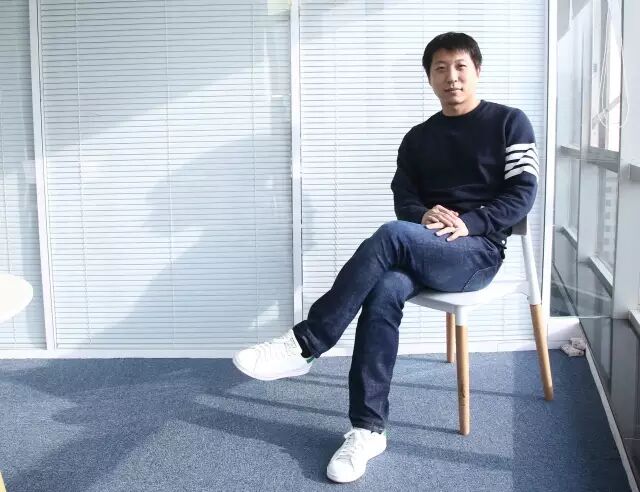
Yongqianbao CTO Qi Peng
In October 2015, when monthly transactions surpassed 1,000, Qi Peng began feeling "this might actually work." From then on, the company made plans every month for the next: performance targets, product initiatives, risk control goals, architectural support needed... And from then on, almost all important milestones were executed strictly according to plan without deviation.
This was a point of pride for Qi Peng. He cared about the right "posture" for team execution. Yongqianbao's rapid business growth was driven by the principle of "business-driven" development — the correct approach for professional entrepreneurship rather than showing off technical prowess. All strategy, architecture, data, and service lines proceeded from functional satisfaction to architectural abstraction, from categorization by business line to layering that improved iteration efficiency and knowledge sharing. This laid roadmap foundations for employee development and prepared thoroughly to safeguard the business.
In interviews, Qi Peng repeatedly emphasized the difference between "behavior-oriented" and "goal-oriented" approaches. In his view, most individuals and companies are behavior-oriented, but running a business requires results orientation. Clear goals give everyone clear expectations. Now, one of Qi Peng's key tasks was decomposing company goals into targets for each team, even each engineer, then ensuring teams completed system development and iteration tasks on schedule. This strict planning and execution enabled Yongqianbao to reach over one million monthly transactions in a short time. But journeying a hundred li is half done at ninety. To collect all seven Dragon Balls and achieve the small goal of ten million monthly transactions, Yongqianbao needed to become stronger.
At this point, grasping rhythm was crucial. Previously, looking one month ahead sufficed; now they needed to look one quarter ahead. Previously, they completed one key task per month; now multiple tasks ran simultaneously. If one thing wasn't done well, it could affect next month's business development. Now Qi Peng had to decompose the company across both "tasks" and "people" dimensions — while executing, he also had to build the team.
If Baidu gave him management and technical experience, then AutoNavi taught him the importance of corporate culture.
Qi Peng often told team members that excellent internet entrepreneurs need the spirit of "recognizing insufficiency to strive forward, knowing shame to become courageous." The first half means recognizing gaps, admitting them — but not just admitting, refusing to accept defeat and working hard to catch up.
A soccer enthusiast, he liked using football clubs as metaphors. He hoped excellent employees could practice self-management. In his words, only when everyone is professional can the team trust each other. And this professionalism shows in whether you run when you should run, whether you score when you should score. With this capability, your value naturally rises. But individual professionalism wasn't enough — Qi Peng also hoped team members could appreciate each other, forming effective默契 and trust. Only then could the team be combat-effective and go further together.
Entrepreneurship is an endless long-distance run. Since the product launched in July 2015, everyone had been working day and night. The first wave to leave each evening was around 10 p.m.; the last wave never before midnight.
It was this dedicated attitude that created Yongqianbao's leading position in the industry today.
AI-Powered Risk Control
For Yongqianbao data scientist Jing Du, December 30, 2016 held double significance. At the company celebration, he proposed to his girlfriend of many years. Du felt that since joining this company, his life had finally caught the right "rhythm."
Du completed graduate studies at National University of Defense Technology, then also went to Baidu, working on personalized recommendations under web search — a highly specialized field. After two and a half years, Du wanted to see the bigger world outside. Leaving Baidu, he first joined an online education company.

Yongqianbao Data Scientist Jing Du
In September 2015, before Du joined Yongqianbao, Jiao Ke had invited some friends to his home to play Mafia. When Du closed his eyes and heard Jiao Ke's magnetic baritone say "Close your eyes, killers open your eyes," he felt completely immersed. In that moment, he sensed Jiao Ke's "magnetic field."
From then on, Du became familiar with the Yongqianbao team. Working on Baidu's web search, Du had used machine learning algorithms. Doing this work, he developed particular interest in data. Hearing Jiao Ke's introduction to internet finance, Du felt finance could very likely match with machine learning, and decided to join.
The finance industry is most suitable for AI application. This relates both to finance's inherent attributes and AI's characteristics. Finance is inherently a digital industry — allocating resources across time periods requires using numbers to price and mark purchasing power. Many financial business objectives are numerical increases. AI essentially uses machines to find relationships between business objectives and data samples. Machine learning algorithms seek relationships between these two sets of numbers, making them "equal," solving the function Y=F(X).
Unwittingly, Du had entered one of the hottest startup tracks: if the Mobile Internet beginning in 2012 catalyzed China's internet finance wave, then the recently explosive AI technology would bring even more profound changes to finance.
Take risk control systems: AI differs greatly from traditional approaches. Traditional finance relies on judging users' strong features — does the borrower have a house, a car, what is their monthly income? This risk control method is relatively rigid, with high due diligence costs, easily excluding those who don't meet conditions. AI risk control, however, looks at users' weak features — their behavioral characteristics across various internet platforms, and their usage patterns within the Yongqianbao app itself.
While issuing instructions to machines, Du and colleagues constantly mined new data features on the front lines, trying different models and algorithms to see how well they performed on specific datasets. Thus, Yongqianbao's risk control system iterated daily. All of this served to better solve the function Y=F(X), grasping patterns from big data and expanding business boundaries.
In this process, some interesting patterns emerged. For instance, some users showed strong unidirectional calling characteristics — frequently dialing out, rarely receiving calls. Such users had slightly higher delinquency rates than those with reciprocal calling patterns.
Another example: borrowers' phone battery levels. This data seemingly unrelated to default rates, the machine nonetheless found certain patterns. It discovered that people who generally kept phone battery above 50% had default rates 2–3 percentage points lower than those below 50%. This pattern isn't hard to understand — people who regularly keep their phones charged tend to be cautious and reliable. However, patterns found in single-dimension data weren't enough for machines to make final decisions; a 2–3% gap was truly minute. Machines must examine thousands of data dimensions to reach a final decision.
Currently, Yongqianbao's system supports 30,000–40,000 transactions, with each transaction sample containing over 1,200 weak features. Excluding existing data, 30–40 million feature points return daily. Du and colleagues continue racing against time to improve algorithms and iterate systems, advancing toward the small goal of over ten million monthly transactions and collecting all seven Dragon Balls.