Under 'New Retail,' Where Do Brick-and-Mortar Stores Go From Here? | Source Code Capital Insights

For the future of retail, there's no distinction between online and offline traffic — only differences in acquisition cost and how fully it's utilized.
Source Code Capital Internal Brief
Issue 1
About the Author
Kaisi Chang
Executive Director, Investment

Mr. Kaisi Chang joined Source Code Capital in 2016.
Prior to Source Code Capital, Mr. Chang worked at Actis and Capital Group, where he focused on investments in consumer and internet sectors. His representative investments include Bellagio, 7 Days Inn, DiDi, and other outstanding companies.
Mr. Chang graduated from the Department of Automation at Tsinghua University and earned his PhD at the University of Cambridge.
Contact: ks@sourcecodecap.com
[ Editor's Note ]
Amid the "new retail" megatrend, Source Code Capital presents the first issue of [Source Code Capital Internal Brief], offering an exclusive analysis on how to reassess the value of offline stores.

Perspective
Where Do Offline Stores Go Under "New Retail"?
Research by/Source Code Capital
○ The recent "weak recovery" of offline stores is merely an active adjustment by e-commerce. In the long run, offline retail must transform aggressively to adapt to the future of retail;
○ Successful offline stores of the future will need to: focus on immediate-consumption and service-oriented categories, control upstream supply chains, and prioritize experience over display;
○ The greater opportunity for offline stores lies in fully unlocking the value of offline traffic. For the future of retail, there is no distinction between online and offline traffic — only differences in acquisition cost and degree of utilization.
1
Behind the "Weak Recovery" of Offline Stores, Deeper Challenges Loom
Source: Company annual reports
Over the past five years, e-commerce has been virtually the only theme in retail. Starting with 3C electronics, moving to apparel, and then expanding to general merchandise, e-commerce has disrupted offline stores with overwhelming momentum across nearly every category. Under this pressure, offline retail began talking about transformation early on — from the "omnichannel" concept proposed in 2010, to later iterations like O2O, "Internet Plus," and most recently "new retail" — a constant stream of buzzwords and concepts.
By the numbers, after nearly five years of prolonged stagnation, offline stores do seem to be showing some signs of life. According to Ministry of Commerce statistics, in January–February 2017, sales at major supermarkets grew 3.8% year-over-year, while sales at major specialty retailers grew 5% — significantly better than Q1 2016. Offline stores appear to be experiencing a "weak recovery."
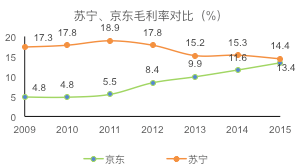
However, in our view, these transformations remain far from sufficient. The recent "recovery" is less a success for offline stores than an active adjustment by e-commerce. Over the past decade, e-commerce's primary weapon against offline stores has been price. Though this came at the cost of gross margins, it allowed platforms to leverage internet demographic dividends for rapid expansion while using upstream payment terms to generate sufficient cash flow to fuel growth.
In recent years, as competitive dynamics have stabilized and internet demographic dividends have faded, e-commerce has adjusted prices and gross margins to levels comparable with offline retail, giving offline stores room to breathe.
Yet in the medium to long term, as e-commerce matures in higher-dimensional monetization channels such as cloud computing and internet finance, the pressure on offline stores will only intensify. The struggles of offline stores — declining foot traffic, e-commerce's disruption of pricing systems, rising rents — are merely symptoms. The deeper issues are a lack of control over upstream supply chains, inability to reach downstream consumers directly, and insufficient fully digitalized operations. Whether launching proprietary e-commerce platforms, adopting mobile payments, or upgrading IT systems, most changes by offline stores have been patchwork, defensive measures that fail to fundamentally close the efficiency gap.
2
Consumption Transformation, Upstream Supply Chain, and Functional Shift
We believe that for offline stores to survive, they must achieve the following:
-
Focus on immediate-consumption and service-oriented categories: Alcohol, tobacco, snacks, dining, coffee, tea — anything related to food — as well as services like KTV, movies, education, and printing. These are areas where e-commerce struggles to penetrate;
-
Control upstream supply chains: Stores dependent on third-party brands are easily crushed by e-commerce platforms' advantages in sales volume and purchase frequency. Only by controlling branding and design can they improve efficiency at the supply chain level and create value for users;
-
Prioritize experience over display: The function of offline stores as product陈列 and display venues will be weakened. Whether in terms of shelf陈列 quantity or ranking precision, offline stores cannot compete with e-commerce. The advantage of offline stores lies in creating scenario-centered user experiences that strengthen consumer perception of product quality and brand.
3
The Urgent Need to Unlock Offline Traffic Value
Source: Savills
The characteristics above can make for an excellent brand. However, the greater opportunity lies in fully unlocking the value of offline traffic. Despite e-commerce's rapid growth, it still accounts for only about 10% of total social retail. The vast majority of traffic and consumption remains offline. The difference is that e-commerce reaches consumers through every operational环节, fully extracting traffic value. In contrast, most offline stores remain stuck at the product display stage, with even basic transaction digitization incomplete. Massive offline traffic not only fails to be converted into meaningful consumer touchpoints, but the resulting consumer behavior data remains fragmented and wasted.
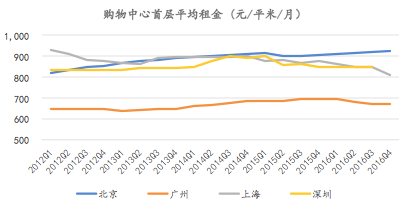
From a traffic cost perspective, offline rents have stabilized since 2015 and even declined somewhat, while online traffic costs have risen rapidly — nearly tripling from 2012 to 2015. How to fully unlock the potential of offline traffic will determine the future of offline retail formats.
We believe that future stores will gradually shift from being sales-centered to traffic-operation-centered, with sales becoming integrated across online and offline channels. As offline traffic data gradually accumulates, future traffic data mining will also become integrated across channels, supporting monetization across more dimensions. The evolution of offline store formats is still in its early stages. New technologies will play an increasingly important role in offline traffic operations, improving overall efficiency. Kidswant is a strong example of offline traffic operation. Its entire operation revolves around a membership system, with member sales accounting for over 95% of revenue. Member management tasks are fully deployed via mobile platforms to each salesperson, with each store conducting an average of 1,000 events annually to boost user engagement. Despite rising e-commerce penetration in the母婴 category, Kidswant has maintained annual growth exceeding 50%.
For the future of retail, there is no distinction between online and offline traffic — only differences in acquisition cost and degree of utilization.