Xingshi Wang, Source Code Capital: Industrial Internet Innovation Through the Lens of Organizational Capability

Source Code Capital remains committed to creating lasting, tangible value, focusing on the challenges and uncertainties that member companies face as they scale from 1 to 100. And organizational capability building is one of the most critical factors determining whether a growth-stage industrial internet entrepreneur can achieve iterative expansion.
From December 19–21, 2019, the "6th China Industrial Internet Conference" was held in Ningbo, where Source Code Capital was named one of the "Top 10 Investment Institutions in China Industrial Internet 2019" (ranked #2). At the invitation of the organizer, Tobii Network, Xingshi Wang, Managing Director of Source Code Capital, attended the conference and shared his in-depth reflections on organizational capacity building amid the wave of industrial internet innovation.
Driven by deep research as its foundational logic, Source Code Capital has since its founding in 2014 successively invested in outstanding industrial internet companies including Baibu, Yimutian, Pipipifa, Car300, YQN Logistics, Yijiupi, Ruigu, Yimi Dida, Chuxin, Xiaoyaoyao, Zhangshang Fucai, Edianzu, ZNLH, and CassTime. Source Code remains committed to creating lasting, real value, paying close attention to the challenges and uncertainties its portfolio companies face as they grow from 1 to 10, and from 10 to 100. Organizational capacity building is one of the most critical factors determining whether industrial internet entrepreneurs in their growth phase can achieve iterative expansion.
Full Transcript:
I. The Importance of Organizational Capacity
First, I'd like everyone to consider this question: What drives your company's growth? Market-driven? Organization-driven? Innovation-driven?
If you chose market-driven, congratulations — your industry still has incremental tailwinds. But please also consider: How long will these tailwinds last? When they end, how will your company win in zero-sum competition?
If you chose innovation-driven, please consider: What is the foundation of your company's innovation? Was your previous innovation incremental or disruptive, and has it already evolved into a stable new business?
Most companies will eventually enter an organization-driven growth phase. With solid organizational capacity, a company ascends to a new level. Organizational capacity is tied to a company's stage and business scale — different stages and scales present different organizational challenges, each requiring its own solution. So the formula "corporate success = strategy × organizational capacity" makes a great deal of sense.
II. Industrial Internet Demands Organizational Capacity Building Even More
We've noticed that industrial internet companies rarely have young CEOs. Even when we do encounter relatively young ones, they either come from families that have long been in the business or entered the industry at a very young age. Why? Because most of these businesses are genuinely too complex.
The leading self-operating distribution companies across various sectors have grown extremely rapidly over the past five years. Breaking down their business modules, they generally include procurement, warehousing and fulfillment, sales, operations, customer service, product and R&D, finance, and so on.
Every single order requires coordination across all these modules to be completed. The entire enterprise operates like a precisely calibrated machine. Because these modules cannot yet be 100% digitized, the larger the business grows, the more people the organization requires.
A CEO need not be an all-rounder, but they must think through the essentials of each module and how they all coordinate — only then can they manage effectively. By the time they've figured all this out and developed real management expertise, they're no longer young.
Many rapidly growing internet giants never had to confront such challenges in their early stages. Some CEOs joke that their business is more complex than Meituan Waimai or Pinduoduo. Meituan Waimai has no warehousing; Pinduoduo doesn't manage an offline BD team. The organizational capacity challenges facing industrial internet CEOs are harder and more demanding.
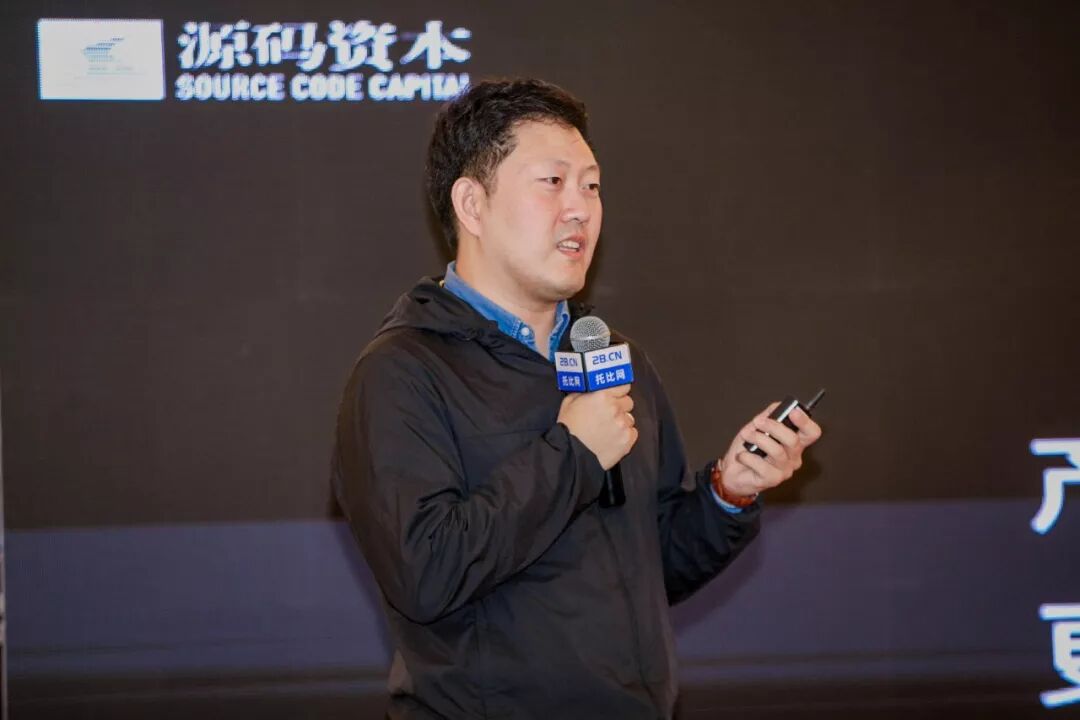
Xingshi Wang of Source Code Capital speaking at the event (Source: Tobii Network)
III. Common Traits of Companies with Strong Organizational Capacity
Although organizational capacity presents significant challenges, many excellent companies have built the organizational capabilities to reach Series C and D stages. Let's examine what they have in common.
High and Replicable Per-Capita Productivity
Take sales teams, for example. At excellent companies, average sales productivity is more than double that of traditional enterprises, with smaller variance. Only with such sales teams can a company support rapid growth and continuously expand into new cities. The same applies to procurement and finance teams.
For instance, several of our portfolio companies achieved 3x year-over-year scale growth in 2019, yet various efficiency metrics improved rather than declined. Looking at frontline team morale, they weren't overwhelmed despite the breakneck business expansion. Supported by new IT systems, the difficulty and intensity of their work actually decreased.
High Internal Organizational Coordination Efficiency
High efficiency in each module is like having well-developed muscles, but muscles alone may not be coordinated. Only when both muscles and nervous system are highly developed can a person run fast, jump high, react quickly, and even take a hit. The internal coordination mechanism is that nervous system. Excellent companies prioritize replacing tedious, inefficient repetitive work with IT systems, then further build internal collaboration networks. Never underestimate these networks — when organizational scale exceeds 10,000 people, such collaboration networks become the greatest competitive advantage and moat. When opened to the entire industry, they form a massive industrial ecosystem. The most recent company to do this was KE Holdings. We hope the next one will be among our portfolio companies.
Prioritizing Organizational Capacity Building
For any CEO, the scarcest resource is time — how it is allocated matters enormously. CEOs of excellent companies spend substantial time on organizational capacity building: learning from Alibaba and Huawei about organizational expertise, designing organizational structures best suited to their own companies, iterating management approaches that best fit their business, and so on. Over time, we find that excellent CEOs are not consumed by day-to-day operations; instead, their organizations develop strong core management and middle-management layers. The growth of such CEOs often leaves investors quietly amazed.
IV. Tips for Investing in Organizational Capacity
Organizational capacity building is every company's and every CEO's own journey, but here are some effective and interesting frameworks worth sharing:
Time Machine Model
Most organizational problems have commonalities. With similar business models, larger-scale companies likely already have solutions. Identify several typical benchmark companies, study them closely, and answers will emerge. In certain business modules — such as offline BD management — consumer internet dividends are rapidly transferring to industrial applications. Meituan's BD teams entering certain industries often feel like they've traveled back in time.
Sports Team Model
Management theory says organizations should resemble sports teams rather than families. What I want to emphasize is the bench — the substitute players. CEOs should regularly consider: How deep is our bench? Strong succession planning sustains long-term talent supply. Substitutes can fill gaps when starters are unavailable; substitutes can grow into the next star players; the bench can even field a lineup as competitive as the starters.
V. The Delayed Gratification of Organizational Capacity
Building organizational capacity is an incremental, compound-interest endeavor that rewards patience.
It may not be as immediately intuitive as classic analytical lenses like network effects or economies of scale, but its power is immense. I hope CEOs will not underestimate this force.
Returning to our opening question, an unexpected dividend of organizational capacity building may be another growth engine: innovation-driven growth.
Innovations such as OEM products through proprietary channels, even consolidating upstream production capacity; exporting SaaS systems to downstream customers; or exporting supply chain service capabilities externally. These innovations emerge from organizational capacity and, leveraging that capacity, become a company's second or third growth curve.
VI. Conclusion
To summarize simply: Organizational capacity is important, and especially so for industrial internet companies. There are methods to building it; benchmarking excellent companies accelerates growth.
China's industrial upgrading requires great companies with strong organizational capacity. Source Code Capital hopes to grow alongside excellent companies and build organizational capacity together with outstanding CEOs. Creating lasting, real value!