Code Brain | YC Co-founder's New Theory: The "Founder Mode" That Turned Airbnb Around Against All Odds

J&T Global Express's founder has a distinctive management style.


When a company's founder directly manages the business, the approach required is completely different from that of a "professional manager."
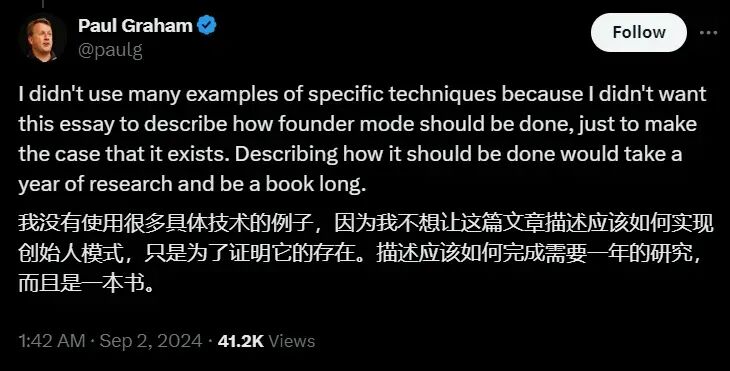
Paul Graham, co-founder of YC, put forward this view, calling the former "Founder Mode." The idea sparked heated discussion.
It originated from a speech by Airbnb founder Brian Chesky.
Chesky had focused on strategy and capital, delegating the company to division heads — many of them excellent managers hired from outside — but the results were underwhelming. "The more I let go, the more problems arose. And the longer it took to fix them."
He then took full control, ensuring Airbnb's operations stayed within his personal focus. "That's what Steve Jobs did at Apple," Chesky said.
Now Airbnb's net profit rises every quarter, and its cash flow is among the most comfortable in Silicon Valley.
This case got PG thinking. He wrote an article, which Elon Musk retweeted, sparking widespread debate in the startup community.
This article is republished from Founder Park.
1
Founder Mode
More Complex, But More Effective
At a YC event last week, Brian Chesky gave a speech that everyone present will remember.
Afterward, I spoke with several founders. Most considered it the best speech they'd ever heard. Ron Conway — the 70-something Silicon Valley legend — even forgot to take notes for the first time in his life.
I won't try to recreate that speech here. Instead, I want to address a question it raised.
Brian's theme: the conventional wisdom about "how to run a large company" is actually wrong.
As Airbnb grew, well-meaning people advised him that he had to run the company in a certain way to scale. To summarize: "hire good people and give them lots of room to do their jobs."
He followed this advice. The results were poor. So he had to figure out a better approach himself, partly borrowing from how Steve Jobs ran Apple. So far, it seems to be working. Airbnb's free cash flow margin now ranks among Silicon Valley's best.
Many successful founders we back were in the audience, and many said they'd faced similar situations. As their companies grew, they received the same advice, which not only failed to help but actively harmed their companies.
Why is everyone giving founders this bad advice? That was the puzzle.
After some thought, I found the answer: the advice they received was aimed at people running companies they didn't found themselves — how to manage a company controlled by professional managers. This approach is less effective, so founders feel it's wrong. Founders can do things managers can't, and being prevented from doing them feels wrong.
In fact, there are two fundamentally different ways to run a company: Founder Mode and Manager Mode. Even in Silicon Valley, most people implicitly assume that scaling a startup requires switching to Manager Mode. But we can infer another mode exists from the frustration of founders who tried Manager Mode, and from their success after struggling to escape it.
As far as I know, no books specifically address Founder Mode. Business schools don't even know it exists.
So far we only have individual lessons learned by founders through trial and error. But now that we know what we're looking for, we can explore it.
I hope that in a few years, Founder Mode will be as well understood as Manager Mode. We can already guess at some differences. The way managers are taught to manage resembles modular design — you treat sub-departments in the org chart as black boxes. You tell direct reports what to do; how they do it is up to them. You don't get involved in the details of their work; that would be bad micromanagement.
"Hire good people and give them lots of room." Sounds ideal, right? Yet from founder after founder, the practical result seems to be: hire professional "impostors," then watch them run the company into the ground.
In Brian's speech, and in follow-up conversations with founders, I noticed a common thread: founders feel they're being "gaslit." They feel manipulated by advice telling them to run their companies like managers, and then manipulated by employees when they follow it.
Normally, when everyone around you disagrees, you should assume you're wrong. But this is a rare exception. VCs who haven't been founders themselves don't know how founders should run companies, and some C-level executives are extremely skilled at "managing up" — even at hiding the real situation.* Note: If you want a more diplomatic phrasing, this could read: experienced C-level executives are typically very skilled at upward management. I doubt anyone familiar with this field would disagree.
Whatever Founder Mode specifically entails, it clearly breaks the convention that CEOs can only engage with the company through direct reports. "Skip-level" meetings will become normal, not so rare they need a special name. Once this restriction is abandoned, founders have far more options for running their companies.
For example, Steve Jobs held an annual retreat for Apple's 100 most important people — who weren't necessarily the highest-ranked on the org chart. Can you imagine the audacity of doing that at a normal company?
Yet imagine the benefits: this could restore startup energy to a large company. If these retreats didn't work, Steve obviously wouldn't have kept doing them. But I've barely heard of other companies with similar practices. Is this a good idea or a bad one? We still don't know. That shows how little we understand about Founder Mode.* Note: If many companies started doing this, even politically calcified mature ones, we could quantify organizational aging by one metric: average depth of participants in the company hierarchy.
Obviously, founders can't run a 2,000-person company the same way they ran a 20-person one; some delegation is inevitable. Where the boundaries lie, how much flexibility exists — these probably vary by company, and even within the same company, they change as managers earn trust.
So Founder Mode is likely more complex than Manager Mode, but also more effective. We've already seen this in some founders' trial and error. In fact, I have another prediction about Founder Mode: once we truly figure out what it is, we'll find some founders were already very close to it — but their approaches were often seen as weird, or worse.* Note: I have a less optimistic prediction too: once the concept of "Founder Mode" is established, people will abuse it — founders who don't want to delegate necessary tasks will use it as an excuse. Non-founder managers will try to imitate founder behavior. To some extent, this might work, but when it fails, the results will be very messy. At least modular management limits the damage an incompetent CEO can do.
Interestingly, despite how little we know about Founder Mode, this is actually exciting. Look what founders have already achieved amid terrible advice. Imagine what they could do when we can teach them to run companies like Steve Jobs instead of John Sculley.
2
The Startup Community Erupts
What Exactly Is Founder Mode?
@smugglerFlynn: Honestly, this comment section unsettles me. It feels like people are discussing Paul's new concept without clearly stating what they're actually talking about. What is "Founder Mode"?
@FloorEgg: I think Paul may be referring to what I've heard called "integrated complexity." Simply put, this means companies need people who can hold the entire business in their heads and understand how all levels interact — like founders. Not everyone can do this, but those who can are more effective because this ability improves consistency and accountability.
When you hand someone a problem (HR strategy, infrastructure scaling, new UX feature), they typically treat it as the most important thing. If they break it down and delegate parts, those delegates do the same with their pieces. Eventually, what actually matters and what people think matters drift apart. One day you find many people busy doing things that aren't actually important, or even counterproductive. A founder who can continuously check all levels of the company in their head can spot and correct these deviations.
@ahaucnx: My understanding of the article's point is that in Founder Mode, managers possess a very unique ability to set a startup's strategic direction. This requires not just extensive abstract thinking, but tactical and operational skills to ensure the business is profitable at its current stage.
3
The Two Modes Aren't Opposites
@JakeSc 3: As someone who founded four companies and served in senior management, I have to say the founder-versus-manager dichotomy is flawed.
The most successful managers I've seen were often founders too. They had autonomy, organizational trust, and tenacious creativity — usually leading to massive success. Treating "are you a manager or founder" as binary is a false dichotomy that excludes some excellent people.
Founder mentality has identifiable traits: they do whatever it takes to succeed, apply creative solutions to complex problems, cross role boundaries to win, and invest energy far beyond standard. You can hire for these qualities and build an organization with trust and autonomy.
That said, I do think Paul Graham touched on something very interesting — an almost anthropological understanding of the "founder" role as a crucial research area for the next generation of great companies.
What PG and Brian Chesky are really getting at: rigid, hierarchical employee types are bad for long-term company success. Instead, build teams with passionate, smart, creatively problem-solving people who aren't afraid to break rules to succeed. But you definitely need to build a trusting organization that gives founder-minded people the support they need to succeed.
4
Don't Take Steve Jobs's Advice Uncritically
@madeuspagel: "We hired truly great people and gave them the room to do great work. A lot of companies hire people to tell them what to do. We hire people to tell us what to do. We figure if we're paying them all this money, their job is to figure out what to do and tell us." — Steve Jobs
@Aurornis: Advice like Steve Jobs's needs to be taken in context.
I once worked for a VP/CTO who took this literally: they wanted to hire smart people and let them decide what to do. The company took this to extremes, even abdicating responsibility for making decisions and executing. They felt their job was just to convene meetings and ask us questions about what we were going to do.
Problems emerged when we lacked guidance to effectively accomplish important tasks. We could write good software, but we needed the VP and CTO to use their positions in meetings to align other departments on critical cross-functional issues for implementation and adoption.
Instead, it became endless Socratic questioning: What do you need to finish? How will your team achieve this? Who can you talk to? Whenever we clearly needed them to push something internally, they'd lecture us on self-sufficiency and independent work.
Predictably, little got done. Our software was decent, but whenever it required VP or C-level collaboration, we hit bottlenecks. You can't just rely on junior employees telling you what to do — it's not enough.
@maayank: You could say, "You can't delegate a task called 'vision' to employees."
5
Company Stage Determines the Mode
@smeej: Isn't this article really about "startup" mode versus "professionalized company" mode?
Once I'm three management layers from the CEO, all their roles require proving they somehow "managed" my work, even if they don't know how to do it. The company can't be in startup mode anymore.
"Professional managers" and "startups" can't coexist. Startups must move and pivot so fast that a manager who actually doesn't know how to do their reports' jobs is useless. They'll constantly be asked to fill gaps. If they only know how to "manage," they're dead weight.
The Tao that can be told is not the eternal Tao
Labor costs are what most need optimizing, and have the most room for improvement @dheera: This reminds me of a fundamental problem with methodologies themselves:
They're not panaceas for fundamentally flawed businesses, nor can they save companies building the wrong product.
They don't solve interpersonal problems.
If you have the right business and team members who respect each other as human beings, you don't need any methodology — just keep doing what you're doing.
@p1necone: You can't simply imitate successful companies' or individuals' processes to achieve the same success, because those processes are often results of their capabilities, not causes of success. This is a widespread problem.
Beware Concept Abuse!
@gregfjohnson: A footnote in the article resonated with me: "I have a less optimistic prediction: once the concept of 'Founder Mode' is established, people will start abusing it." Just like "Product-Market Fit."
In the current AI wave, almost everyone claims their product has achieved "product-market fit." But if you truly reached PMF, you should need an efficient team to help new users adopt it, not just a sales team.