Yi Cao: Source Code Capital's "Three Horizontals, Nine Verticals" Investment Map

Where, when, and by whom will the next major innovation opportunity emerge?
It has been nearly 20 years since the "Big Three Portals" — NetEase, SINA Corporation, and Sohu — were founded. The explosive growth of China's information industry has been just as sweeping as the Industrial Revolution and the Electrical Revolution before it. The sector's total market cap has grown from less than $10 billion in 2004 — the year I stumbled into the VC industry — to roughly $700–800 billion today. Tencent's market cap surged from roughly $1 billion at its 2004 IPO to $260 billion today, trading places with Alibaba for the title of Asia's most valuable company.
Why has the information industry achieved such staggering growth over the past two decades? Where, when, and from whom will the next wave of industrial opportunity emerge? How large can this sector ultimately become? These are questions every practitioner must grapple with, because if you figure them out, you might just become the next Jack Ma, Pony Ma, Neil Shen, or Masayoshi Son — haha.
Over my 12 years in the industry, I have spent each day observing, discussing, thinking, practicing, and summarizing. Along the way, I've missed some towering peaks, dodged plenty of landmines, and absorbed lessons from countless elites, steadily finding my way out of "errors and misconceptions." Through sunshine and rain alike, I have remained deeply immersed in this great "information revolution," and I have loved every minute of it. Today I'll offer a brief summary to share with you all — consider it a modest contribution to spark broader discussion and add my small drop to this "information revolution."
Where exactly does China's remarkable information industry growth come from? I believe it stems primarily from two forces: the powerful supply push of computing driven by Moore's Law, and the economic demand pull of ever-growing consumer and production needs.
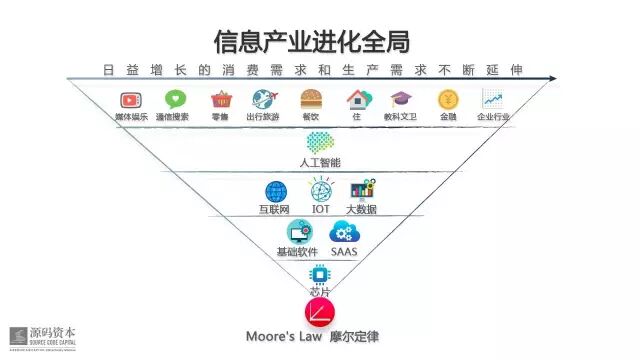
Chart: The "Inverted Pyramid" Evolution of the Information Industry (click to enlarge)
Supply push: Under Moore's Law, the costs of computing, storage, and transmission keep falling. Massive energy radiates from the core bottom like a nuclear reactor, wave after wave, nourishing the application endpoints and transforming every industry with relentless innovation and vitality.
Demand pull: Every industry has gradually been "activated" by informatization, sooner or later launching the use of information technology to transform products, services, and allocation methods — and once started, there was no stopping it. Take the media industry, the earliest to be "activated": from text and images to short video, from HD to mobile HD, consumers' insatiable appetites have fueled rapid sector growth.
Since American companies still hold clear advantages in IT "infrastructure" — including chips, operating systems, databases, and other foundational software — and serve global markets, we will focus more on application-layer innovation for the time being. Next, let's examine the development logic at the top application layer: where, when, and from whom will the next major innovation opportunity emerge?
1. Location: "Three Horizontals, Nine Verticals"
We have divided the application-layer "information revolution" into three major waves.
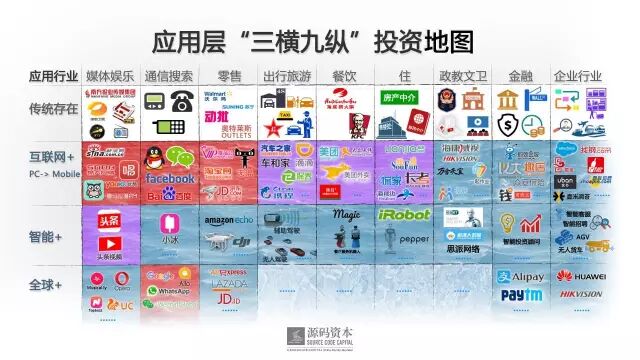
Chart: Application-Layer "Three Horizontals, Nine Verticals" Investment Map (click to enlarge)
The first wave is the "Internet Plus" wave. Moving operations online has been the most important theme of the past 20 years, and it laid the most critical first step for the industry — what we might call "Market Economy 2.0." "Moving" here means taking established offline economic activity and relocating it online. The greatest value lies in making resource allocation more efficient, optimizing existing stock while activating incremental growth, and enabling ordinary people and SMEs to access high-quality products and services at low cost. Take the earliest example of media going online: consumers could through the "Big Three Portals" read "newspapers" and "magazines" from around the world anytime, for free — turning non-newspaper buyers into regular news consumers. Similarly, in the subsequent retail online migration, ordinary people who previously could only buy from nearby department stores and markets could now purchase goods from anywhere in the world through e-commerce platforms like Taobao, JD.com, VIP.com, and MOGU — at lower prices. Enterprise sectors have also been deeply penetrated by the internet, with dramatically improved internal management efficiency and more effective B2B transactions. Our portfolio company Yijiupi helps over 10 million small retail terminals (restaurants, tobacco and liquor shops, convenience stores) make better, more efficient procurement decisions. In internet finance in recent years, massive underserved consumer and business populations have finally been reached. Traditional banks and financial institutions treated low-to-middle-income individuals and SMEs as "ugly duckling" markets — serving them through traditional counters and relationship managers was simply uneconomical. New finance companies in our portfolio like Qudian, Yongqianbao, and Yinke use internet customer acquisition, remote big-data risk control, and efficient internal information systems to turn what were once poor mines into silver and gold mines. This is the classic example of activating incremental value.
Internet Plus can be roughly divided into two phases: the first half was PC Internet Plus, the second half is Mobile Internet Plus and IoT Plus. The first half mainly addressed "middle-to-high-income people," "anytime," and "large-scale allocation"; the second half tackles "universal access," "anywhere," and "new supply." In the great migration from PC Internet Plus to Mobile Internet Plus, some internet incumbents successfully boarded the ark and maintained their dominance, while others failed to make the crossing and were killed off by the new climate.
The second wave is the "AI Plus" wave. "Internet Plus" made three outstanding foundational contributions to the "AI Plus" wave: connectivity, data accumulation, and abundant usage scenarios. With these three elements, artificial intelligence could finally take flight. It's like a human brain that needs to read books left by predecessors (data accumulation), needs practice scenarios (usage scenarios), and needs to be able to mobilize its limbs (connectivity). The connectivity here includes person-to-person, person-to-thing, and thing-to-thing connections — enabling electrons to mobilize electrons, and electrons to mobilize atoms.
Take "AI Plus" in media content: our portfolio company Toutiao provides ordinary people with a "personal content consumption secretary" — like the dedicated assistants that corporate executives and wealthy people have to clip articles, summarize books, and make recommendations. In lifestyle consumption, Meituan provides food, entertainment, and e-commerce services; its next step will be to follow Amazon's Echo/Alexa with a "personal life services secretary," helping users find offline consumption destinations more conveniently and accurately. In transportation, Google, Uber, and Tesla in the United States are battling to become the ultimate winner in autonomous driving, offering users a "personal chauffeur service." In manufacturing, the employment penetration of "robot workers" keeps rising... Will these "specialized robots" eventually be unified into one omnipotent "super robot"? I believe so. In the future, this "super robot's" only rival may be the cyborg.
If the "Internet Plus" wave was mainly about resource allocation — optimizing existing stock and activating incremental growth — but was essentially still helping offline economy "move" online without creating "entirely new" products; then "AI Plus" will create entirely new "species," namely robots, representing value creation at a higher level.
The third wave of opportunity is the "Global Plus" wave. The "Global Plus" era has already arrived, it just hasn't been evenly distributed yet. The entire world needs the tremendous benefits brought by the information revolution, but most countries cannot provide quality products and services to their own residents and businesses. Ultimately, American and Chinese companies will be the primary providers of quality information products and services to other regions.
Huawei's success proves that Chinese companies can enter core segments of mainstream global markets. We also see companies like Hikvision, Kunlun Tech, 360 Security (Mobimagic), Apus, and Cheetah Mobile achieving strong results overseas. Leveraging China's sufficiently large domestic market, growing political and cultural influence, massive talent pool, and effective capital markets, Chinese companies will win half the global market.
For example, our LP Kunlun Tech was among the first wave of Chinese digital companies going global six years ago. Kunlun Tech founder Zhou Yahui had terrible English fundamentals and zero overseas infrastructure, yet by drawing on China's excellent web and mobile game development resources and operational experience, the company forcibly carved out a major market. This year, Kunlun Tech advanced to higher-tier tracks through acquisitions of Opera and Grindr. Another portfolio company, Mobimagic, has accumulated hundreds of millions of monthly active users through its 360 Security utility software, including capturing tens of millions of daily active users in the mainstream United States market — not easy, but entirely logical. All this shows that the "Global Plus" wave has only just begun.
2. Timing: "Winter, Spring, Summer, Fall"
We believe the entire information industry is in the latter half of the Cambrian period. While some large species have already formed imperial strongholds, countless new species continue to emerge amid tectonic shifts and climate changes.
Each of the 27 cells in the "Three Horizontals, Nine Verticals" framework above has its own developmental "timing" — winter, spring, summer, and fall, or "frozen ocean, blue ocean, purple ocean, red ocean" — representing different stages of industry development. In the "frozen ocean" period, the water is too cold and organisms lack sufficient elements to develop; at this stage we closely monitor the water temperature, waiting for the moment of early spring germination. "Purple ocean" domains remain worth fighting for, because new entrants that seize key elements can achieve explosive growth.
We also see numerous blue ocean and frozen ocean domains awaiting entrepreneurs and investors to explore and build.
3. People: "The Nine Swords of Solitude"
Today's entrepreneurs need to master the "Nine Swords of Solitude" — capable of defeating sword, blade, spear, whip, chain, palm, arrow, and qi. They must both identify user pain points and needs for rapid entry, and gradually establish strongholds to wage positional warfare, demonstrating solid capabilities in strategy, culture, organization, communications, fundraising, and tactics.
The "Internet Plus" wave is deepening into more industries. Take industrial internet: compared with internet plus media, it involves retail, traditional distribution, and other links with higher barriers to entry and greater cross-domain difficulty — but simultaneously faces fewer competitors and offers higher success rates. When advancing from the "Internet Plus" to the "AI Plus" era, entrepreneurs must not only understand their industry but also be able to leverage AI technology, infrastructure, and concepts. The new wave demands ever more from entrepreneurs. Only by mastering the "Nine Swords of Solitude" and collecting all "seven Dragon Balls" can one laugh at the world's rivers and lakes!
Returning to our original question: just how large can China's information industry become? We believe this market can reach $1.5 trillion, roughly on the same magnitude as U.S. GDP. The total market cap of all Chinese information industry companies currently stands around $750 billion. "Internet Plus" alone has at least 2x more room to grow (consider internet finance, Ant Group); entering the "AI Plus" era adds another 5x of imagination space, when robots will be everywhere; entering the "Global Plus" era, Chinese companies' service population expands from 1.3 billion to 7 billion — even capturing just half the market means another 2x of growth space. So overall, the industry still has 20x growth ahead... Not bad, right? We're all quite fortunate to be here now!
By then, there will no longer be labels like "internet company" or "AI company," because these will have become as fundamental as water, electricity, and gas for every enterprise. Ultimately, a company's value territory will derive from: the scale and quality of connections it possesses, how much exclusive valuable data it holds, and its brand equity.