Yi Cao: The Nine Faces of Technological Innovation

At the "2017 Impact Investing Summit" hosted by China Renaissance Alpha, Yi Cao, founding partner of Source Code Capital, shared his exclusive insights.
On August 17, the "2017 Impact Investment Summit" — "Cutting Through the Hype, Seeing the Truth" — hosted by China Renaissance Alpha kicked off its first day in Beijing. The summit brought together veteran investors from prominent institutions and entrepreneurial elites from the tech and new consumer sectors for in-depth discussions, attracting nearly 2,000 targeted entrepreneurs and investors who registered to attend. The two-day event, running August 17–18, featured intense debates on cutting-edge topics centered around "The Era of Tech Scenarios" and "The Rise of New Consumption," stripping away the fake to reveal the real, dissecting the essence of business before re-examining what's "hot."
Below is a sharing by Yi Cao, founding partner of Source Code Capital, as a guest speaker during the "Tech Commercialization" session on "The Nine Faces of Tech Innovation." The following is a transcript of his live remarks:

Good afternoon, everyone! Today's conference theme is wonderfully evocative: "Everything that hasn't been technologized yet is temporary." I had originally planned to talk about artificial intelligence, but after seeing friends from iFlytek and SenseTime present earlier, I wisely retreated and changed my topic at the last minute, staying up until 2 a.m. this morning to prepare. I'd like to share some thoughts on how we, as investors focused on the tech industry and especially as early-stage investors, view the role that "technology" plays in creating value and what characteristics it has.
1. The Five Elements of Enterprise Value Creation
Before diving into tech innovation, I'd like to briefly outline the sources of value creation in business. For entrepreneurs building companies and investors backing them, what kind of companies can reach $1 billion, $10 billion, $100 billion, or even $1 trillion in market cap?
Market cap must come from value creation, and the elements of value creation can be summarized as: technology, business model, management, production resources, and creativity.
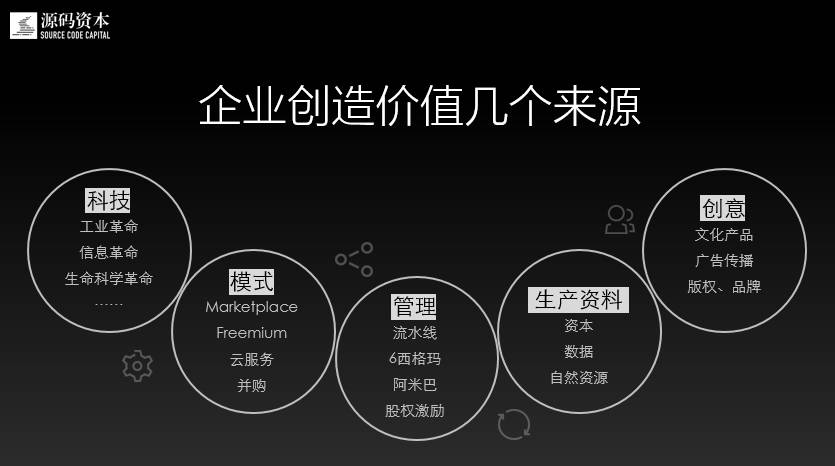
Typically, a company needs to assemble more than one of these elements and advance them together to have a shot at creating lasting, substantial value. Not just strong technology, not just a good model, not just highly effective management, not just abundant production resources, and not just great creativity. More often, it's about doing all of these things well and thereby capturing the optimal timing, geography, and harmony of people. Under such conditions, there's an opportunity to create tremendous value and build a company of massive scale and market cap.
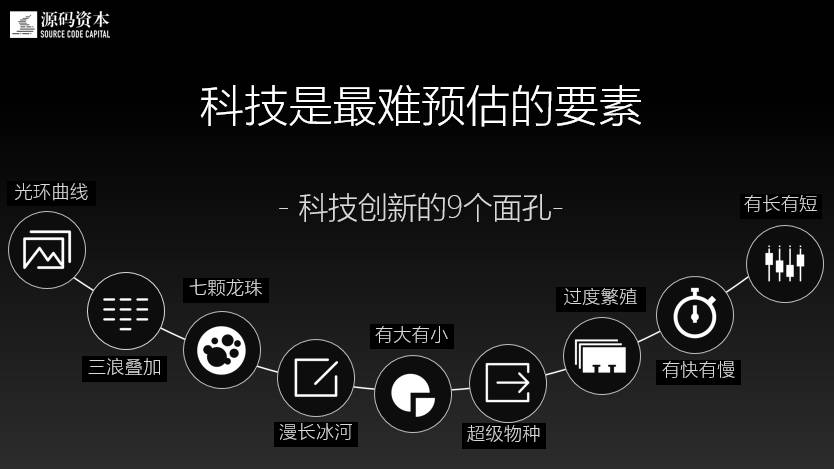
2. The Nine Faces of Tech Innovation
Among all these elements, technology is the most important yet the hardest to predict. Over the past 15 years, compared with the United States, China has typically not been the leader in technology, but our model innovation has often been world-leading: for instance, the marketplace model, the pioneering use of freemium in gaming, as well as cloud service models, leasing models, and value creation through M&A.
The technology element is also the most fascinating — it has many faces. Today, I'd like to share with you some of our more intuitive and analytical observations.
We often see technology's various "faces": sometimes like a "cockroach that just won't die" — resiliently making changes from obscure corners; sometimes like "Angry Birds" — having built up tremendous force, yet野蛮 and disruptive, crashing and overturning; sometimes like "spring drizzle" — gentle and silent in its nurturing; sometimes like "flood and beast" — violently and grandly driving commercial transformation; sometimes like an "elderly sage" — combining firmness and flexibility, advancing steadily.
The full picture of tech innovation is complex and ever-changing. Let's look at its nine faces.
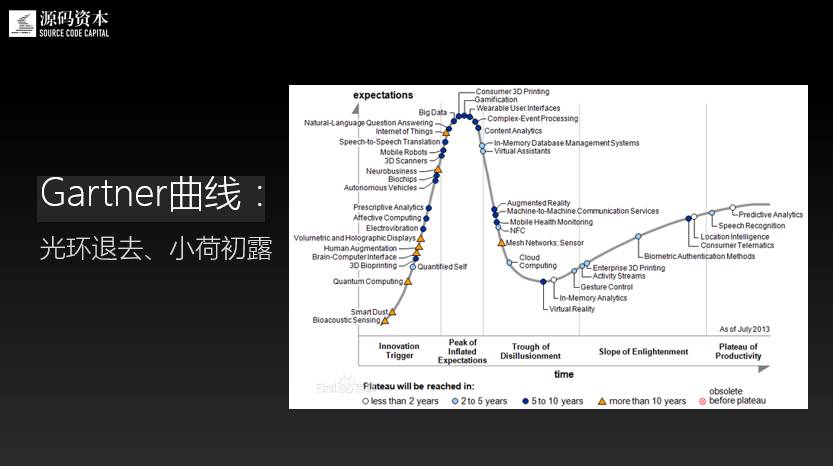
1. The Hype Cycle, also known as the Gartner Hype Cycle
This curve is familiar to all. For example, the current AI industry is in the hype phase — its halo may even deepen and multiply. But typically, it's only when the halo begins to fade that value is most fully revealed, like a lotus seed pod that eventually emerges above the water. This phenomenon frequently occurs when technology creates value or transforms industries: people tend to be overly "optimistic" in estimating a technology's impact in the next 1–2 years, but usually underestimate its impact over 10–20 years. There needs to be a process from hype accumulation, to hype fading, to the first tender shoots appearing, and finally to abundant fruit.
2. The Three Overlapping Waves
Three overlapping waves refers to when the first wave of technology-driven impact is still building momentum, a second major wave has already risen, and sometimes even a third wave is gathering strength. This happens frequently in the tech industry, especially against the backdrop of China's rapid economic development.
The most typical example is China's retail sector in 2008. At that time, there were three forces: first, traditional retail continuously improving efficiency through technology; second, big-box retailers like Suning and Gome expanding nationally through "technologization," "chain-ification," and M&A; and third, the force of e-commerce represented by Taobao.
In 2008, everyone was quite happy, seemingly enjoying growth of several dozen percent, 100%, or even more, but none perceived the competitive threat from e-commerce.
Especially the first and second forces — they thought that while e-commerce was growing fast, its scale was still small and wouldn't significantly impact them. Everyone had this kind of illusion: those standing on the second wave felt they were already quite high up and failed to see the third wave lurking behind them. So we say, the Yangtze's later waves push the earlier ones, and the earlier waves are trapped in their own beautiful, comfortable delusion — a situation that occurs with particular frequency in China.

3. The Seven Dragon Balls: Who's Still Missing?
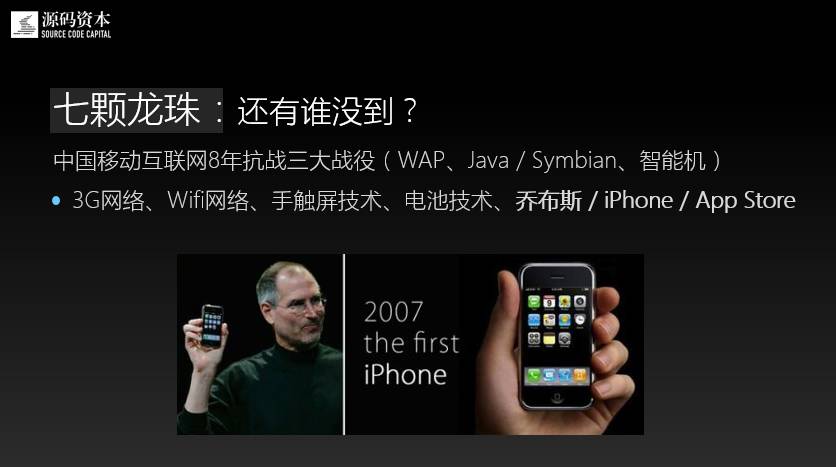
This is the most deeply personal case for me. I entered the investment industry in 2004, devoting 100% of my time to looking at mobile internet opportunities — back then it wasn't called mobile internet, but "mobile phone internet" or "wireless internet." The form of access was still WAP, using mobile browsers to get online through feature phones. The first wave consisted of companies everyone knew: Monternet, 3G.cn, Yicha, and others. A few years later came the second wave of Java, Symbian, and others. When the second wave arrived, we wondered if mobile internet's spring was finally coming? Mobile terminals were getting better, computing power stronger, functionality richer — it should be coming, right? But actually, it still hadn't arrived. There was once a major hypothesis: when would 3G come? If 3G came, mobile internet's spring would certainly come. But when 3G did arrive, spring still didn't come.
In the end, everyone waited for Steve Jobs, who brought the iPhone — this was the seventh dragon ball. When the iPhone arrived, all seven dragon balls were assembled, the dragon could be summoned, and the great wave of mobile internet officially began.
So I spent eight years waiting for these seven dragon balls to come together. This was extremely deeply etched in my memory. For the earliest four to five years, I can't say it was entirely wasted effort, but it was certainly quite frustrating.
4. Overbreeding
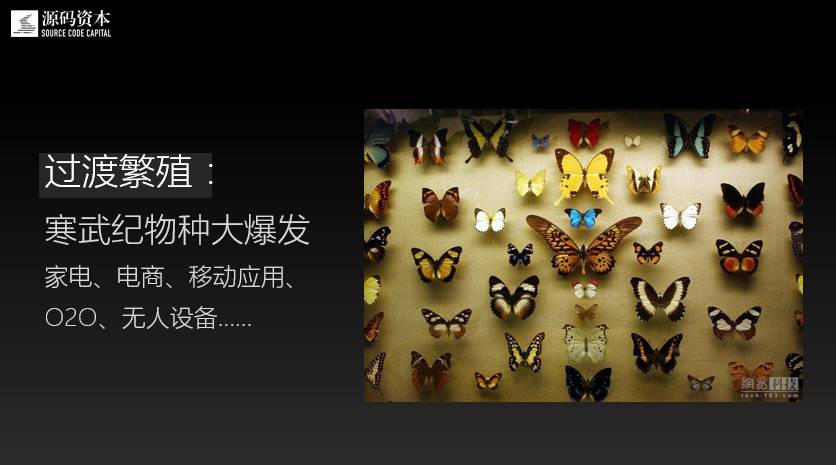
Once the great wave opens, a massive number of species appear, and the same species spawns countless small variants. For example, the butterflies in this image are all butterflies, but with slight morphological differences. When a field begins to explode with opportunity, it enters an overbreeding phase.
In the entrepreneurial realm, hundreds or even thousands of companies may emerge to do the same thing at this stage. Some make small micro-innovations; some simply copy directly with no innovation. All kinds of species appear, and some may survive only a few days before being eliminated by climate shifts. Take the home appliance industry: when the electrical revolution occurred, many electrical devices appeared, but only a few types are still used in homes today. Many interesting "taken-for-granted" inventions at the time ultimately didn't survive.
Another example is e-commerce. When the e-commerce wave began, all kinds of e-commerce exploded: vertical self-operated e-commerce, discovery e-commerce, traffic-directing e-commerce, platform e-commerce, and now social e-commerce, among others. Or take the mobile app industry: there are now roughly 1.5 million apps, like 1.5 million species. At the end of the mobile internet wave, probably only the top 1% or even 0.1% will remain in the mobile internet ecosystem. Current O2O, unmanned devices, and others are going through this phase. Internet finance has already passed this stage and is now entering a phase of relatively rapid convergence.
5. Super-Species
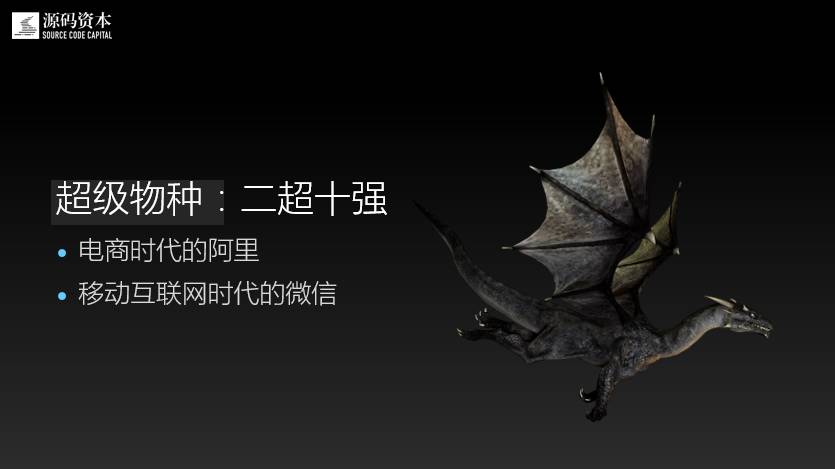
After overbreeding of tens of thousands or millions of species, through three to five years of ecological competition and optimization, very few super-species ultimately remain. For example, China's internet industry landscape: "two supers, ten strong."
The "two supers" refer to Alibaba and Tencent. There are also some in the second tier with the potential to become super-species. Although super-species bring some negative effects, such as monopoly and its consequences, ultimately, super-species create the greatest value for the ecosystem.
So after each long wait, following the great explosion of species, things eventually converge to form an ecosystem centered on a few super-species, which create the ecosystem's maximum value.
6. The Long Ice Age
The ice age refers to when super-species' dominance over the ecosystem is so strong that nothing grows where they exist — only plains, no forests. The ecosystem during this period can be called very orderly, or very dull, or lacking in vitality, and this ice age can be very long.
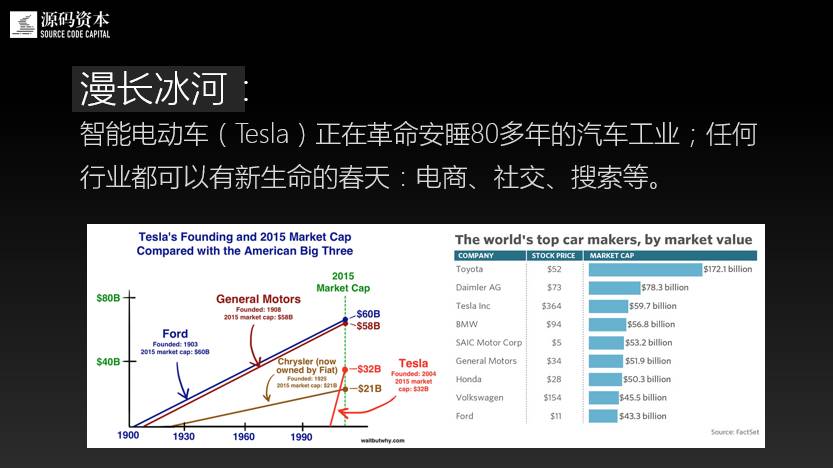
Take the automotive industry: for more than 80 years before Tesla appeared, no new companies emerged in this sector. The leading car companies comfortably coasted through 80-plus years, lying there making lots of money. But even in an industry as heavy and high-barrier as automobiles, where super-species are particularly powerful, changes and thawing of the permafrost can occur after a long ice age, with new species beginning to emerge.
We believe that cases like Tesla will also appear in e-commerce, social, information search, and other fields in the next 10, 20 years, or even longer. Disruptors will cause the previous generation of super-species to decline and be gradually replaced by new-generation ecosystems. We see industrial internet (B2B) fundamentally transforming many "ancient," stable industries.
Everyone needs patience — this process may be very long, something our generation or possibly our children's generation may witness. Though the ice age is long, there will certainly come a day of awakening.
7. Big and Small
Big and small means that when technology's impact first emerges, everything looks roughly similar in scale, but after five or ten years, the differences become clearly apparent. Within the same industry, technology's impact varies in intensity: some become massive — social networking, e-commerce; some are smaller — for instance, among social products,熟人 (acquaintance-based) is bigger than陌生人 (stranger-based). Across different dimensions, mobile e-commerce is many times larger than mobile gaming; mobile internet is bigger than PC internet.

8. Fast and Slow
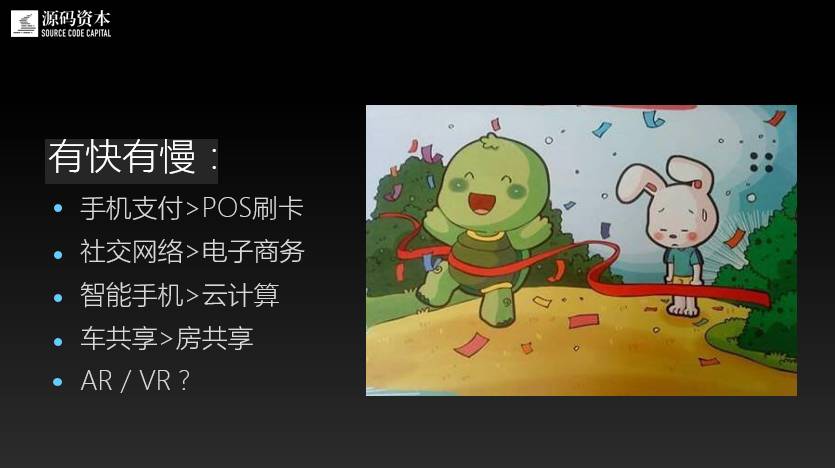
Fast and slow refers to the varying speeds at which tech innovation's impact unfolds. For example, mobile payment spread much faster than POS card-swiping technology; social networks like Facebook, WeChat, and WhatsApp penetrated much faster than e-commerce. After the iPhone, smartphone adoption rapidly replaced feature phones, faster than cloud computing replacing traditional computing and client-side computing. Car-sharing was faster than home-sharing — Uber and DiDi-type car-sharing was faster than Airbnb-type home-sharing.
9. Long and Short
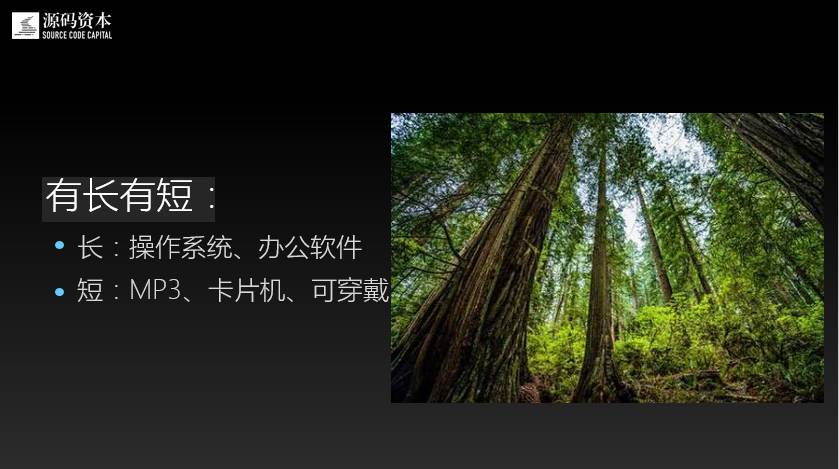
Long and short refers to the varying durations of tech innovation's impact. Operating systems and office software have very long impact periods, while things like MP3 players, compact cameras, and wearable devices are much more fleeting.
In the end, speed doesn't really matter — faster or slower is fine. What matters most is being enduring, authentic, and grand. Today, some say the internet is dead, the landscape is set, and so on. As investors and entrepreneurs, we hope everyone can maintain greater expectations. We must resiliently wait out the long ice age, filter out the dizziness brought by hype, carefully check whether all seven dragon balls have arrived, welcome the Cambrian explosion of species, strip away the fake to reveal the real, and ultimately nourish a new generation of super-species to build a new ecological balance. Creating lasting, authentic value.
Thank you, everyone!