Zheng Yunduan | How to Think About Organizational Strategy in a New Era?

Strategic insight and strategic decision-making are the foundation of organizational will. In this new era, whether an organization can sustain its drive depends on whether there is shared "hope and meaning" that the organization can rally around.
Tap "Source Code Capital" at the top → tap the ··· button in the upper right corner → Set as Star ⭐️

- As individuals, we have our own will. But does an organization have a will?
- Where does organizational will typically manifest?
- How can we strengthen organizational will?
Recently, Yunduan Zheng — Partner & CHO at Source Code Capital, and former CHO at KE Holdings — delivered a keynote speech titled Organizational Strategy for the New Era at the "Cool Organizational Power | 2023 First Lecture of the Year," co-hosted by CoolCollege and DingTalk. He addressed and analyzed each of these questions in turn.

This article was originally published on the WeChat public account "Notesman" (Biji Xia). We share it here for our readers.
Hello everyone, I'm Yunduan Zheng. Today's topic is organizational strategy for the new era. This "new era" has three characteristics: first, China has emerged from three years of pandemic and is gradually returning to normal; second, there are expectations of economic recovery; third, security remains the world's primary contradiction.
In this "new era," there are also three positive factors: first, the pandemic has essentially ended and is no longer the main contradiction in social and business operations; second, the government transition is largely complete, and economic development has once again become the government's priority; third, China's economy is shifting toward internal circulation, with new energy, electric vehicles, and AI emerging as new growth opportunities.
On the other hand, significant challenges remain: first, US-China relations continue to be the primary contradiction in global relations, and the outlook is not particularly optimistic; second, the Russia-Ukraine war continues to reshape the world order; third, although the pandemic has ended, entrepreneurs and consumers have not fully emerged from their emergency-response mentality.
In short, compared to three years ago, the world has changed.
From another angle, this is the organizational challenge of the new era: consumers, investors, entrepreneurs, and employees all have wildly divergent expectations.
First, expectations around black swan events differ.
What kind of black swans might occur in the next three, five, or ten years? Judgments vary. War, regulation, and pandemic risks all remain uncertain, and assessments of this uncertainty differ from person to person.
Second, after the turbulence and pandemic of recent years, consumer expectations and expectations for future income growth vary enormously.
Third, investors' willingness to invest and their assessments of the investment climate ahead also differ considerably.
Fourth, different startups face vastly different cash flow challenges and questions about the sustainability of their business models.
Beyond all this, almost every executive and employee in an organization has a different outlook on the future. Some executives and employees may not see a clear path forward, and their will to fight is not particularly firm...
So people's worldviews, outlooks on life, values, and business philosophies have all shifted dramatically over the past three years. We are physically the same people, but our understanding of the world has changed — and we are no longer aligned.
In this new era, organizational strategy must be understood through three dimensions: first, organizations need to realign their organizational will, including a renewed vision and path; second, they must build agile organizations, but not simplistic ones; third, they must focus on organizational effectiveness rather than scale driven by ineffective growth.
1. Organizational Will
1.1 Defining Organizational Will
I define organizational will through several dimensions:
First, the will to survive.
For example, Alibaba's vision is to last 102 years. My interpretation is that this represents Alibaba's pursuit of enduring greatness — its will to survive, to transcend different eras, different leaders, and different challenges, and to achieve lasting success.
Many entrepreneurs, executives, and professional managers have also chosen to lie flat. Last year there was a popular term, "run out" (run chu), referring to emigration — this too represents a survival instinct, whether organizational or personal.
Second, the will to strive.
Is the vision or Point B (the ultimate goal) still worth pursuing? Is Point B still meaningful? Is it still credible?
Third, the organization's collective mental map.
The defining feature of an organization is that it develops collective mental models and collective behavioral patterns. People in an organization will have worldviews, outlooks on life, and values that are somewhat similar and compatible.
Fourth, the organization's business philosophy.
People in the organization lack consensus on their collective understanding of the macro environment, industry, customers, competitors, and themselves.
Fifth, the organization's path and methodology.
Are previous paths and methods still effective? If not, what are the new ones?
1.2 Four Crises Facing Organizations
First, a crisis of strategic consensus. Do founders, CEOs, executives, and employees still share consensus on strategy? After the pandemic years, do they still see eye to eye on strategic insights across the five dimensions of macro environment, industry, competitors, customers, and self? I believe many companies need to rebuild their strategic consensus.
Second, a crisis of vision. Do people still agree on the organization's Point B? Does Point B need to be redefined?
Third, a crisis of confidence. Can the organization safely navigate future upheavals? Can it see the endgame? Can it see its own position in that endgame?
Fourth, a crisis of goals. Every company has short-, medium-, and long-term goals. Are the previously defined medium- and long-term goals, the strategic goals, still credible? Can they still be achieved? Are they still meaningful?
Zhengfei Ren said: Victory is our only way out.
For most ambitious entrepreneurs and most executives and employees, there is no retreat either. We need to face these crises, rebuild consensus within them, and emerge anew.

1.3 The Power and Impact of Organizational Will
What exactly is organizational will? What power does it hold? What impact can it produce? I'll use two brief stories to illustrate.
① The Tianxinwei Reorganization — The Rise of Zhu De
At the time of the Nanchang Uprising, the rebel force numbered nearly 20,000. After the uprising failed and the retreat reached Tianxinwei, desertion had reduced the force to just 800 men, who now faced the crisis of complete dissolution.
Before this, Zhu De was not a core member of our party. His position was not important, and no one listened to him.
At this critical moment when the organization was on the verge of collapse, Zhu De gathered these 800 men and gave a brief speech. He said: "On the eve of the October Revolution, there was also darkness, but it ultimately shone across Europe. The Chinese revolution is the same — it will prevail."
It was this speech that steadied the confidence of these 800 men. They were preserved, and later became the foundation of the People's Liberation Army, the core of its combat strength.
At the 1955 founding ceremony for military ranks, three marshals — Zhu De, Lin Biao, and Chen Yi — as well as Su Yu, the first of the ten grand generals, all came from these 800 men. The density of talent speaks for itself.
Why was Marshal Zhu De able to step forward at that moment? In one sentence: "Because he believed, he could see."
He believed in the future of the revolution, so he could see hope ahead — and he transmitted that hope to the 800 men, ultimately ushering in revolutionary victory.
② On Protracted War — The Will to Resist
When the War of Resistance Against Japan first broke out, there were two viewpoints.
The first was the theory of national subjugation: Japan was too powerful, China might be conquered — a deeply despairing view.
The second was the theory of rapid victory: emboldened by some major battle victories, some became overly optimistic, believing that with support, China could quickly defeat Japan.
In this context, in 1938, Chairman Mao wrote On Protracted War in Yan'an. The book accurately predicted that the war would pass through three stages — strategic defense, strategic stalemate, and strategic counteroffensive — and pointed out that Japan would ultimately be defeated and victory would belong to China.
"On Protracted War" clearly answered the questions people most cared about but could not yet see clearly. With its powerful intellectual force and foresight, it enormously strengthened the confidence and determination of the entire nation to resist to the end.
This foresight and intellectual force influenced not only the Communist Party but also the Nationalists. Nationalist general Bai Chongxi summarized the spirit of On Protracted War into two phrases: "Accumulate small victories into great victory; trade space for time." The Nationalist government promulgated this nationwide as the strategic guiding thought for the war.
From Chairman Mao's perspective, this can be described in one sentence: "Because he could see, he believed."
History has its own laws. National strength and war potential can be calculated. Based on his insight, Chairman Mao could see the direction of the war's development, so he believed. At the same time, he influenced and built others' belief in his thinking in his own way.
Thus we can see how important organizational will is for unleashing an organization's overall energy.
1.4 Strategic Insight and Strategic Decision-Making as the Foundation of Organizational Will
Strategic insight and strategic decision-making are the foundation of organizational will, and organizational will in turn drives the quality and speed of strategic execution.
In this "new era," strategic insight and strategic decision-making matter more than strategic execution.
The "new era" holds much uncertainty. In this shifting environment, strategic insight is unquestionably critical.
Because when we "see," we become resolute. If we cannot "see," we become blind, and it becomes hard for others to follow us — or for us to follow others. So strategic insight is the foundation of strategic decision-making; decisions made with insufficient insight are rash decisions.

Strategic insight should not be merely the CEO's personal capability — it is certainly the CEO's responsibility, but in systematized companies, leaders at all levels should have strategic insight capabilities.
Every organization should build strategic insight as an organizational capability.
Does the organization have positions and departments for strategic insight, strategic research, strategic decision-making, strategic decoding, and strategic execution? Does it have broadly consistent methodologies? Does it have broadly consistent operating mechanisms?
If these elements are present, the organization has strategic insight capability. Otherwise, it does not.
1.5 Balancing Hygiene Factors and Motivators
In the "new era," whether an organization can sustain its striving depends on whether it has consensus on "hope and meaning" for the future.
① Definition and Role of the Two Factors
The two-factor theory is a familiar management theory, encompassing hygiene factors and motivators.
Hygiene factors are extrinsic to the work itself — company policies, colleague relationships, working conditions. When unmet, satisfaction suffers. But even when excellent, they do not motivate. So anything that demands equality is necessarily a hygiene factor.
Motivators are intrinsic to the work and position itself — the meaning, enjoyment, sense of responsibility, and challenge of the work. When these are satisfied, they produce powerful motivation. An organization needs to find the greatest meaning for its work and existence; employees need to find their own sense of value in the organization.
Therefore, anything that demands fairness is necessarily a motivator.

Note that fairness and equality are not the same thing. Fairness sometimes means inequality — if people's performance differs, how can their rewards be the same?
In the upheaval of the "new era," all organizations must balance hygiene factors and motivators. Many organizations focus heavily on motivators while paying insufficient attention to hygiene factors.
② "Low Power Distance" or "Organizational Warmth" Drives Greater Efficiency
In fact, hygiene factors are very important. For example, in the Red Army, hygiene factors (equality) played a crucial role. Hygiene factors can be understood as "low power distance" or "organizational warmth."
First, the Red Army required leaders to "lead by example and struggle together." In every battle, commanders reconnoitered enemy positions at the front lines and charged alongside soldiers in the assault.
Second, the Red Army required "equality between officers and men." This "equality" did not mean identical job responsibilities, but identical working conditions.
If officers and men are equal, satisfaction is high — but this equality does not motivate higher performance.
Consider some companies that set up executive dining rooms, executive parking spaces, and executive office areas, making hierarchical distinctions glaringly obvious.
Of course, we cannot simply judge this as good or bad — there are pros and cons. Meanwhile, in some companies, from founder to executives, everyone sits in open offices with no executive dining rooms or parking spaces — in such environments, hygiene factors are excellent.
"Equality between officers and men" also has other benefits: it facilitates communication, creates psychological safety for expressing opinions, and fosters innovation.
So doing hygiene factors well is highly valuable for building long-term organizational identity and strong organizational will.

In the "new era," we need a new era's entrepreneurial spirit, a startup spirit, and we need to rebuild organizational consensus.
Every era has its entrepreneurs and founders. In any era, some entrepreneurs retire, and large numbers of founders set out (many Fortune 500 companies were born during economic troughs).
We also need to re-understand "long-termism." Surviving a long time within the same cycle does not mean long-termism. Truly healthy existence after crossing different cycles — that may be genuine "long-termism."
At the same time, founders, entrepreneurs, and organizations all need to update their consensus — re-consensus on mission, vision, values, and battle maps; organizational objectives and plans also need renewed consensus.
Only then can the uncertainty of the environment and the uncertainty of people's emotions be transformed into organizational will and organizational strength.
To summarize simply: organizational will is an organization's deepest, most powerful, and most inexhaustible source of momentum, and its most fundamental energy reserve.
2
Agile Organization
1. Agile Organizations Are Not Simple Organizations
Whether large or small, companies often hope to simplify their organizations. But simplified organizations are not agile, nor are they more effective.
Organizations themselves are constantly evolving complex systems.
First, organizations evolve from singular to plural — from single products, single business units, single regions toward diversity.
Second, organizations evolve from individual to system — starting with a founder, then a founding team, then building functional systems, business unit systems.
Third, organizations evolve from centralized to distributed computing.
When a company is just starting out, the founder has not yet established absolute authority. The trap at this stage is "headless dragons" — the founder calls the shots and frequently makes mistakes.
After several battles, having paid costs and achieved successes, personal authority gradually forms. People begin to recognize who is usually right and who is usually wrong. At this point, "centralized growth" easily emerges.
"Centralized growth" is not bad for a certain period — it is quite healthy. But after a certain stage, it becomes personal authority, and the second trap of "personalization" sets in.
An individual's capabilities are ultimately limited. No one can be familiar with all professional domains. To correct "personalization," organizational system growth is needed — including sales, R&D, supply chain, HR, finance, as well as brand, marketing, government relations, and other professional lines.
But system growth brings a third trap: "departmentalism." As specialization becomes increasingly fine-grained, silos form, and many new businesses get strangled by these departments.
At this point, organizations must begin "decentralized growth" — establishing business units or branch companies, making big companies small, becoming more flexible.
But this brings a fourth trap: "loss of control." Branch companies and business units become departments and silos themselves. Now the challenge is collaborative growth — finding balance between control and decentralization.
Organizational evolution does not remain in a simple state; it becomes increasingly complex. But this complexity has its own patterns. We cannot resist this complexity, ignore it, or attempt to resolve it through crude and simplistic means.
2. Whether an Organization Can Be Agile Depends on the Design of Its Structure, Processes, and Mechanisms
In an org chart, what most easily catches attention is the vertical structure, representing resource authorization and control. The horizontal structure represents division of labor and collaboration.
Whether vertical or horizontal, both are essentially processes. An organization exists not to control, but to serve customers.

Most companies' organizational changes merely involve drawing an org chart, announcing appointments, and dividing territory — then assuming the reorganization is complete.
In fact, true organizational change is process change, because division of labor creates fractures — between positions, between departments, between businesses, between headquarters and the front lines.
What reconnects these fractures? Processes — horizontal business processes and vertical management processes that re-link them.
Division of labor is the pearl; process is the necklace. Those who truly understand management focus more on process than on division of labor.
Of course, division of labor is also important — it is the prerequisite, and it enables greater specialization. Every department has core cadres, because no matter how you divide and collaborate, there are always fuzzy boundaries, and these fuzzy boundaries must be filled by human flexibility.
3. Whether a CEO Can Be Agile Depends on the Four-Horse Carriage
Many CEOs and founders fail to make the transition from startup mode, remaining trapped in operational details and frontline processes, and thus never truly achieve their own agility.
If the CEO is not agile, the entire organization cannot be agile.
How to achieve CEO agility? It depends on whether the CEO can effectively build and use the four-horse carriage.
GE's legendary CEO Jack Welch proposed three horses: the COO (Chief Operating Officer; operations), CFO (Chief Financial Officer; finance), and CHO (Chief Human Resources Officer; HR).
But today, digitalization is the latest productivity, an unavoidable productivity. So we must add the CTO (Chief Technology Officer; information), making it four horses.
These four horses may start as positions, but as organizations develop toward systematization and collaboration, positions evolve into professional lines.
Simply put: the COO handles strategic research, strategic formulation, and strategic operations; the CFO handles finance and fundraising; the CHO is the organization department and HR; the CTO handles informatization and digitalization.
China is a super-scale organization of 1.4 billion people. The Chinese Communist Party steers this organization through the four-horse carriage of its party-government system.
The General Office of the CPC Central Committee and the General Office of the State Council are equivalent to the enterprise CEO — the core of China's party-government system. The Organization Department and Propaganda Department are equivalent to HR (CHO). The People's Bank of China and Ministry of Finance are equivalent to finance (CFO). The Ministry of Industry and Information Technology is equivalent to information (CTO).
In China's party-government system, secretaries are crucial positions. They are not in the Organization Department, Ministry of Finance, or MIIT, yet they often grow to become top leaders of party and government. This is because secretaries are equivalent to the COO position in enterprises. Therefore, companies must attach great importance to the operations line.
4. Whether an Organization Can Be Agile Depends on Having a Championship Team
A championship team refers to the selection and building of a cadre corps and cadre pipeline.
Speaking of cadres, how do we effectively identify outstanding cadre candidates from among people?
Assessment and interviews are important methods, but more important is designing good growth paths for cadres. What truly cultivates cadres is the path, not the selection method.
In China's government system, there are over 2,000 county party secretaries, over 500 city party secretaries, and over 30 provincial party secretaries. The paths of these positions are the most powerful means of cultivating cadres, not selecting leaders through assessments or interviews.
The military is the same: from ten soldiers select one squad leader; from three squad leaders select one platoon leader; from three platoon leaders select one company commander. These position and path designs are very powerful.
At the national level, China advocates building a cadre corps of "strategic top leaders" plus "strategic professional cadres" plus "strategic scientists." Most enterprises lack cadre growth paths. Therefore, we must design cadre growth paths, especially for business unit leaders.
How does an organization effectively cultivate business unit leaders?
I propose a "king" (wang) shaped development: vertically, create cadre growth paths and pipelines across "grassroots — middle — senior" rank and positions; horizontally, develop cadre capabilities through professional lines, building professional capabilities laterally.
"Prime ministers arise from local offices; fierce generals emerge from the ranks." This shows that you cannot discover prime ministers and fierce generals through "horse appraisal" (xiang ma) — they must be tempered through a series of positions. This is the true path of cadre development.

5. Agile Organizations Are Also Resilient Organizations
① Financial Liquidity
Financially, there must be robust strategic reserves, with cash flow supporting sustainable development.
In the Tashan Blocking Battle of the Liberation War, strategic reserves accounted for one-third to two-thirds of forces, because war is unpredictable and requires sufficient maneuvering room. When annihilating the enemy, local superiority of 5:1 or even 10:1 in forces was sometimes needed.
Such strategic reserves ensured resilience — sufficient resources to compensate when the unexpected occurred.
② Business Flexibility
In business processes, regardless of cause, alternative plans must be available.
For example, in recent years, some companies' supply chains broke when cities were locked down due to COVID, while other companies maintained sufficient business flexibility and actually stood out during the pandemic.
③ Organizational Flexibility
Organizations need not only distributed computing capability but also centralized computing capability — such organizations will be more resilient.
If all decisions rely on centralized computing at headquarters, once headquarters has a problem, every region and business unit will have problems.
④ Resilient Leadership
Resilient leadership means whether leaders recognize the importance of resilience and whether they advocate and instill this resilience throughout the organization.
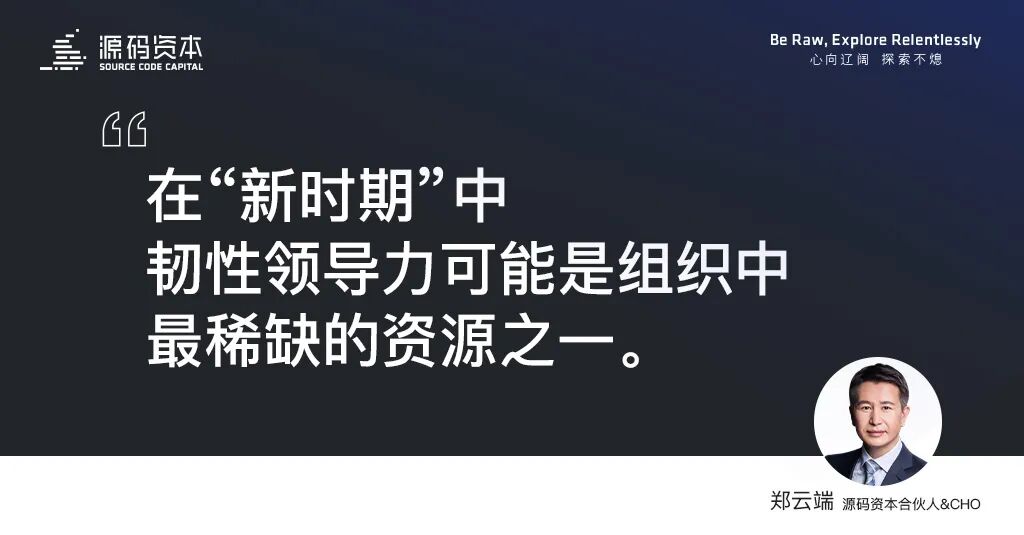
In the "new era," resilient leadership may be one of an organization's most scarce resources.
3
Organizational Effectiveness
Organizations that cannot create an organizational effectiveness "scissors gap" will struggle to cross cycles in the new era.
1. The Scissors Gap Is the Core Contradiction in Management
Here, the "scissors gap" is the core or most critical contradiction in organizational management.
If you grasp this contradiction and effectively, appropriately resolve it, perhaps all organizational problems will be readily solved.
"Ratio of labor cost to revenue" and "labor cost per employee" are such a pair of contradictions.
If a company's "labor cost ratio" is flat or declining year over year, this is a very favorable trend.
If a company's "labor cost per employee" is flat or rising year over year, this too is a very favorable trend.
But the contradiction becomes stark: employee labor cost per person rises year over year, while total labor cost as a percentage of revenue declines year over year — how can both be achieved?
A declining "labor cost ratio" is what the company wants, what shareholders want. Rising labor cost is what employees want. Whoever resolves this contradiction well will win.
The core way to resolve this contradiction is the well-known phrase: three people do the work of five, and get paid for four.
Of course, this should not be solved merely through overtime. More likely, it is solved through talent density, or through organizational and process improvements, or through informatization and digitalization — ultimately achieving this goal.
Rising "labor cost per employee" is inevitable. Inflation, annual promotions, and salary adjustments mean employee labor costs will necessarily grow every year.
If productivity is not improved, allowing the labor cost ratio to remain flat or decline, the company will eventually be eliminated.
2. Organizational Effectiveness Must Simultaneously Address Shareholder and Employee Perspectives
From the shareholder perspective: first, focus on the "labor cost to revenue ratio" dimension; simultaneously, examine whether people efficiency (profit/revenue/users per capita) is increasing; then, examine whether yuan efficiency (profit/revenue/users per yuan of wages) is increasing.
From the employee perspective: first, examine whether average compensation is increasing; second, examine whether turnover is decreasing.
These two perspectives coexist simultaneously. The key lies in how we find the balance point.
3. Organizational "Fitness" Requires Precision
In the "new era," organizational "muscle building" (hiring and expansion) and "fat cutting" (layoffs and downsizing) both require precision.
In recent years, many companies have intermittently hired frantically, then intermittently laid off frantically. These occurrences all stem from failure to form an effective closed loop from strategic consensus to strategic objectives to operational targets and budgets.
Without this effective closed loop, hired talent is uneven in quality, work naturally becomes inefficient, then layoffs follow. If "one-size-fits-all" layoffs are used, even excellent talent is cut, and employer brand suffers great damage.
These are imprecise, unprofessional, and undesirable approaches.
The above represents my thoughts today on the new era, organizational will, organizational effectiveness, and agile organizations — for your reference.
Finally, I wish everyone a smooth journey into the new era, and that in the new year you may achieve your strategic objectives and your career goals.