Zheng Yunduan | Navigating Change, Growing with Resilience

#Code Brain Ecological Connection, Cognitive Resonance
Recently, Zheng Yunduan, Partner & CHO of Source Code Capital, was a guest at the Journey to the West Great Lecture Hall, where he joined Cao Xia, Dean of Qingquan Academy, for a dialogue on "Resilient Society, Resilient Organization, and Resilient Individual."
Zheng Yunduan emphasized that the harder the times, the more resilience an organization needs. Organizational resilience may manifest as financial liquidity, operational flexibility, and organizational agility; it may also be the will to survive, a psychological contract, and resilient leaders within the organization. Resilient organizations and resilient leadership are the scarcest resources in periods of transformation. Adapting under intense pressure, adjusting in adversity, and recovering amid change all require perseverance, willpower, and strong resilient leadership.
We have compiled the dialogue transcript, hoping to bring some inspiration to fellow entrepreneurs.
Cao Xia: While learning about your background and experience for our fellow trekkers, I found your career path remarkably rich. I'd like to ask: among your past experiences, which parts mattered most to you?
Zheng Yunduan: Over 27 years of career, roughly 14 were in foreign enterprises, 12 in domestic companies, and 1 spent studying full-time overseas.
The first 14 years I valued most were at Procter & Gamble and Shell — one American, one European, both global enterprises over a century old, both having survived World War I and World War II. Both possessed excellent organizational capabilities and culture; they were, in essence, resilient organizations.
The subsequent 12 years I valued were at China Fortune Land Development and KE Holdings, both in high-growth industries and companies. I experienced participating in building organizational systems, HR systems, and HR teams. I also witnessed corporate peaks and valleys, and the challenges these posed to organizational capability and will.
I joined Source Code Capital in 2021 and am still learning this industry. What impressed me most about Source Code is its entrepreneurial spirit plus deep cognitive capability. In the current environment, Source Code is also strengthening its institutionalization and organizational resilience — for instance, by building distributed organizations and enhancing leadership and culture development.
Cao Xia: With your extensive experience and high professional caliber in human resources, I'm confident you'll bring tremendous value to our fellow trekkers today. This session's theme is "Navigating Transformation, Growing with Resilience — Embracing Change Through Resilient Society, Resilient Organization, and Resilient Individual." Please start our conversation with German author Markus Brunnermeier's recently popular book, The Resilient Society.
Zheng Yunduan: Having only quickly read through The Resilient Society, several conceptual pairs stood out to me.
- Robustness and flexibility. The author uses the mighty oak to describe robustness, and the supple reed as representative of flexibility. Robustness is the capacity to withstand risk without adjustment. Flexibility is the capacity to yield, adapt, adjust, and recover. Upon reflection, I find the stone and water from the Tao Te Ching perhaps even more vivid.
- Redundancy. Redundancy is particularly important — it's strategic reserve, essential to both robustness and flexibility. However, robustness requires redundancy at every stage. In periods of transformation, sufficient resources must be preserved.
- Social contract. Social resilience sometimes derives from the social contract. Generally, this means shared beliefs and behavioral norms (roughly equivalent to what we call values), realized through morality, law, and markets. The social contract is resilience at the ideological level; its essence is social trust.
- Organizational models. Organizational models are resilience at the structural level. The author argues distributed organizations are more resilient than centralized ones, but I believe China's centralized organizations cannot be said to lack flexibility. Absolute centralization or absolute distribution may both lack resilience. Organizations likely function best with elements of both. Yet regardless of form, the transmission of accurate information is crucial, as it is fundamentally the basis of trust.
- Resilient society requires long-term solutions. Using the pandemic as example, the long-term solution may not be lockdowns, but rather vaccines that address the root cause.
Cao Xia: As a long-time expert focused on organizational building, how do you define a resilient organization? Or what characteristics should a resilient organization possess?
Zheng Yunduan: A resilient organization should have two layers of characteristics — surface and underlying:
(1) Surface characteristics:
- Financial liquidity. Financially robust strategic reserves, with cash flow supporting sustainable development. I recently studied the Battle of Tashan during the Liberation War, where strategic reserves comprised one-third to two-thirds of forces — because war is unpredictable, sufficient maneuvering room is essential. When annihilating enemies, local superiority of 5 to 10 times the force was even sought.
- Operational flexibility. The organization must have alternative solutions at every link of operational flows such as supply chains. Operations should be risk-diversified — whether in products, customer segments, or regions. When unknown shocks hit certain operational links, there is time and space to respond and adjust.
- The organization possesses not only centralized computing capacity but also distributed computing capacity. For example, the base areas during the Anti-Japanese War had distributed computing capacity. Simultaneously, the organization maintains talent diversity.
(2) Underlying characteristics:
- The will to survive. This is the spiritual source of resilient organizations — the shared aspiration, vision, belief, and goals of the organization. Organizational will is irrational; it is the organization's deepest, most powerful, and most inexhaustible source of motivation, as well as its most fundamental psychological reserve. The Red Army possessed this psychological reserve. Many excellent organizations have it — Procter & Gamble, Shell, Vanke. In such organizations, the organization is value-driven, not merely materially driven. Additionally, fairness. Fairness helps maintain the psychological contract. Thus in turbulent times, equality between officers and soldiers and shared hardship are important, yet difficult to achieve. Much of the Red Army's combat effectiveness came from this equality and shared hardship.
- Trust. This is the foundation of resilient organizations; shared purpose and values are the foundation of trust. "Purpose" (zhi) means shared vision; "values" (dao) means shared worldview and methodology. Trust carries the lowest cost. Trust accelerates speed, trust brings the greatest satisfaction, trust motivates most effectively. Because of trust, efficiency; because of trust, low cost; trust has the greatest resilience. With high trust, even if you misspeak, others will understand your true meaning; without trust, even precise wording will be misinterpreted. The risk of trust is great; the risk of distrust is greater. Trust and trust-building are both critical leadership capabilities — leverage in the leadership model.
- Resilient leadership. The deepest gene of resilient organizations: Resilience Leadership. We might previously have called this leader's will — the dauntless spirit of persevering through setbacks — an important leadership trait. Resilient leadership is the leadership trait that needs emphasis in transformational periods, because changes in such periods are not only dense but profound and unpredictable. Resilient leadership is the scarcest resource in transformational periods.
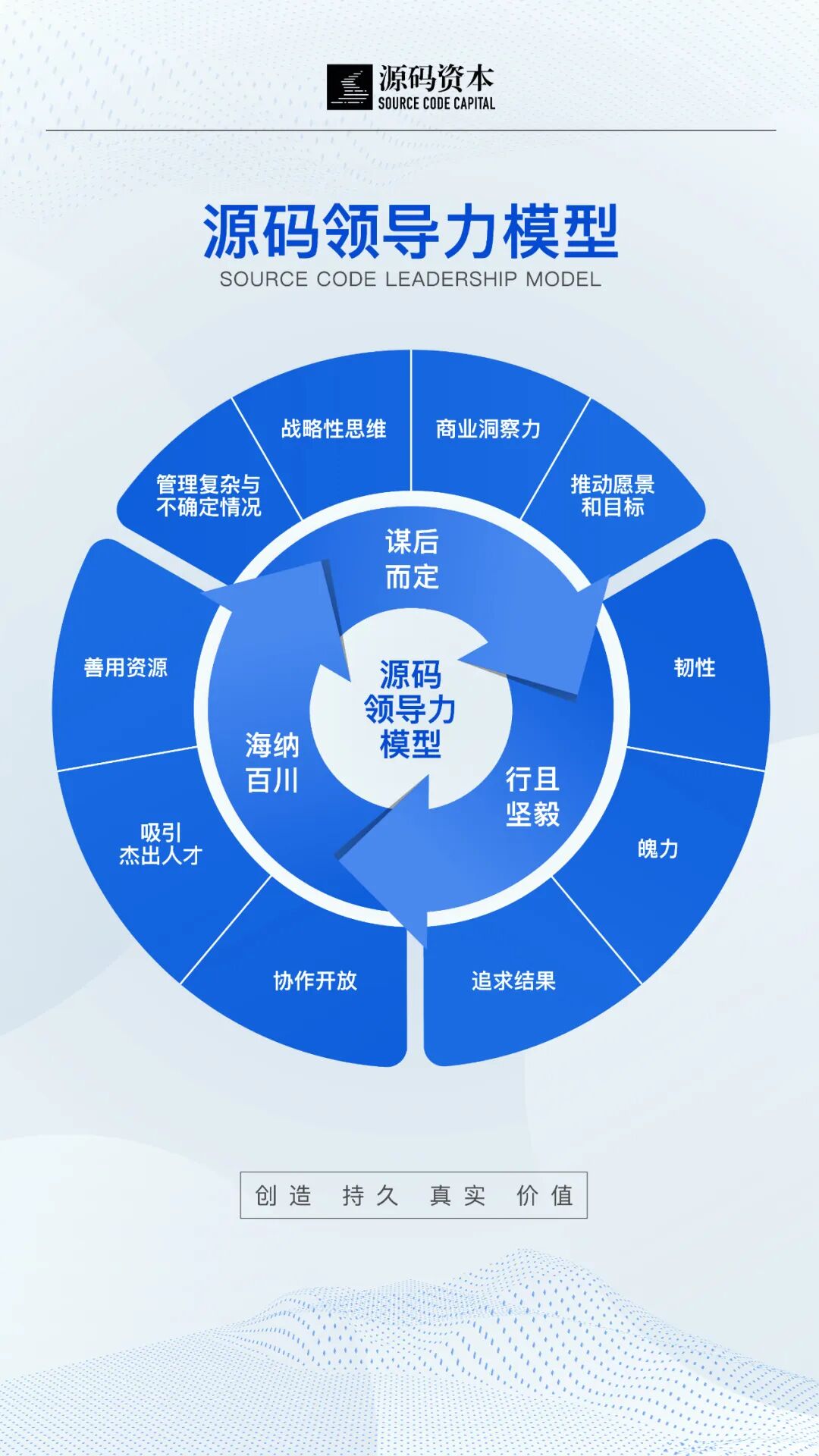
(3) Source Code Capital's leadership model contains three dimensions:
- Deliberate then decide (managing complexity + strategic thinking + business acumen + vision and goals);
- Act with perseverance (resilience + boldness + results orientation);
- Embrace diversity (attracting outstanding talent + open collaboration + leveraging resources);
Cao Xia: You wrote an article in 2019 called "The Rise of the Organization Department." We're very interested in this topic. Please tell us: what value does the Organization Department bring to resilient organizations?
Zheng Yunduan: Enterprise business capabilities generally refer to R&D capability, sales capability, and production capability. For enterprise success, beyond adequate business capabilities, management capabilities must also be adequate. I generally call management capabilities "the capability to build organizational capability," typically including the strategy and operations department, finance department, digital department, and organization department.
Former GE CEO Jack Welch once spoke of "four horse-drawn carriages" — CEO, COO, CFO, and CHO. That was the industrial era. In today's digital age, a fifth carriage has been added: CTO.
The strategy and operations department bears responsibility for knowing oneself and the competition, setting goals and plans, and following through on execution and progress. Operations is equivalent to the military's general staff; at the operational level, its importance actually exceeds that of the organization department. In unpredictable environments, it is the most indispensable team force for commanders. In some companies it's called business analysis, planning and analysis, strategy and operations, etc.
The finance department bears the core function of strategic reserve. In military terms, this roughly corresponds to the general logistics department, stockpiling continuous war resources for the front lines. In environments of transformation and strategies for secure survival, it bears the core capability of resilient organizations.
The digital department bears the most advanced technological force for information and intelligence transmission, ensuring that when the organization must employ distributed computing, information can still be transmitted accurately, promptly, securely, and with consistent standards to all quarters. Accurate and timely data and information transmission is the foundational guarantee for correct decision-making and judgment.
The organization department bears responsibility for identifying and building organizational functions, identifying and developing core personnel, and identifying and uniting teams of shared purpose. All competition ultimately is competition among people; all judgment ultimately is judgment by people; even strategic analysis and formulation are conducted by people. Organizational resilience ultimately derives from team and individual resilience.
These organizational functions are not business functions. Yet they are the underlying infrastructure of business functions, the guarantee and leverage of business functions, the capability to build the business organization's capabilities.
Specifically regarding the organization department, I first encountered this concept in 2012. At that time at China Fortune Land Development, it was my first time serving as the top HR executive in a rapidly growing domestic enterprise. Previously in foreign enterprises, I had been more at the HR "operational level" — recruitment, training, performance, compensation. As the top HR executive, I first had to confront HR at the "strategic level" — organization, cadres, incentives. At that time I still lacked this mode of thinking, and conversations with the CEO were often like chickens talking to ducks.
At that time, what I discussed with the team was to benchmark against the world's most excellent organization and see how they did things. We chose the Communist Party of China. This organization, over nearly 100 years, has led the world's largest population through war, reform, and succession, remaining prosperous throughout. Within this organization, there is a remarkable department: the Central Organization Department. In 1945, to seize the Northeast, the Organization Department deployed 20,000 cadres at once to depart with the army. In 1947, to build national cadre reserves, the Organization Department deployed 53,000 cadres at once to follow the army southward. This provided tremendous cadre echelon support for the cause of the Party and the nation.
The Central Organization Department, full name Organization Department of the Central Committee of the Communist Party of China. It belongs to the Party Central Committee, not the State Council. Its positioning is "assistant and advisor to the Party Central Committee on organizational matters," overseeing Party building and cadres. Party building roughly equals corporate culture and values. Core principles are "the Party manages cadres" plus "position roster system." For many years, these two principles have basically remained unchanged. The Organization Department supports 90 million Party members, 600,000 cadres, over 4,000 directly managed cadres, and over 1,000 directly managed reserve cadres. The Organization Department system itself reportedly has around 100,000 people maintaining its operations.
The Central Organization Department's main working methods also offer much worth learning from: the Organization Department always focuses on "main-line cadres" — that is, the top-leader teams, such as town Party secretaries, county Party secretaries, city Party secretaries, and provincial Party secretaries; the appointment and removal of senior cadres is not the result of "negotiation" but of "combined forces," avoiding turbulence in the senior cadre team; in selecting cadres, don't look at one moment or one matter, but at their entire history and entire body of work; the Organization Department's cadre management authority generally extends one level down — "skip-level management"; the Organization Department cultivates cadres emphasizing rotation, with large-scope, large-span position rotation.
At the level of scientific management, Chinese enterprises should still earnestly study excellent American enterprises; I don't recommend rushing to be original. But at the level of organizational management artistry, many of the Central Organization Department's management methods are very worth learning from.
Cao Xia: You once recommended two courses to enterprise managers: one was The 7 Habits of Highly Effective People, the other was the Journey to the West deep experiential leadership program. I'm particularly delighted to have your recognition. Could you share your understanding of the Journey to the West?
Zheng Yunduan: I first encountered the Journey to the West when serving as a consultant at Vanke. The real implementation was at KE Holdings. At that time, the KE Holdings team faced a challenge — the core management team had three types of people: (1) business operations line, such as regional general managers and vice presidents; (2) engineers, from internet companies; (3) professional line colleagues, like HR, finance, and legal. These three groups had very different thinking patterns and language systems, yet the team needed deep integration and chemistry to build resilience and form a resilient organization and team.
The Journey to the West is a top-tier leadership training ground. Even during the pre-race and race process, we began discovering its value for team integration. Especially in the Gobi scenario, you quickly find that a person's behavioral patterns, expression patterns, and interaction patterns within a team don't differ greatly from work scenarios. I very much recognize the Journey to the West's value for team integration, for resilient teams, and for teams with chemistry.
The Shackleton Award of the Journey to the West is an award that made a very deep impression on me. First, the entire team must arrive to receive this award; its standard is not abandoning teammates. Second, more than one team can receive this award — all teams meeting the standard can receive it. This is not a win-lose award design; it is a win-win award design.
The Journey to the West is very meaningful for resilient organizations in transformation. Many of our enterprises, whether leading companies, hidden champions, or startups, even outside transformational periods, are essentially walking in uncharted territory in their respective fields. As leaders and leadership groups, how do we lead our teams through uncharted territory and successfully reach the destination? You can have a condensed experience of this in a short time through the Journey to the West.
Cao Xia: Among the trekkers in our livestream, there are entrepreneurs, enterprise managers, and many young friends. From the individual perspective, how do you think young people should cultivate their resilience to address the anxiety and unease brought by uncertain times?
Zheng Yunduan: I'll still use the framework from The 7 Habits of Highly Effective People to respond, specifically the seventh habit: Sharpen the Saw — constantly cultivating four capabilities, with resilience being the sum of these four.
First is physical cultivation. Physical strength is the foundation of resilience; without physical strength there can be no resilience. Running, hiking, walking — these are the simplest exercises, accessible to everyone, anytime, anywhere, with no venue requirements. I don't love running myself, but I'm willing to hike in expansive spaces — the Gobi, desert, grasslands.
Second is mental cultivation. Much of our world's emo stems from not understanding the world. Read more, build multiple perspectives on the world, and thinking broadens considerably. Especially in transformational periods, we need different modes of thinking. In this period, we should establish PPE thinking — Philosophy-Politics-Economics thinking. The key contradiction of this period is not market economics, but political economy. Additionally, I've found that the best way to learn a discipline's mode of thinking is to read that discipline's introduction. I've bought introductions to many fields — history, sociology, archaeology, finance, economics. The more perspectives we have for observing the world, the less confused we become. Another very important pathway is working with excellent people, from whom we can learn very different perspectives and habits.
Third is social (leadership-followership) cultivation. At work, be a good leader and follower; in family, be a good leader and follower in both the nuclear and extended family; in friendships, also be an organizer and follower, even if rarely. The troubles of interpersonal relationships are the source of self-knowledge. Through others, know yourself. Do not do to others what you do not want done to yourself — I don't do this well either.
Fourth is spiritual (spiritual power, willpower) cultivation. One can meditate, calming and centering the mind; one can practice self-awareness, timely perceiving one's emotions, observing them, digesting them. Read "useless" books: Tao Te Ching, Zhuangzi, Diamond Sutra, Heart Sutra, Ksitigarbha Sutra, Analects, Yellow Emperor's Inner Canon, The Art of War, Book of Lord Shang... I especially recommend that classmates from science and engineering backgrounds read more "useless" books.
Fifth is financial redundancy. Save more money — even Americans have started saving now.
From resilient society, to resilient organization, to resilient individual, resilience supports the valleys of nations, enterprises, and individuals, and will surely witness their ascent. Zheng Yunduan led us from The Resilient Society to understand organizations' resilient characteristics, resilient organizational building, courses for cultivating organizational and individual resilience, and some answers for young people. May this content help everyone discover some certainty within uncertainty.

Monday, November 28, 8:00 PM,
Source Code Capital's Zheng Yunduan in dialogue with Dedao's Tuo Buhua,
jointly exploring Ten Iron Laws for Managerial Leapfrog Growth — welcome to register!


Issue 37 Code Brain | Compensation Incentives: Both Science and Art
Issue 36 Code Brain | The Essence of Performance Management Is Unlocking Human Potential
Issue 35 Code Brain | The First Step in Identifying and Deploying Talent: How to Interview Scientifically
Issue 34 Code Brain | How Far a Team Can Go Depends on These 6 Points
Issue 33 Code Brain | An Entrepreneur's 11,626.5 Hours
Issue 32 Code Brain | Leadership Is Leading People to Uncharted Territory
Issue 31 Code Brain | Amazon's Ten Compliance Experiences for Going Global
Issue 30 Code Brain | 60 Hours of "Practical Leadership" — Full Highlights Review!
Issue 29 Code Brain | Zheng Yunduan: What Actually Drives Organizations?
Issue 28 Code Brain | Understanding Human Nature to Build a Good "Vanguard" for Going Global
More MaHui members can click "Read Original" to view