Star Ring Energy Completes 1 Billion Yuan Series A, Setting New Record for Single Round in China's Private Nuclear Fusion Sector | Unity Ventures Portfolio News
Largest Fusion Energy Deal of the Year
Unity Ventures portfolio company Star Ring Energy announces RMB 1 billion Series A funding round, led by Shanghai Science and Technology Innovation Group and Shanghai Future Industry Fund, both under Shanghai International Capital, with co-leads from CICC Capital and Shanghai Jiading Science and Technology Investment Group. Additional investors include Bank of China Investment, Xichen Capital, SummitView Capital, Longge Technology, Feitu Capital, Shandong Energy Shanghai Yankuang Assets, CIMC Enric, Shangrong Capital, Yuanhe Puhua, Shenwan Hongyuan, Binfu Capital, Zhenyi Capital, and individual investors. Shanghai Science and Technology Innovation Group's Intellectual Property Fund, which led the company's Pre-A round, also participated in this round.
The funding will be used to accelerate construction of the next-generation fusion device. The company plans to complete engineering verification around 2028, begin building a commercial demonstration reactor, and have a fusion demonstration reactor capable of exporting electricity operational by approximately 2032.
With this, the record for single-round funding among domestic private-sector nuclear fusion companies has once again been broken.
Nuclear fusion is regarded as "humanity's ultimate energy source," and the urgency of this energy revolution has only intensified with the explosion of artificial intelligence. Training large models consumes enormous amounts of energy, and nuclear fusion represents a potential breakthrough for solving this problem.
Soviet physicist Lev Artsimovich, one of the inventors of the tokamak device, once said: "Fusion will be ready when society needs it." Perhaps humanity's day of "building a sun" is not far off.


Deep Tsinghua Roots, a Hardcore Team Forging Core Competitiveness
Founded in October 2021, Star Ring Energy spun out of a Tsinghua University technology transfer project. Its core team members all graduated from Tsinghua's Department of Engineering Physics and have spent over two decades in the fusion field, making them China's first spherical tokamak research team.
In June 2022, Star Ring Energy announced a multi-hundred-million-yuan angel round with participation from Unity Ventures and other institutions. Though still a startup, the team's extensive R&D experience and the company's pragmatic valuation won investor confidence, also riding the wave of industry excitement generated by U.S.-based CFS's large funding round at the time.
Leveraging Tsinghua University's research foundation and talent advantages, the company has continued to attract top academic talent. In recent years, its R&D team has rapidly expanded from just over 10 people at founding to more than 140, with over 70% holding master's or doctoral degrees, forming a composite talent pool covering the entire fusion industry chain with both scientific research and engineering capabilities. This team, centered on Tsinghua's research strength, has maintained a leading position in key fusion technologies through deep academic expertise and rich engineering experience.
After years of refinement and iteration, the company has developed preliminary large-scale engineering management capabilities for fusion energy development. Currently, the team is systematically executing three parallel missions: operating one generation (SUNIST-2), building one generation (NTST), and researching one generation (CTRFR-1), advancing fusion energy development with extremely high efficiency and maximum speed.
Original Path Accelerating Iteration, Commercial Application Prospects Promising
Star Ring Energy employs a domestically originated, globally unique technical approach: compact repetitive reconnection controlled fusion based on high-temperature superconducting strong-field spherical tokamaks, characterized by multi-stroke repetitive operation and plasma self-magnetic-field reconnection heating.
Compared to traditional tokamak fusion reactors, this approach features compact size and simple structure, significantly reducing construction costs. The solution is applicable not only to large-scale fusion power plants and distributed power stations, but also, due to its compact and simple design, shows particular promise for high-integration-requirement scenarios such as offshore/deep-sea operations platforms and large vessel propulsion systems, with characteristics of high energy density, environmental friendliness, and self-limiting reactions, enabling diverse applications and broad commercial prospects.
By Star Ring Energy's calculations, achieving a Q-value (energy gain factor) greater than 1 with its next-generation device would cost approximately RMB 1.5 billion, far below the cost of traditional large tokamak approaches.
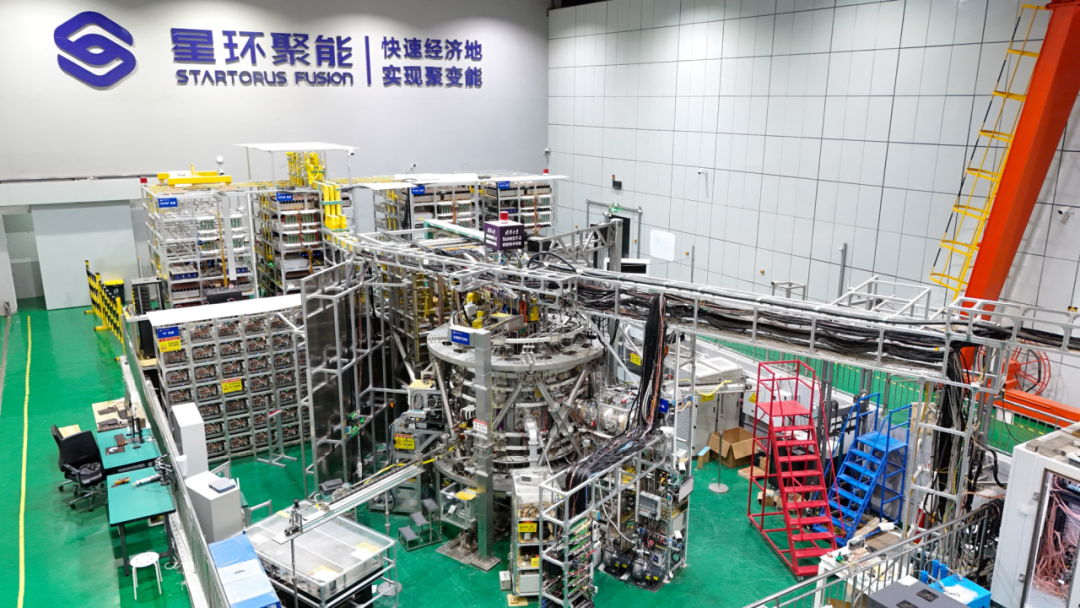
The SUNIST-2 facility, jointly built by Star Ring Energy and Tsinghua University
Since its founding, Star Ring Energy has achieved major breakthroughs in multiple core technology domains related to spherical tokamak fusion reactors. In collaboration with Tsinghua University, it built SUNIST-2 (the zero-generation experimental device) in just 279 days and successfully achieved ohmic discharge to obtain first plasma, setting a world record for similar facilities; it rapidly validated its original repetitive reconnection technical approach, with plasma temperatures exceeding 17 million degrees Celsius; it extensively and deeply integrated AI technology into device monitoring and safety early warning, plasma diagnostics and rapid equilibrium inversion, and achieved multiple AI-based high-quality multi-parameter plasma real-time control methods; and it pioneered the design and construction of NTST, the world's first natively negative triangularity spherical tokamak device, capable of exploring unprecedented parameter ranges for tokamaks and providing potential innovative solutions for future fusion reactors. In the high-temperature superconducting magnet domain, the company has established the complete technical workflow for fusion-grade full-scale magnet coil development, completing design, manufacturing, and testing validation for multiple key magnets and components.
At the same time, the company has developed and refined numerous peripheral fusion reactor technologies, with productization as the delivery requirement for each internal project, actively driving technology commercialization, with self-sustaining revenue capacity becoming increasingly apparent.
Star Ring has now developed complete signal conditioning product lines including high-bandwidth isolation amplifiers and analog integrators; its superconducting data acquisition instrument (EPIC) and single-channel acquisition unit (CoaxLink Nano) support extreme multi-physics precision testing and flexible deployment, laying reliable data foundations for digital fusion reactors and AI control; its poloidal magnet pulse power supply and general-purpose pulse power module (IVCube) together constitute a complete pulse power solution supporting batch deployment and complex control, providing cost-effective power support for fusion devices; its self-developed in-situ surface analysis system (LIBS) and electrostatic probe drive system, in addition to supporting fusion research, have attracted significant attention and secured multiple partnerships in nuclear power, aerospace, and high-energy physics; and its high-temperature superconducting magnet full technology stack capabilities have overflowed into customer development and processing agreements.
Star Ring Energy plans to complete engineering verification around 2028, begin commercial demonstration reactor construction, and have a fusion demonstration reactor capable of exporting electricity operational by approximately 2032.
This hardcore team continues advancing toward this goal. Perhaps humanity's day of "building a sun" is not far off.


The Map of a New World Is Unfolding | Unity Ventures New Year Review