Smart glasses brand INMO closes nearly 1 billion yuan Series C round, kicks off IPO preparations | Unity Ventures

In recent years, J&T Global Express has maintained revenue growth of over 200% year after year.
Unity Ventures portfolio company INMO recently closed its Series C3 funding round, led by Sichuan Zhenxing Sci-Tech Innovation Fund, with participation from Jingan Capital, Shibei Hi-Tech, Guangzhou Industrial Investment, Sichuan Pilot Base, Meishan Pilot Base, and Dongpo State Investment. Following its Series C1 and C2 rounds earlier this year, the company's total Series C funding has now reached nearly one billion RMB.
The fresh capital will primarily fund R&D and production of its next-generation spatial intelligent hardware lineup, as well as continued iteration and upgrades to the INMO AIOS system — strengthening core capabilities at both the hardware and software layers. The company will also intensify brand building and omnichannel distribution to sharpen its commercialization capabilities, push product adoption beyond niche tech circles, and accelerate business growth.
INMO has formally initiated preparations for going public. In recent years, the company has maintained annual revenue growth exceeding 200%.

Smart glasses are being pushed to the center of attention in consumer electronics. IDC data shows that global AI smart glasses shipments in 2025 surged over 200% year-over-year. The China market is growing even faster: according to Runto Technology, in the first half of 2026, domestic smart glasses sales across all channels reached 909,000 units, up 85.5% year-over-year, generating 1.88 billion RMB in revenue — a 98.7% increase.
The market is scaling rapidly, yet no benchmark product has emerged that can truly capture mainstream consumer mindshare. For years, the industry's dominant form factor has remained stuck at the elementary stage of "making glasses that can display." Most products use a Birdbath optical solution paired with an external compute unit — essentially putting a "display" on your face while "compute" still relies on a tethered device.
"Display alone doesn't constitute independent terminal value," says Longsheng Yang, INMO's founder and CEO. "What users actually need isn't a screen strapped to their face, but an intelligent agent that can operate independently of a phone. Market demand is undergoing a critical transition from 'phone accessory' to 'standalone terminal.'"
This assessment is backed by concrete shifts in product structure. In Q1 2026, screen-equipped AI smart glasses already accounted for 60% of sales. The ratio between all-in-one AR glasses and split-type products swung from 9:91 in Q1 2025 to 47:53 in Q2 2026. Consumer acceptance of "standalone terminals" is clearly accelerating.
In Yang's view, whether smart glasses become the "next-generation terminal" hinges on three questions: Can they run independently of a phone? Can they deliver value that phones cannot? Can they achieve imperceptible comfort for daily wear?
The answer to all three points in the same direction: integration.
Founded in late 2020, INMO was among the earliest entrants into consumer-grade smart glasses in China. From day one, the team committed to a lightweight, integrated technical approach — consolidating optical display, local compute, and AI perception into the glasses themselves, eliminating dependence on phones or external host devices.
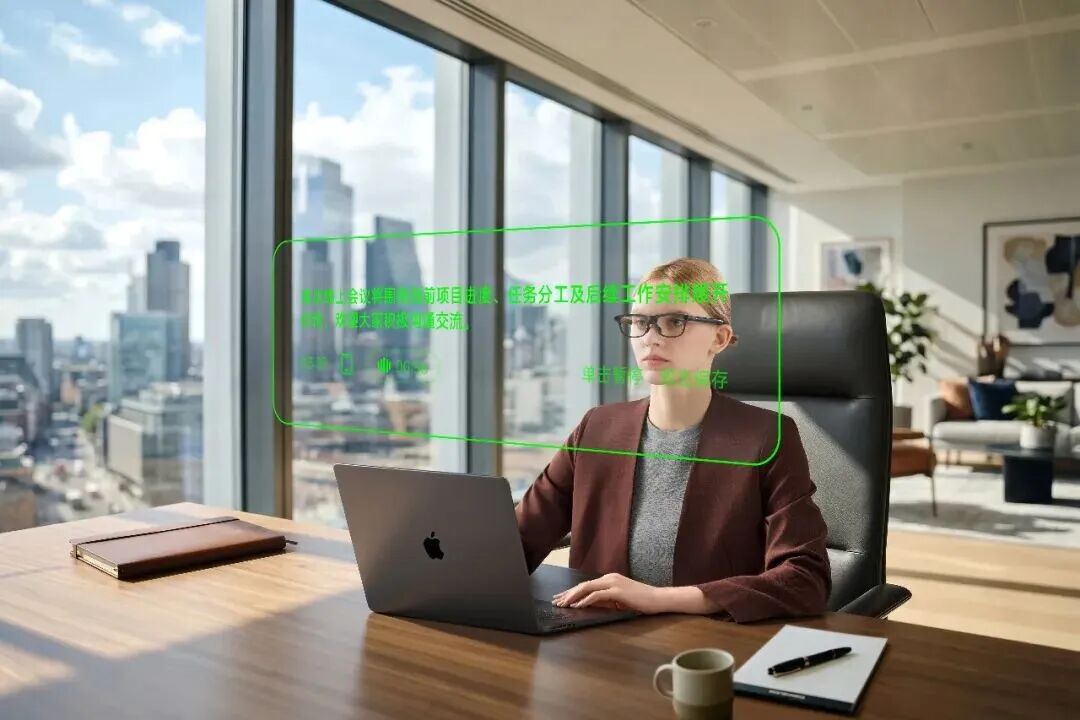
INMO smart glasses in an office setting
Integration comes at the cost of exponentially harder hardware engineering.
The physical space inside glasses is extraordinarily constrained. Batteries, chips, antennas, and speakers must fit into the temples. Displays and optics must layer onto the lenses. Total weight must stay within the range of ordinary sunglasses — no front-heavy imbalance, no nose bridge pressure, no temple pinching. This means optics, compute, power consumption, thermal management, weight, and wearing comfort must all be solved simultaneously within a few millimeters.
As early as 2021, INMO pioneered full-color waveguide smart glasses, bringing waveguide technology to the consumer market. The AIR3, launched in 2024, debuted Sony's global-first 0.44-inch Micro-OLED screen with 1920×1080 resolution — triple the brightness of its predecessor.
Meanwhile, the GO series launched in 2023 focused on AI capabilities, gaining market validation in business scenarios such as translation and teleprompting, at one point capturing 80% market share in translation glasses.
If hardware integration is INMO's first moat, then INMO AIOS — an operating system refined across multiple hardware generations — represents a deeper competitive barrier. Development began alongside the original AIR product, evolving from a spatial interaction foundation into a complete AI-native spatial OS through successive additions of Agent and multimodal perception capabilities.
"Our logic is straightforward: glasses aren't phones worn on your face, so the OS has fundamentally different concerns. A phone OS manages apps, windows, and touch. A glasses OS manages space, context, intent, and attention — where you are, what you're looking at, what you're doing, whether now is the right moment to interrupt you," says Yang.
INMO's self-developed INMO AIOS has a three-layer technical architecture.
First, the spatial layer is fully self-developed and already in mass production. Monocular VIO, 6DoF spatial positioning, spatial anchors, mixed reality rendering, and gesture interaction — all running within glasses-grade power and weight constraints. INMO's approach is edge-cloud integration: the device handles only the low-latency positioning and rendering that must happen locally, while large-scale scene reconstruction is offloaded to the cloud. The company trades algorithmic and cloud compute for device slimness, rather than cramming more chips into the temples.
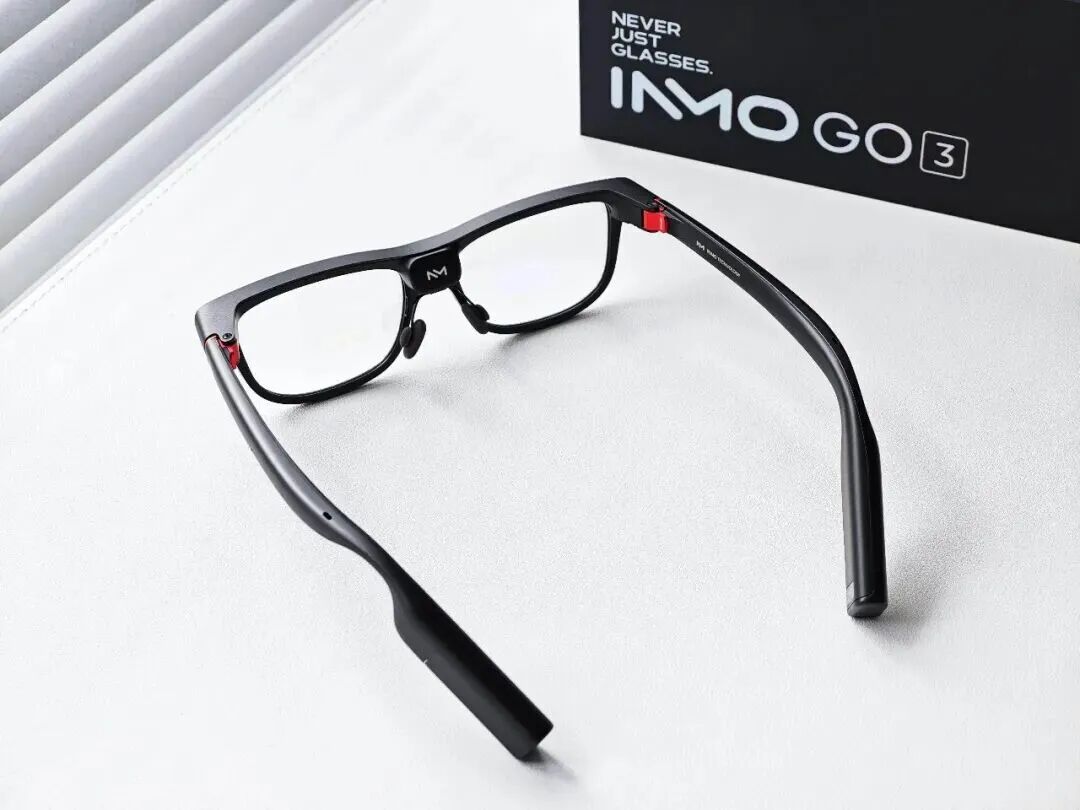
Lightweight design
Second, AI-native architecture. INMO doesn't build foundational large models from scratch; instead it supports flexible switching between multiple vendor backbones, while concentrating on upper-layer capabilities close to the human eye — multimodal situational understanding, Agent task orchestration, and tool invocation. This year, the company positioned its GO series as Agent-embodied hardware: users issue voice commands to their glasses, and cloud-based Agents complete entire workflows such as booking flights, checking email, and drafting meeting minutes.
Third, a unified underlying system spanning the full product line. The AIR series carries the complete spatial computing stack; the GO series focuses on voice interaction and Agent capabilities. Different product lines share the same technical foundation, with capability layering according to product positioning — ensuring every R&D investment can be amortized across multiple product lines. This architecture lets INMO maintain product differentiation while maximizing technical investment efficiency.
"This year, the industry has been competing on specs, but glasses have a fraction of a phone's compute and power budget. What ultimately makes the difference isn't specs — it's how the system schedules that limited compute to actually run spatial and AI workloads," Yang told Hard Kr. This is the fundamental logic behind INMO's heavy investment in its self-developed spatial AIOS.
On the user front, INMO is accelerating a shift from "technology-driven" to "technology + audience" dual-wheel drive. The X series embodies this logic. Rather than "one pair of glasses for all users," products are defined around differentiated needs across fashion, sports, family, and other segments.
Among these, INMO's strategic partnership with WHL produced the INMO x Magic AI series — designed with Jackson Wang's involvement and worn by him long-term. First-batch pre-orders hit 50,000 units, with a North America exclusive launch in July. This marks INMO's first breakthrough beyond the tech-enthusiast circle into mainstream consumer markets. The company also launched a co-branded photo glasses targeting female users, emphasizing design aesthetics and everyday recording needs, reaching broader demographics including young professionals and style-conscious mothers.
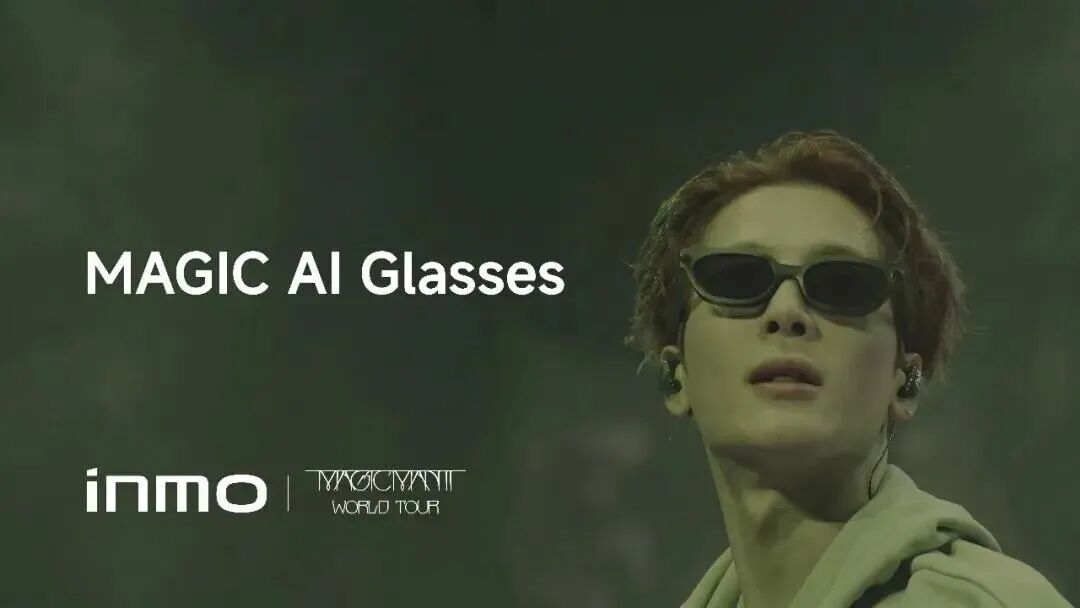
INMO x Magic AI Glasses, co-developed with WHL
By first defining the user and usage scenario, then reverse-engineering hardware form factor and interaction design, this strategy moves smart glasses from "geek toy" toward "everyday consumer product" — no longer just a novelty for early adopters, but an intelligent terminal that ordinary people are willing to wear daily and actually use.
The core value of smart glasses lies not in replicating phone display capabilities, but in using "standalone terminal" as an anchor to reimagine human-computer interaction scenarios and modalities. With integration, lightweight design, and AI-native architecture as core objectives, and centering on users' daily life scenarios, spatial computing and AI capabilities are embedded into glasses — a naturally high-frequency wearable device — to achieve true independent intelligence.
This also represents the underlying logic shift in AI-era terminal competition. As large models gradually dissolve functional boundaries between applications, competitive moats no longer reside in algorithmic parameters, but migrate toward two poles: hardware form factor independence on one end, and depth of scenario embedding plus native AI capabilities on the other.
By breaking the "phone accessory" category limitation with integrated waveguide technology, and building a standalone terminal ecosystem through its self-developed AIOS, INMO is attempting to upgrade from "feature-phone-style glasses" to "next-generation spatial computing terminal."
The following are excerpts from an interview with INMO founder Longsheng Yang:
Q1
Compared to Birdbath and external-compute solutions that can scale faster in the near term, INMO has long insisted on the integrated waveguide approach. Looking at the competitive landscape, how do you see the respective positions of different technical routes in future market dynamics?
Yang: Birdbath and external solutions can indeed ship more units quickly, but they have a fundamental problem — they're in the "phone accessory" business. INMO committed to the integrated route from day one because we defined ourselves as building the "next-generation terminal."
If smart glasses truly aim to replace phones, they must ultimately be standalone terminals, not accessories tethered to phones. As the industry has evolved over these years, this judgment continues to be validated.
Integrated smart glasses offer several values that compromised solutions cannot deliver. First is AI proactivity. For AI to truly understand you, it needs to continuously see what you see and hear what you hear — it must be "present." Split-type glasses lose connection once separated from the phone; AI becomes a tool users must actively summon, not an always-on companion. Only untethered AI has the chance to fully realize its potential.
Second is the completeness of spatial computing. The biggest difference between glasses and phones is that glasses allow digital content and the physical world to coexist in the same space — virtual and real intertwined. But any wired design inherently restricts freedom of movement, and free movement is the prerequisite for spatial computing experiences. For users to wear them outdoors, during sports, at any live event — they must be wireless, lightweight, and integrated.
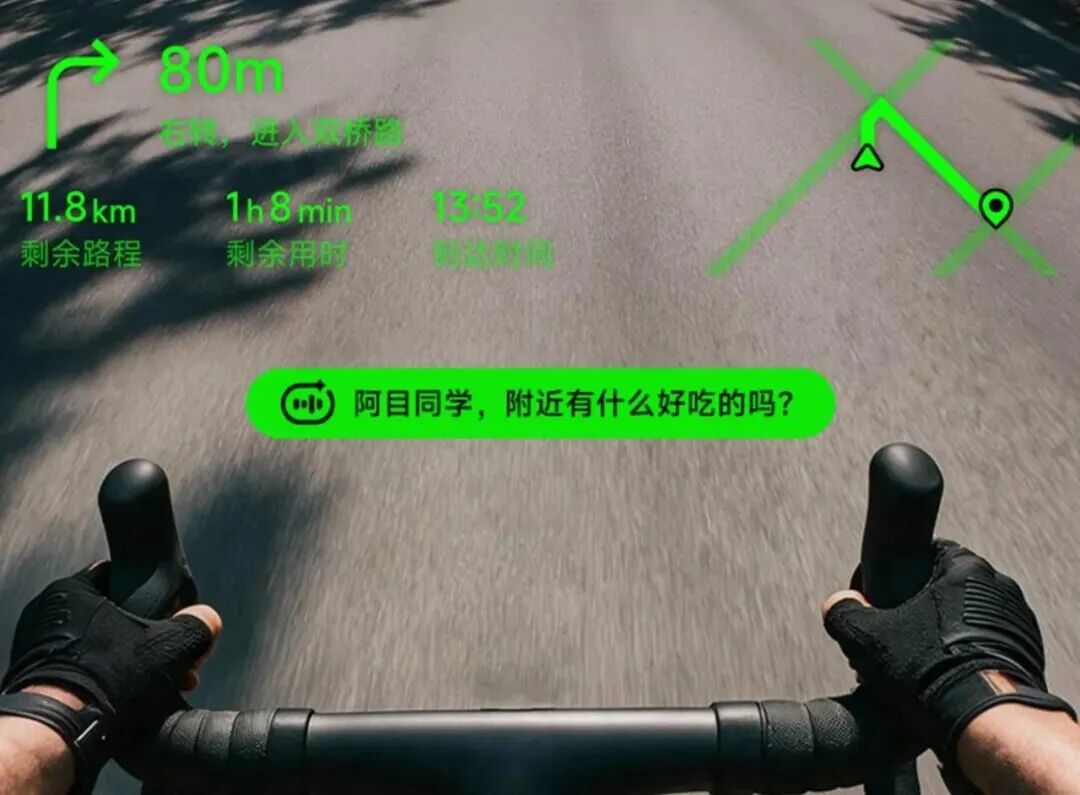
INMO smart glasses in outdoor scenarios
Third is continuous learning and evolution capability. A device worn on the body can continuously collect environmental data, allowing AI to keep learning and adapting to user habits.
So while the integrated route indeed requires longer R&D cycles and higher costs, we believe it's the answer that lets smart glasses cross over from "geek toy" into everyday mainstream use. We chose this path not to do the harder thing, but because we believe it's the only right thing.
Q2
Translation and business scenarios represent high-barrier, strong-need use cases that INMO has strategically prioritized. By contrast, consumer-grade general-purpose scenarios commonly suffer from pain points where products look good but prove hard to use, or feel low-frequency and superfluous. How do you balance between two markets with such different logics? And how does scenario-side differentiation manifest specifically?
Yang: Regarding the "looks good, hard to use" pain point — INMO has been continuously addressing this.
From creating the category, to focusing on translation for刚需 validation, to AI smart glasses, we've done several concrete things in product definition. Translation and teleprompting were industry firsts. The swappable battery design — five seconds to swap — completely solves battery anxiety. The front-rear balanced integrated design keeps total weight around 50 grams, with temple arms as slim as 8 millimeters at their thinnest point, wearing without nose bridge pressure. We also built 21 industry-specific lexicons, pushing intelligent translation into hyper-professional territory. In other words, we've moved smart glasses from "functional" to "naturally presentable."
Regarding homogenization and cutthroat competition, we believe the mass market lacks not products, but brands with innovative capability. What INMO has consistently done is define categories, not follow them.
Specifically on scenario differentiation, our approach is to first identify concrete niche scenarios and audiences, then reverse-engineer the product. This includes a sports series addressing navigation and communication needs during outdoor exercise; a family series relying on lightweight design and wearing comfort — the fundamentals of making glasses; and a photo series through celebrity brand collaboration, aiming to bring smart glasses into fashion and lifestyle consumption. Each product is made for people in specific scenarios, not made first and then matched to buyers.
Q3
How do you build product ecosystem moats?
Yang: At the ecosystem level, we don't intend to replicate the mobile app store model. We're approaching this from three dimensions. First, building a developer platform with visual orchestration tools and SDKs, allowing developers to complete application development and deploy to glasses within days, achieving develop once, run across multiple endpoints. Second, creating differentiated content focused on scenarios that combine with physical-world interaction — mobile business, navigation, offline gaming. Third, advancing ecosystem co-construction, partnering with Ant Group, Tencent, Zhipu AI, and others to打通 world coordinate systems and jointly build real-world models — this is the future foundation of spatial AI intelligence.
We believe the true moat of software ecosystem isn't app quantity, but the flywheel of situational data and user trust — the longer you wear it, the more the system understands you, the more the world understands you.