Independent Variable Robotics Unveils World's First World Unified Model, Next-Gen Robot to Enter Real Homes in 34 Days | Unity Ventures Portfolio

This marks a major leap for embodied foundation models, from the VLA architecture toward a native multimodal fusion architecture.
On April 21, Unity Ventures portfolio company Independent Variable Robotics held a product launch to unveil its next-generation robot-for-the-home initiative. In one month, its robots will ship with the company's new self-developed embodied intelligence foundation model, WALL-B.
This is the world's first embodied intelligence foundation model built on a World Unified Model (WUM) architecture, marking a major leap from the VLA paradigm toward a native multimodal fusion architecture.
Qian Wang, founder and CEO of Independent Variable, and Allan Wang, co-founder and CTO, offered a comprehensive breakdown of WALL-B's technical architecture, data strategy, and training mechanisms. They announced that on May 25, the first batch of next-generation robots equipped with WALL-B will enter real homes, kicking off their journey to serve family life.
The Home Is Embodied Intelligence's True "Exam Room"
"Seven a.m. The alarm goes off. You climb out of bed and walk into the living room. Your slippers are nowhere to be found. The kitchen dishes are unwashed. Your kid's backpack is on the floor. The cat has knocked over a glass of water." Qian Wang opened with this everyday scene to illustrate the essence of home environments — random, fragmented, constantly changing. Currently, no robot anywhere in the world can independently complete the integrated tidying tasks in this scenario without remote control.
This reality clashes with public perception. Backflips, breakdancing, and calligraphy demonstrations on stage make for strong visual impact, but these movements are essentially preset trajectories from "command-line robots" — every motion is pre-programmed or remotely operated. Industrial robots already deployed in factories are no more comparable: in a factory, one action can be repeated ten thousand times under identical conditions; in a home, ten thousand actions might each happen once, every time under different conditions.
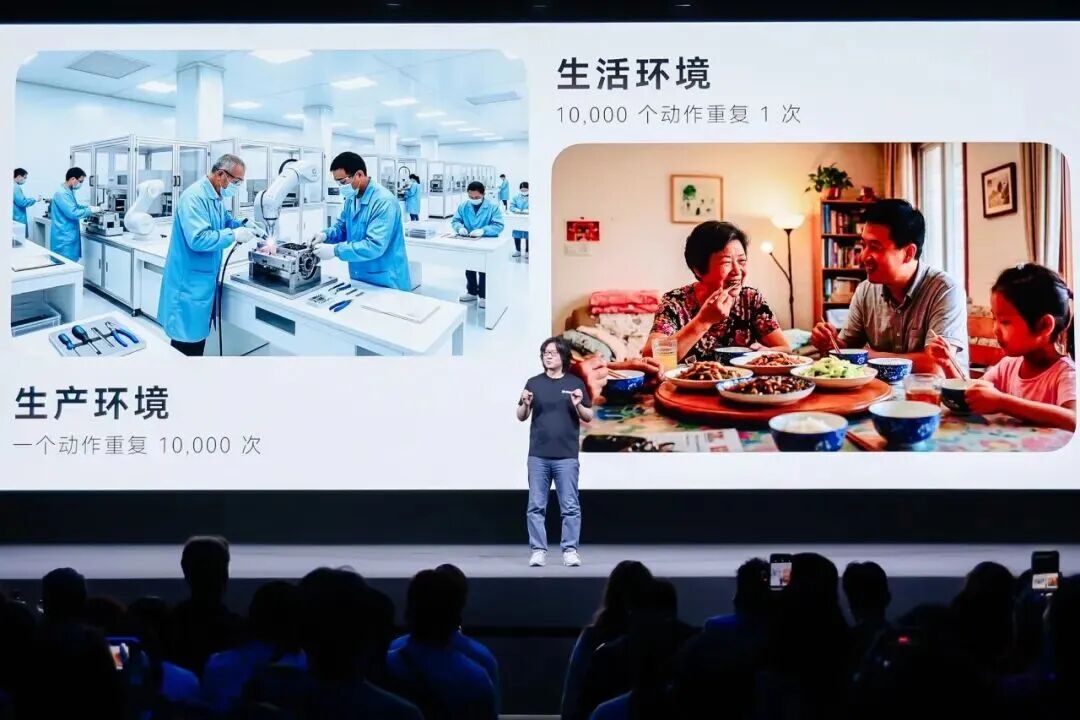
"The hardware is already there — bipedal locomotion, dexterous hands, force-controlled joints, all good. But the brain hasn't caught up. The core bottleneck for robots today isn't the body, it's intelligence. Every second in a home environment can bring a completely new event: when the cat jumps on the table, where the child throws a toy, how carpet friction differs from lab flooring. Existing technology can't handle this randomness and fragmentation, and getting robots into homes is regarded as 'one of the hardest technical problems of our era.'"
From WALL-A to WALL-B: The Limits and Breakthrough of VLA Architecture
From its founding, Independent Variable Robotics has focused on building a "brain" for robots — an end-to-end embodied intelligence foundation model. At the end of 2024, the company released its first-generation embodied foundation model WALL-A, based on the VLA (Vision-Language-Action) architecture. In September 2025, it open-sourced a lightweight version of the same architecture, WALL-OSS.
On the application side, Independent Variable partnered with 58.com to deploy robots running the WALL-AS model into real homes, working alongside cleaning professionals. This marked the world's first instance of robots entering homes to serve complex domestic life for humans, and also the first large-scale consumer deployment of robots in complex environments.
These real-world home deployments revealed the "ceiling" of the VLA architecture. Allan Wang explained that VLA is essentially a stitching together of three independent modules: a vision module for object recognition, a language module for instruction understanding, and an action module for trajectory generation.
Data passes through these modules step by step, with information loss and latency at every module boundary. More fundamentally, VLA models can only imitate trajectories seen in training data; they cannot truly understand the laws of the physical world. "It doesn't understand why a cup falls, or why a plate hanging over a table edge needs to be pushed back. It's just repeating what it's seen."
WALL-B is the response to this predicament. It is not the next version of WALL-A, but a complete rewrite from underlying architecture to training paradigm.
World Unified Model (WUM): From "VLA" to "Unified Whole"
What truly distinguishes WALL-B from other industry approaches is its architectural revolution from VLA to WUM.
The design thinking parallels Apple Silicon's unified memory architecture: before the Apple M1 chip, Mac CPUs, GPUs, and memory were each separate, and the latency and overhead of data movement became a performance bottleneck. Apple solved this by having all processing units share the same memory pool, dramatically boosting performance.
In robotics, VLA resembles the pre-M1 laptop architecture — vision, language, and action modules each doing their own thing, data shuttling between modules and losing information with every transfer. The rich information learned by vision arrives at the action module as little more than a fuzzy summary.
WUM, as adopted by WALL-B, shares the same core idea — putting vision, language, action, physical prediction, and all other capabilities into the same network, jointly trained from scratch as an integrated whole, eliminating module boundaries and data movement overhead.
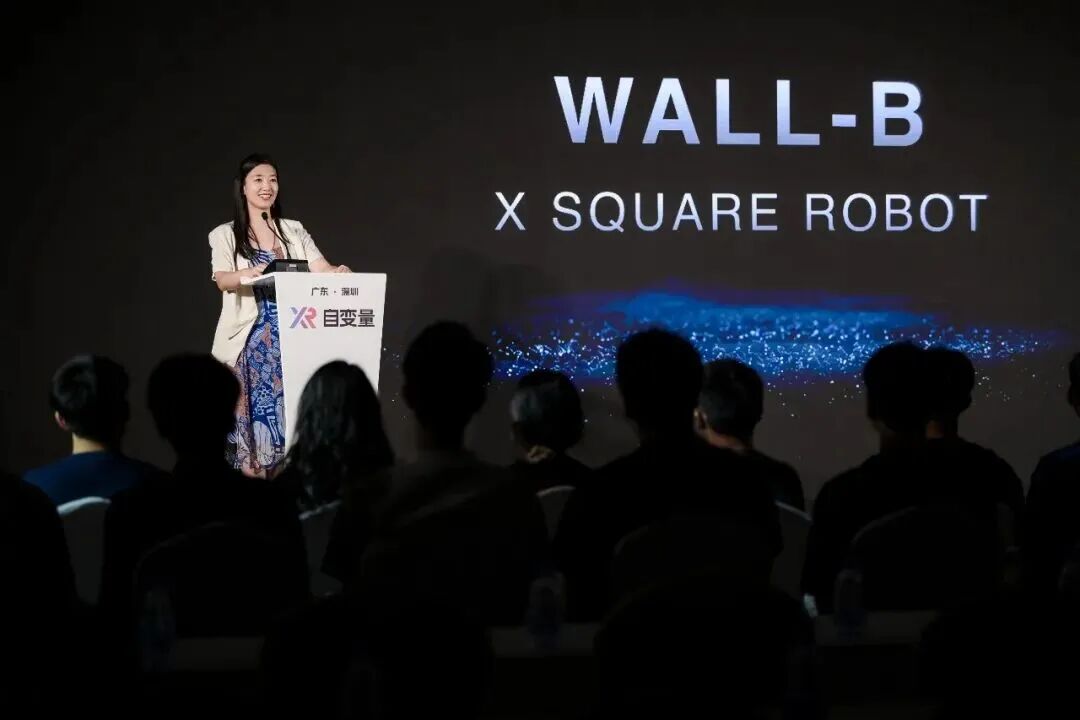
(Independent Variable co-founder & COO Yang Qian presenting at the Shenzhen satellite venue)
Based on this architecture, WALL-B achieves three core technical characteristics that distinguish it from existing industry models:
First, native multimodality. From day one of training, WALL-B performs synchronized annotation and joint training on visual, auditory, language, tactile, and action data, achieving "multimodal in, multimodal out." This means the model doesn't need to "pass messages" between modules — it begins preparing to reach the moment it sees a cup, and adjusts force the moment it feels weight.
This architecture also gives the model a capability called "native proprioception" for the first time: without continuously observing its own body or relying on extensive external sensors, WALL-B can intrinsically perceive its own spatial dimensions — height, width, arm reach — and judge whether it can pass through a space or reach an object. This is an endogenous spatial awareness, not obtained through external measurement or modeling. Allan Wang noted that many animals don't even possess this capability.
Second, a "worldview" of physical reality. WALL-B can perceive and predict fundamental physical laws such as gravity, inertia, friction, and velocity. In never-before-seen scenarios — for example, a plate half-hanging over a table edge — the model can infer that the plate will fall and break, and take preventive action.
This understanding of physical laws provides the foundation for zero-shot generalization. In daily life, physical laws remain consistent across environments, so WALL-B can leverage its understanding of basic physical common sense to handle new scenarios in any home it has never visited, without needing to be retrained for each household.
Third, interacting with the world and self-evolving. This is the most fundamental characteristic distinguishing the WUM architecture from all existing VLA models. Currently, mainstream robots typically stop dead after task failure, return an error, and cannot learn from failure. WALL-B behaves entirely differently: after failure, it adjusts strategy and tries again; if successful, it directly updates this successful experience into its model parameters.
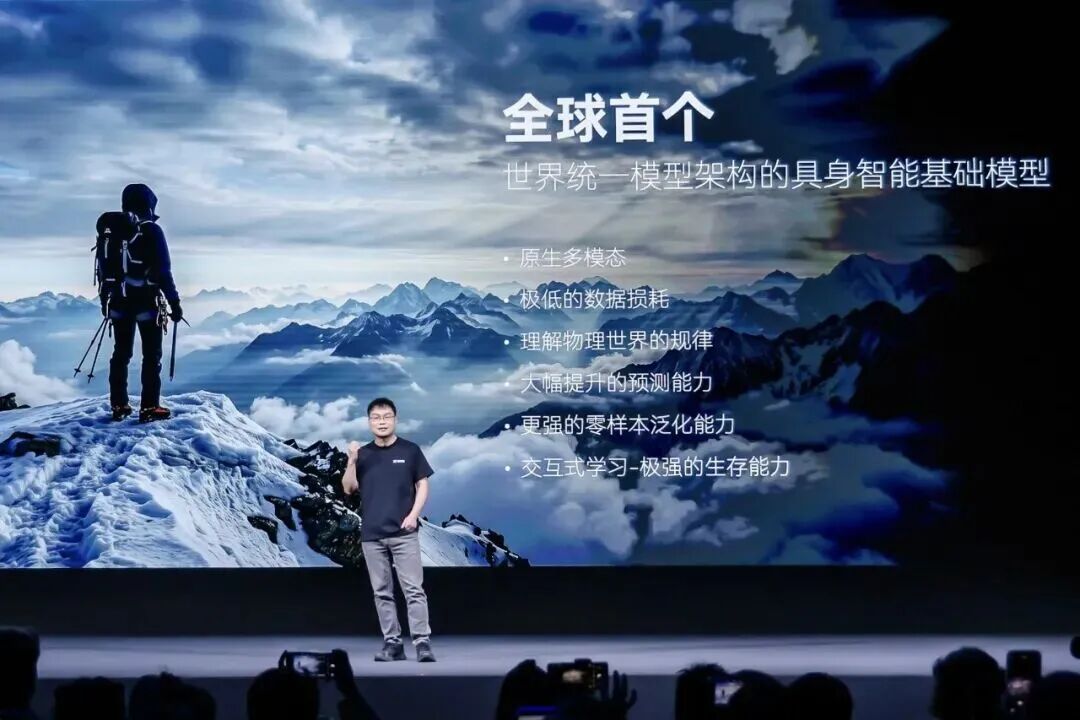
This mechanism enables the model to complete self-iteration in real environments, without engineers retraining, without manual data injection, without returning to the lab. Allan Wang compared it to how humans learn to use chopsticks — they drop them countless times, but every failure adjusts hand control until stable skill is formed. WALL-B overcomes the Transformer architecture's difficulty with long-term internalized memory; all experience is stored as native multimodal memory and self-updated through a mechanism analogous to human memory.
Data Strategy: From "Sugar Water" to "Milk"
Currently, most model training data in the industry comes from laboratories: fixed lighting, fixed object positions, disturbance-free environments. Allan Wang likened such lab data to "sugar water data" — clean, controllable, abundant, but significantly different from the real world, especially from the changing natural light, casually placed objects, and random movements of children and pets in homes. Models trained on such data fail quickly in real environments.
In contrast, what Allan Wang called "milk data" — noisy, variable, randomness-filled data collected from real home environments — is the path Independent Variable has chosen.
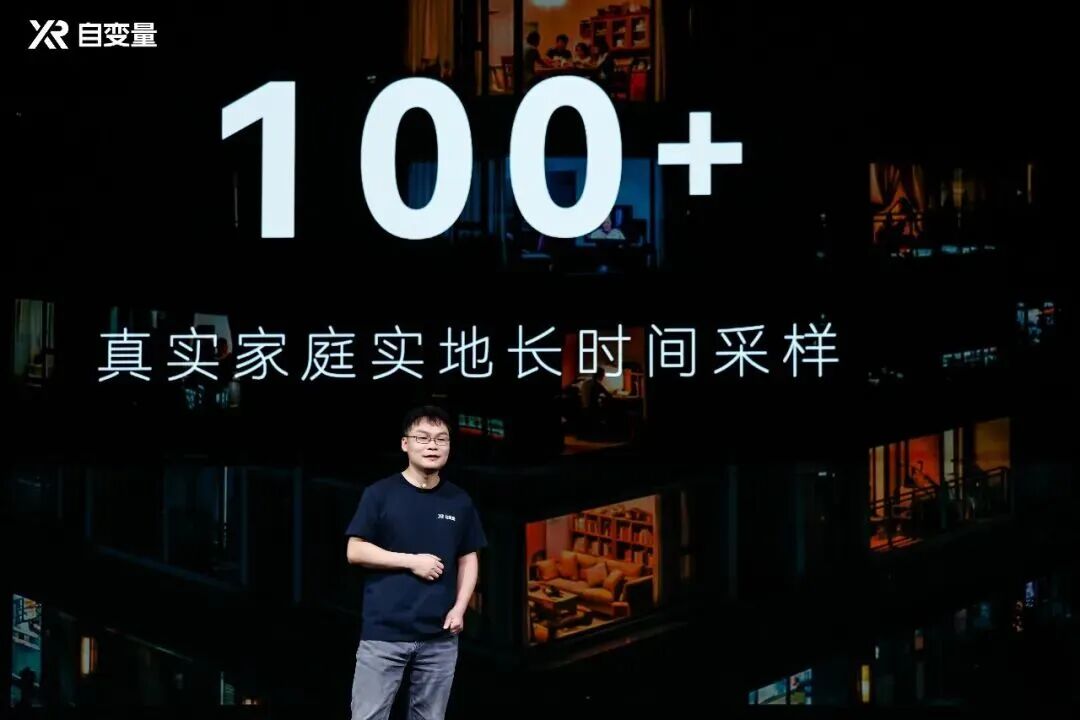
To obtain this data, the Independent Variable team entered hundreds of volunteers' real homes for model training. Every household's layout, lighting, object placement, and level of mess differed. Some had floors scattered with slippers, delivery boxes, toys, and socks; some had cats suddenly jumping on tables; some had warm-toned kitchen lighting and cool-toned living room lighting. These variables cannot be simulated in labs, yet they are everyday conditions in home environments — precisely what the model must learn to handle.
In summary, Independent Variable's data strategy can be described as: lab data for foundation, real scenarios for quality. Lab data builds basic capabilities — recognizing common objects, executing basic actions; real home data teaches the model to survive in uncertain environments. A data flywheel driven by real, random, unpredictable real-world data is the true moat.
Next-Generation Robots Enter Real Homes in One Month
As robots enter homes, privacy issues cannot be avoided. Qian Wang offered the Independent Variable team's clear solution:
Visual desensitization — robots perform real-time blurring of raw images on-device; raw images never leave the device; what the robot sees is already scene data with personal characteristics removed;
Transparent authorization — users must actively press an agree button before the robot powers on; there is no "default consent"; if the user disagrees, the robot does not start;
Purpose limitation — absolutely no sharing with third parties; the robot recognizes only one owner; suspicious commands trigger immediate lockdown.
"Promises are cheap; user trust is the most expensive thing," Qian Wang said.
On the commercialization front, Independent Variable's timeline is also set: on May 25, next-generation robots equipped with WALL-B and with hardware upgrades for home environments will enter the homes of first-batch users. Qian Wang noted that the current model is still at the "intern" stage — it will make mistakes, need remote assistance, and sometimes might put slippers in the kitchen or pause mid-table-wiping to "think." But it can work 24 hours without interruption, and every day of work makes it "smarter" through new data generation.
Starting today, Independent Variable is recruiting the first batch of "parents" for its home-entry robots; users can apply through official channels.

Continuous advancement of embodied foundation models has been Independent Variable's pursuit since its founding. Building a robot brain that can truly understand the world and continuously learn within it, entering homes to serve humanity every day, is the company's long-term vision.
"Though the robots entering homes now are still clumsy, moving slowly, often making mistakes. So too was the first step humans took as infants. Every great journey begins with a staggering first step. Today, robots have already begun their journey of learning and evolution in the most complex place of all."
The model continues to iterate; WALL-B's specific details and ecosystem foundation will be fully unveiled on April 27 at the first Guangdong Province AI Application Matchmaking Conference in Shenzhen.


Investment heat rises alongside spring temperatures | Unity Ventures spring recap