Unity Ventures-Backed Melting Speed Tech Closes Nearly 100 Million Yuan Series A to Accelerate DED Additive Manufacturing Industrialization

Addressing the demand for manufacturing large-scale components in industrial sectors such as aerospace, steel and metallurgy, and petrochemicals.
Unity Ventures portfolio company Rongsutech has announced the completion of a nearly RMB 100 million Series A funding round, with investors including Henan Yuzi Group and Suzhou SND Rongxiang Fund. The capital will be used to further optimize product technology and production line construction, as well as to enhance delivery capacity and production scale in response to market demand.
Founded in 2020, Rongsutech was established by Fangda Xu, a postdoctoral researcher at the University of Bath in the United Kingdom, who has focused on research in large-scale additive manufacturing. The company specializes in next-generation DED wire-feed 3D printing technology, addressing the demand for large-component manufacturing in industries such as aerospace, steel and metallurgy, and petrochemicals. It offers three types of services: printing, equipment, and components. Its STAR series products have already received orders from leading enterprises including AVIC, CRRC, and CSSC.
Recently, Rongsutech launched the Laser Mini, a desktop multi-laser wire-feed metal 3D printer. Featuring compact size, simplified operation, high-precision printing, safety and zero pollution, and multi-material compatibility, it aims to further cover education, scientific research, and training needs, providing a flexible and practical metal additive manufacturing solution.
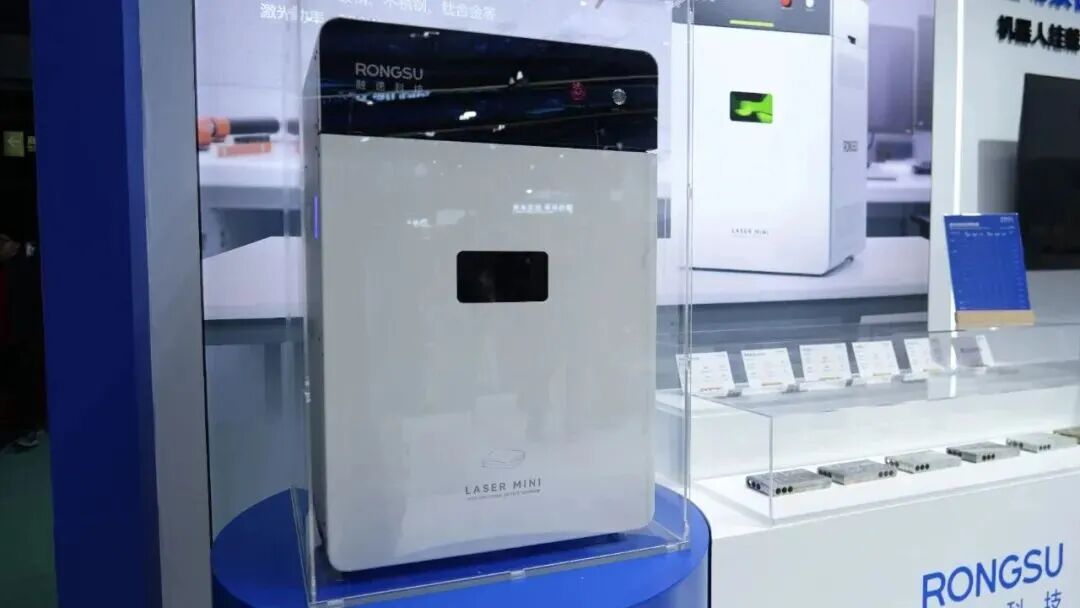
Desktop metal 3D printer Laser Mini

01
Evolution of Technology Roadmap, Production Efficiency Quadrupled
Consumer-grade 3D printing technology is already familiar to the general public. Industrial-grade 3D printing operates on similar principles — using 3D model data as a foundation, it builds solid components layer by layer from materials such as metals, plastics, and ceramics. The industry refers to this as "additive manufacturing."
Compared to traditional "subtractive manufacturing" (cutting and machining) and "formative manufacturing" (forging and casting), additive manufacturing's logic of "building from nothing, layer by layer" enables streamlined pre-processing workflows, eliminates machining allowances, and reduces raw material costs.
In the metal additive manufacturing sector, two main technical routes dominate. Selective laser melting (SLM) holds the mainstream position, with its advantage lying in the ability to produce precision components of extremely high complexity, already applied in areas such as rocket engine parts for commercial aerospace. Meanwhile, directed energy deposition (DED) technology, leveraging its advantages in deposition efficiency and build size, shows promise in large-scale structural component manufacturing and high-end part repair.
Fangda Xu, founder of Rongsutech, explains that Rongsutech focuses on the DED route and is driving the evolution of its products from first-generation wire arc additive manufacturing (WAAM) technology to second-generation wire laser additive manufacturing (WLAM). "Arc additive manufacturing as a first-generation technology had issues with surface roughness, slow printing speed, and high costs. Second-generation wire laser additive manufacturing has solved the surface roughness problem — our current product surfaces can be made very smooth, basically achieving semi-finishing levels of conventional manufacturing."
During high-speed printing, components within the equipment may burn out, affecting print speed and stability. To address this, Rongsutech developed its proprietary multi-laser coaxial wire-feed technology VEAM. The multi-beam optical pressure can refine grain structure and improve precision, solving stability issues during high-efficiency printing.
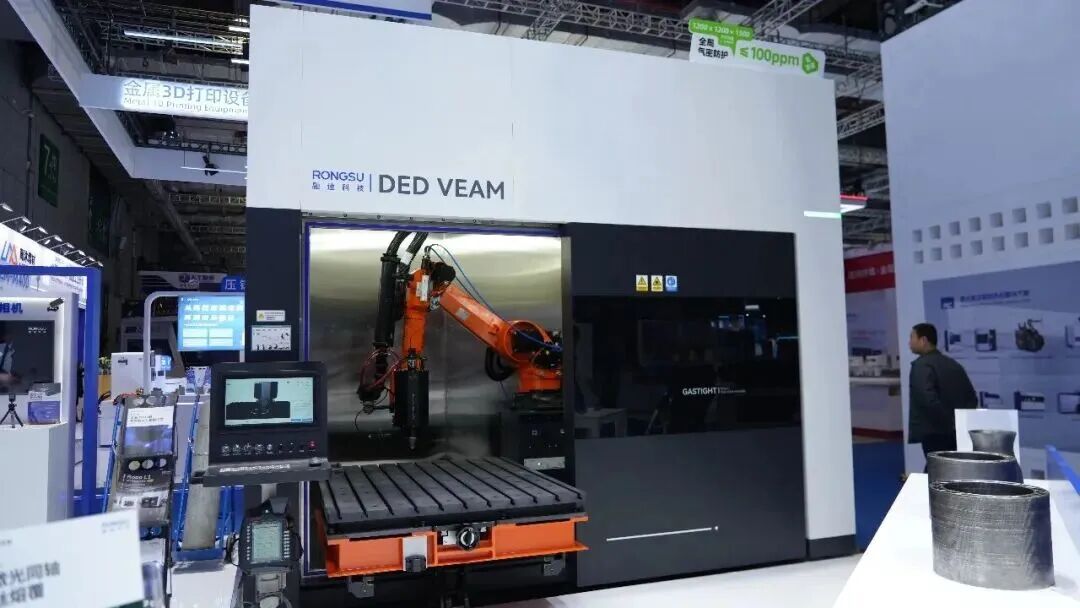
Ultra-coaxial laser additive equipment Robo L1
02
Enhancing Delivery Capacity, Accelerating Market Adoption
Improvements in technical capability and cost reduction can undoubtedly accelerate the market adoption of innovative technologies. However, for traditional manufacturing industries, another major hidden cost of adopting new technology lies in production line retrofitting and acceptance system establishment.
To accelerate market adoption, Rongsutech plans to enhance its own delivery capacity through production line construction, enabling customers to purchase finished products directly and reducing the cost burden of production line retrofitting and equipment procurement.
"For customers, the core metrics are quality, price, and delivery capacity," Xu explains. In terms of quality, Rongsutech's delivered products have met customer standard requirements after verification. Cost reduction and improved delivery capacity will be important future priorities.
In November 2025, Rongsutech's global additive manufacturing service base headquarters project was established in Suzhou High-Tech Zone, with planned investment exceeding RMB 500 million. The project will carry out 3D printing equipment design and manufacturing as well as 3D printing contract manufacturing services, with projected annual revenue exceeding RMB 300 million upon reaching full production capacity. The service base construction will expand Rongsutech's production scale and further extend its reach to customers in Jiangsu and the broader Yangtze River Delta region.
Regarding specific customers, Rongsutech is prioritizing expansion in aerospace and heavy industry, having already established partnerships with major commercial aerospace customers while simultaneously developing clients in steel and metallurgy, petrochemicals, and other industrial sectors. Xu analyzes that the aerospace industry has relatively high acceptance of new technologies, making it a priority expansion direction. Traditional industries, driven by cost reduction and efficiency improvement needs, also present opportunities for partnership and adoption provided their technical specifications pass verification.
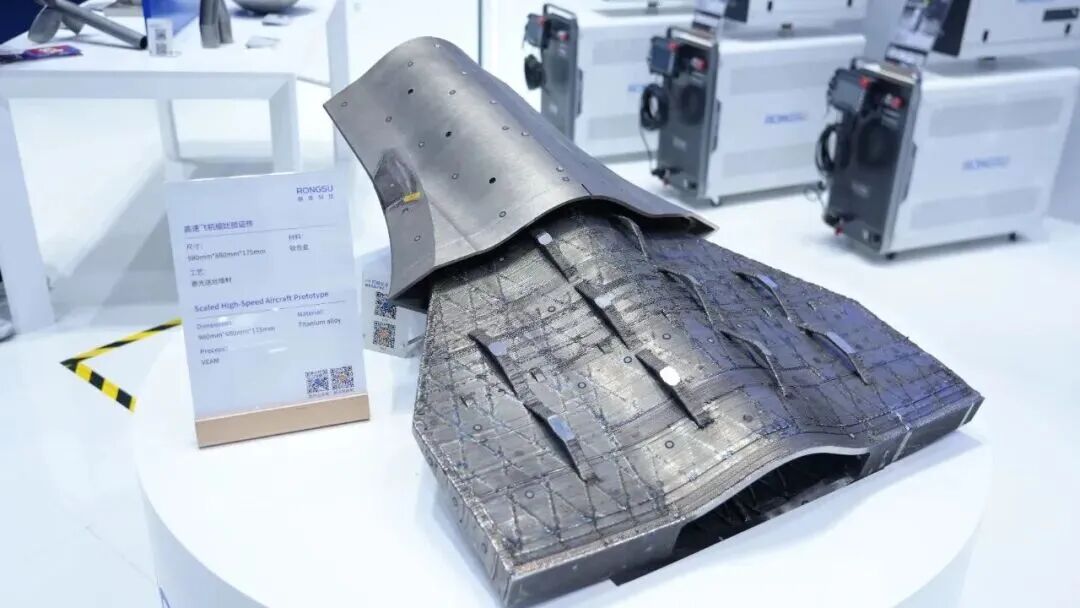
High-speed metal 3D printed aircraft scale model
Meanwhile, emerging sectors such as low-altitude economy have also become important directions for Rongsutech's market expansion. Components for drone equipment, vehicles, and airport support infrastructure such as brackets and structural parts can achieve cost reduction, efficiency gains, and improved development speed through additive manufacturing.
Currently, among Rongsutech's three service types — printing, equipment, and components — equipment revenue accounts for the largest share. Xu anticipates that as delivery capacity improves, printing services will become the primary revenue driver going forward, in turn stimulating demand for upstream equipment.
In 2025, Rongsutech achieved revenue in the tens of millions of RMB, with projected revenue tripling in 2026.