"Ultra Intelligent" Closes Series B Funding, Accelerating Mass Production of Consumer Exoskeleton Robots | Unity Ventures Portfolio News

Multiple consumer-grade exoskeleton robots are about to hit the market, marking the inaugural year for consumer-scenario applications.
Exoskeleton robotics platform company ULS Robotics announced the completion of a tens-of-millions-of-yuan Series B funding round.
This marks another capital injection for ULS Robotics following its tens-of-millions-of-yuan Series A+ round in July 2024, bringing its total raised to several hundred million yuan. Unity Ventures led the company's Pre-A round.
Currently, multiple new consumer-grade exoskeleton products from ULS Robotics have entered the critical stages of trial production and mass manufacturing, kicking off what the company calls the "first year of consumer scenario applications." Going forward, it plans to build a three-pillar development structure spanning B2B, government, and consumer markets.

Exoskeleton robotics platform company ULS Robotics announced today that it has completed a tens-of-millions-of-yuan Series B funding round, led by Binfu Capital with continued follow-on investment from existing shareholder Guoyi Capital. This marks another capital injection following the company's tens-of-millions-of-yuan Series A+ round in July 2024. The new funds will accelerate mass production of its consumer-grade exoskeleton products and drive deeper integration of exoskeleton hardware with AI technology.
Founded in 2018, ULS Robotics focuses on exoskeleton robotics R&D and applications. It has completed five funding rounds totaling several hundred million yuan raised, with Unity Ventures leading its Pre-A round.
Compared to humanoid robots, exoskeletons operate through direct human wear, effectively enabling "hand-in-hand" learning of human behavior. By collecting large volumes of real-world data and training on it, the software can self-learn and self-optimize, eventually achieving millisecond-level response to human movement intent by predicting the next action based on the wearer's intent.
ULS Robotics' exoskeleton product line covers upper limb, waist, lower limb, full-body, and humanoid robot categories. Its industrial-grade offerings include the BES series and MAPS series exoskeleton robots, already deployed in automotive manufacturing, aviation ground services, mining, logistics, and other industrial scenarios, with sales networks established across 17 countries including Germany, the United States, and Southeast Asia.
Additionally, ULS Robotics has launched the Inspirai TR01 humanoid exoskeleton composite robot. Standing 190 cm tall and weighing 120 kg, the unit features 27 humanoid joints, can carry 40 kg loads, and operates for over two hours on a single charge. The TR01 combines exoskeleton assistance with autonomous humanoid operation capabilities, freely switching between exoskeleton AI learning mode and autonomous humanoid operation mode.
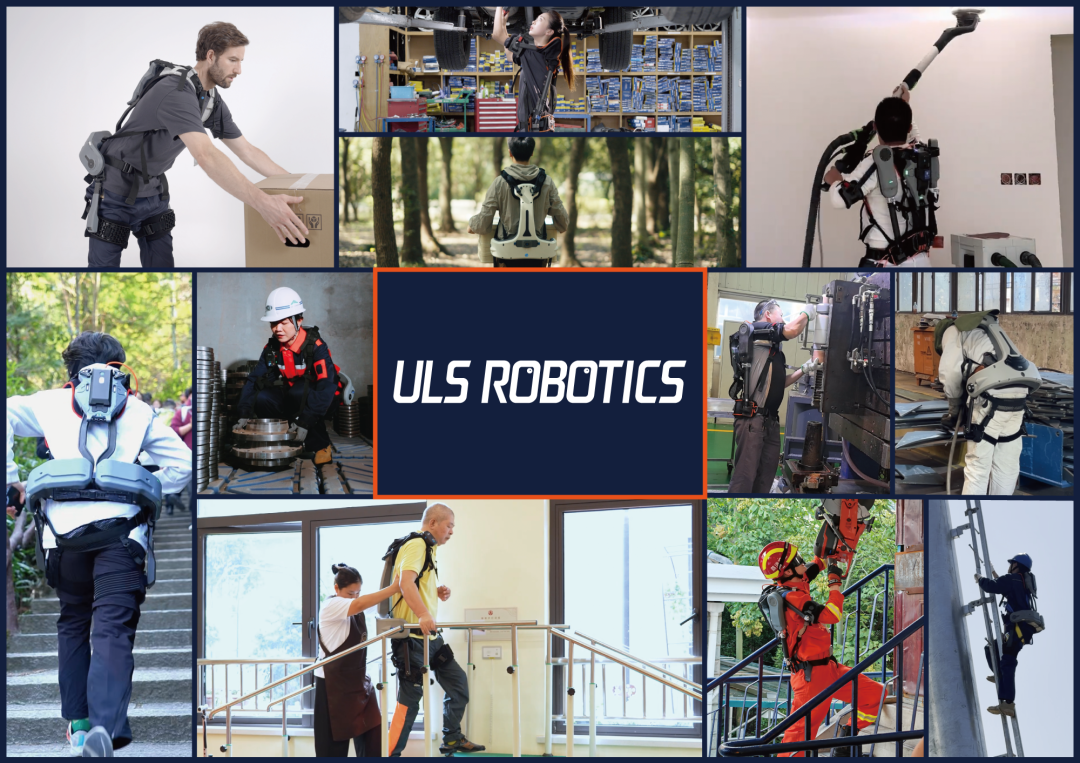
If public perception of exoskeletons in recent years was still shaped by sci-fi films like Iron Man and The Wandering Earth, in the future they will become increasingly common assistive devices in everyday life.
A series of events signals rising momentum for consumer exoskeleton products: In July 2024, French Paralympic athlete Kevin Piette wore a new personal exoskeleton from Wandercraft to carry the Olympic flame; around the same time, Skip and Arc'teryx announced a new powered exoskeleton device called "MO/GO," making waves in outdoor and tech circles; and domestic media across multiple regions reported on famous scenic areas — Huangshan, Huashan, Lushan, Taishan, Qingchengshan — introducing hiking exoskeletons, with images of tourists climbing mountains while wearing them sparking heated discussion on social media.

A user wearing ULS Robotics product while climbing the Great Wall
As global aging accelerates, and as health consumption, outdoor equipment demand, and smart wearable adoption all rise, the consumer-grade exoskeleton robot market is entering a period of explosive growth. Industry reports project that the global exoskeleton market will exceed $100 billion by 2030, with consumer scenarios accounting for an increasing share.
In 2024, ULS Robotics announced a strategic pivot in its market and product approach, advancing a "B2B-to-consumer" strategy and planning to build a three-pillar development structure spanning B2B, government, and consumer markets.
On the consumer front, ULS Robotics has introduced multiple lightweight "sub-10,000-yuan" exoskeleton products, including the PES-U energy-storing upper limb exoskeleton, the FIT-U intelligent powered upper limb exoskeleton robot, and the FIT-HV intelligent powered waist exoskeleton robot.
Through partnerships with scenic areas and healthcare institutions (such as the Fanjingshan and Wuyishan "hiking exoskeleton" cases), the company is addressing needs for outdoor assistance and home-based elderly care.
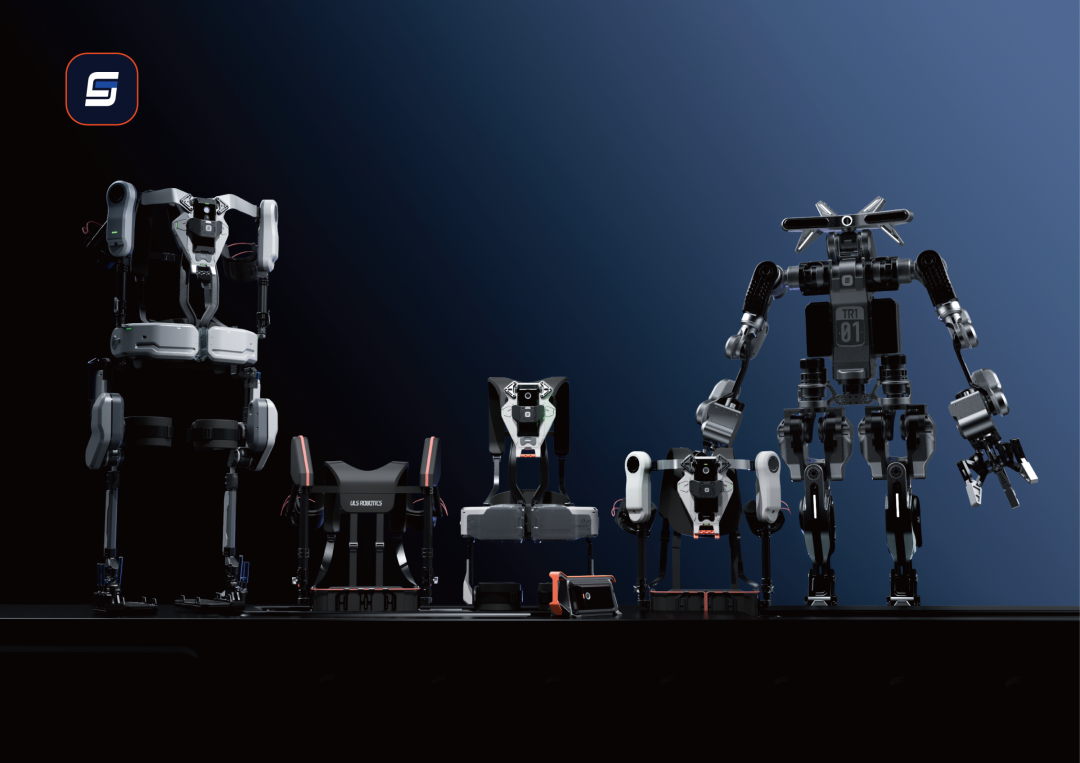
ULS Robotics full product lineup
ULS Robotics invests over 70% of resources in technology R&D. Its latest products feature large AI model training capabilities, supporting real-time data interaction and personalized learning. Multiple new consumer-grade exoskeleton products have gradually entered the critical stages of trial production and mass manufacturing, while the company is also accelerating AI optimization of the Inspirai TR01 humanoid composite robot for task execution in complex environments. Meanwhile, ULS Robotics has initiated brain-computer interface pre-research, with plans to launch next-generation products integrating neural signal recognition to enhance human-machine coordination precision.
ULS Robotics founder Zhenhua Xu, a graduate of Shanghai Jiao Tong University, previously served as senior R&D engineer at Japanese robotics firm FANUC and at SAIC-GM. In 2015, Xu and Jie Gu founded Fourier Intelligence, focusing on lightweight rehabilitation exoskeletons. In 2018, Xu established ULS Robotics, entering the market through industrial exoskeletons.
Zhenhua Xu, founder of ULS Robotics, said: "This year marks the first year of consumer scenario applications for ULS Robotics. We are about to release multiple consumer-grade personal exoskeleton robots, transforming exoskeletons from 'iron man suit' sci-fi imagination into mass-market 'tech lifestyle products.' I believe that within five years, exoskeletons will become as natural an extension of human capability as smartphones."


- "Little Rascal" Takes Marathon Second Place, Noetix Robotics' N2 Robot Becomes Hottest Dark Horse | Unity Ventures Portfolio
- Noetix Robotics Completes Hundreds-of-Millions Funding Round, N2 Robot Capable of Consecutive Backflips | Unity Ventures News
- Embodied Artificial Intelligence Reaches Critical Juncture, Independent Variable Robotics Completes Hundreds-of-Millions Pre-A++ Round Within One Month | Unity Ventures News