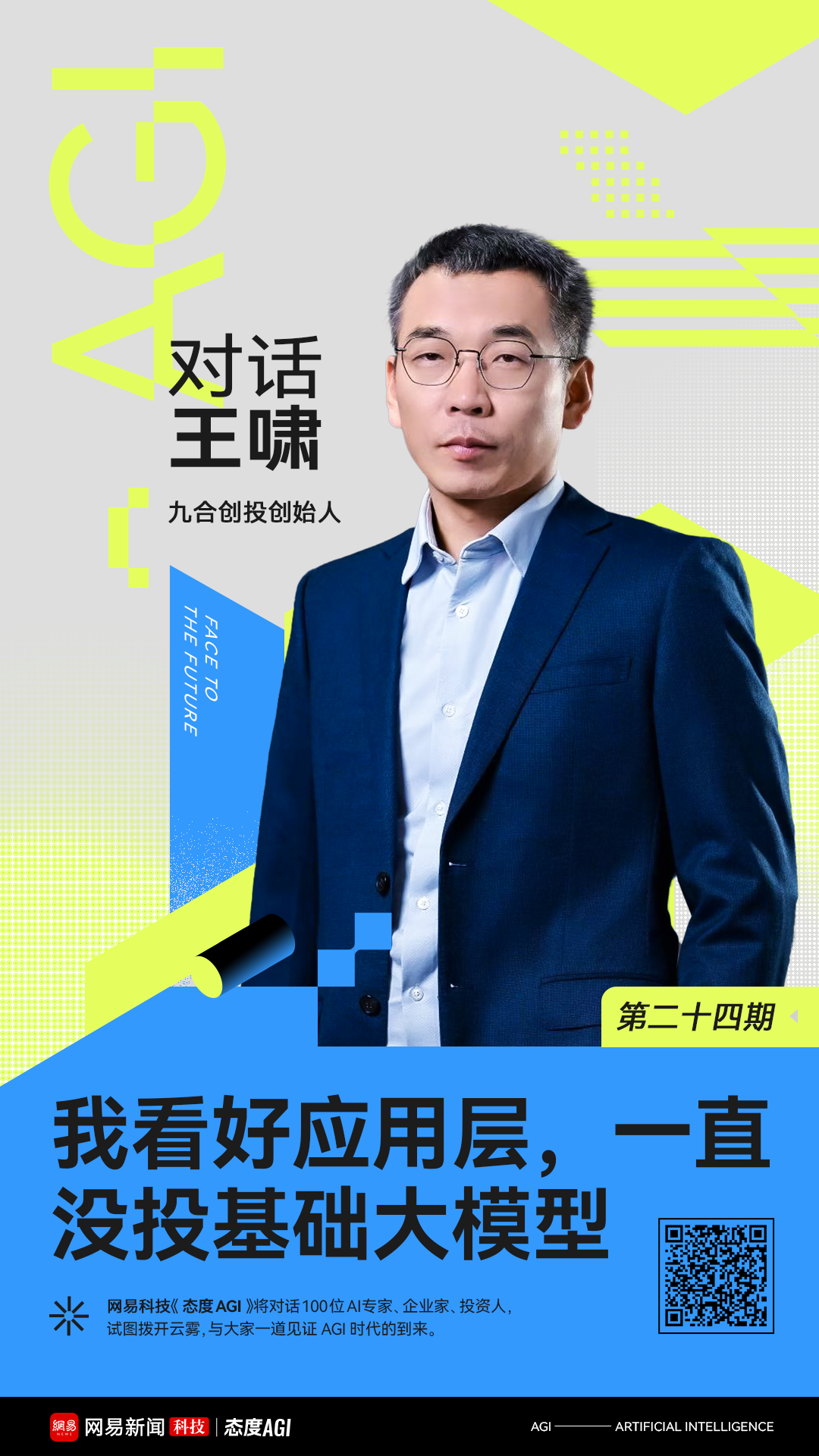
Why I've Always Been Bullish on the AI Application Layer | Unity Ventures' Xiao Wang in Conversation with NetEase Tech
The generative AI wave is not merely an evolution in technology, but a profound reshaping of business models.
The start of 2025 has reignited debate about the future of large language models and the real-world deployment of AI applications. Unity Ventures has remained steadfast in its conviction that the application layer represents the greatest opportunity. At the end of 2024, Xiao Wang, founder of Unity Ventures, sat down with NetEase Tech to reflect on the fund's AI investments over the past year and the investment thesis he formulated at the very beginning of the generative AI wave.
Key Takeaways:
- Large models must be "useful"; Wang is more bullish on their ability to improve service efficiency in specific scenarios.
- Past internet platforms were built on traffic distribution logic. Large models represent a service model — directly providing valuable services that users pay for.
- Large models are more like "engines": they can power a car, but building a complete vehicle still requires an entire system and process.
- Large models are inherently suited for cross-lingual applications, putting Chinese AI startups on the same starting line as their American counterparts.
- Both AI and globalization are structural opportunities.
Produced by | NetEase Tech Attitude AGI
Interview | Xiaqing Yang, Ning Yuan (writing)
Editor | Guangsheng Ding

Barely into 2025, prominent large model companies are already addressing operational challenges. More people are predicting that 2025 will be a year of reckoning for large models, a year of application explosion, a year of commercial elimination — everything points to execution and monetization.
Rewind to late 2022, when the large model wave first broke and massive capital flooded into foundational model companies. Xiao Wang, founder of Unity Ventures, didn't invest in a single one. He believed model capability was foundational, but what mattered more was that it had to be "useful."
Go back further, and he had already invested in OneFlow, a deep learning framework company, in 2017 — widely seen as an early bet on the potential of model scaling.
As one of Baidu's founding "Seven Musketeers," Wang's technical fluency has earned him a reputation as a technically oriented investor.
Over the past few years, he has been convinced that large models would create structural opportunities and has continued to bet accordingly. For two consecutive years, 2023 and 2024, AI-related projects accounted for 50% of Unity Ventures' investments.
Yet despite his "technical" label, his portfolio reveals he is no technological idealist.
Unity Ventures has backed autonomous driving company Momenta, "China's first medical AI IPO" Airdoc, AIGC company ColorfulClouds, data annotation company Longmao Data, AI entertainment assistant LynkSoul, AI short video content platform CreativeFitting (Jingying Technology), and game industry AI enablement platform Xingzhe AI, among others.
Wang's investment logic is clear: target industries and find teams that best combine large model capabilities with sector-specific scenarios. "When I find one, I invest — turning conviction into fuel for founders' dreams," he says.
In Wang's view, the AI wave triggered by ChatGPT is not merely technological evolution but a profound restructuring of business models. "In the mobile internet era, platforms relied on traffic distribution to earn commissions, essentially monetizing through advertising. The core metrics were user scale and retention, which naturally led to winner-take-all dynamics," Wang explains.
Wang believes that unlike the "traffic model" that dominated the internet era, this wave of large models generates service value. The profit model charges for services delivered through intelligent agents, improving human efficiency and creating possibilities for multi-stakeholder wins.
He emphasizes achieving product-market fit. "If users are willing to pay you, that's PMF." He seeks projects with clear commercial logic that can close the loop. Wang is blunt: many startups fail because they never achieve PMF, and today's environment demands even higher standards for it.
At the same time, he encourages companies to go global. He believes today's AI entrepreneurs should be "born global." "For the same service, why only earn RMB when you could earn USD?" His answer is characteristically direct.
In his view, the cross-lingual nature and universal applicability of large models create natural globalization opportunities for Chinese startups. AI services are no longer confined to specific markets from birth — they can face the world from day one.
In short, Wang's vision extends beyond what large models can do to "how they land" and "how they generate returns." He sees AI as a structural opportunity, and globalization as one too.
On the final day of 2024, Unity Ventures published a message: Look far, look within, move forward.
Below is the conversation between NetEase Tech and Xiao Wang, edited for clarity.
01 Large Models Must Be "Useful"; Bullish on Efficiency Gains in Specific Scenarios
NetEase Tech: I noticed you invested in OneFlow back in 2017. Did you already believe large models were coming?
Xiao Wang: I did believe large models would emerge. At first there were small models and small data, only capable of things like facial recognition. But I believed that to solve core problems, you needed large models and big data. The trajectory of AI development would inevitably trend toward large models — only they could truly solve problems.
Of course, there was no product form like OpenAI at the time, and it wasn't clear what kind of data large models would need. In fact, the largest data source is internet data. If you could combine internet language data with other data, that combination is essentially the OpenAI logic.
NetEase Tech: I understand that in 2023, nearly 50% of Unity Ventures' investments were AI-related. How did that figure change in 2024?
Xiao Wang: It remained basically around 50%, including embodied intelligence and AI-related industrial chains, such as intersections between AI and advanced manufacturing, energy technology, and other fields.
NetEase Tech: You didn't invest in domestic general-purpose models?
Xiao Wang: No. The resource competition for large models is too intense — even for major tech companies, it requires enormous capital outlay.
NetEase Tech: So startup companies outside the tech giants face no shortage of challenges?
Xiao Wang: It's definitely harder. Though they've all announced raising some funding, the amounts are typically in the billions or hundreds of millions of RMB — far from sufficient. There are hardly any opportunities left for startups in foundation models.
NetEase Tech: Zooming in on the AI track, which sectors has Unity Ventures invested in? What makes you optimistic about them?
Xiao Wang: Unity Ventures has invested in AI short dramas (video generation), game creation, AI + executive search, embodied intelligence, general-purpose embodied intelligence hardware and software platforms, and more.
Large models provide foundational capabilities, but that doesn't equal good products. Startups need to experiment in vertical domains, combining industry data and know-how to apply AI capabilities within specific sectors.
Take AI-powered executive search: it can use large models to gather information and accelerate matching between talent and positions. If developed into a platform, it could potentially become a company with billions in revenue, integrating product and service capabilities, reorganizing division of labor, and improving human efficiency.
NetEase Tech: When making specific investments in these areas, how do you screen targets?
Xiao Wang: My core view is that large models must be "useful." Just chatting has limited utility. Even current chat models, including ChatGPT, have clearly visible ceilings on daily active user growth. Fundamentally, chatting isn't a particularly hard need. Of course, it still has value for knowledge Q&A and information retrieval as tool-type applications, but user stickiness and demand rigor remain questionable.
I'm more optimistic about large models' ability to improve service efficiency in specific scenarios — secretaries, designers, programmers, doctors, teachers, executive recruiters, and other high-end service contexts. You can pull out the slightly higher-end domains within services and see how much efficiency gain large models can deliver.
NetEase Tech: Are you concerned that improving model capabilities might subsume existing AI application products?
Xiao Wang: I don't think they'll be subsumed. Because service is a closed-loop process, and large models only accelerate it — playing a role similar to a core tool. Take executive search: the service requires engaging with companies to get hiring requirements, and communicating with candidates through the entire process. Large models can't fully replace this closed-loop service.
Large models are more like an "engine" — they can power a car, but building a complete vehicle still requires an entire system and process. Similarly, large models only provide a core capability, but the richness of end-use scenarios and deep development must be built by enterprises themselves. Just as China Mobile and WeChat coexist, model upgrades won't directly subsume all specific applications.
02 The Internet Is Traffic Logic; Large Models Are Service Logic
NetEase Tech: Many large model companies claim they're aiming to be "the next Google," and what they're competing for is the value of traffic entry points. But you just mentioned the service value that large models create. From traffic to service, is the business logic different?
Xiao Wang: I believe these are two completely different business logics. Past internet platforms were built on a traffic model: attract users with quality products, retain them, then monetize by distributing user attention through advertising. Whether Baidu, Tencent, Alibaba, or JD.com — they were all fundamentally traffic distribution logic.
Large models, by contrast, are more like a service model: directly providing valuable services that users pay for. The core of the service model is the margin between the value provided by large model capabilities and the input costs — that's the commercial value.
Companies need to find balance between high-value services and large model capabilities. At the current stage, for example, teaching math may not work, but teaching Chinese or English is already viable. So the core is finding business models that provide end-to-end services, rather than stopping at the tool-capability stage.
NetEase Tech: If it's service logic, does that mean companies need very deep understanding of industries and scenarios? How do you tell whether an application has a higher ceiling?
Xiao Wang: Entrepreneurs need at least sufficient industry understanding — if you don't even understand the industry, you're finished. This industry understanding is foundational; then you combine it with VC funding and large model capabilities.
NetEase Tech: From last year to this year, what has your investment pace in AI been like?
Xiao Wang: Last year our pace in AI applications was slightly faster. This year we've looked at many industries, but still need to find the parts where we're especially compelled to act.
NetEase Tech: Why? What's the bottleneck?
Xiao Wang: The core reason is still the gap between current model capabilities and actual needs. Completion rates in some demand scenarios remain low. Facial recognition, for example, requires 99.9% accuracy to meet application requirements; otherwise usability suffers. Current large models may frequently "hallucinate," with error rates still too high to solve high-precision scenarios.
Model capabilities need further improvement, and the fit between needs and models needs refinement — what we commonly call PMF. Future opportunities may lie in deep development of niche scenarios, such as calling multiple models and combining industry algorithms to compensate for general model limitations.
NetEase Tech: Do you think the applications you've invested in have achieved PMF?
Xiao Wang: Some have.
NetEase Tech: What criteria do you use when selecting investment teams?
Xiao Wang: We prioritize teams' deep cultivation capabilities within their industries. For example, if traditional executive search services have been done well, then AI recruiting has a chance of success. Similar logic applies to gaming, education, and other fields.
If a team lacks industry experience, it's very difficult to form a strong AI application — simply calling large model APIs won't achieve breakthroughs. The core is that you need insight capabilities and accumulated knowledge.
NetEase Tech: Among your 2024 investments, what ultimately convinced you?
Xiao Wang: The key was that it applied model capabilities within a complete commercial closed loop, forming a relatively end-to-end solution. If a model can't form a closed loop, it's just hype. The significance of a closed loop is that it satisfies a clear need and makes users willing to pay. For example, if it can improve my English ability or let me watch high-quality short dramas, I might be willing to pay.
For the B2B market, if you can develop a project and the other party is willing to pay, that's also a closed loop. If you do 10 to 20 similar projects, you can reach tens of millions in scale, further developing to hundreds of millions or even IPO.
03 AI Entrepreneurs Should Be "Born Global"
NetEase Tech: Unity Ventures invested in an AI short drama project. Is it already profitable?
Xiao Wang: It's already profitable in the United States. They have their own app with monthly revenue exceeding a million dollars. If these AI companies face global markets, where will their competitiveness lie? And their weaknesses?
NetEase Tech: Why choose to face foreign users? Why not do domestic?
Xiao Wang: For the same service, why only earn RMB when you could earn USD? The costs are the same, so of course you choose the higher-value market. Additionally, the foreign short drama market hasn't experienced the intense competition and "shakeout" that China's has, so user novelty and acceptance are higher, making it easier to form commercial closed loops.
NetEase Tech: Many AI startups chose a going-global strategy from Day One. What considerations drove this? Is it because overseas users have better payment habits?
Xiao Wang: That's one aspect. But mainly large models are inherently a global technology without language barriers — they lean more toward semantic-level model vector spaces, naturally suited for cross-lingual applications. For example, when we describe the concept of "black tea," whether in Chinese or English, the underlying semantics expressed are consistent. So from a technical essence perspective, large model applications possess global advantages — they're naturally a global proposition.
Second, many overseas AI models provide APIs and are open-source, creating a friendlier ecosystem for startups.
Third, overseas users have already been educated by ChatGPT and the market, giving them higher acceptance of AI products.
This is an opportunity for Chinese AI companies — standing on the same starting line as American companies, facing a much larger market. Facebook's user base is in the billions, while WeChat's primary users are China's 1.4 billion people.
NetEase Tech: If these AI companies face global markets, where will their competitiveness lie? And their weaknesses?
Xiao Wang: Our user operations, grasp of demand, and product understanding are all solid. China has an engineer dividend and the most diligent entrepreneurs, with strong product definition capabilities, high efficiency, and fast iteration.
The main weaknesses are understanding of the US market, and B2B customers' tendency to prefer local vendors.
NetEase Tech: What question did you think about most in 2024?
Xiao Wang: Where large models are most appropriately applied, and where they can be commercialized. When I find a project with potential, I invest — turning knowledge into equity assets.
NetEase Tech: Compared to 2023, what do you see as the biggest change in AI investment in 2024? Is this change an opportunity or a challenge?
Xiao Wang: Compared to 2023, we haven't changed much — it's the market that changed. At first everyone was investing in large models; this year they started investing in application companies. We were firmly investing in applications from the start, and this year continue to focus on opportunities combining AI with vertical industries and niche domains.
NetEase Tech: What plans might Unity Ventures have for next year?
Xiao Wang: The fundraising for our fifth RMB fund is nearing completion. We're expanding our investment teams for hard tech, biomedicine, and globalization. We'll maintain our investment pace and continue deploying in AI, hard tech, advanced manufacturing, biotechnology, and other fields.
NetEase Tech: Is there anything you're more certain about?
Xiao Wang: First, on large models — this is a structural opportunity. At first people didn't necessarily share this consensus; now it's fully formed.
Second, providing services must create value; you must provide end-to-end closed-loop services. If you're just providing images, articles, or PowerPoints, the value is limited.
Third, if you have the capability, do global business. This is an evolved conviction — aim for globalization from the start.
In short, AI is a structural opportunity, and globalization is too.


- Look Far, Look Within, Move Forward | Unity Ventures Quarterly
- TTC Completes New Funding Round from Unity Ventures, Advancing AI-Driven Professional Human Capital Services | Unity Ventures Portfolio
- Before AI Changes the World, First Find PMF | Unity Ventures "Growth" Series Salon Highlights