Zero real-world training data, nearly 100% success rate! Sudu Tech debuts self-developed system #Sudo R1 | Oasis Vitality

Unlocking a New Paradigm in Embodied Artificial Intelligence

Oasis Capital portfolio company Sudu Tech (Sudo), which recently closed its Pre-A round, has published its first technical blog post.
The blog showcases multiple videos — including an unedited, 60-minute continuous real-robot test — and systematically introduces #Sudo R1, a fully self-developed hardware and software robotics stack, breaking down its underlying technical approach centered on an integrated world model and reinforcement learning.
Without relying on any real-world robot data, the system achieves near 100% Zero-shot success rates on key tasks, with stable generalization verified in complex environments — pointing toward a new paradigm where embodied intelligence scales through simulation-driven data.
Professor suho, who recently returned to China to take up positions as suho at Fudan University and Director of the Institute for General Physical Intelligence, participated in building and advancing this technical architecture as the company's Chief Technical Advisor.
This advance is not a single-point performance breakthrough, but a reconstruction of the underlying paradigm for embodied intelligence: when data supply and model capabilities begin co-evolving along a scalable path, embodied systems enter a verifiable, replicable stage of scaling.
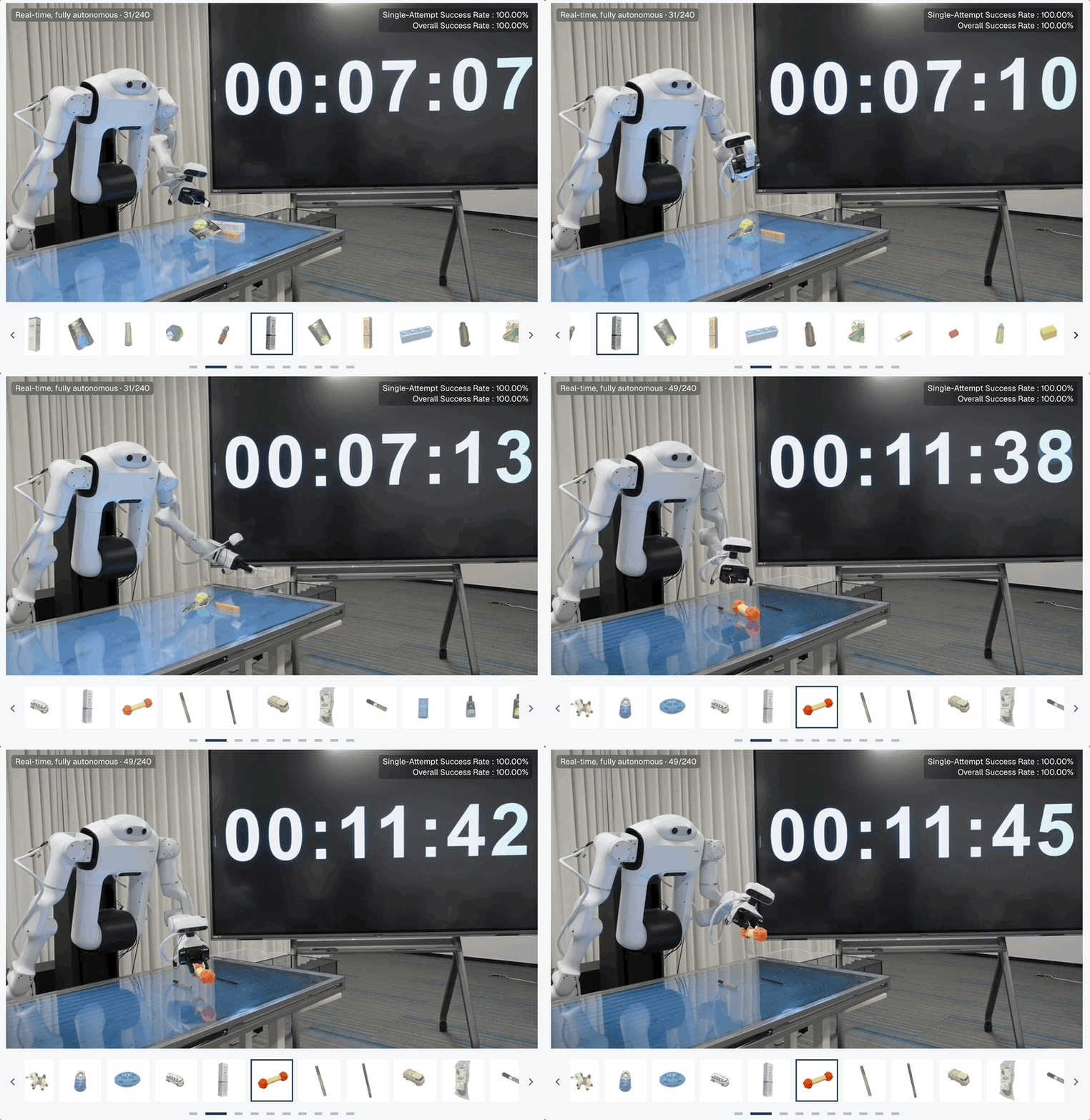
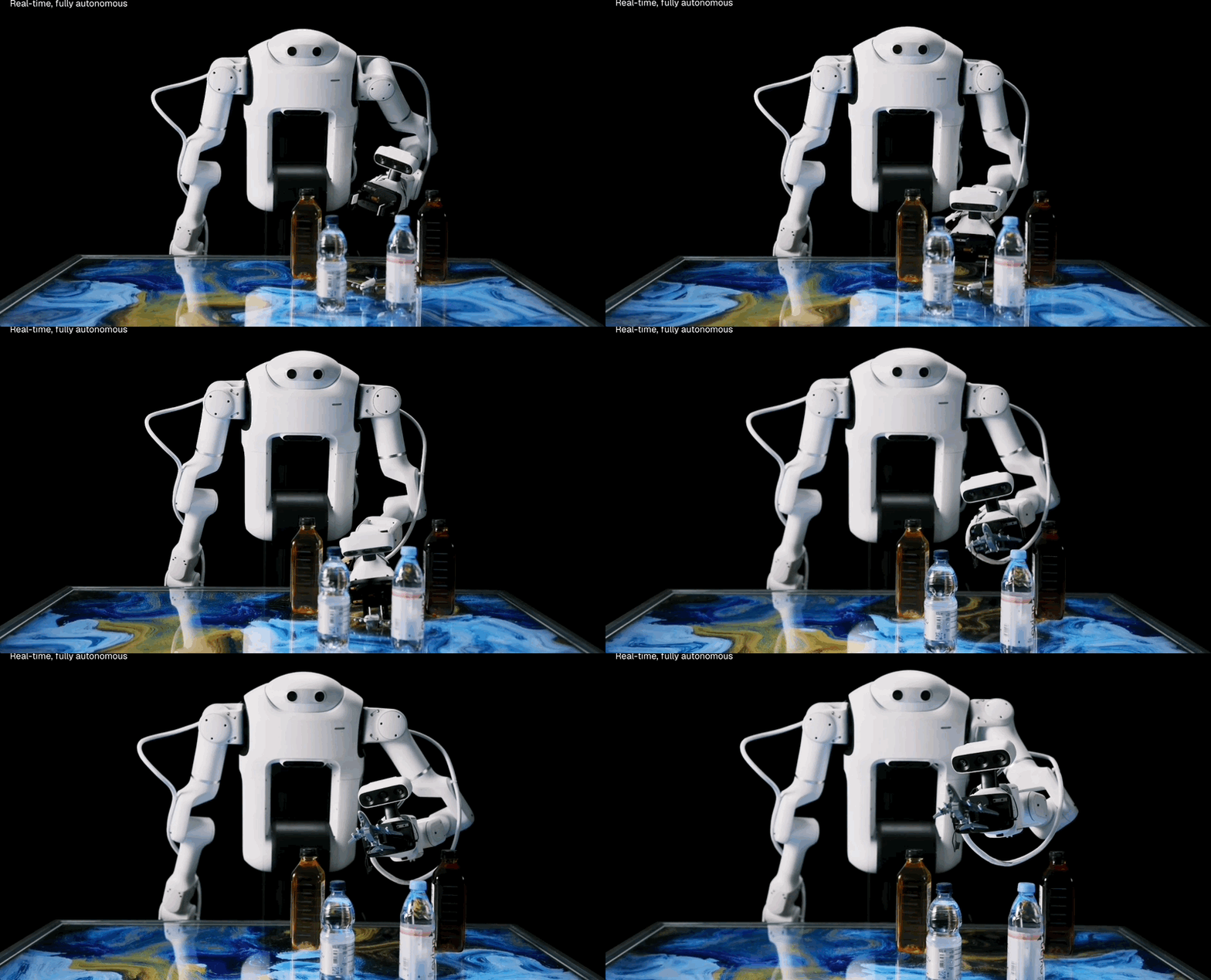
In Sudu Tech's first technical blog, the robot running the #Sudo R1 model faced multiple complex grasping tasks. Under varying lighting and background conditions, it achieved near 100% grasping success on previously unseen objects across multiple categories — transparent, reflective, flexible, and irregularly shaped — demonstrating robust closed-loop real-time control and spatial obstacle avoidance with high motion fluency, embodying a distinctive "out-of-the-box" capability.
Model technology routes represented by PI (Physical Intelligence) and Generalist typically rely on Few-shot adaptation — requiring demonstration teaching for specific scenarios, and achieving high success rates and stability only under constrained environments and object conditions. This mode more closely resembles "task-level optimization" rather than "capability-level generalization."
If we draw an analogy to large model development, Sudu adopts a paradigm closer to ChatGPT — solving tasks through general underlying capabilities rather than separate adaptation for each scenario. The team deliberately designed a technical path verification: without real-robot data alignment, testing whether simulation pre-training alone could support the model across the complexity and uncertainty of the real world.

This marks the industry's first achievement of this goal, opening new avenues for breaking through data bottlenecks and realizing embodied Scaling. For this reason, #Sudo R1's significance extends beyond a high-quality demonstration — it verifiably touches the most fundamental underlying proposition of embodied intelligence.

Breaking Through Embodied Development Bottlenecks, Cracking the Core Data Supply Problem
Currently, mainstream industry reliance on real-robot data collection (teleoperation, UMI, human-perspective collection, etc.) — while continuously optimizing on cost and efficiency — still faces economic challenges in scaling, with data supply unable to grow linearly with compute power.
More fundamentally, such data, while containing visual and action information, provides only indirect and incomplete characterization of the core of the physical world — Dynamics — making it difficult for models to learn stable, generalizable physical interaction patterns. This is the root cause of why most embodied systems perform unstably in real environments and struggle to scale, and also a problem that current real-robot routes rarely address head-on.
However, simply debating "whether real-robot data or simulation data is superior" is not practically meaningful. The key lies in constructing a scalable path through the combination of data and models.
Simulation data, by its nature containing complete physical interaction information with significant cost and scale advantages, is better suited to building "breadth and physical commonsense"; real-robot data, with authentic noise, sensor errors, and complex environmental perturbations, provides critical signals aligned with real-world distributions. The team dynamically determines the ratio between the two around specific scenarios. The prerequisite for this ratio capability is a sufficiently realistic simulator, and deep understanding of how simulation and real-robot data collaborate across different scenarios — this is what forms long-term competitive moats.
The data ratio directly determines model architecture evolution; the two are tightly coupled and mutually constraining. Sudu's data system is built on a high-fidelity simulator, naturally containing direct expression of physical Dynamics, enabling the model to learn generalizable physical laws — making Sudu the team with the most verified progress on integrated world models and reinforcement learning. In other words, what #Sudo R1 demonstrates is not the result of task-specific parameter tuning, but the external manifestation of its underlying data approach and model architecture working in concert.
Meanwhile, #Sudo R1's results shatter long-standing fundamental doubts in the industry about the Sim2Real path, not only proving this route's feasibility but simultaneously approaching production-grade standards across four dimensions — generalization, agility, robustness, and spatial intelligence — something no single previous system had achieved.
Its deeper significance lies in not simply replacing the "manual data collection"-centric technical route, but redefining data's role and division of labor in the system: when system capability improvement no longer primarily depends on expensive, poorly scalable real-world data, but instead uses scalable data generated by simulation systems as a foundation, combined with real-robot data for key alignment and correction, the development of embodied intelligence, physical intelligence, and even world models can enter a more scalable Scaling curve.
This is not merely a change in data source, but a reconstruction of training paradigm and technical path.

Starting from General Grasping, Building a "Foundation Model + Agent" Ecosystem
Additionally, in this demonstration, the team deliberately avoided "complex but hard-to-verify" motions, focusing instead on showcasing only the single skill of "general grasping" to prioritize establishing a verifiable, deployable foundational paradigm.
Only when foundational paradigms are verified in real environments and accepted by developers and customers does subsequent skill expansion gain scalable significance, with marginal development costs dropping significantly.
Around this general model capability, Sudu is simultaneously building developer centers domestically and overseas, opening underlying models and toolchains to support developers in application development based on a unified capability framework — becoming the first in embodied intelligence to replicate the "foundation model + Agent" ecosystem structure seen in large language models.

Accelerating Industrial Deployment: Building Manufacturing Benchmark with CATL, Achieving Multi-Station Generalization
On the industry side, the team has begun supporting secondary development with leading customers in industrial manufacturing and logistics.
Current paths partially reliant on real-robot data collection require customers to open their own production data for collection and adaptation, not only incurring high costs but also creating significant constraints around data security and practical deployment. Sudu avoided this dependency from the start — its model can complete preliminary deployment with Zero-shot and high-success-rate capabilities, without collecting customers' sensitive data.
This redefinition of problem boundaries has earned it higher recognition on the industry side. Meanwhile, Sudu will provide system interfaces and developer tools in a platformized manner, supporting customers in rapidly completing scenario adaptation and system integration on top of its foundation.
According to available information, Sudu has initiated joint development with CATL across multiple core manufacturing scenarios, advancing embodied intelligence system deployment verification around battery production and logistics links. Based on general model capabilities, Sudu is building the industry's first robot system achieving multi-station coverage, enabling the same model to stably migrate across different stations and support rapid product switching and continuous operation.
This is particularly critical in actual production — for customers, what truly matters is not single-point capability improvement but cross-station generalization; otherwise, the essence remains close to traditional automation systems, unable to support flexible manufacturing needs.

Building General Model Capabilities, Precipitating Long-Term Technical Moats and Industrial Value
Sudu is one of the few teams over the past year to make clear non-consensus choices on technical path and consistently deliver results. Since its founding, the company has maintained low external exposure, long focusing on the most core and challenging foundational problems in embodied intelligence.
Sudu has continued to gain recognition and support from leading industry customers and top global investment institutions. As of end-2025, investors include Oasis Capital, CATL, Alibaba, Hillhouse, China Life Private Equity Investment Company Limited, Tencent, Ant Group, IDG, BlueRun Ventures, Digital Future, Fortera Capital, Fudan Sci-Tech Innovation, and Yunhui Capital.
The company has always remained highly selective in choosing partners, preferring to establish relationships with institutions possessing long-term technical judgment and industrial understanding rather than taking capital itself as the sole consideration. This choice is also reflected in its investor structure — these institutions are generally distinguished by long-term technical judgment and industrial understanding. A common trait among these investors is genuine, deep understanding of technical fundamentals, with judgment focused on the key question: the establishment of general model capabilities, rather than short-term fitting to single scenarios.
Precisely for this reason, this unassuming path is more likely to precipitate long-term technical moats and industrial value.
Click "Read Original" for detailed information on this update