Surging 200% on Day One, Peak Market Cap of $9.2 Billion | Oasis Vitality

Oasis Capital Celebrates Its First IPO

He embodies vitality in its fullest form. That's why I've believed in Lao Sun for so long.
On the eve of the Lunar New Year, China's first SaaS company to list in the United States officially made its debut.
PEDaily reports that on the evening of February 9, Beijing time, Cloopen — a Chinese intelligent cloud communications service provider — officially landed on the New York Stock Exchange. The IPO priced at $16 per share, surged 200% on its first trading day to close at $48, pushing its market cap past $7.6 billion (approximately RMB 49 billion).
"Eight years ago, we pioneered cloud communications services in China, innovating the enterprise communications service model," said Cloopen founder Changxun Sun at the listing ceremony. A Huazhong University of Science and Technology graduate who majored in applied mathematics, Sun spent nearly 15 years in the telecommunications industry before founding Cloopen at age 37. In just eight years, he transformed the company from an unknown startup into China's largest cloud communications provider.
The journey was hardly smooth, but Cloopen overcame every obstacle. Behind it stands an impressive roster of investors: HSG, Trustbridge Partners, Prospect Avenue Capital (PAC), Oasis Capital, Yunhui Capital, New Oriental Industry Fund, China Reform Fund, and Tencent, among others.
A Star-Studded VC/PE Backing
Cloopen's journey would not have been possible without its VC and PE supporters.
According to incomplete statistics from PEDaily, Cloopen completed at least seven funding rounds, with investors including HSG, Trustbridge Partners, Prospect Avenue Capital (PAC), Oasis Capital, Yunhui Capital, New Oriental Industry Fund, China Reform Fund, Tencent, and other financial and strategic investors.
Sun recalls that shortly after Cloopen's registration in 2013, HSG helped the founding team complete its spin-off from the parent company and arranged equity incentives for core team members, leading the company's Series A round. As China's communications market evolved dramatically, Cloopen continued to grow amid competition, with HSG supporting it all the way — leading the Series C and doubling down in the Series E to become the company's largest financial investor.
HSG's contribution extended far beyond capital. It played an active role in securing team interests and providing ongoing encouragement. HSG also assisted Cloopen with fundraising and M&A integration, helped refine its business strategy, introduced strategic partnership resources, and even helped recruit a CFO and recommend investment banks for the IPO. In short, HSG was there for the full eight-year journey of Cloopen.
Jinjian Zhang, founding partner of Oasis Capital, also witnessed Cloopen's growth firsthand. Zhang met Sun in 2014 while still at Trustbridge Partners. After thorough due diligence, he championed Trustbridge's lead investment in Cloopen's 2015 round — the firm's first enterprise software investment. Trustbridge added to its position in 2017, with HSG also stepping in during this period.
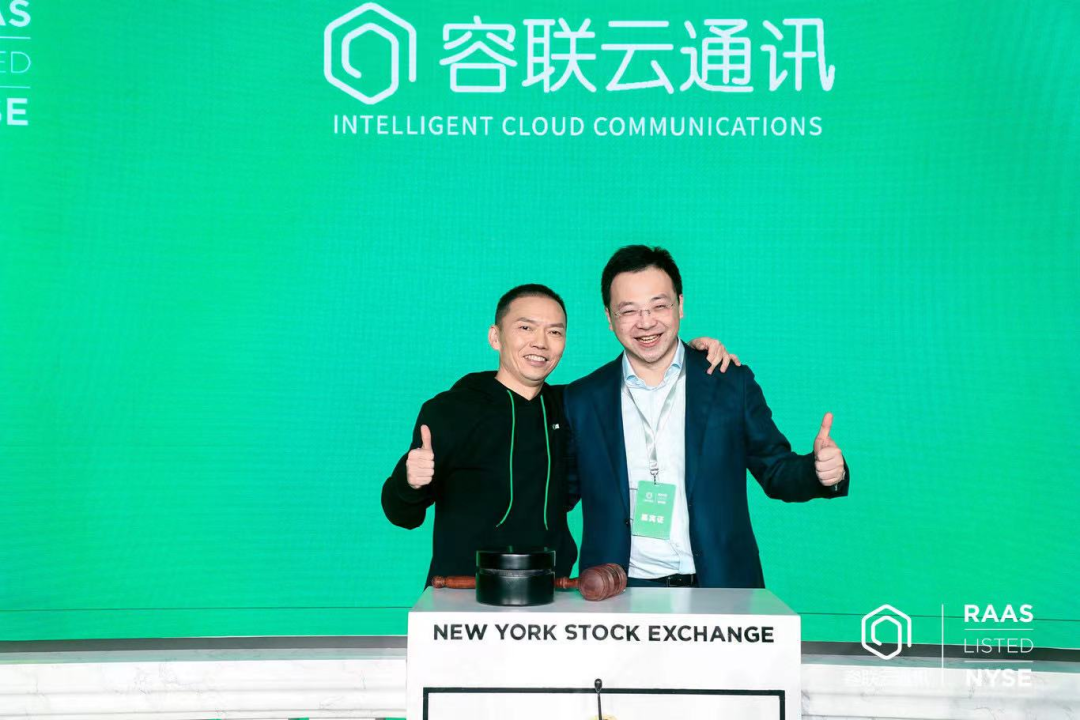
Later, when Zhang founded Oasis Capital, Cloopen was his very first investment. "Throughout the evolution of cloud communications, I feel Lao Sun (Changxun Sun) quietly endured an enormous amount. As his board member, I witnessed some of it, but only a small fraction. Much of the hardship he carried alone — whether external pressure or integrating multiple product lines internally. I think he embodies vitality in its fullest form. That's why I've believed in Lao Sun for so long," Zhang told PEDaily.
In October 2019, Cloopen completed a Series E round of several hundred million RMB, led by Prospect Avenue Capital with Yunhui Capital, Oasis Capital, and existing shareholder HSG participating.
In November 2020, Cloopen completed a $125 million Series F round — the largest private equity financing in China's cloud communications sector to date. The round was led by China Reform Fund, with New Oriental Industry Fund, Mirae Asset Group, Lanteng Capital, Tencent's Image Frame Investment (HK) Limited, and CloudAlpha joining as strategic and financial investors.
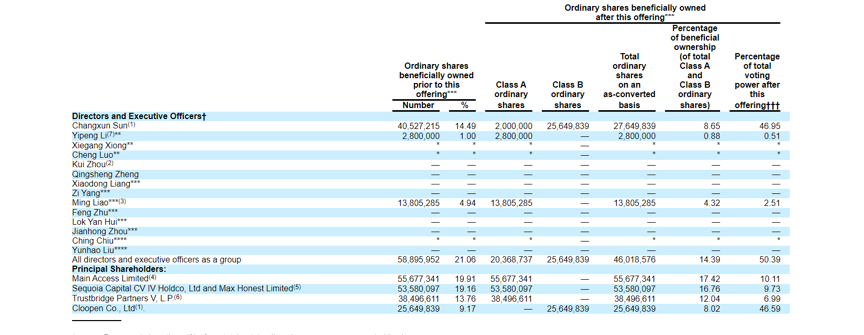
Cloopen's prospectus shows that post-IPO, Sun holds 8.65% of shares with 48.95% voting rights. HSG, as the largest financial investor, holds 16.76% with 9.73% voting rights. Trustbridge Partners holds 12.04% with 6.99% voting rights. At the $7.6 billion market cap, Sun's stake is worth $660 million (nearly RMB 4.2 billion).
Another Huazhong University of Science and Technology Alumnus Rings the Bell: Eight Years to a RMB 49 Billion Market Cap
Behind Cloopen's rise is its helmsman, Changxun Sun.
In 1994, 18-year-old Sun enrolled in Huazhong University of Science and Technology's applied mathematics program. He was a genuine top student, frequently scoring perfect marks on exams. In his spare time, he enjoyed researching audio and video compression algorithms and kept a close eye on industry convergence trends. His first job after graduation was in CTI (computer-telephony integration).
In 2000, Sun joined the communications division of Gaoyang Shengsiyuan, eventually rising to vice president and chief R&D engineer. At the time, the communications industry revolved around operators, but with the rapid growth of the internet, operators faced severe disruption and profits along the supply chain plummeted. Gaoyang Shengsiyuan encouraged internal entrepreneurship, so Sun led his team through several attempts, exploring both B2B and B2C directions.
In fact, Sun had long harbored entrepreneurial ambitions. Back in 2008, HSG partner Kui Zhou was invited to give a talk on entrepreneurship to MBA students at Tsinghua University's School of Economics and Management. During his speech, Zhou remarked: "This is the best era. Start a business while you're young." Sun, then 32, sat in the audience and was deeply moved.
By 2013, Sun decided to formally go independent, still targeting cloud communications. That year, he registered Cloopen and its cloud communications platform quickly went live.
Math majors are uncommon among entrepreneurs in this circle, but Sun found his background enormously helpful: "First, probability; second, modeling. Probability mainly influenced my direction selection — from choosing what to build early on, to deciding among countless business opportunities today, it's fundamentally a probability problem. Mathematical modeling has been very instructive for our business model — what kind of model fits the Chinese market, how to scale and upgrade, how to manage risk. I see mathematical modeling thinking behind all of it."
But entrepreneurship is never easy. Before completing the Series A, Sun and his team were preoccupied with survival. Fortunately, emerging technologies like cloud computing and AI were revolutionizing how enterprises upgraded their communications infrastructure. Cloopen, positioned at the inflection point of this industry explosion, began growing at a staggering pace.
Eight years after its founding, Cloopen has become China's largest cloud communications solutions provider, serving more than 70,000 enterprise clients including industry leaders such as Bank of China, Ping An Insurance, Haier, Lianjia, Tencent, DiDi, Ele.me, Xiaomi, New Oriental, and TALEducationGroup across finance, energy, manufacturing, education, and internet sectors.
On the evening of February 9, Cloopen successfully listed on the NYSE. Its shares surged 200% on the first trading day to $48, pushing its market cap past $7.6 billion (approximately RMB 49 billion).
What Powers an IPO: Projected Annual Revenue Exceeding RMB 700 Million
As the first Chinese SaaS company to list on a US exchange, what business is Cloopen actually in?
Company materials describe Cloopen as a leading multi-service cloud communications provider in China and one of the few full-service communications providers in the country. Its solutions cover Communications Platform as a Service (CPaaS), Cloud Contact Center (CC), and Cloud Unified Communications and Collaboration (UC&C). The company aims to enhance organizational communication experience and operational efficiency through innovative marketing and operations strategies and SaaS-based tools, ultimately driving the upgrade of enterprise communications.
"Eight years ago, Cloopen pioneered cloud communications services in China. Today, we integrate AI technology to provide Chinese enterprises with the full suite of CPaaS, CC, and UC&C cloud communications services. We bear the historical mission of driving the cloudification and intelligentization of Chinese enterprise communications," said founder Changxun Sun.
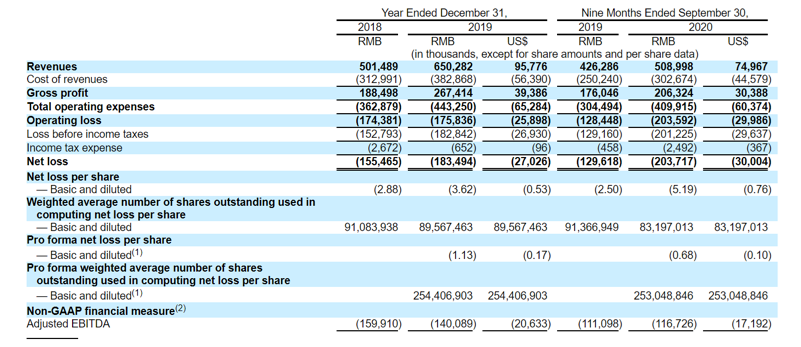
The prospectus shows Cloopen's revenue was RMB 500 million in 2018 and RMB 650 million (approximately $95.78 million) in 2019. For the first nine months of 2020, revenue reached RMB 509 million ($74.97 million), compared to RMB 426 million in the same period the previous year. Since Cloopen's revenue is historically highest in Q4, it's estimated that Q4 2020 revenue will exceed RMB 200 million, pushing full-year 2020 revenue past RMB 700 million.
In terms of revenue sources, CPaaS services — primarily voice and SMS — remain Cloopen's main revenue driver, accounting for roughly half of total revenue.
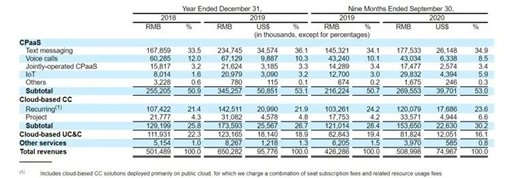
CPaaS monetizes by charging customers periodically based on monthly SMS volume and call minutes provided through its solutions. It also assists and supports mobile network operators in building and operating communications service platforms, recognizing revenue under revenue-sharing arrangements. Additionally, it recognizes net revenue from IoT-related services.
In essence, Cloopen obtains telecom resources from operators and provides corresponding solutions to enterprises across industries. Its client base spans internet, telecommunications, financial services, education, industrial manufacturing, and energy sectors.
This is a substantial market. Research shows that from 2015 to 2019, China's cloud communications market grew at a 21.7% CAGR to RMB 35.7 billion. By 2024, the market is projected to reach RMB 101.5 billion. Looking back at Cloopen's trajectory, the company precisely targeted communications services — a business necessity — to achieve multi-system integration and rapid growth to industry leadership.
The Curtain Has Just Risen: A Wave of SaaS Listings Is Coming
Cloopen's successful listing is only the beginning. "We're very bullish on this space," said HSG partner Kui Zhou, who believes cloud communications may be among the first applications to fully migrate to the cloud. "In the US market, several companies with market caps in the tens of billions of dollars have already emerged."
The most representative case is Twilio. In recent years, the US-listed cloud communications company has seen its stock climb steadily, with its market cap now exceeding $60 billion. When Twilio first went public in 2016, it sparked discussion in China about who would become the "Chinese Twilio." Now, Cloopen has provided an answer tailored to the Chinese market.
HSG director Jia Zhai once recalled that, like many Chinese investors years ago, he would look to the US for reference — which general SaaS categories took off first, which B2B sectors produced IPOs. But experience proved that blindly chasing US SaaS models and obsessing over standardization was a dead end.
"Cloopen's eight years of deep cultivation prove that B2B is a domain requiring long-term commitment but offering fully compounding, high-value growth. We've seen how founder Changxun Sun, through his resilience in technology exploration and acuity in market demand, led the company through the process of putting down deep roots, establishing a B2B development model that belongs to China," Zhou told PEDaily.
"Cloopen's listing will significantly boost the confidence of domestic B2B entrepreneurs and provide multidimensional lessons in technology application, business model development, and more," said HSG partner Qingsheng Zheng. "Going forward, HSG will continue to deepen its presence in the B2B ecosystem, leveraging global resources more effectively to empower domestic B2B startups, working alongside entrepreneurs to create greater value in improving enterprise efficiency and driving industrial development."
Cloopen is HSG's latest B2B IPO. In September 2020, Sequoia Capital listed software companies Snowflake and Unity within a single week, with Snowflake setting the record for the largest software IPO in US history. Two months prior, HSG's 20.1% stake in Zhonglian Yungang received approval for listing on ChiNext, marking the harvest season for its B2B portfolio.
Like Sequoia, China's B2B venture investors are poised for their own harvest. "With relaxed listing requirements on the STAR Market and rapid revenue growth among SaaS companies, numerous vertical SaaS leaders now have revenue between RMB 100-500 million and are maintaining high growth rates," said a Beijing-based VC investor. "In the next 3-5 years, China's SaaS industry will see a wave of listings."

Oasis Capital is a new-generation Chinese venture capital firm dedicated to discovering the most vital entrepreneurs of the next decade and growing alongside them to create long-term value. "Championing Vitality" is Oasis Capital's vision and mission. This vitality represents both the direction of structural transformation in the era and the resilience and evolutionary power of entrepreneurs.
Oasis Capital focuses on early and growth-stage investments, with ticket sizes ranging from $3 million to $30 million. It concentrates on technology-enabled services in education, healthcare, and enterprise services, supporting the upgrade of China's technology-driven new services.