Oasis Capital Delivered Keynote Speech at 2022 ChinaVenture Annual Summit

Structure and Rhythm in Investing

Recently, Jinjian Zhang, founding partner of Oasis Capital, delivered a keynote speech titled Structure and Rhythm in Investing at the 16th ChinaVenture Annual Investment Summit, hosted by ChinaVenture and ChinaVenture.com. Below is a transcript of his remarks:
Hello everyone! Thank you to ChinaVenture for this opportunity to share with you today. I'm an engineering guy by training — I spent seven years studying radar, focusing on noise and signal analysis in high-definition imaging. Later I moved into investing at a dollar-denominated fund, and I've been at it for 11 years now. Over these 11 years, I've witnessed the ups and downs of cycles, and these experiences bring me back to my earlier work studying signals and noise.
So the topic I'm sharing today is Structure and Rhythm in Investing.
This year is particularly special because the changes from quarter to quarter have been dramatic, with an enormous amount of new information. This information constantly shifts our state — sometimes anxious, sometimes pleased. In fact, much of what we call anxiety or happiness stems from focusing only on short-term rhythmic issues. Problems generally fall into two categories: long-term structural issues and short-term rhythmic issues. But because of how we think, our sense of subject and object, we tend to pay more attention to short-term rhythmic issues rather than long-term structural ones.
Just like many parents here who tutor their kids daily, checking their exam scores every quarter — thrilled when they do well, anxious when they don't. Yet these are all rhythmic concerns; structurally speaking, raising them to be upright and kind people may matter far more. The investment market works the same way: when a founder is thriving, we're delighted; when they're struggling, we scramble to connect them with resources, hoping they'll grow. But these are all rhythmic responses — we may be overlooking the more important structural questions: Is this the right person? Are they doing the right thing?
Whether it's an enterprise, a child, or a country, the pattern holds. Much of our worry and anxiety, much of our confusion, comes precisely from focusing on rhythmic difficulties while missing structural opportunities.
We often say "country" is a vast concept, but is it really that vast? At its core, it's a combination of people. If the world is a global village, what kind of person is China? Japan might be an old man, Vietnam a twenty-something young adult — then what about China?
Look at this chart. Twenty years ago, China's average age was 30. In 2001, when it joined the WTO, it was like an eager 30-year-old stepping onto the global stage. What was on his mind? He thought he could do any job. He might not be the most profitable person in the world, but he was certainly the most diligent. Whatever the task, given the opportunity, this young man would do it. That was China in 2000.
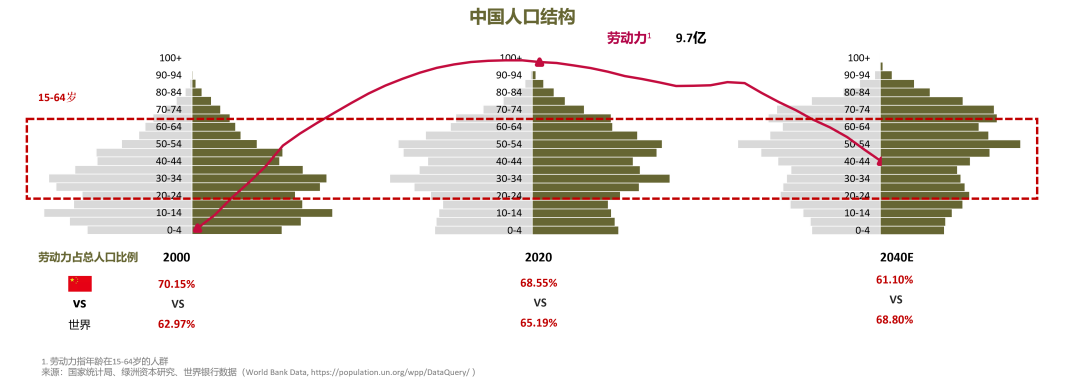
After two decades of development, we've accumulated enormous wealth and become one of the world's major consumer markets and economies. But what has happened to our country after twenty years? By 2020, the average age of Chinese people had risen to 38. Twenty years ago, a 30-year-old was thinking about whether the world would give him a chance. But at 38, a middle-aged man is definitely not thinking that he can do every job and handle every task. The old model of working overtime no longer fits today's China — we must change and upgrade our industries. At this point, he realizes he's doing the same low-end manufacturing as twenty-something Vietnam and thirty-something India, except they work harder and cost less. He looks ahead — in 2040, what will China's average age be? 47. At 47, what can he still do? Can he still strive as he does today? Can he still get things done through heavy pollution and massive labor inputs? He cannot.
This transformation involves three parts: first, taking care of one's health — hence "lucid waters and lush mountains are invaluable assets"; second, the country must boost fertility rates and slow aging as much as possible; third, industries must be upgraded to become more valuable and higher-quality.
How does this massive entity called China level up? By making every circulating element within its body more efficient.
Over the past forty years, China's principal contradiction was between the people's ever-growing material and cultural needs and backward social production. During these four decades, many giants emerged, providing one-stop services for the nation — they might be internet platforms or super manufacturing companies. Whatever their name, what they fundamentally addressed was the people's ever-growing material and cultural needs. But by 2020, this 38-year-old wanted to live longer and healthier. Thus, the 19th National Congress reframed China's principal contradiction as one between "the people's ever-growing needs for a better life and unbalanced, inadequate development."
Why is development unbalanced and inadequate? Why is efficiency low in some places? Precisely because factors of production are not circulating effectively. Today, the same social security program costs differently in City A versus City B. The same talent search yields completely different results in City A versus City B. This is because the circulation of factors of production is constrained, which manifests as the unbalanced, inadequate development we see in China today. And this characteristic of unbalanced, inadequate development further limits the quality of work this 38-year-old middle-aged man can do, limiting his position in global asset allocation.
So we can see that after 2017, China introduced a series of policies primarily aimed at marketizing China's factors of production, including for the first time incorporating data as a factor of production under regulatory scope. What the state seeks to regulate may not be specific companies — fundamentally, we've recognized that data is a factor of production. If we bring factors of production under regulation and revitalize the body, the country will become more vibrant, more youthful, higher-quality. This is the core driving force of national policy.
In fact, what is the real meaning of differentiation? It's the differentiation of factors. A healthy body has room to rise because factors of production can be addressed through socialized means. If a startup has no user data, no mature market support, no land or talent, how could it possibly grow strong? Much of the regulation and impact we see reflects a country's long-term thinking and action in support of its economy.
From Oasis's perspective, if we interpret the contradictions mentioned above as opportunities Oasis can seize, I would say it's the contradiction between increasingly differentiated demand and insufficient specialization. In recent years, demand for specialization has grown stronger, with the underlying logic being that demand is differentiating. In the past, everyone was satisfied with a bowl of rice. But today, some eat rice, some eat noodles, some eat dumplings — and among dumpling-eaters, some prefer meat filling, some vegetable. Within a country, people's demands are differentiated, and differentiated demand requires more specialized supply.
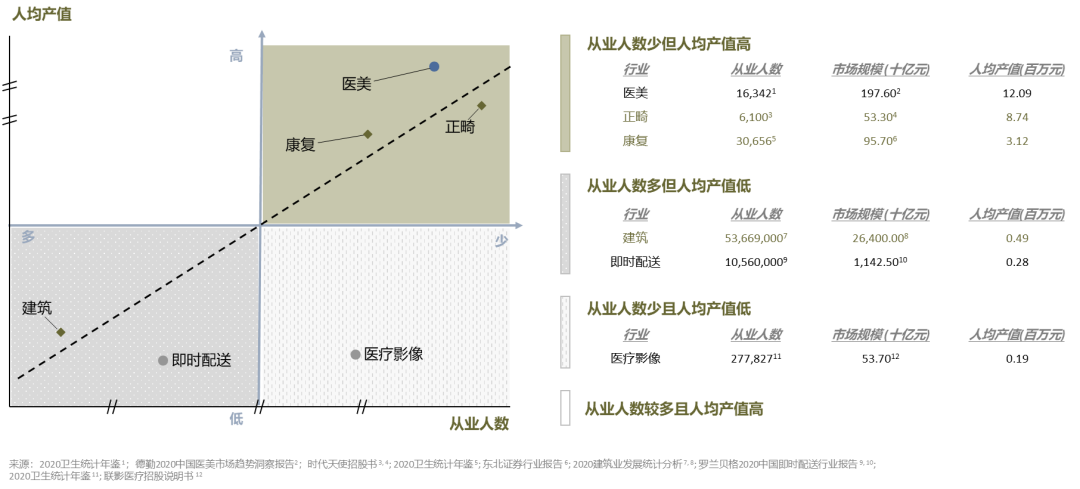
Clearly, specialized supply in many fields remains inadequate today. Take the orthodontic market: last year, 3.5 million people in China received orthodontic treatment. It sounds simple, but it requires highly specialized training — an orthodontist uses their hands and craftsmanship to shape the future form of teeth, and an excellent doctor needs over ten years of training. Yet China has only 6,000 doctors serving these 3.5 million people. If this 3.5 million grows to 10 million over the next decade? This problem needs to be solved through digitization. In the children's space, companies like LM and in the adult space, Invisalign, combine 3D scanning, digital modeling, and 3D printing to transform what doctors solve into software and manufacturing, empowering every doctor. This is what we mean by China's greatest opportunity — using digitization to empower the upgrading of services.
Today's market is filled with all kinds of voices. We see some people pessimistic, some optimistic; we see people cheering over some things, anxious over others. But most of this is short-term and rhythmic. Ignoring this rhythmic noise and focusing on long-term structural signals is what long-term investors should embrace, support, and work to change. Betting heavily on China's industrial upgrading is the main theme of China's future. Let us also grow healthier and better together with this country.
That's what I wanted to share with you today. Thank you!





Oasis Capital is a new-generation venture capital firm in China, dedicated to discovering the most vital entrepreneurs of the next decade and growing alongside them to create long-term value. "Nurturing Vitality" is Oasis's vision and mission. This vitality is both the direction of structural transformation in the era and the resilience and evolutionary power of entrepreneurs. Oasis Capital focuses on early and growth-stage investments, with individual investments ranging from $3 million to $30 million, concentrating on technology-enabled services in healthcare, enterprise services, and other sectors, supporting China's new service upgrade driven by technology.