Professor Tongxin Li, The Chinese University of Hong Kong: Applications of Power Agents | Agent Insights

Counselor on Vitality

In an era that champions energy conservation and environmental protection, Agent has joined the sustainability movement too. How can Agent substantively drive technological progress in smart grids and energy management? This week, Oasis invited Professor Tongxin Li from The Chinese University of Hong Kong, who brings deep research expertise in power systems and trustworthy machine learning. His team has been exploring the Equitable Agent framework — a promising solution that could help individuals, utilities, and data centers alike save energy and cut costs. Let's hear how he's using Agent to help users save money and improve efficiency. Enjoy.
Building Socially-Equitable Public Models
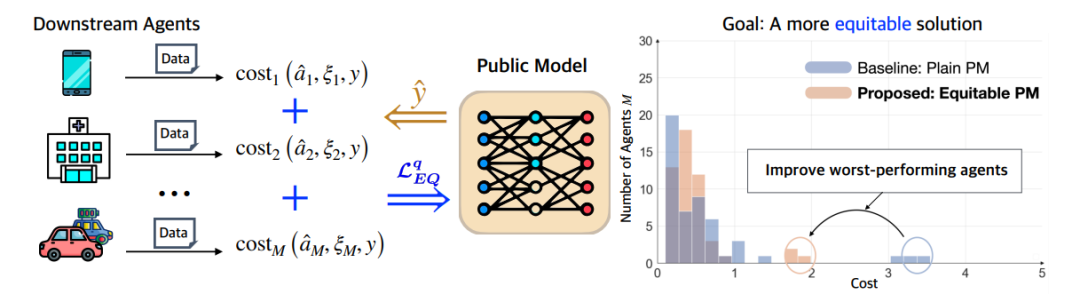
Equitable PM Agent Framework
Paper Link: https://arxiv.org/abs/2406.02790
Problem Addressed: Public models provide predictions for various downstream tasks, but an exclusive emphasis on prediction accuracy may conflict with the diverse end goals of downstream Agents. The team integrates Agent downstream objectives into the optimization process and proposes the Equitable Objective, which yields a more uniform distribution of downstream Agent performance — with each Agent having its own unique priorities.
Model Architecture: The Agent architecture consists of two components. The front end handles public objective setting to satisfy fairness for all (Define Fairness). The back end employs specialized solvers for computation and training, ultimately ensuring that Agent predictions align more closely with real-world objectives.
Application Scenarios: Power Agents, Energy Agents, Traffic Agents, and other mission-critical contexts.
Test Results: The Equitable PM framework proposed by the team minimizes prediction errors. Compared to approaches that ignore downstream Agent objectives across different environments, Equitable PM achieves fairer solutions.
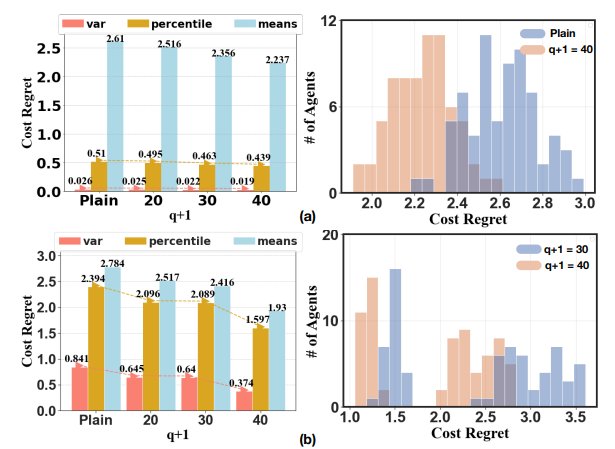
Partial Test Results of the Equitable PM Agent Framework
Oasis: Could you introduce your background and research directions?
Professor Li: My research has focused on smart grids and trustworthy machine learning since my PhD, primarily on control and optimization in physical systems — for instance, decision-making scenarios in complex networked systems, how to better control power grids, or model and optimize transportation networks. Power grids involve many physical laws and constraints (such as Kirchhoff's laws, Ohm's law, etc.) that are nonlinear, making the overall optimization problem extremely difficult to solve. Traditionally, power grids have used PID, LQR, or MPC (model predictive control), but these methods don't fully leverage collected data. Yet the feedback data we routinely monitor from networks is incredibly valuable — for example, we can use reinforcement learning to learn from historical data and generate better decision-making behaviors.
These AI-driven decisions often can't be adopted directly. How to introduce trustworthy hyperparameters so that algorithms balance worst-case guarantees (also known as "robustness") with sufficient adoption of favorable AI decisions (also known as "consistency"); how to rigorously define and compare consistency and robustness across different models under different AI decision paradigms; and at the theoretical level, whether tradeoffs exist between them for any algorithm — these were all directions I pursued during my PhD. My background differs from traditional deep learning research in that I focus on AI in serious decision-making scenarios. Unlike other machine learning scholars who lean toward virtual settings, I'm more interested in the role AI methods play in real-world, large-scale physical systems and the corresponding difficulties and challenges.
The potential application value of trustworthy machine learning is very high. In some real-world mission-critical systems, even a small error or violation of established constraints can lead to severe consequences with substantial economic losses. How to make Agents built on foundation models trustworthy, and how to improve the credibility of core Agent decision-making — these are all current research directions of mine. At the application level, my research involves many power system cases, because power systems represent an ideal landing scenario for controllable machine learning. Ensuring that power systems don't experience major failures is similar to the safety and robustness requirements of autonomous driving — once a system issues instructions exceeding capacity, there's a risk of burned-out power lines. So power systems represent fertile ground for future Agent applications, and trustworthy methods will help Agents fully materialize in reality.
Oasis: What motivated the development of Equitable PM?
Professor Li: This work was completed in collaboration with Professor Shaolei Ren's team at UCR. The motivation for Equitable PM came from thinking about future Agent development directions —底层 foundation models will likely become public services. However, when each user employs an Agent, their differing objectives make it difficult to provide equitable customized services for everyone. So we wanted to develop the Equitable PM framework to better serve each user's optimization goals when fine-tuning models. The paper discussed here uses data centers as an example, where we use Agents to predict data center carbon efficiency. Users select the public service provided by the Agent, using predictions of future carbon emission efficiency to optimize data center costs. Data center optimization decisions depend on the model's time-series predictions. Yet the optimization objectives for power consumption models differ completely for another细分 application in a similar scenario. For example: for data centers we need to predict electricity prices and corresponding power efficiency over the coming days, while for charging stations we need to predict similar data over the coming hours — so the tasks that Agents need to accomplish on top of the same foundation model are entirely different. Our method can be used to train Agent models providing public services across many such diverse scenarios, achieving social equity at the user level.
Oasis: Could you explain how the Equitable PM framework was developed?
Professor Li: The Equitable PM Framework comprises two parts. The first is public objective setting — essentially, how to define fairness that satisfies everyone (Define Fairness). Mathematically, this involves balancing each individual's expectations, which in the power domain typically means the average cost incurred by users. If my electricity costs differ too much from everyone else's, I'll certainly be dissatisfied. To characterize social equity, we introduce a q parameter for balancing. This is essentially similar to the concept of norm in mathematics — the parameter can be set as the variable q in the norm for adjustment, then averaged after large-scale sampling. The second part is training. With such data, traditional solvers can't be used for computation because some users' optimization costs are discrete, non-differentiable functions. At this point we need to use black-box optimization methods, which requires putting some sampled data into a batch for optimization solving.
Oasis: How were experiments set up in the two evaluation cases — data centers and EV charging stations?
Professor Li: In the first data center example, we assumed 50 data centers uniformly adopting one company's prediction service, with all models using time-series prediction models (LSTM) for forecasting. The model has its own parameters determining each data center's carbon emission values for each time period. After receiving these predictions, each data center models costs through appropriate mathematical formulas involving data including the allocation ratio of renewable versus fossil fuel energy over time. Each user wants to minimize their own costs. We also used Azure Cloud Workload Data.
In the second EV charging station example, we assumed a public model with Transformer architecture, using a relatively simple single-layer encoder-decoder combination with position encoding for vector processing. In this scenario, when users arrive at charging centers, prediction displays show different charging amount recommendations for different electricity prices, incorporating complex data on water consumption, carbon emissions, and other specifics — all combined to give users an optimal decision result. Some of this data came from actual data I collected from Caltech campus charging station projects, where user behavior varied dramatically across different years (pre-pandemic, post-pandemic), different time periods, and different weather conditions. Additionally, the US power grid system has many different suppliers — basically each state has its own utility company, unlike China where there are only a few large power companies — making modeling considerably more complex. In both examples, our Equitable PM framework can guarantee social equity. In the Equitable PM framework, the first part — public objective setting — is crucial. As engineers, we need to deeply understand user requirements and feed this back to system designers so they know what costs users actually care about, enabling more accurate model balancing. Moreover, once the model is established, it can provide users with highly personalized prediction schemes. Against the backdrop of ever-increasing renewable energy penetration, such solutions will be in great demand at large companies, utilities, or aggregators, because they can better predict the future.
Oasis: What are your next steps?
Professor Li: My doctoral work was relatively theoretical; going forward, I'll try to make my research more applied. For example, I'm currently interested in fine-tuning based on large models for better performance in vertical scenarios. Traditional optimization methods use LoRA or QLoRA, but when there are thousands or tens of thousands of users, we need to consider how to balance — whether to design one model (incorporating some economic indicators, reducing interaction with Agents), or how to combine public models with multiple Expert Agents. I'm also quite interested in online decision-making problems — how to use Agents to better solve online problems. Online is actually a very practical problem model; many decisions need to be made in real-time, users don't know what will happen in the future, and Agents can provide better advice and prompts, though Agent recommendations occasionally have problems and aren't entirely trustworthy. Once errors occur in important systems, consequences can be very serious. Incorporating error correction methods into the model training process is also an AI online decision-making scenario I'm currently focused on.
Oasis: What do you think is currently lacking in practical Agent applications?
Professor Li: I think one important gap in practical application is how general Agents can become "down-to-earth." Whether through combining with traditional methods or other approaches, how can we get people to trust and use Agent systems? How do we persuade users to transition from traditional methods to genuinely trusting and using Agents? To give a simple example from my familiar domain of grid-controlled inverters, which connect photovoltaics to the entire power system — grid-connected PV requires converting AC to DC, and traditional methods already have many standardized implementations. For instance, traditional grid droop control has internationally recognized standard systems, but these don't utilize the large amounts of operational data accumulated by power grids. Recently there have been cases using Agent approaches to optimize decisions, with good results in special experimental scenarios. However, making Agents trustworthy and actually deployable in practice still has many difficulties to overcome. In short, for near-term Agent capability delivery, current models are already sufficient. But for downstream applications, domain experts still need to do specific optimization of model outputs, ultimately ensuring through special design that the system won't crash after deployment. This way, Agents can improve system efficiency and consistency without losing the reliability of traditional solutions, while also saving users money.