Microsoft Research Asia's Jindong Wang: Agent's Cultural Park | Agent Insights

Counselor Vitality

The diversity of world cultures creates communication gaps between people from different backgrounds — and the same holds true for Agents born from those different contexts. Jindong Wang at Microsoft Research Asia has been working on a project called CulturePark that breaks through this cross-cultural barrier technically, opening up new possibilities for cultural understanding in Agent applications. We invited him to share his vision for how large models and Agents can coexist harmoniously with human society. Enjoy.
"CulturePark: Boosting Cross-cultural Understanding in Large Language Models"
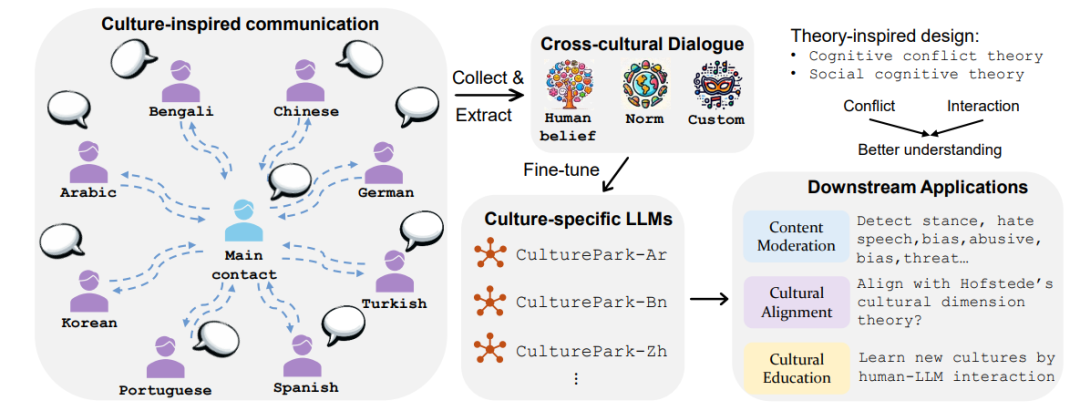
CulturePark Multi-Agent Communication Architecture
Paper link: https://arxiv.org/pdf/2405.15145
Problem addressed: Traditional LLM training corpora consist primarily of English data reflecting Western cultural values. Existing approaches to fixing LLM cultural bias — prompt engineering and pre-training in non-English languages — are prohibitively expensive. The team designed a multi-Agent communication framework called CulturePark to collect cultural data and generate high-quality, diverse cross-cultural dialogues for fine-tuning culture-specific LLMs.
Model architecture: CulturePark has two layers. The first layer consists of moderator Agents, typically American Agents with an English-language background. The second layer consists of participant Agents from multiple national backgrounds. During cultural debates, moderator Agents pose specific questions, and participant Agents respond with viewpoints and engage in debate.
Application scenarios: Agentic fine-tuning framework, applicable to educational Agents, customer service Agents, and other domains.
Test results: The team's fine-tuned models significantly outperformed GPT-3.5-Turbo and GPT-4 across major cultural datasets. The team also recruited 24 volunteer evaluators, and manual evaluation showed that CulturePark more closely aligned with real-world cultural morality, demonstrating its strong cultural alignment and cultural understanding capabilities.
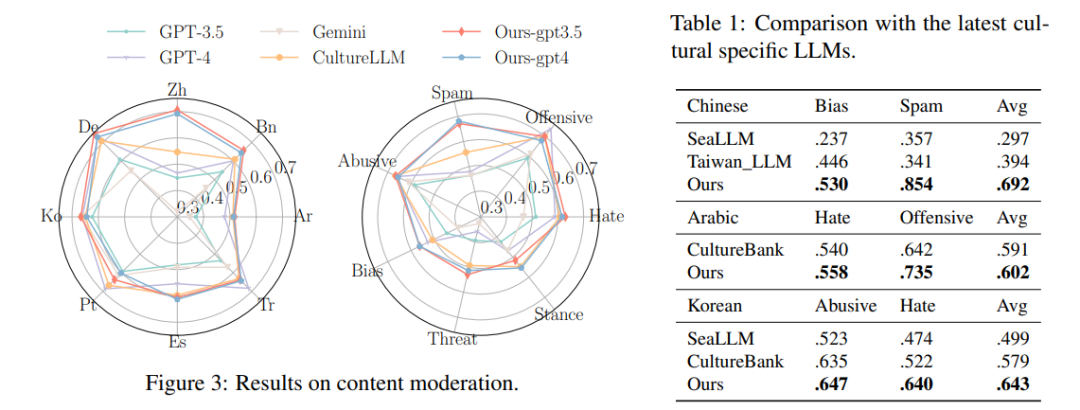
CulturePark evaluation results
Oasis Capital: Could you walk us through your educational background and research experience?
Jindong Wang: I did my PhD at the Institute of Computing Technology, Chinese Academy of Sciences. My initial research direction was using mobile phones or sensors for human behavior recognition — things like breathing, heartbeat, and motion acceleration, applied to disease detection. At the time, I found there was very little data in the field, making it impossible to build general-purpose models, so my research gradually shifted toward transfer learning. After joining Microsoft Research Asia, my work expanded from transfer learning to semi-supervised learning, OOD generalization, federated learning, and other areas — all aimed at building algorithms that solve more practical problems.
Since the release of large models led by ChatGPT, I've adjusted some of my research directions. Because LLMs simplify many of the cumbersome steps in natural language preprocessing, scholars like me without prior NLP experience can also benefit, so I've moved toward LLM-related research. At Microsoft, my focus isn't on pre-training large models but on downstream work — LLM capability evaluation, downstream task adaptation, and combining large models with social science.
Transfer learning wasn't originally a computer science concept. In 1901, psychologists proposed the idea of situated knowledge transfer. It wasn't until 1995 that computer scientists asked whether we could find correlations between computing tasks, and transfer learning formally entered computer science and AI. Machine learning is essentially an abstract concept — you can think of it as reapplying existing knowledge to similar downstream tasks.
With the emergence of large models, the concept of transfer learning has also evolved. The most obvious change is addressing the pain point where computing resources are extremely scarce and model training can't be the default option. Transfer learning enables rapid task adaptation after calling open-source models or closed-source model APIs.
Oasis Capital: What motivated you to design CulturePark?
Jindong Wang: Before CulturePark, we did another project called CultureLLM. We noticed that many studies only tested English or Chinese in isolation, with downstream tasks limited to reasoning or math. But for large models to truly enter every household, they need to be useful not just on the tasks everyone cares about, but also on culturally specific problems. There are hundreds of countries and thousands of languages worldwide. People with different living habits express different meanings even when using the same language. So we wanted to design a model that feels comfortable to use regardless of your background — one that fully understands what people from a particular culture or language are trying to say. That's how CultureLLM came about.
Building on CultureLLM, we used an Agent architecture to design a data augmentation algorithm, upgrading the optimization approach from CultureLLM. We constructed a virtual environment where Agents interact freely. This communication method is grounded in interpersonal communication theory and has a sociological foundation, enabling Agents to better learn cross-cultural interaction patterns.
CulturePark relies on very little seed data — the vast majority of precise data is generated through model interaction. Everyone knows that useful training data on the internet is becoming increasingly scarce. Our thinking was: can we generate a continuous stream of new data through the models' own interactions? We chose 8 national backgrounds for testing, mainly based on the standardized test set Cultural Dimensions (a cultural dimension dataset created by the renowned Dutch social scientist Hofstede). Agents from different backgrounds needed to meet 2-3 standardized test criteria, and we ultimately selected Agents from these 8 countries as the most suitable.
Oasis Capital: Could you explain the CulturePark architecture?
Jindong Wang: CulturePark has two main types of Agents. During communication between Agents, the moderator prepares questions extracted from the World Values Survey (WVS) dataset, which is a very well-known survey. Then the other type — Agents from different activity backgrounds — respond to specific questions. During the process, Agents debate different viewpoints, fully expressing perspectives that differ from others'.
Honestly, at first we didn't know how to control what data the Agents would generate. All we could do was write good prompts and try to get Agents to defend their own cultures while other Agents refuted them. During this process, we collected cross-cultural dialogues. We typically set the moderator as an American with an English cultural background. For redundant content generated by GPT, we used data filtering, cleaning, and clustering to extract viewpoints. Finally, we did some fact-checking, along with malicious content, bias, and attack detection, to ultimately extract different cultural viewpoint data.
Another thing that sets us apart from others doing cultural evaluation is that beyond standard dataset evaluation, we also introduced volunteers for human evaluation. The results were quite striking, because culture is highly subjective. With real people evaluating, we could highlight cultural data beyond just the "standard answers."
Oasis Capital: What scenarios can CulturePark be applied to?
Jindong Wang: The uses are mainly at two levels: the model layer and the application layer. At the model layer, we designed a data augmentation algorithm. You could swap out culture for any theme and use this same framework. For example, if we wanted legal data augmentation, we could take legal statutes as seed data, have 2 Agents debate them, and through debate explain the statutes in more detail. This would generate ample data for fine-tuning large models. The other layer is improving the quality and quantity of cultural data during fine-tuning. The more cultural data you include, the more granular you can get — even hundreds of cultural datasets — so that when people worldwide use your model or Agent, it can better "understand" you.
The application layer is even broader. The examples we gave in our paper include education, customer service, and other fields. Additionally, using the CulturePark framework, you could swap in data from many other domains you want to emphasize. While boosting capabilities in specific domains, you won't experience catastrophic forgetting, and performance on other tasks won't degrade. Developers can confidently deploy whatever models they want.
Oasis Capital: What's next along this line of thinking?
Jindong Wang: Since CultureLLM used manually designed algorithms for data augmentation, and CulturePark mainly focuses on machine-to-machine interaction, our next step is to incorporate human-machine interaction data as well. Going forward, we'll also do work on Agent ethics and safety.
Another direction is introducing multimodality into how cultural data is presented. Much culturally relevant data comes in images — for example, seeing the Great Wall, foreigners and Chinese people think of completely different descriptions. We hope to make the way the world is presented richer and more diverse.