Yixi Biotech's Liu Zhenyun: When the Evolution of Life Can Be Engineered | Agentic Era

Helping Carbon-Based Life Go Further
Every shift in technological paradigm quietly redraws the boundaries of what it means to be human:
As embodied intelligence enters reality and computing approaches its limits, the life sciences are reaching their own inflection point in the Agentic Era.
We use technology to expand our external frontiers, yet we've forgotten that life itself is Earth's oldest, most efficient "computational architecture." Synthetic biology is not merely a new industry — it is a key to re-understanding life and redesigning the future.
At this AGM, Dr. Zhenyun Liu delivered a remarkable talk: from the storage density of DNA to the evolution of gene editing; from the industrialization of scarce substances to rebuilding global protein systems through straw fermentation; from the evolution of life to its redesign.
This is not merely technological progress. It is a meditation on where humanity goes next.
The following is adapted from his live presentation. Approximately 7,000 words, 18-minute read.
Enjoy.
There are many robots here today. But when I see robots, what do I think?
A human being — a life form of several dozen kilograms — consumes less than one kilogram of starch per day. The energy consumption, all things considered, is actually quite reasonable.
We shouldn't always be thinking about building robots to imitate humans. What do robots have that's worth learning from? Why not just make humans stronger? Why build a machine at all? Whatever robots can do, why can't humans do it too? Modify humans to have those capabilities, and the problem is solved.
So today I'd like to introduce what we're working on.
We are Yixi Biotechnology, based in Suzhou. We aim to use technology and creativity to expand the boundaries of humanity's food sources, and to use research and imagination to explore new forms of life.
Our company was founded in 2019. Before that, I worked in pharmaceuticals, in gene and cell therapy. As Jinjian mentioned earlier, I was one of seven drafters of China's industry standards for gene and cell therapy.
In the course of my pharmaceutical work, I discovered new opportunities. I believed the life sciences had entered a new era, so I chose to start a company.
I could have joined another company, of course. But my previous experience convinced me that for a company to become great — to change humanity — technical people must have decisive power over its direction. So I chose to build my own.
My academic training is in the life sciences, so I chose to work in that field. My specific direction: synthetic biology.
McKinsey & Company once predicted that synthetic biology would eventually affect one-third of manufacturing, creating $30 trillion in value. Globally, and primarily in the United States and China, bio-manufacturing has received tremendous attention in recent years, achieving rapid growth. But fundamentally, analogous to semiconductors, synthetic biology remains in an early stage.
If we look at its developmental trajectory, a question arises: why did I choose synthetic biology? Why this field?
First, at the national level: we know China's industrial policies have achieved enormous success in recent years. As previous speakers noted, China didn't invent solar power, yet China now essentially dominates it. This pattern repeats across many domains.
Synthetic biology has likewise received significant attention from Chinese policymakers. As early as 2023, the Central Economic Work Conference identified bio-manufacturing as a national development priority. In both 2024 and 2025, bio-manufacturing was written into the Government Work Report as a future development priority. The term the state uses is "bio-manufacturing," not the more commonly used "biomedicine" — these are entirely different concepts.
In the Government Work Reports for '24 and '25, bio-manufacturing was listed among future industries. Particularly in 2025, it was the very first future industry mentioned. Less than a month ago, when the director of the National Development and Reform Commission introduced recommendations for the upcoming 15th Five-Year Plan, he stated that China would spend ten years building a high-tech industry equivalent to "another China." Among the six directions identified was bio-manufacturing.
To understand bio-manufacturing, we need to examine the history of life itself.
Many people think life is complex, that its emergence was difficult. In fact, this is not the case. Geological evidence shows Earth formed 4.6 billion years ago, yet the earliest life appeared 3.8 billion years ago.
Consider what this means: life emerged just a few hundred million years after Earth's birth. Earth may still have been in a magma phase — extraordinarily early. This far exceeds most people's imagination. We assume life requires highly complex conditions to arise. The evidence shows otherwise.
Life appeared while Earth was still cooling. It then endured three and a half billion rather boring years until, roughly 500 million years ago, it experienced its first truly major explosion. This occurred in the geological period known as the Cambrian — the Cambrian explosion.
If you had visited Earth before this Cambrian explosion, you might not have noticed life at all. Life consisted entirely of microorganisms, single-celled organisms. After this explosion 500 million years ago, life went from single-celled to multicellular. The earliest life forms moved from oceans to land. All of this began at that moment. Over billions of years of evolution, life has cycled through extinction and rebirth, surviving multiple mass extinctions. But through this process, life became increasingly efficient. After this streamlining, the essential information transfer of life can be understood as the central dogma — a remarkably simple flow from DNA to RNA to protein.
Do you know how efficient life's storage is? We all know Amazon — there was that story about them moving data by loading hard drives onto trucks. In fact, if they stored that information in DNA, less than one kilogram would suffice. One person could carry it by hand. Consider how compact biological information truly is.
We think humans are complex, but the human genome contains only about 3 gigabytes of data — remarkably small. Yet from this tiny dataset emerges something as complex as a human being. Through billions of years of evolution, life has become extraordinarily efficient. As I mentioned earlier, a human of several dozen kilograms requires less than one kilogram of starch per day to accomplish so much. I don't know of any device or machine as complex as a human that operates on such low energy.
Analogous to semiconductors, we can store information in DNA, transmit it, and ultimately express it through proteins. Based on this central dogma, we can do a great deal of design. This is why I chose synthetic biology: because the underlying logic has changed. Once these three problems in the life sciences were solved, everything became different.
The first is information. Of all information humanity currently possesses — setting aside duplicates — the vast majority of our knowledge comes from genomes. A few years ago, the vast majority of new knowledge came from genomes, with genomic data measured in petabytes annually.
The breakthrough in genomic technology owes thanks to Roche. Around 2005, Roche launched the Roche 454 high-throughput sequencing platform. But the technology proved difficult to use, so a company called Illumina developed the Solexa sequencing technology.
After 2008–2009, high-throughput sequencing became widely accessible. This is why domestic high-throughput sequencing companies in China were mostly founded between 2008–2009 and 2012. After 2012, that window closed. But companies founded earlier, if their business was sound, could easily achieve annual revenues of 200–300 million RMB with profits in the tens or hundreds of millions.
Those few years saw an explosion of information. We gained DNA information from countless species on Earth. With this information, if you're training large language models or other models, it's equivalent to having a database — enabling us to better understand and interpret how life actually operates.
For example, humans have roughly 3 gigabases of DNA, comprising about 20,000 genes. Humans do not have the largest genome on Earth. Many plants have genomes 50 times larger or more. Humans don't have many genes either — only about 20,000 functional ones — while E. coli has over 4,000. Consider: from E. coli to human, genes increase from roughly 4,000 to 20,000, just a fivefold difference, less than one order of magnitude, yet life transforms so dramatically.
The smallest independently viable organism is Mycoplasma. Some debate whether Mycoplasma can truly survive independently, but under adequate nutritional conditions, it generally can. Its genome contains roughly 700 genes — a very small number sufficient to sustain life. Viruses are exceptions, of course. We now know software can generate viruses — for example, Evo2 can generate bacteriophages, viruses that target bacteria. These can now be computationally designed. But viruses are not complete life forms; they require very few genes.
Consider a disease that causes suffering for over 100 million people in China: hepatitis B. Its genome? Just over 3 kilobases. A virus of barely 3 KB causes such immense suffering for so many.
High-throughput DNA sequencing has given us access to vast biological information. Only with this information can we properly understand life's operational logic.
The second problem to solve was materials.
With genomic sequencing and this information, we previously needed raw materials for gene editing and design — DNA fragments.
In vitro, the longest DNA fragments we could obtain were roughly 10,000 bases, about 10 KB, using PCR. This was far too short. Genes are measured in megabases, so we could only make minor patches. Before this, genome modification was done gene by gene, in small fixes. True life design was impossible.
The technology that solved this materials problem owes thanks to one person: Daniel Gibson. I believe he deserves a Nobel Prize. He invented a method called "Gibson Assembly" — a remarkably simple assembly process yielding DNA lengths in the megabase range, essentially reaching small genome scale or beyond. This technology incubated between 2002–2005, was formally presented in 2009, and matured around 2015. After maturing, it took only a few years to essentially obsolete restriction enzyme technology, which had been used for over a century. When I was doing my PhD in 2012, restriction enzymes were still the mainstream DNA assembly technology. By 2015, just a few years later, they were completely displaced.
When Gibson's method first emerged, one reaction cost roughly 200 RMB. People still used it because it saved enormous experimental effort. Now numerous domestic imitations exist; one reaction costs under 10 RMB. Previously, assembling a long DNA fragment took days or even months. Now one reaction takes just a few hours.
This solved our materials problem for in vitro genome design.

The final problem was tools.
Everyone knows this one: CRISPR-based gene editing tools democratized gene editing in academia — from "aristocratic to平民化" [accessible to all], so that virtually every researcher can use and operate it. If something circulates only in small circles, it's difficult to create significant value. Only when it becomes truly accessible can it generate more possibilities.
Before this, there were two gene editing tools: ZFN (zinc finger nucleases) and TALEN (transcription activator-like effector nucleases). Both could only edit specific sites, with narrow coverage ranges, and were extremely difficult to use.
CRISPR became remarkably simple and convenient. Feng Zhang (Chinese-American molecular biologist) published his influential article in 2013. Many others then developed extensive CRISPR toolkits, making it highly user-friendly — again, around 2015.
So you see: with information, materials, and tools, we could truly perform large-scale genome editing.
The era of synthetic biology had arrived.
After 2015, synthetic biology became genuinely feasible — transforming from dream to practical reality. Knowledge diffusion takes time; training people takes time — roughly five years for a PhD. So it was natural that synthetic biology became hot after 2020.
In China, attention really began in the second half of 2020; in the US, slightly earlier. I started my company in 2019, when synthetic biology was still extremely niche. In China at that time, you couldn't raise money for it — no one knew what it was. There was only one company in China claiming to do synthetic biology; they had laid off half their staff and were struggling to survive. By 2020, of course, life became much easier.
In truth, if we truly want to redesign life, these three alone are insufficient. But with these three, we can at least patch existing organisms.

When I started the company, my first product was biosynthesizing a substance with very limited natural sources.
We were not the first globally to biosynthesize this substance. But to this day, in terms of yield, process, and production cost, our biosynthesis technology for this substance is the best in the world.
Then we developed a second product.
We know global population has exceeded 8 billion and continues growing, yet global arable land can hardly increase further. You're not going to discover a new continent, right? That's unrealistic. Earth's land area is finite; you can't clear all forests for crops.
So as population grows, how to feed more people is a concern for everyone. For China, this problem is particularly severe. China has 1.4 billion people but less than 200 million mu of arable land. Based on current Chinese dietary patterns, feeding 1.4 billion people requires roughly 280 million mu. Thus China's food security has always been an extremely serious issue. We import massive quantities of grain annually, primarily soybeans, mainly from the United States, Brazil, Argentina, and elsewhere. Annual soybean imports approach 100 million tons — 99.41 million tons in 2023, exceeding 400 billion RMB. The protein from these soybeans is primarily used for animal feed. Animals can only convert amino acids and protein; they cannot synthesize new amino acids or protein themselves, so we must feed them protein. Globally, the vast majority of feed protein comes from soybeans. China has implemented numerous policies to address this. Food security is an extraordinarily difficult problem. People can tolerate a generation-old phone. But when people truly cannot get enough food, cannot eat meat or drink milk — that is genuine suffering.
So we must find ways to increase arable land. We've tried growing crops on the Loess Plateau; some experts have proposed growing rice on hillsides and various other approaches. We must recognize that in places like Shanghai, suburbs have become urban — they were once farmland. Urban expansion everywhere occupies arable land. Creating new farmland is extraordinarily difficult.
Our solution: why create farmland? We can utilize existing biomass, solving the food problem. We know that in nature's biosynthesized substances, carbohydrates are most abundant. Whether rice, wheat, or corn — wheat produces large quantities of straw alongside grain; corn produces stalks alongside ears; rice yields much straw beyond its grain. Straw constitutes roughly half the biomass.
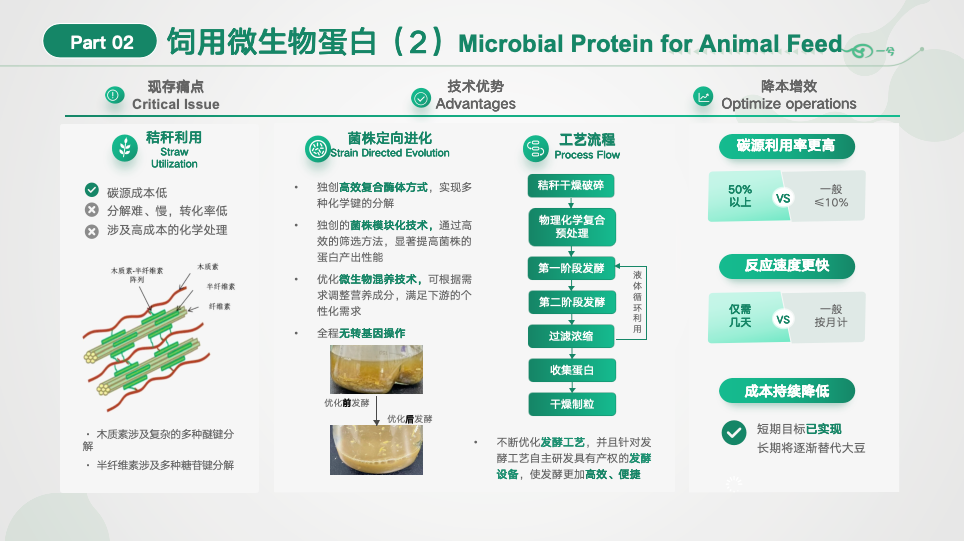
What approach do we use? Ferment the straw; after fermentation, protein is produced. You may not see this clearly in the image. This is wheat straw; after our fermentation, the protein concentration is essentially comparable to milk. Milk is roughly 3-point-something percent protein, right? After our fermentation, measured protein content is basically equivalent to milk — achieved in under five days.
In future feed production, we can eliminate soybeans. Animal husbandry consumes massive grain quantities, with feed comprising three main categories. First: energy, currently mainly corn. Second: protein, currently with roughly 75% coming from soybeans. Third: vitamins and minerals. Our solution can directly replace the protein component, while also addressing mineral and partial vitamin sources. Microbial protein surpasses traditional soybean meal in virtually every aspect.
China's annual straw production is roughly over 900 million tons. Using our technology, collecting less than one-third — under 300 million tons — could solve all animal husbandry protein needs. Beyond imported soybeans, most domestic amino acid production also serves animal husbandry; this would no longer require consuming grain for amino acid fermentation. This effectively increases China's food supply and can help feed more people globally. We reutilize the "straw" portion of the grain-to-straw ratio. This effectively adds roughly one-third to global arable land equivalent. If Earth currently supports 9 billion people, with the same arable land, our technology could support at least 12 billion.
Beyond these, we've also developed natural pigments and other products — I'll mention just these two examples.

We all know life science is extraordinarily wondrous.
There's an American company called Colossal. Their idea is to resurrect mammoths — Elon Musk even reposted this on X. They've already resurrected the dire wolf, extinct in North America for over 10,000 years, and are now preparing to resurrect mammoths, with plans to eventually bring back dinosaurs.
This resurrection has a viable pathway. For example, working backward from birds, from chickens, to reverse-engineer dinosaurs, or reconstructing from fossils — this is their approach. I don't think achieving Jurassic Park-style human-dinosaur coexistence is necessarily very difficult; it may not take long. If we can resurrect creatures extinct for over 10,000 years, we can resurrect those extinct for 1 million or even 10 million years.
This forward-looking approach doesn't interest me. What interests me more: humans have existed on Earth for a long time. We face enormous disruption — everyone says the intelligent era is coming. What should we do? Simply wait to be eliminated? Everyone ponders this. What I want to do: what next for humanity? Seeing robots today, I wonder: can we incorporate machine functions into ourselves, rather than passively awaiting extinction? Consider Alien — might we humans draw inspiration from that?
Elon Musk's idea is sending humans to Mars as backup. If a flood is coming, Musk's approach is essentially building an ark to transport humans elsewhere. But my thought is: when the flood comes, why don't we learn to swim? In The Three-Body Problem, there's a passage: "The sea is drying. The puddles will dry too. All fish will eventually disappear. But the fish who dried the sea are not here — they went ashore before the sea dried." We humans too must not wait for extinction, but actively integrate into the new era.
If the future truly requires massive computational power, or if other silicon-based life emerges, why don't we modify ourselves to become stronger? Why not provide ourselves with better computational capacity, or endow humans with new capabilities? For example, if we find human lifespan too short, when redesigning life we could remove lifespan limits. And beyond that — we could open far more imaginative possibilities for humanity.
We know our brains are shaped as they are not because they can only grow so large, but because evolution struck a balance under chronic food and energy scarcity. Your body today is also an evolutionary adaptation. But many problems that once plagued humanity are now solved. Most humans no longer spend their days searching for food or facing severe food shortages. Among our roughly 20,000 genes, a substantial proportion address food scarcity and infection. If we could redesign life, we could genuinely improve the human species. If embodied intelligence is needed, I think we humans are already excellent examples.
Redesigning life could solve many medical and other problems — work we're already pursuing. Of course, redesigning life differs from what people imagine. As I mentioned, the smallest independently viable genome still contains over 700 genes. Seven hundred genes represents enormous computational complexity — it's not simply stacking 700 genes together. Gene-gene interactions form extraordinarily complex networks. Genes don't exist in a vacuum; every gene, every protein operates within a confined space. Thus design requires addressing countless gene-gene interaction issues, demanding massive computation.
Today's computational power — what people call the compute revolution — provides humanity with a new opportunity. I mentioned that information, materials, and tools have been solved. Now, if computational power is also sufficiently robust, I believe a new era will arrive — an era when humanity can truly redesign life.
If previous life sciences represented traditional life sciences, then with AI and the explosion of computational power, a new era of life sciences has arrived. We hope to achieve breakthroughs in this field — a bit of self-salvation for carbon-based life.
In fact, I believe carbon has advantages over silicon in the universe. We know the most abundant element in the universe is hydrogen, followed by helium, then oxygen and carbon. Helium is a noble gas with no chemical bonds. Beyond helium, the most abundant elements are hydrogen, oxygen, and carbon. The three most abundant elements in life are also hydrogen, oxygen, and carbon. Carbon holds significant advantages in many respects.
May we carbon-based life forms journey farther. Thank you.