Agentic Era: Believe in Innovation, Believe in the Future | Oasis Capital 2025 Annual Meeting

Counselor Vitality

On November 13, Oasis Capital held its Annual General Meeting (AGM) in Shanghai.
The event was themed "Bridging Vitality, Building the Future", carrying forward the firm's core value of nurturing life force.
This year's AGM adopted a hybrid offline-online format, bringing together investors, founders of portfolio companies, and industry partners for in-depth discussions on AI technological progress, embodied intelligence pathways, and structural social transformation.
Event footage
At the event, Hillbot co-founder Professor Su Hao and Spirit AI co-founder Professor Gao Yang joined Oasis for a roundtable on "Technological Advances in Robotics and AI."
Dr. Liu Zhenyun, founder of Yixi Biotech, and Professor Zhang Wei, founder of LimX Dynamics, delivered keynote speeches on "Next-Gen Biotechnology" and "Next-Gen Humanoid Robots" respectively, each addressing their specialized fields.
As a next-generation venture capital firm, Oasis used this AGM to systematically present its long-term observations, investment strategies, and tangible results in AI and frontier technology amid accelerating global AI transformation. The firm also sought to explore with entrepreneurs on the cutting edge how to sustain innovation and vitality in the coming Agentic Era — to keep nurturing life force.

In his keynote, Jinjian Zhang, founding partner of Oasis, took a macro-historical perspective, emphasizing that technological evolution brings not just efficiency leaps but deep structural transformation of society.
Every leap in civilization has been accompanied by a shift in the primary productive force.
He traced this from the foraging age centered on "humans," to the agricultural age of "livestock and plow," to the industrial age dominated by "machines." Now, with AI accelerating, humanity is entering a new era led by Agents:
"All productivity going forward will become Agent-based."
AI is not merely an assistive tool, but a "new subject" capable of autonomous decision-making, executing complete workflows, and continuously interacting with its environment. This means the basic working unit of future enterprises may be collaborative systems composed of multiple intelligent agents:
"When you go meet a founder in the future, you might just bring an AI analyst — it understands context, reads emotions, automatically records key points, and generates assessments."

Meanwhile, AI development will fundamentally reshape organizational structures. From large corporations to communities, organizations will become increasingly small-scale, fluid, and intelligent:
"The most powerful organizations of the future may be communities of just a dozen or so people."
As new protocols like HTTP 402 and 8004 gradually proliferate, AI agents will directly transact, verify, and incentivize one another, and the attention economy as we know it will collapse:
"AI doesn't care about your fame. It only cares whether your content provides context."
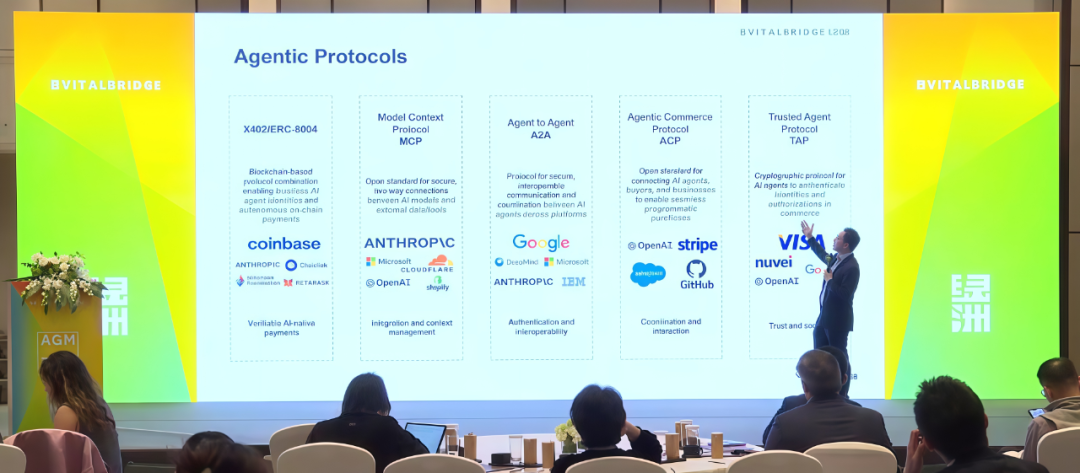
Concluding his speech, he framed this transformation as the dawn of a new era: the Agentic Era. Agent-led new productive structures are reshaping the underlying logic of human society.
This is also the future direction Oasis is firmly committed to investing in.

Following the Agentic Era theme, Oasis invited Hillbot co-founder Professor Su Hao and Spirit AI co-founder Professor Gao Yang for a dialogue on "Technological Advances in Robotics and AI."
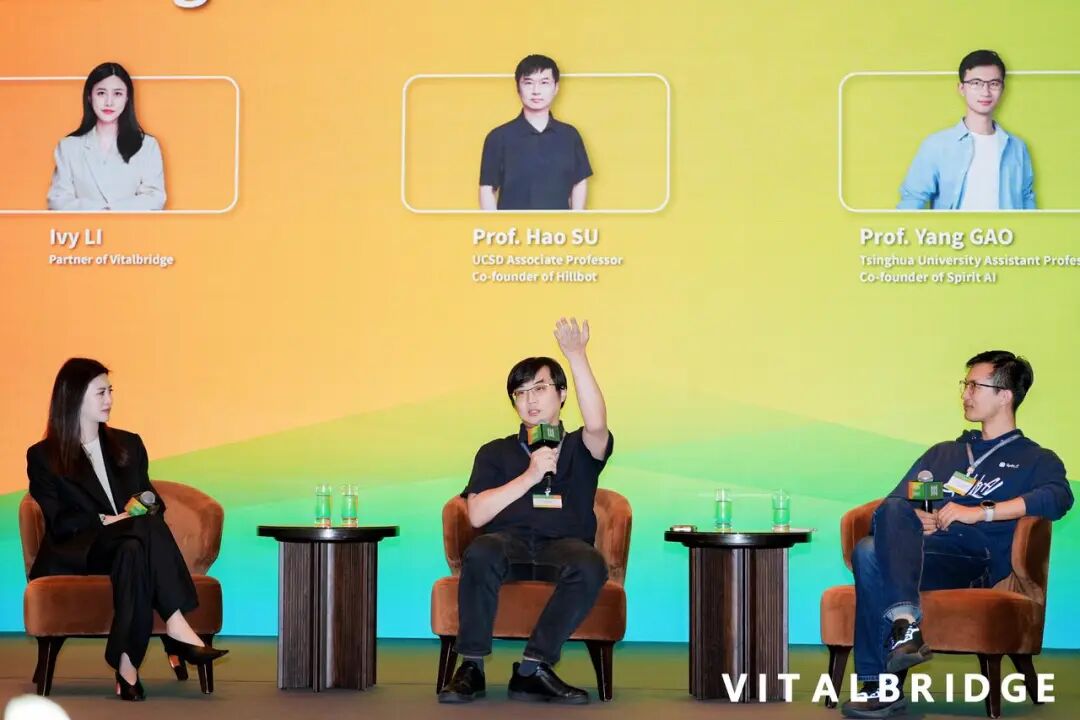
The two speakers systematically explained the latest research progress and technical challenges in embodied intelligence from the perspectives of world models, vision-language-action systems (VLA/VLM), robotic embodiment structures, and data collection systems.
Professor Su Hao noted that while current mainstream models perform well on closed datasets, they still show a "lack of causal understanding" when faced with complex scenarios:
"The model looks strong enough, but once you put it in a real environment, you realize it doesn't actually know why it succeeded."
Professor Gao Yang, approaching from the model's comprehension capabilities, further emphasized the necessity of environmental predictability for embodied intelligence:
"When a model has predictive capability, it is already an Agent in the minimal sense."
Both agreed that the core competence of future embodied intelligence companies will be built on the synergy of "model × control × data × structure." With domestic enterprises' growing capabilities in compute scheduling, autonomous robotic embodiment R&D, and large-scale data collection — combined with first-mover advantages in supply chain systems — China is entering a strategic window period that cannot be ignored in this globally competitive race.
The two founders also expressed that Oasis stands at the forefront of this era, supporting entrepreneurs not only with capital but with deep dialogue and long-term trust, becoming an important companion in their processes of technical iteration and critical decision-making.

Dr. Liu Zhenyun, founder of Yixi Biotech, presented under the theme "Next-Gen Biotechnology," demonstrating synthetic biology's progress in scalable manufacturing and engineering implementation, grounded in his company's current development.
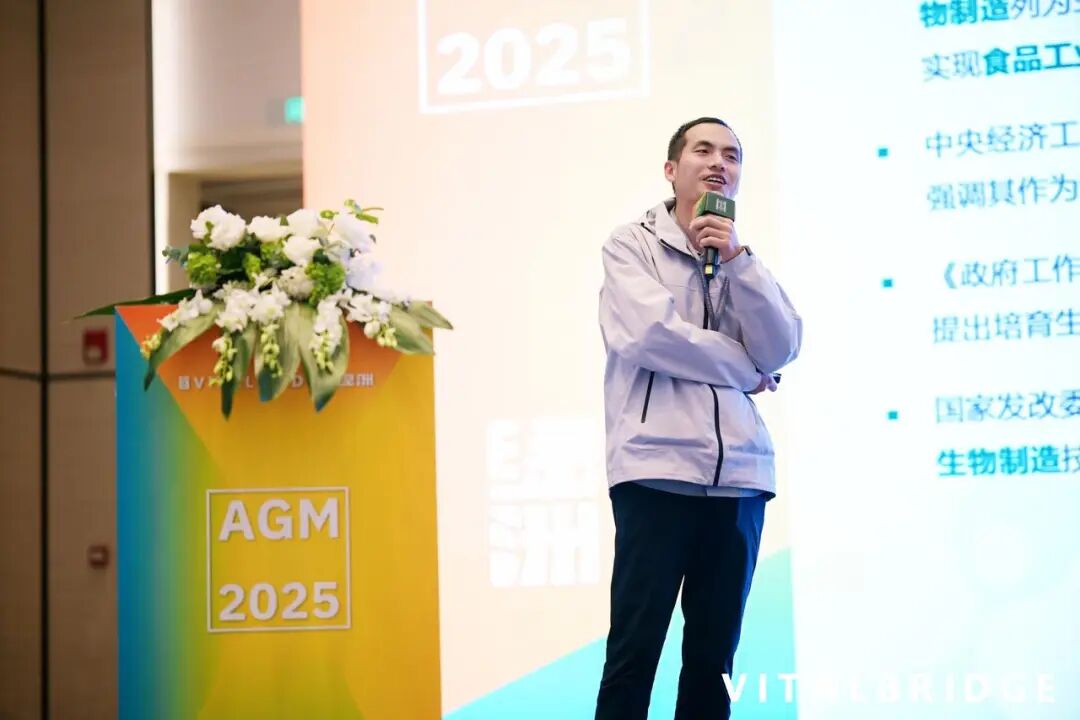
"We built China's first HMO production line, which is also about to become the world's highest-capacity factory."
As a technology pioneer, Dr. Liu's team achieved stable mass production of HMOs through techniques modifying microbial metabolic pathways, demonstrating strong capabilities in synthetic pathway design and engineering translation.
He further argued that against the backdrop of intensifying global land and food supply contradictions, synthetic biology is gradually evolving into the underlying infrastructure of next-generation supply systems:
"China needs 2.8 billion mu of arable land to feed 1.4 billion people, but our actual arable land is less than 2 billion mu."
Synthetic biology represents not just an emerging industry but also an expression of progress in life sciences, and holds promise as one of the infrastructures for ensuring sustainable human development.

In the humanoid robot keynote, Professor Zhang Wei, founder of LimX Dynamics, delivered a systematic presentation on "Next-Gen Humanoid Robots."
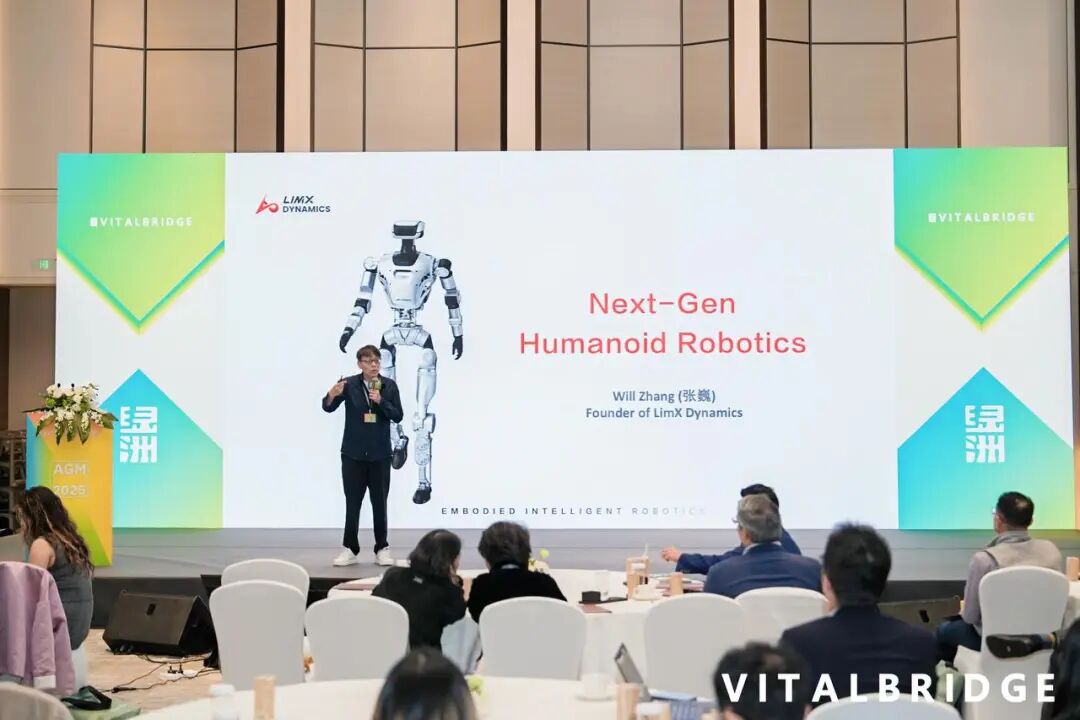
He argued that compared to non-humanoid designs, humanoid robots hold irreplaceable advantages in versatility, environmental adaptability, and transferability of control strategies:
"For robots to ultimately replace human labor, they must operate in a world built for humans."
Zhang showcased LimX Dynamics' latest progress in robot configuration, self-developed key components, cerebellar control models, and training data closed loops:
- High-degree-of-freedom, low-cost modular embodiment
- Rapid control system training based on human motion demonstration
- Model-plus-engineering integrated architecture optimized from the control side
His assessment:
"Humanoid robots aren't about 'can they be done' — they're about 'when do they become the mainstream form.' They will be the best vehicle for computational intelligence and the next-generation super terminal."
LimX Dynamics' progress marks China's engineering implementation efficiency and model integration capabilities in the humanoid robot race as globally cutting-edge.

This year's AGM conveyed a clear judgment from Oasis:
In this window where technological leap and structural transformation overlap, Chinese innovation is showing the possibility of systematic breakthrough. And the true value of investment lies in becoming the most solid bridge connecting entrepreneurs to the future.
Oasis Capital will continue to focus on AI, embodied intelligence, advanced manufacturing, and other key directions, deeply cultivating long-term opportunities in the Agentic Era, firmly supporting entrepreneurs with global vision, and driving toward a more vital future.
In the coming days, we will compile the speech transcripts and share them with you in text and video form, looking forward to deeper exchange and discussion with you.
Nurturing life force.