Professor Jun Wang, UCL: A New Data Paradigm for AI Employees | Agent Insights

Counselor Vitality / Counselor of Vitality (Note: This appears to be a fragment without context. "参赞" can mean "counselor" (diplomatic title), "advisor," or "to participate in planning/support." "生命力" means "vitality" or "life force." If this is a title or brand name, it could be rendered as "Vitality Counselor" or "Counselor of Vitality.")

As data continues to be generated and accumulated in work environments, data science has become the operational core across virtually every industry. The immense potential of large language models in data science remains largely untapped. How can data science evolve to better support organizational decision-making, business optimization, and comprehensive efficiency gains? Professor Jun Wang of the Computer Science Department at University College London (UCL) has developed DS-Agent, an innovative case-based reasoning approach that dramatically enhances automated problem-solving capabilities in data science — building on traditional BI to improve efficiency across generalized scenarios. Enjoy
"DS-Agent: Automated Data Science by Empowering Large Language Models with Case-Based Reasoning"
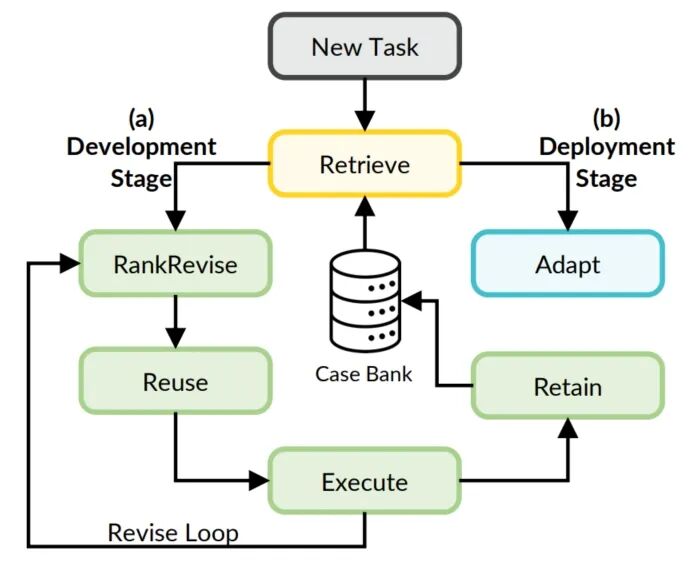
DS-Agent overall framework
Problem Addressed: Data science encompasses critical stages including data collection, processing, modeling, and prediction — a complex process that is nonetheless essential for enterprises and research. Traditional machine learning applications in data science require substantial time to accumulate sufficient fine-tuning data, and the backpropagation process demands considerable computational resources. DS-Agent leverages case-based reasoning to continuously accumulate experience from past problems, reusing case solutions when encountering new challenges to ultimately enhance data science problem-solving capabilities.
Model Framework: DS-Agent employs case-based reasoning to analyze, extract, and reuse human expert insights from Kaggle (the world's largest data science competition platform), iteratively refining solutions based on actual execution feedback.
Performance: With DS-Agent, even users without programming knowledge or machine learning training can solve complex data analysis problems and derive deep business insights, delivering significant cost-efficiency improvements for enterprise data departments.
Applications: Any automated workflow requiring data science processing, including marketing, finance, state-owned enterprises, and other scenarios.
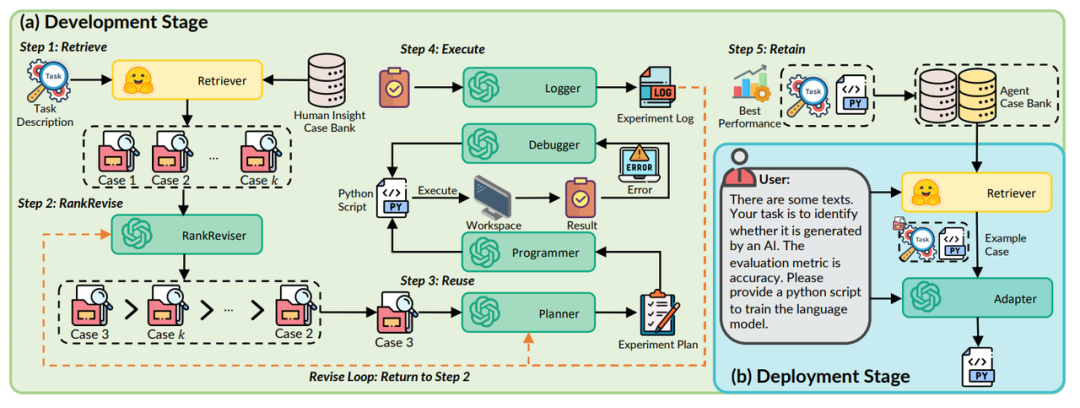
DS-Agent development phase and deployment phase
Evaluation Results: During development, DS-Agent using GPT-4 achieved 100% success rate on data science tasks for the first time. Notably, DS-Agent with GPT-3.5 even outperformed the strongest baseline, ResearchAgent, running on GPT-4. In deployment, DS-Agent with GPT-4 achieved a near-100% first-attempt success rate for the first time, while boosting the open-source Mixtral-8x7b-Instruct model's first-attempt success rate from 6.11% to 31.11%.
DS-Agent development phase performance evaluation results
Oasis Capital: In DS-Agent, you designed a CBR (Case-Based Reasoning) approach for Kaggle data retrieval and learning. Could you walk us through your thinking behind this design choice?
Professor Wang: First, data science represents the largest application in enterprise B2B scenarios. Any corporate work environment involves computers, which generate substantial data during operations — data science is the core of how enterprises run. From a machine learning perspective, LLMs have brought transformative changes to data science, introducing the Copilot concept that helps data scientists effectively tackle long-tail problems. Previously, large enterprises faced high costs for data science analysis and could only address major machine learning challenges. The arrival of LLMs has reduced certain costs while enabling solutions to long-tail problems that were previously intractable, allowing agents to generate diverse applications in the data science domain.
In early database systems, predictive analytics, process visualization, and result generation all required code generation. Within our DS-Agent framework, we utilized CBR as a self-evolving learning method. Traditionally, the core of machine learning has been backpropagation — essentially predicting Y given X, finding the relationship between X and Y through multiple data points to achieve generalization for new X values. However, this approach has several pain points: it requires substantial computing power, training and testing are separated, and it's not the most efficient method. In this process, electricity basically turns into heat (laughs).
A significant advantage of LLMs is their long context window, meaning different historical data in the context produces different results. Therefore, we don't necessarily need backpropagation; we can use prompt engineering to guide outcomes. This allows us to input all historical experience as prompts through case-based reasoning, repeatedly telling the model about certain problems until it remembers them, achieving generalization to new problems at a certain threshold. Throughout data science history, numerous code contributions have been made to solve specific problems with varying performance. These constitute a case database, which we extract through case-based reasoning and train based on different performance feedback. This method effectively addresses long-tail problems, remembers cases, and enables direct retrieval when similar problems arise — achieving a self-evolving effect of continuous improvement.
Historical case-based reasoning lacked the summarization and generation capabilities of large language models, relying primarily on similarity measures akin to earlier recommendation systems. LLMs can effectively summarize case-based reasoning results and imbue them with meaning. Thus, we made the first attempt to organically combine LLMs with case-based reasoning, truly understanding the feedback effects of case-based reasoning. Next, we will explore drawing inferences from reasoning, which we call Tutorial-based Reasoning. Imagine giving an LLM a chess tutorial, enabling it to comprehend the tutorial and ultimately learn to play chess. Leveraging LLMs' language understanding capabilities combined with CBR's case-based reasoning abilities opens new possibilities for machine learning.
Oasis Capital: While maintaining optimal machine learning solutions in the repository reduces costs, won't this create storage burdens over the long term?
Professor Wang: Indeed, that's a valid concern. Current context lengths can reach 1 million or even 2 million tokens, so we're considering using retrieval to improve efficiency — distinguishing what needs to be stored in memory versus what is redundant or useless and doesn't warrant storage waste. In the current industry, everyone is working to extend context lengths, yet research on how to conduct retrieval as data volumes increase remains relatively superficial. Present methods mainly involve similarity measures like Top 10 Token, then feeding these similar tokens into attention mechanisms.
To address this, we've proposed two improvements. First, rather than token-level retrieval, we adopt segment-level retrieval — for instance, grouping 256 tokens into a segment, which significantly improves efficiency. Second, we aim to enhance information retrieval methods, moving beyond mere keyword matching to more relevance-based approaches; relevance-based retrieval models are also a direction of current interest.
Oasis Capital: Which industries could draw inspiration from applying the CBR framework in data science?
Professor Wang: In the B2B domain, massive amounts of data require process automation — banks, investment banks, state-owned enterprises, and so forth. Case-based reasoning can help automate entire data processing workflows, improving accuracy and automation levels. This encompasses not just intelligent data arrangement for code generation, but also backend decision optimization. In B2C scenarios, such as meeting summarization and edge-side personal data processing, case-based reasoning can similarly provide highly efficient operating system optimization.
Oasis Capital: Indeed, enterprises are highly focused on how to combine LLMs with data analysis to lower barriers and costs, enabling analytical results to better support management and business development. Several of our portfolio companies have made excellent attempts in this regard. For example, DataGPT, Arctic Nine's self-developed conversational data analysis platform, serves clients including State Grid Corporation of China and China Energy Investment Group.
Oasis Capital: How do you define AIGA (Artificial Intelligence Generated Agent)? What is its significance?
Professor Wang: From the internet perspective, the internet has fundamentally enabled human-machine interaction — search, online shopping — while also enhancing online interpersonal communication. AIGA introduces machine-to-machine communication scenarios; in the future, bots might hold meetings, compare notes, and complete a meeting among themselves. The shift from AIGC to AIGA represents a transformation of the entire internet. Of course, achieving complex decision-making and coordination in this process still faces considerable generation challenges.
Oasis Capital: What does reinforcement learning mean for agents?
Professor Wang: This is a double-edged question. Reinforcement learning excels in scenarios like chess and advertising recommendation, but its generalization capabilities may fall short in other contexts. Moreover, reinforcement learning training requires large-scale simulated data — precisely where LLMs' efficient generalization capabilities can compensate. At its foundation, AIGA still relies on LLMs, which can offset many of reinforcement learning's shortcomings.
Taking chess as an example, the learning process essentially involves teaching an agent winning strategies, fundamentally building a world model through repeated training to achieve proficiency — AlphaGo followed this approach. As the agent continuously learns prior knowledge, the world model brings it greater intelligence. Without establishing a world model, an agent can never understand the real world, and true intelligence can never emerge.
The essence of reinforcement learning is inductive bias — summarizing patterns from a dataset. Current research on reductive reasoning remains insufficient. Reinforcement learning's understanding of the world, combined with LLM-based agents' powerful generalization capabilities, can solve many unknown problems.
Recent papers have discussed how Next Token Prediction minimizes prediction error, but research shows its capabilities are inherently limited. The Transformer architecture itself prevents the model from understanding physical laws, creating an insurmountable bottleneck. We must use methods like reward maximization to understand edge cases in the world, ensuring agents follow rules — this is the essence of reinforcement learning. Through scoring feedback, models continuously improve. One of the best current implementations is OpenAI's Q-star. Our team recently proposed TDPO (Token-level Direct Preference Optimization), a fine-tuning method following the same principle.
Oasis Capital: Reinforcement learning typically achieves better results in environments with abundant data and dense feedback. Is achieving ideal results more challenging when applying reinforcement learning in the physical world?
Professor Wang: From a safety perspective, some scenarios with high precision and safety requirements — such as embodied intelligence and autonomous driving — require introducing regulatory control methods on top of reinforcement learning, even establishing certain rules to ensure safety. For example, Model Predictive Control (MPC) for embodied intelligence shares origins with reinforcement learning. Additionally, in robot-LLM integration, building world models — particularly in 3D scenarios — is crucial, requiring strong environmental modeling and simulators. Meanwhile, solving the Sim2Real problem is also essential for optimizing reinforcement learning effectiveness in physical-world applications.
Oasis Capital: What changes would you like to see in AI and the agent space?
Professor Wang: In the near term, I look forward to seeing AIGC evolve into AIGA, with AIGA solving practical problems. If AIGA can make decisions with contextual awareness like GPT, that would be tremendously valuable. In data science, imagine multiple people interfacing with specific data — describe a particular problem to an agent, and two hours later it delivers a complete solution. The efficiency gains across all workflows would be enormously exciting. In the long term, as hardware matures, I also look forward to household robots entering homes.
Oasis Capital: We previously saw your work on StarCraft II, "Large Language Models Play StarCraft II." We'd love to hear your insights on the future development and application space for LLM-based agent technology.
Professor Wang: This is quite interesting. Everyone is exploring applications for LLM-based agents, with diverse approaches, but there isn't yet a definitive killer application. Data science is one scenario; robotics is another promising direction. I believe we're in the darkest hour before dawn — that thin membrane is about to be pierced.