From DJI to Wuyun Innovation: How He's Using AI to Redefine Traditional Hardware | Vital View

"Everyone said it wasn't needed. That only made me more certain."

Zettlab, an Oasis Capital Pre-A lead portfolio company, has recently closed a new round of funding worth tens of millions of RMB, led by Starlink Capital with joint follow-on investments from Vertex Ventures and Fengqiao Capital.
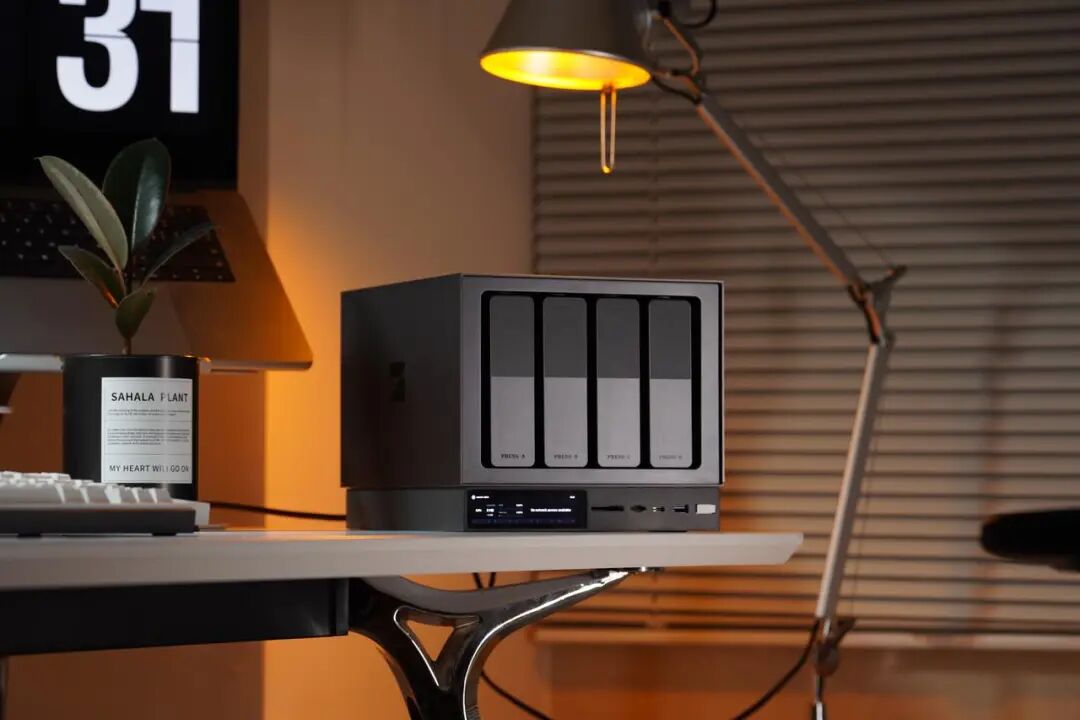
At a time when data volumes are surging and privacy risks are mounting, traditional cloud drives face security and subscription cost concerns, while conventional NAS (Network Attached Storage) devices, though capable of centralized storage, remain complex to operate and lack intelligence. Zettlab has pioneered the AI NAS category, transforming storage from passive archiving into "active understanding, automatic management, and intelligent generation" — truly enabling "data to think at the source."
We are republishing and sharing an interview with Zettlab founder and CEO Yanan Guo; full read time is approximately 12 minutes.
Enjoy
In this year's primary market, Zettlab is absolutely a "unique" project.
It has the qualities investors currently favor most: a team from DJI, vertical AI NAS hardware, technical moats, and — crucially — solid crowdfunding results.
But founder Yanan Guo's emotions no longer swing with praise or skepticism.
In 2023, when the primary market's funding environment was at its worst, Guo resigned from Cloud Whale. Almost everyone expressed bewilderment, yet he believed that "everyone's standing at the same starting line, everyone's swimming naked — (at a time like this) the opportunities are definitely the best."
Guo plunged into NAS, a rather niche and traditional category. NAS stands for Network Attached Storage; simply put, it's a private cloud whose basic functions are storage, network connectivity, and some computing capability.
Across the entire market, enterprise users account for roughly 60% of NAS market size, with manufacturers based in Taiwan holding relatively stable positions; the remaining 40% comes mainly from consumer and small-to-medium studio users, a more fragmented segment divided among enterprise NAS vendors and hard drive manufacturers.
But NAS had never intersected with AI. When the team conducted user research, NAS users said they didn't need AI. When advertising overseas, people would curse at them: "Fancy words, nothing useful." The negative feedback and skepticism were intense — almost no one could see the vision for AI NAS.
Guo trusted his instincts as a technical engineer.
As early as 2014, he began engaging with AI, debugging autonomous driving algorithms in the ice and snow of Mohe to build his student-era first self-driving vehicle. From DJI to Cloud Whale, Guo was always responsible for AI-related business, witnessing AI capabilities grow increasingly rich along the way. In his view, NAS without AI is the counterintuitive position.
As the convergence point for users' private data, NAS is one of the ideal platforms for hosting localized AI agents. Next-generation AI products will make data volumes ever more massive; how to use that data will become the challenge. In Zettlab's product vision, AI can process vast on-device video data: searching, organizing, interpreting, even editing.
The market has indeed proven his judgment correct. On the crowdfunding platform Kickstarter, Zettlab received over $1.4 million in backing, with 80% of users purchasing for the AI capabilities. Zettlab's previous shareholders include Oasis Capital and Delian Capital, and it recently completed its third funding round from Starlink Capital, Vertex Ventures, and Fengqiao Capital, totaling tens of millions of RMB.
Hard Kr interviewed Zettlab founder and CEO Yanan Guo to review his entrepreneurial journey and discuss his outlook on the AI NAS market. Below is the edited transcript:

Hard Kr: NAS is quite a niche track. Why did you consider entering it?
Yanan Guo: AI over the past decade has been "distributed." Your door lock, security camera, and TV each have AI — tiny chips costing a few dollars that enable some functions, but what they can do is very limited.
This generation of AI is different. For it to truly work, it needs a "central node" that simultaneously has computing power, bandwidth, and storage. So we saw the opportunity here — NAS is naturally a small-scale data hub, capable of aggregating these AI capabilities.
You could say we're evolving from previously "siloed" distributed intelligence toward "collaborative" aggregated intelligence, and that's exactly why we decided to enter the NAS space.
NAS itself is niche and storage-oriented. We want to first get storage right, then layer on AI and computing. These users care more about localized storage and privacy, so we can capture them more easily.
Hard Kr: Does your entrepreneurial direction also relate to your background? Could you share your background?
Yanan Guo: I graduated from Beijing Institute of Technology, where I studied mechanical engineering for both undergrad and graduate school. Then I went to DJI — I joined in 2016 and started working on AI there. Actually, I was already transitioning before DJI, around 2014. There were autonomous driving competitions domestically and overseas, and I built the first self-driving vehicle by Chinese students at that time.
Doing AI back then was very difficult. Running a detection, recognition, or obstacle avoidance model required hauling a server in the car. We were in Mohe, minus thirty or forty degrees Celsius; the computer would die quickly if used, or shut down if not, because it simply wasn't designed for that environment. But now, autonomous driving algorithms run on chips the size of a fingernail.
Later I joined DJI to work on consumer electronics and discovered that AI functions and algorithms could be integrated into very small phones and drones. Around 2021, I went to Cloud Whale, also responsible for the AI team and some products. From these past experiences, I believe the future on the device side (edge) is tremendously promising. I also have the capability to execute cross-domain projects combining "AI + hardware + storage."
Hard Kr: The team is also very important for hardware. What's your internal team like?
Yanan Guo: Our people come from DJI, Huawei, ByteDance, and Li Auto. We've worked on drones, robot vacuums, written algorithms, built system foundations, and done integrated marketing and international markets — hardware + AI overall is a good match.
And everyone shares a consensus — we like technology and products that can truly land and be perceived by users.
Hard Kr: Though, when you started out in 2023, the environment didn't seem great?
Yanan Guo: 2023 was the worst year for investment. Everyone told you not to start a company — what are you doing starting a company now?
Hard Kr: So why did you still decide to do it, and in this field?
Yanan Guo: Because OpenAI fired a shot, telling everyone a new era had begun. Everyone's standing at the same starting line; whether big company or small, no one has experience, everyone's swimming naked. Starting a company in that state, the opportunities are definitely the best.
The more it's that kind of stage, the more new species have a chance to emerge.
We later summarized two principles: first, short-term revenue with long-term exponential growth; second, technical moats where we have advantages.
Screen by these two criteria, and there aren't actually many things you can do. We tried some other categories and eventually abandoned them — either too competitive, or the growth logic didn't hold.

Hard Kr: Then you settled on NAS?
Yanan Guo: NAS was a relatively easy direction to think through. First, data will only become more important — all devices eventually converge on a "data hub." NAS naturally has computing power, bandwidth, and storage; it's the ideal vehicle for local AI.
Hard Kr: How did you see the NAS space at the time?
Yanan Guo: I talked with many friends, and quite a few recommended NAS. I'm also a NAS user of over ten years myself — I've used ZSpace, QNAP, and Synology. Another key point: DJI's user base partially overlaps with NAS users, so I could quickly find a cohort of users to interview and analyze pain points.
There was a very counterintuitive phenomenon at the time: if you ask whether NAS needs AI, everyone tells you it doesn't.
Hard Kr: I was also pretty shocked the first time I heard about AI features in NAS.
Yanan Guo: I was looking at discussions in Reddit communities, and almost everyone said "NAS doesn't need AI." Many veteran NAS users are naturally resistant to AI, seeing it as a marketing gimmick.
But from common sense, if data grows and you can't use it, that data is garbage, worthless. AI can help you better use, manage, and even generate data — this is fundamentally aligned with human nature, it's just that negative information was overwhelming at the time.
Hard Kr: I feel like video creators are probably the first group to feel the "storage" pain point. Could you give an example to elaborate?
Yanan Guo: For example, a video creator often doesn't shoot in chronological order.
Maybe filming at home in the morning, outdoors in the afternoon, back home at night — piles of scattered footage. AI can help re-understand and categorize the material, automatically aligning video, images, and text, dramatically improving post-production efficiency.
Also, creators often need to find "a shot from before" — previously you'd dig through hard drives and asset libraries; now a natural language search finds it. That experience gap is disruptive.
Hard Kr: So Zettlab uses AI for video search? Previous NAS products couldn't do this?
Yanan Guo: Let me give an example: you're a sports photographer who shot two hours of a game and need to immediately post short videos of highlights when you get back. How do you find them? Watch two hours. But with natural language search, it clips them for you in under a minute — that's a massive efficiency gain.
Hard Kr: Overseas users care deeply about privacy. How do you balance AI capability with privacy protection?
Yanan Guo: That's why we chose an on-device AI architecture. All core functions can run locally and independently, without relying on the cloud.
Network connectivity is only for the convenience of remote access — for instance, when a user travels and wants to pull up materials.
But all searching, recognition, and intelligent processing happens locally on the device; data synchronization between devices is also P2P direct connection, not passing through third-party servers. This way, AI capability and privacy protection are no longer in tension — they coexist.
For most users, their data exists only in their own devices; security is controllable and trustworthy.