Jensen Huang: AI Will Become a Multimodal, Multi-Embodied General-Purpose System | Vital Views

Counselor Vitality

Since 2023, Oasis Capital has firmly believed that embodied intelligence is not merely an extension of artificial intelligence, but the starting point for intelligence to truly enter the physical world. Based on this conviction, we have successively invested in frontier companies in the embodied intelligence space, including LimX Dynamics, Spirit AI, and Inxbot, positioning ourselves for a future production system where intelligence and the physical world are deeply integrated.
Recently, at Citadel Securities' "Future of Global Markets 2025" forum, NVIDIA founder and CEO Jensen Huang sat down with Sequoia Capital partner Konstantine Buhler to reflect on NVIDIA's journey from its 1993 insight into computing power to its present-day infrastructure building. He further noted: embodied intelligence will become the next phase of the AI revolution — when intelligence acquires a "physical form," it will redefine how society operates.
This was not merely an entrepreneur's talk, but a profound consensus on the future of technological transformation.
We have compiled and recommend this video, hoping to explore these ideas together. The full transcript below takes approximately 20 minutes to read. Enjoy.
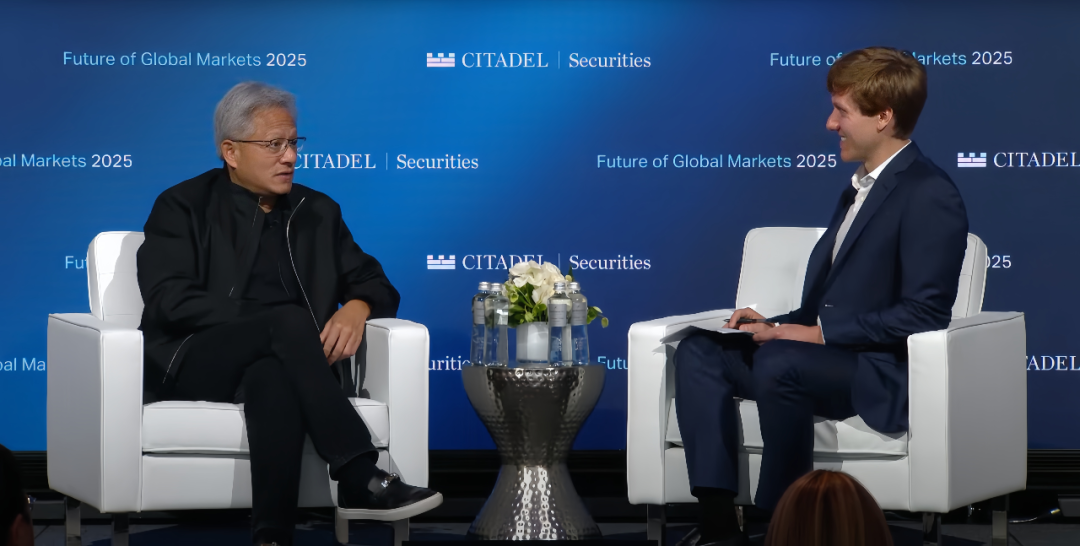

Konstantine: In 1993, you were 30 years old. What was the insight that gave you the opening to create NVIDIA?
Jensen Huang: We were in the midst of the personal computer (PC) and central processing unit (CPU) revolution — the era of Moore's Law. At the time, integrated microprocessors, Intel, Moore's Law, transistor scaling — these were the hot topics. Nearly all of Silicon Valley's investment capital was flowing into these directions in computing.
But we noticed something different. We said that one advantage of CPUs is their generality, but the fundamental problem with general-purpose technology is that it's very difficult to excel at extremely complex problems.
So we proposed two hypotheses:
First, we observed that there were problems that could be solved by "accelerators" — something more specialized, more domain-focused — and that these problems themselves were immensely valuable to research and solve.
Second, we also noticed that the transistor scaling upon which general-purpose computing depended would eventually hit limits. Continuing to shrink transistors, relying on this "scaling" technology — actually a set of empirical rules known as Dennard Scaling; in fact, the underlying principles behind Moore's Law were proposed by Mead and Conway. Going back to these fundamental principles, you realize that transistor scaling cannot continue indefinitely. There will inevitably be diminishing returns.
We believed that there were almost infinitely large problems in computing. At some point in the future, an entirely new form of computing would emerge. So we decided to focus our company on a technology called "Accelerated Computing" to augment and complement general-purpose computing. That was our core insight.
You also mentioned a point: NVIDIA is always one step ahead. Often, if you reason from first principles — asking what foundational principles underpin something that works very well today, and how those foundations will change over time — it gives you the opportunity to foresee inflection points in advance.
Konstantine: When you first developed graphics accelerators, you were indeed among the earliest entrants. Soon hundreds of competitors emerged, and ultimately you stood out in that market.
Moving into the early 2000s, you had an idea: "Maybe this technology can be generalized." You meant that, just as the CPU was a general-purpose processor, perhaps the GPU could be generalized into a broader computing platform.
Let's talk about CUDA. How was this idea born? Where did your inspiration come from? There's a rumor that it came from researchers — how did you read their work and conclude that the GPU could become a general-purpose computing device?
Jensen Huang: First, NVIDIA was difficult to build because we had to simultaneously invent a new technology and create a new market. In 1993, if you wanted to build a new computing platform, you needed a market large enough to sustain it. But companies doing 3D graphics back then, like Silicon Graphics, were in markets too small to support a new computing platform. In other words, if we wanted to create a new computing architecture, we needed a large market; but that market didn't exist because the architecture itself didn't yet exist — the classic chicken-and-egg problem.
NVIDIA ultimately succeeded because we developed two capabilities along the way: first, the ability to build the technology itself; second, the ability to cultivate the modern 3D graphics and video game market. We made enormous contributions in both areas.
However, the biggest concern Sequoia Capital had when evaluating NVIDIA's funding plan was precisely this: we were trying to simultaneously invent technology and market. And the probability of both happening together was approximately zero.
I still remember when I went to pitch, Don Valentine asked me: "Jensen Huang, where is your application? What's your so-called 'killer app'?" I replied: "Oh right, there's a company called Electronic Arts." I didn't know at the time that Don had just invested in that company. I continued: "Electronic Arts is developing video games. We're going to help them make 3D graphics games, and together we'll create this market." Don smiled and said: "You know what Jensen, we just invested in Electronic Arts. Their CTO is 14 years old and still needs someone to drive him to work every day. You're telling me this is your 'killer app'?"
Anyway, we ultimately did create the modern 3D graphics and video game ecosystem. As you know, it has become one of the world's largest entertainment industries.
And the fundamental problem of 3D graphics is really about simulating reality. If you go back to first principles, 3D graphics is essentially about reconstructing the real world. The core computation behind it is used to reproduce realistic images and dynamic worlds — it's really physics simulation. Linear algebra obviously plays a crucial role as well, which we recognized very early on. The question then became: how do you transform a general-purpose computing architecture into a highly specialized system?
This was our company's major innovation. We not only invented the technology but also created the market, while designing a path that would allow us to expand from a highly vertical industry into a more general-purpose computing platform. Such a path is extremely rare and extremely difficult. I don't want to take too much time on the details, but suffice to say, CUDA's birth was both a technical breakthrough, stemming from our observation of how to "generalize" the GPU, and an invention at the product and strategy level.
We had to invent new products and think about how to bring them to market; we had to invent new strategies to gain market acceptance; and ultimately we had to invent new ecosystems to create "flywheel effects" that would allow the entire computing platform to reinforce and grow itself. All of these were created from scratch, entirely new things.
If you step back and think about it, besides ARM and x86, what other computing platform is used by nearly everyone in the world? None. And creating such a new computing platform has almost never happened. In our case, it took us nearly 30 years.
Konstantine: You successfully transformed a highly specialized, high-performance acceleration device into a general-purpose computing tool accessible to researchers and academia worldwide, allowing them to complete computational tasks much faster. The performance bottleneck previously constrained by Moore's Law was dramatically broken through at that moment. So let's fast forward to the early 2010s. At that time, deep learning was still on the fringes of academia. The concept of neural networks had endured a long "winter." It wasn't until 2012, with AlexNet's breakthrough in computer vision, that everything changed. And that breakthrough was achieved through acceleration on NVIDIA GPUs. Was that the moment you realized the AI revolution was truly coming? If so, how did you seize that opportunity? What made NVIDIA the core of this revolution?
Jensen Huang: There were two completely serendipitous moments, plus one profound observation based on first principles, that made all this possible.
The first serendipitous thing was that I was trying to solve computer vision problems at the time. But computer vision back then was extremely brittle, difficult to generalize, and mostly cobbled together from various ad hoc tricks. I was deeply averse to where the field was heading and extremely frustrated by its progress. Meanwhile, one of our company's important strategies was to get more people to use our computing architecture: to let scientists, especially higher education researchers, use our platform — CUDA. So I started pushing CUDA everywhere, from seismic imaging to molecular dynamics, particle physics, quantum chemistry, across all fields. In fact, there was even a strategy inside the company called "CUDA Everywhere," which basically meant: Jensen Huang is going to take CUDA to every corner of the world.
So I started visiting universities around the world, meeting with researchers everywhere. Our push to get CUDA into universities and research institutions led some researchers to reach out to us in 2011 and 2012. At the time, there was a competition called ImageNet being organized by Fei-Fei Li, and Geoff Hinton, Andrew Ng, and Yann LeCun were all working on computer vision — and it just so happened that I was working on computer vision myself. When you're focused on solving a problem and discover a group of incredibly insightful people working on the exact same thing, you naturally get drawn in. That's serendipity. But the more important insight was that we realized we could build them an entirely new computing tool, called cuDNN. It was somewhat of a continuation of "storage computing," which you could think of as "network computing." Through this computing approach — this software library called cuDNN — we enabled all researchers to successfully run their models on CUDA.
The real key, though, was that while we and others saw the same experimental results — everyone saw this massive leap in computer vision performance — we went further and asked: Why is it performing so well on computer vision? And where else could it work? We noticed that deep neural networks are powerful because they can become extraordinarily "deep." Each layer can be trained independently, yet through backpropagation, feedback travels all the way from the loss function back to the input, so the model can learn virtually any kind of function. We concluded: deep neural networks are universal function approximators. If we then add the concept of "state" to them — CNNs are a two-dimensional or multi-dimensional pattern recognition structure; RNNs introduce a state machine on top of that; LSTMs make the state machine stronger; and Transformers bring the "ultimate state machine" — then we have a universal function approximator that can learn almost any function.
The next question was: what can it actually solve? When we thought about it in reverse, we found that nearly every computational problem we wanted to solve could incorporate deep learning. So we started projecting: where will deep learning be in ten years, twenty years? We deconstructed the entire computing problem and ultimately concluded that every chip, every system, every layer of software — every level of the entire computing stack — could be reinvented. And we decided to do it. Without question, this was one of the most correct decisions in NVIDIA's history.

Konstantine: I was doing AI research at Stanford at the time, and the biggest constraint was always compute. We only had limited computing clusters to run these algorithms. NVIDIA's emergence didn't just break through that compute bottleneck — it made large-scale computing truly possible through the CUDA infrastructure. That's pretty much the through-line of your company's history: making more powerful compute a reality.
In 2016, you released the world's first "AI factory," the DGX-1, which is widely known. You even personally delivered that machine to Elon Musk — back when he was still at OpenAI...
Jensen Huang: I had built an entirely new computer. Its appearance, its structure, how it worked — it was completely different from any computer that existed in the world. I remember unveiling it at GTC. The audience was completely silent; nobody understood what I was talking about. It became a bit of a joke — the applause was pretty scattered.
I had invited Elon on stage to talk about autonomous driving, because we were both working on it at the time. After he came up, he asked me: "Jensen, what is that computer?" I said: "This is the DGX-1. I built it for this purpose." He said: "I might need one." A while later I received a purchase order, and he added: "By the way, I have a nonprofit now." I thought: "Oh no — when you've just built a brand new product, the last thing you want to hear is that your first customer is a nonprofit."
But in the end, I really did personally deliver that computer to San Francisco, like a "computer delivery guy." And that company was OpenAI.
Konstantine: At the time, OpenAI was a very "profitable and revenue-generating nonprofit."
Jensen Huang: Yes, we've been working together for a long time. Since then, every single one of their models has been trained on NVIDIA's platform.
Konstantine: Yes, and this thing was physically enormous. When Jensen says "computer," we're not talking about a normal machine — it's a massive piece of equipment loaded with NVIDIA GPUs.
Jensen Huang: When people hear "GPU," they tend to think of small graphics cards. But our GPUs are now rack-scale systems: two tons, 120,000 watts, about $300,000 — that's one GPU. We certainly sell smaller GPUs too, like the kind Geoff Hinton used back in the day, around $500 to $1,000, that you can plug into a personal computer for gaming or AI research and such. But we also have much bigger ones. And if you build a GPU system at the gigawatt scale for an AI factory, you're talking about roughly $50 billion total.
Konstantine: So talk to us about these "AI factories" — the small ones you might call "AI blenders," but then you have the massive ones, the true AI factories. You went all-in on this in 2016 and declared that the world would need AI factories. How did you form that judgment and conviction? Where does that foresight come from?
Jensen Huang: We built the first AI factory, the DGX-1, which was the most expensive computer in the world at the time, $300,000 per node. But its commercial performance wasn't particularly successful. So I reached a conclusion: we hadn't made it big enough.
Later we built the second generation, bigger, and it was a massive success. Then the question became: how big should it actually be? How far should compute be pushed? The reason everything has developed so quickly is because of NVIDIA's product cadence, and the way we innovate and design. We're not "designing a chip" — we're designing the entire infrastructure simultaneously. Today, NVIDIA is the only company in the world that can do this: you give us a building, enough power, and a blank sheet of paper, and we can build the complete system inside it — all the networking equipment, switches, CPUs, GPUs, all the compute technology throughout the entire factory. And all of it runs on the same NVIDIA software stack. Because we can build systems this way, integrated from the ground up, we move incredibly fast. We can redesign the next generation, then redesign the next, and the software is fully compatible between each generation. The greatest value of software compatibility is that it enables tremendous development velocity.
The reason personal computers developed so quickly back then was because they were all compatible with Windows. In other words, as long as you adhere to the same software stack, you can design new chips at whatever speed you want. That's what we're doing now too — we're building AI factories at speeds that are almost at the physical limit. Because we're innovating at such massive scale and using "co-design" — simultaneously improving algorithms, software, networking, CPUs and GPUs — we've managed to break through the limits of Moore's Law, which itself was already slowing down. As a result, we can achieve performance improvements of about 10x with each generation, which is an astonishing level in the industry. We do this because we believe that, just around the corner, there will always be a massive new problem that requires bigger, faster computing. At the same time, as we improve performance while keeping power consumption the same, we continuously reduce the cost of computing. This means customers can accomplish bigger tasks at lower cost, generating more revenue from the same factory.
NVIDIA is widely adopted today precisely because we offer the highest performance, the largest scale, and the lowest cost all at once. If you want to build hyperscale systems, we can do it. And our energy efficiency is extremely high. For example, if your data center has a 1-gigawatt power limit, you can't exceed that ceiling. But if our performance per watt is three times higher, then with the same energy consumption, your factory generates three times the revenue. That's why I call it a "factory" — it's not a data center, it's a factory that produces profit. These AI factories constantly pursue greater scale, greater output, and higher throughput, and that's the fundamental driver of our sustained high-speed innovation. It's also why others struggle to catch up with us, and it explains the root of NVIDIA's success.

Konstantine: Jensen, you've transformed from a single-component manufacturer into a complete platform company — this is precisely the "AI factory" concept. For the investors here today, can you specifically explain what parts this platform includes? And from this point forward, where is this platform headed?
Jensen Huang: Well, this platform is actually quite complex. It includes CPUs, GPUs, networking processors, and three different types of switches. One of them is a "scale-up switch," which integrates an entire rack into a single complete computer — what we invented as "rack-scale computing." And when you interconnect multiple such racks, you achieve "scale-out." These switches and networking systems all run specialized software, with software layered on top of hardware, ultimately forming a complete system. When you connect all of this together, you can build an enormous unified system, as large as an entire building. Such a system requires roughly 100 megawatts of power. And for a 1-gigawatt AI factory, you're talking about thousands of acres. Then you interconnect these data centers with higher-level networking, so all the data centers can operate and think together. That's the platform architecture we're building today.
As for why infrastructure is being built so quickly, that has indeed sparked some discussion. Some have drawn parallels to the dot-com bubble of 2000. But if you look closely, during that bubble you had hospital.com, pets.com — most internet companies weren't profitable. The entire internet industry was maybe $20 or $30 billion. Today's AI situation is completely different. First, you have to recognize that AI isn't just the story of emerging companies like OpenAI and Anthropic. It's fundamentally transforming how all hyperscale cloud companies operate.
For example, search is now AI-driven. Recommendation systems — whether for ads, news, videos, or stories you see — are now generated or optimized by AI. The distribution of user-generated content also relies on AI. In other words, Google's business, Amazon's business, Meta's business — these represent hundreds of billions of dollars in combined revenue, and they're all now built on AI. Even without companies like OpenAI or Anthropic, the entire hyperscale computing industry is already being driven by AI. So the first thing to see is this: the whole stack is migrating from traditional CPUs and traditional machine learning to AI-based deep learning architectures. This technology migration alone represents hundreds of billions of dollars in market scale.
That's layer one. Layer two is an entirely new market forming — what we call the AI market. It's a whole new industry whose core mission is "producing AI." This includes OpenAI, Anthropic, xAI, Google's Gemini, Meta — they're all AI manufacturers. These AI model makers are also building AI factories, and this AI will become the power source for the next generation of opportunities. On top of this layer, new "AI-native" companies are emerging — Harvey, Open Evidence, Cursor, and so on. They'll connect with these AI models and for the first time enter industries that have never been digitally touched before: the labor industry. This is what's called "digital labor," or "agents" — it will integrate into the enterprise market in supplementary and augmenting ways. For example, at NVIDIA, all of our software engineers, chip designers — essentially 100% of our engineering staff — now use Cursor for assistance. We widely deploy these kinds of AI tools internally, so every engineer has their own AI assistant. This dramatically boosts productivity and significantly improves work quality.
At the same time, a new industry is emerging: what's called "physical AI." If enterprise AI is for cognitive and information work, physical AI is for augmenting human labor. For instance, robotaxis are essentially "digital drivers." Going forward, AI will be embedded in everything that moves. In autonomous driving, the vehicle is the steering wheel and wheels; in other scenarios, AI can drive mechanical arms — one, two, or multiple legs, taking various forms. These two industries — enterprise AI and physical AI — correspond to roughly $100 trillion in global economic activity. And now, for the first time, humanity has technology that can truly augment this portion of economic activity. This is why the world is so excited about the next wave of AI.
Konstantine: Let's talk about the wave before AI, since you mentioned AI is already delivering ROI. For the investors here, Meta is a great case study. In Q4 2022, Apple essentially removed ad attribution data from Meta, and Meta lost hundreds of billions in market cap. The question Meta's team faced was: "How do we solve this?" Their ultimate solution: AI systems powered by NVIDIA GPUs.
Through AI, they rebuilt their ad attribution models and restored system performance to previous levels. This drove a powerful recovery in market cap — not just recovering the losses, but adding over a trillion dollars above the lows. And all of this ROI was fundamentally built on compute power provided by NVIDIA GPUs.
Jensen Huang: The core system Meta uses — actually not just Meta, nearly all large internet companies use it — is an extremely complex software system called a recommender system. It primarily contains two foundational technologies: The first is collaborative filtering, which works by analyzing what I'm doing and observing other users' behavior patterns. If our patterns are similar, the system recommends the same movies, the next item on a shopping list, books, or videos. The second is content filtering, which matches based on user characteristics and preferences combined with the content's own attributes. For example, based on a book's subject matter and my past reading interests, the system can judge whether to recommend it to me. Recommender systems are actually one of the world's largest applied software ecosystems. And now, this entire ecosystem is migrating to AI-driven architectures at extremely high speed. This means massive numbers of GPUs will be needed to support everything going forward.
Konstantine: These systems first became widely known through Netflix's recommendation algorithm competition over twenty years ago. Today, all of Netflix's content recommendations are completely AI-driven. Similarly, as you just mentioned, on Amazon when you purchase products, a substantial portion of recommendations are actually generated by AI recommender systems. Search has also been fully taken over by AI.
Jensen Huang: Search is shifting entirely to AI-driven, the whole stack is supported by AI. TikTok runs on AI, Google Shorts too. These products couldn't exist without AI. All personalized advertising is now shifting to AI as well. So the scale of AI applications is already unimaginably large. And note, these are still "traditional" application scenarios. Next, quantitative trading will also shift entirely to AI. The feature extraction process that was previously done manually is being replaced by AI.
Konstantine: I think this is exactly the area where Citadel Securities has been leading for over two decades — this could be called the quintessential example of "traditional AI."
Jensen Huang: Citadel is an important customer of ours, very grateful to them.
Konstantine: This is a classic case. For investors focused on AI ROI, these results are already manifesting in trillions of dollars of market cap. So let's talk about future investment. By 2025, global AI-related investment could reach as high as $500 billion. Where do we go from here? Does this evolve into an industry category with trillions of dollars in annual investment?
Jensen Huang: Yes, from a manufacturing perspective, the "foundries" of AI are essentially the model developers. You can analogize them to wafer manufacturers in the semiconductor industry. And above that, the application layer of AI — especially large language models — can be viewed as the "operating system" of modern computers. All AI applications are built on top of these models, and not relying on a single model but an entire coordinated system of models working together. So the key question is: what does the application space look like above this model layer? Beyond the traditional applications we've already seen being transformed by AI, a more intuitive analogy is "digital humans." For example, AI software engineers — code-generating AI — this could be a multi-trillion-dollar market. Next we'll see AI nurses, AI accountants, AI lawyers, AI marketers, and so on. We collectively call this category "agentic AI." This technology is developing extremely rapidly. Historically, technology has been "tools that are used" — used by accountants or engineers. Now, technology itself is becoming "digital accountants," "digital engineers." Going forward, enterprise workforces will consist of both humans and digital humans. Some AI will come from OpenAI, some from third-party platforms like Harvey, Open Evidence, Cursor, Replit, Lovable; many enterprises will also develop their own AI, because they have proprietary data and knowledge to protect, and they have the ongoing capability to develop AI. As tools become more accessible, more and more companies will be able to easily cultivate their own digital AI employees. The rise of enterprise agentic AI means there are multi-trillion-dollar opportunities in augmenting the workforce.
A fundamental difference between AI and traditional software is that AI must "think." You can't compile it into binary in advance, download it, and run it statically like before. AI must compute in real-time because it needs to continuously understand your context. AI must think about what you want it to do, then generate the appropriate output. It's constantly thinking, generating content — this process requires machines, requires compute resources. This is why "AI factories" exist. These AI factories will be deployed in the cloud, possibly on-premises at enterprises, distributed globally. They're part of the overall AI infrastructure, used to support this continuous "thinking" process to generate what we call "tokens" — in other words, intelligence itself. This is what's called "cognitive AI," which can also be understood as "digital labor."
The second major domain is robotics. Let me use a thought experiment to illustrate why the robotics era is already very close. Right now, you can give AI a prompt like "Jensen picks up a bottle, opens it, and takes a sip," and AI can generate the corresponding video — in it, I actually open the bottle and drink. If AI can generate this video, why can't it manipulate a robot to perform the exact same action? Following this logic, it's clearly very plausible. By the same reasoning, if we can design a "digital driver" that operates a car, why can't we have a physical robot drive instead? If a physical robot can be given the ability to drive, why can't it be given a "pick and place" robotic arm, or any other form of robotic capability? Humans are inherently embodied — we pick up a fork and knife and make them extensions of our body; we swing a bat and make it part of our motion. We can embody external objects, making them part of ourselves. Future AI will be able to do the same — it will be able to manipulate cars, robotic arms, humanoid robots, surgical robots, and so on. So I believe both of these markets, cognitive AI and physical AI, are now within AI's reach. One final example: once we observe something being successfully achieved, the rest is typically just engineering. Today we have a very successful case — AI software programming assistants. That's why we use it so extensively internally. If AI can write code, why can't it go further and write marketing automation scripts, or generate accounting analysis programs, or other types of software? Since that capability already exists, the rest is just a process of engineering. Similarly, we now have robotaxis, an embodied robot that controls the steering wheel and tires. If that's already achieved, scaling it to broader applications is only a matter of time. So, reasoning from first principles, the proliferation of this technology across industries and throughout society is simply an inevitable outcome.
Next we need to consider: how do we scale all of this? How do we deliver this intelligence to all the different applications? The answer is AI factories.

Konstantine: Let's get more specific about robotics. You have an outstanding team in this direction, and your head of robotics is here today.
In our previous conversations, you shared some perspectives on the future development of robotics. Do you believe the robotics industry will be dominated by a single humanoid robot project? Or will it unfold as open-source projects? How will these open-source projects integrate with the industrial ecosystem? In your view, what form will robots ultimately take in the physical world? And what does the timeline look like?
Jensen Huang: Robotaxis are already appearing in reality today. Their generalization capability across different cities is improving rapidly, and the reason is that the core technology underneath is essentially the same. The process we've gone through is actually remarkably similar to the evolution of quantitative trading or algorithmic trading — from initial manual feature engineering, to introducing machine learning, to using deeper deep learning models, gradually adding multimodal structures, and now achieving end-to-end training. It's this multimodal architecture that gives AI increasingly strong generalization capabilities. The AI models used for autonomous vehicles and those used for humanoid robots or other robotic systems are fundamentally highly similar — they simply manifest in different "embodied forms."
I'm certain of this because humans ourselves are the best example. I can both drive a car and control my own body; I can pick up a fork and knife as if performing "surgery" on a steak. This shows that the same intelligence can function across different embodied forms. This is precisely the direction in which robotics is heading: AI will evolve toward greater generality, becoming multimodal, multi-embodiment systems.
To realize such a future, three core computing systems are needed: First, AI factories for training these models. Second, a virtual world — an environment where AI can learn, experiment, and iterate without immediately entering the real world. It can attempt things trillions of times in virtual space. This virtual world is like a video game; AI "plays a character" in it, follows the laws of physics, and continuously learns. This is precisely the simulation environment we call Omniverse. Third, once AI has learned "how to exist" in the virtual world, it can enter the real world. And in the real world, robots also need a computer as their brain. So three computers in total: one for AI training, one for simulation learning, and one for real-world operation. NVIDIA provides all three computing platforms and collaborates with virtually every robotics company, autonomous driving company, and different types of robotics projects. This domain is very likely to become one of the largest markets in the future.
Konstantine: NVIDIA has now permeated nearly the entire tech sector. As you've said in the past, you always start from "zero-billion-dollar" markets and grow them into "trillion-dollar" industries. Robotics is one of the next frontier markets. Beyond that, are there other emerging domains you're particularly optimistic about? You mentioned healthcare just now — is that an area you're passionate about? What other areas should investors here pay attention to as potential frontier markets?
Jensen Huang: The technology required for healthcare is extraordinarily complex, but we're making very rapid progress. If you can understand the meaning of language, the significance of sequences of characters, then perhaps you can go further and understand the meaning of "structure" — for instance, structures in the virtual world. The reason we can generate video is that the model understands the spatial structure of the virtual world, and thus can generate its image representation. In other words, if AI can generate video, it means it "understands" the world to some degree. Similarly, if AI can understand the world, then it might also be able to understand things with structural characteristics, such as proteins and chemical molecules — and the answer is yes. We are steadily approaching this goal: having AI understand the structural significance of proteins. Technologies like AlphaFold have already made breakthroughs in this direction. Going further, we are gradually mastering AI understanding at the cellular level. Recently we collaborated with ARC to launch EVO 2: one of the first large language models for cellular representation, which can be regarded as a "foundation model at the cellular level." Through it, you can have conversations with the model, such as: "Please generate a cell with the following characteristics." Or conversely, you can "ask" a cell: "What are your properties? What molecules can you bind with? What processes can your metabolic mechanisms activate?" It's like chatting with a chatbot. So we are entering a stage where AI is truly beginning to "understand proteins and cells." Progress in this area is advancing rapidly.
The list here is long. Another area that excites me is the work we're pushing to bring AI into telecommunications. Both 5G and future 6G communication networks will be thoroughly reshaped by AI. Additionally, I'm very excited about our collaboration in quantum computing. By building hybrid computing systems that combine quantum and GPUs, we hope to accelerate the practical application timeline of quantum computing by roughly a decade. In such architectures, GPUs handle error correction, control the quantum computer, and execute post-processing computations. For this, we've introduced an entirely new architecture called CUDA Q — it's CUDA extended for quantum computing. This platform is now being widely adopted. These developments mean we can now solve many complex problems that were previously nearly impossible to address.
Konstantine: Let's talk about "sovereign AI." Mario mentioned on stage earlier that the EU is increasing investment in new technologies, clearly including large-scale AI. What's notably different about this transformation compared to previous ones is the high level of government involvement — both potentially in regulation and in actual procurement of AI factories. Could you share your views on the path forward for sovereign AI: how should countries build and own their own AI systems? And at the import/export level, how should the United States engage and interface with the rest of the world on AI?
Jensen Huang: No country can afford a situation where it outsources all of its data and then "imports" intelligence that belongs to it from the outside. From the most basic logic, this is unreasonable. Of course, this doesn't mean a country must do everything itself, building completely from scratch. Countries can purchase, they can import, but they absolutely cannot abandon the capability to produce their own "national intelligence." I believe this technology is indeed still complex, but it is rapidly becoming increasingly accessible. At the same time, the global open-source ecosystem is extremely active, so I don't think countries should give up on building their sovereign AI. Nations should use their own data to develop their own artificial intelligence systems.
This is already happening everywhere around the world. The future sovereign AI landscape will likely be one where every country finds its balance between "building, purchasing, and importing." There is already substantial technological capability to support this trend. We've seen sovereign AI developing rapidly across the globe. For example, the UK is advancing related projects; I just visited France, where we support Mistral; in the UK there's Nscale; there's a company called Nibbius; Italy, Spain, and Germany all have multiple companies doing similar work; Japan and South Korea are also actively positioning themselves. Sovereign AI is rising quickly in countries all over the world.
Konstantine: Yes, one country that gets mentioned frequently is China. Regarding the export of AI factories to China, from the United States' perspective, what is the right approach?
Jensen Huang: AI is an entirely new technology, so before formulating regulatory policy, we must maintain thoughtful deliberation. The United States certainly wants to take the lead in this AI race, and I believe policymakers' intentions are also correct — they all want America to win this competition. But it's equally important to note that a policy that harms China often, to some degree, harms the United States as well, and may even produce more severe blowback. Therefore, before introducing policies that could restrict or impact other countries, perhaps we should first step back and consider which policies truly benefit America's own development. From first principles, AI — like any computing or software industry — has developers as its most critical element. Whether you can attract and win over developers globally determines who will dominate the future platform. We want the world to build on American technology. NVIDIA is a proud American company, and we certainly hope to create American technology that the entire world relies upon.
China is home to roughly 50% of the world's AI researchers, with strong research institutions, concentrated investment in AI, and tremendous research enthusiasm. From first principles, preventing these researchers from building AI on American technology is a strategic mistake. The key is finding balance — maintaining leadership while ensuring the global AI ecosystem is built on the American technology stack. This balance requires "nuanced strategy," not binary, all-or-nothing extremes. A flexible approach that adjusts over time, preserves American leadership, and continues to attract global developers and researchers is the right direction. That's the position I advocate for now. Currently, our business in China has dropped to zero. We used to hold 95% market share there; now it's 0%. I can't imagine any policymaker thinking this is a good outcome: a policy that took American share in the world's second-largest market from nearly all to zero. In any case, for our shareholders, all of our forecasts currently assume zero contribution from China. If that changes in the future, it will be upside. After all, China is the world's second-largest computer market, with an active ecosystem and massive demand. For the United States not to participate, I believe, is a major strategic error. I hope we can continue to communicate, explain, and look forward to positive policy changes.
Konstantine: Jensen, you came by our office a while back for an AI conference, and you shared some very deep insights on the future of AI safety. This topic is also somewhat connected to sovereign AI. Today we face risks not only from nation-state actors potentially trying to interfere with AI, but also from individual users who may misuse it. What do you think the future of AI safety will look like?
Jensen Huang: The future AI safety system will likely look very much like today's cybersecurity system. It will require collaboration across the entire industry, the entire community. As you know, in cybersecurity, all chief security officers and security teams effectively form a large community: once someone discovers an intrusion or vulnerability, information is shared rapidly. AI safety will likely follow this same pattern.
Second, if the marginal cost of intelligence — that is, the marginal cost of AI — approaches zero, then the marginal cost of "safe AI" will also approach zero. This means every AI system will be surrounded by layer upon layer of safe AI monitoring and protecting it. In the future we will have thousands, even millions, of AI security entities distributed inside and outside enterprises, together forming a defensive system.
Under this philosophy, requiring that "AI itself must be benevolent and reliable" is of course desirable, but we cannot rely entirely on this ideal state. Just as we don't assume all software runs perfectly, we must assume there may be vulnerabilities, malicious code, or intrusion risks. Therefore, we will make AI designs as safe as possible, while also surrounding, supervising, and protecting AI systems with large amounts of safe AI.
Konstantine: You've mentioned that the security dynamics of the physical and digital worlds are actually "decoupled." In the physical world, you might have one security person for every hundred ordinary people; but in the AI world, this ratio could completely invert.
Jensen Huang: Yes. For example, just like in cybersecurity. The number of cybersecurity agents running in our systems far exceeds the number of people actually doing cybersecurity work at the company.
Konstantine: You also mentioned a very interesting point — that in the future, what we face won't just be "rendered computation," but "everything is generated." Could you explain in detail what this prediction means? And what does it mean for NVIDIA?
Jensen Huang: One of the best examples is Perplexity. When you ask Perplexity a question, everything you see is 100% generated in real time. Before this, in the era of traditional search engines, when you entered a query, the system returned a set of links — content that others had written and stored in advance. That is, traditional search relied on "stored computation" or "retrieval computation" systems to retrieve information for you, rather than generating it for you. By contrast, Perplexity and AI search more broadly adopt a "generative computation" model: it actively learns, understands, and reads content, then generates entirely new responses based on context. This is precisely the shift from "retrieval computers" to "generative computers."
Another example is video generation. The generative videos we see today, such as Sora or similar models — every pixel on the screen is AI-generated. It creates based on your prompts and set conditions. You might give just an initial prompt, like: "Generate a video of Constantine and Jensen having a fireside chat," with additional instructions that they should discuss some "wild, imaginative topics," and the AI can generate the complete dynamic footage from that. For the audience watching online right now, this is real.
Then Sora would generate that video. Every pixel, every movement, every word — all generated in real time. Therefore, the future of computing will likely be "generative." Let me illustrate with a simple example. Our entire conversation just now was 100% generated. The questions you asked — I didn't go back to my office, dig through files, and bring them back to read to you. That was how traditional computers worked: retrieve and output.
Today's computing is real-time interaction. Our conversation right now, happening live — all the language, content, and thinking is generated instantaneously, based on this moment's context, the live audience, even the current state of the world. This is real-time generation. This is also the future form of computers: your computer will no longer be just a tool, but possibly a "CEO," an "artist," a "poet," a "storyteller." You collaborate with it to co-create content unique to you. Therefore, future computing will be 100% generative. And the foundation supporting all of this is the AI factory. This is why I'm convinced we've only just set out on the starting point of this journey.
Right now, the world has only built a few hundred billion dollars of AI infrastructure. In the future, trillions of dollars in infrastructure investment may be needed annually. This is the most direct way to understand the trend of future computing.
Konstantine: This computing paradigm is actually very similar to how the human brain operates.
Jensen Huang: Yes, it's "thinking." It's actively generating, actively understanding.
Konstantine: If you're willing, let's try a "rapid fire" round. I'm guessing the final answer will be "fried chicken," though I don't yet know what the question is.
What's one KPI that Wall Street most easily underestimates?
Jensen Huang: In future AI factories, the most critical metric is throughput per unit of energy consumed. It determines customers' revenue levels. This isn't just about choosing better chips — it's about determining your revenue potential. Looking back at all the cloud service providers, you'll find that companies that made the right technology choices early achieved sustained revenue growth, while those that slowed down later had to readjust their direction. Now this trend is becoming increasingly clear.
In short, in an AI factory, your "rate of generation per unit of energy" — that is, the number of tokens generated per unit of energy consumed — directly determines your returns.
Konstantine: What's the most underrated part of the NVIDIA platform?
Jensen Huang: When most people talk about NVIDIA, the first thing they think of is CUDA. Yes, CUDA is indeed very important. But on top of CUDA, there is actually an entire suite of software libraries. I mentioned one earlier today called cuDNN. It is arguably one of the most important software libraries in human history. Before this, a library of comparable influence might have been SQL. And cuDNN represents the key foundation of the AI era. In addition, we have other important libraries, such as KUDF (for data processing) and Litho (for lithography in semiconductor manufacturing). NVIDIA currently has about 350 such libraries. This collection of software libraries is NVIDIA's true "treasure."
The most underrated technology? That would be the "virtual world" — the simulation environment upon which physical AI learns. We call it Omniverse. This is a concept that is difficult for outsiders to fully grasp, but its value is severely underestimated. Not because people don't recognize it, but because they haven't yet realized they need it. Today Omniverse is rapidly spreading throughout the entire robotics industry, and everyone is beginning to understand its importance. Once you actually start building robots, you'll realize how far-sighted it was for NVIDIA to begin developing Omniverse ten years ago. It is the core infrastructure for future physical AI learning, training, and collaboration.
Konstantine: What's the book that influenced you most?
Jensen Huang: Actually, one I really like is everyone's first Calculus textbook. That was the first time I realized that mathematics is "kinetic" — that it can describe change and continuity. That book benefited me tremendously. Also, I greatly admire all the works of Clayton Christensen. He has passed away, but he was a good friend, and his books are all excellent. Al Ries's Positioning is also a very good book, worth reading if you haven't already. Of course, Sapiens is a great work too. And Geoffrey Moore's Crossing the Chasm is also required reading.
However, if I had to choose one category, I would say: all of Christensen's books are worth reading cover to cover.
Konstantine: Favorite comfort food?
Jensen Huang: Yes, it's fried chicken. Finally got to that question.
Konstantine: Alright, last question. If you were a CIO in the audience, with a $10 billion budget to invest in AI over the coming years, where would you invest it?
Jensen Huang: I would advise starting immediately to try building your own AI. The fact is, we have always placed great emphasis on new employee onboarding — how to guide them into the company culture, understand the company's values, and grasp how the organization operates and its practical experience. We spent years accumulating data and knowledge systems, and enabling employees to access and use these resources. These things constituted the core of a company in the past.
In the company of the future, these things will still matter, but you'll need to do the same for AI. You need to onboard your "digital employees" — put AI through the company's cultural and knowledge "onboarding training." There's actually a whole methodology for this; we call it "fine-tuning," but essentially it's about getting AI to learn the company's culture, knowledge systems, skill standards, and evaluation methods, thereby creating a complete "intelligent employee flywheel."
I often tell our CIOs: in the future, the IT department will become the "HR department for intelligent AI agents." They'll be responsible for recruiting, training, and managing "digital employees," who will work alongside human employees. That's what the future company looks like.
So if you have the resources and opportunity to do this now, my advice is to start immediately.
(Click "read more" to watch the original video)