Boli New Materials Closes Series B Round Exceeding RMB 200 Million | Oasis Capital Vitality

Counselor Vitality

Suzhou Polly New Materials Technology Co., Ltd. (hereinafter referred to as "Polly New Materials") recently completed its Series B funding round. The round was led by Luzhou Aviation Development Group and Zhilai Investment, with participation from multiple strategic investors, and existing shareholder Oasis Capital further increasing its stake.
The proceeds will be used to accelerate the R&D and industrial application of mass-manufacturing 3D printing technology, drive innovation in high-performance materials, and explore integration with AI and future technologies.
Driving Mass 3D Printing Manufacturing Through Smart Cloud Factories
Since its founding, Polly New Materials has independently developed HALS ultra-high-speed 3D printing technology, which increases printing speed by 20 to 100 times compared to conventional methods. The speed limitations of traditional 3D printing have made large-scale production applications difficult, but HALS technology dramatically improves production efficiency, providing the foundation for Polly New Materials to achieve mass manufacturing with 3D printing.
Currently, 3D printing terminals developed by Polly New Materials based on this technology have been applied across multiple sectors, achieving mass production at the million-unit scale.
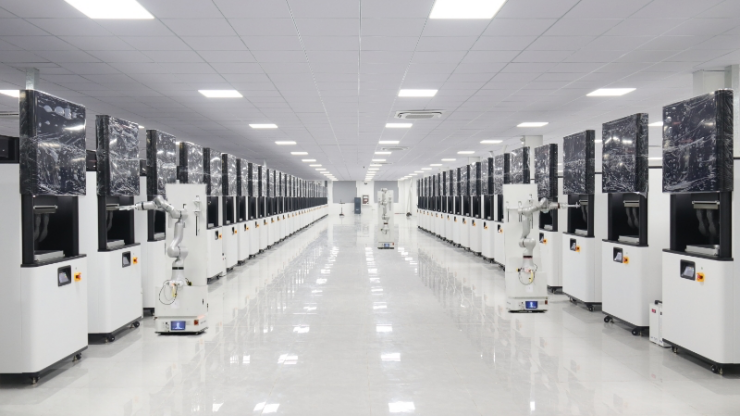
Leveraging HALS ultra-high-speed 3D printing technology, Polly New Materials has built a smart cloud factory system. As of this May, factories have been established in Suzhou, Wuhu, Yangzhou, and other locations. The smart cloud factories use a central production management system to achieve simplified, intelligent, and real-time production management.
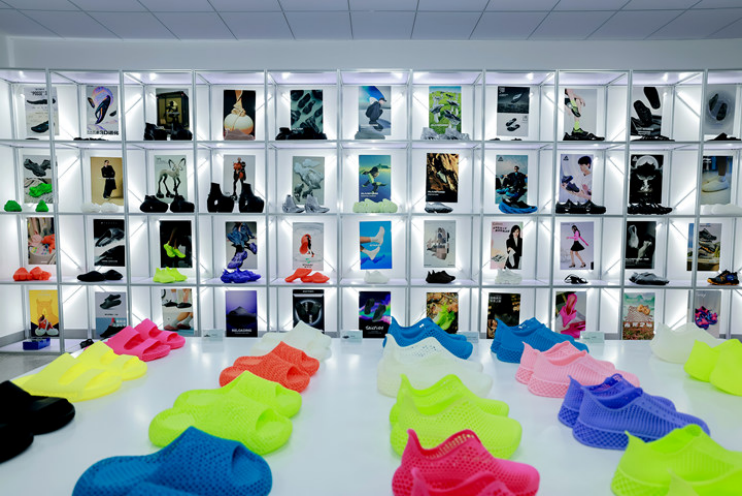
3D-printed footwear represents a significant portion of Polly New Materials' business. Its current footwear solutions cover shoe accessories, midsoles, single-piece shoes, fitting shoes, and shoe molds, with footwear production growing rapidly for four consecutive years. Product categories include athletic shoes, leather shoes, slippers, marathon shoes, outdoor creek-crossing shoes, safety shoes, and protective work shoes. Partner brands include Li-Ning, Peak, Skechers, and other well-known domestic and international brands. Mass production of 3D-printed shoes has been listed by the Ministry of Industry and Information Technology as one of the first batch of typical application scenarios for additive manufacturing.
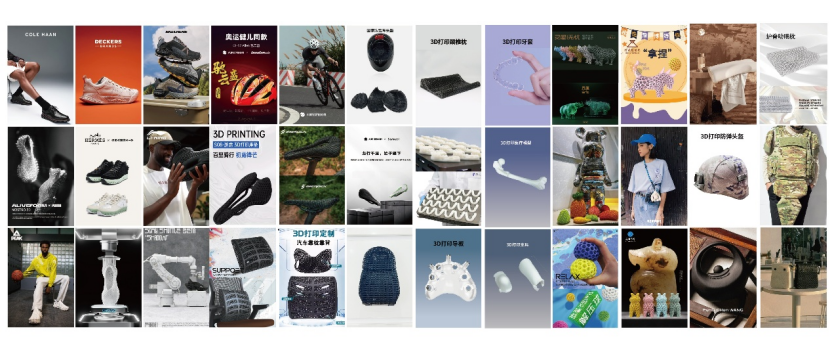
Beyond footwear, million-unit-scale mass production capabilities have been applied in industrial, medical, consumer, sports equipment, education, and cultural creative sectors.
Wenbin Wang, founder and CEO of Polly New Materials, stated: "3D printing and artificial intelligence have long been hailed as signature technologies of the new industrial revolution. Yet due to limitations in material performance, printing efficiency, and cost, 3D printing has remained stuck in rapid prototyping and small-batch production, never truly entering people's daily lives.
In recent years, as technology has continued to evolve, 3D printing is reaching a critical inflection point from prototype manufacturing to mass production of end-use components. Just as AI tools are now accessible to everyone, as 3D printing becomes widely used in end products like footwear, home goods, medical devices, and cultural creative items, mass-manufactured 3D-printed products are entering millions of households — the industry is having its 'DeepSeek moment.'"
High-Performance Materials in Consumer and Industrial Applications
High-performance materials have always been core to Polly New Materials' technology. To date, the company has developed over 10,000 polymer material formulations, building a high-performance material library.
In consumer applications, Polly New Materials' elastomer materials open new possibilities for product comfort and functionality. Taking footwear as an example, the material not only delivers excellent mechanical properties and flex-fatigue resistance, and has passed EU RoHS and California CP-65 testing certifications for reliable safety performance, but also provides outstanding breathability and cushioning. Its special molecular structure efficiently absorbs impact forces during foot strike, providing effective cushioning that reduces joint stress during exercise. Meanwhile, the material's high breathability design allows air to circulate freely inside the shoe, promptly expelling moisture to keep feet dry and comfortable, delivering an unprecedented comfort experience for consumers during athletic activity.
Beyond footwear, this elastomer material performs equally well in bicycle saddles, shock-absorbing helmets, and other products. In shock-absorbing helmets, its energy absorption properties effectively disperse impact forces to protect head safety; applied to bicycle saddles, it dynamically distributes pressure according to riding posture, allowing users to ride for extended periods without fatigue.

Compared to traditional materials, Polly New Materials' newly developed elastomer bio-based materials offer superior durability and environmental performance, providing strong support for upgrading everyday and sports safety products.
For industrial products, heat dissipation and lightweighting are key factors in improving performance and competitiveness. In industrial component manufacturing, this elastomer bio-based material effectively conducts heat — for example, when applied to certain product housings, its special lattice structure, chemical composition, and microstructure rapidly dissipate heat generated by electronic components, preventing performance degradation and shortened lifespan from overheating, significantly improving equipment stability and reliability. For lightweighting, in weight-sensitive fields such as robotics manufacturing and aerospace, Polly New Materials' high-performance materials greatly reduce component weight while maintaining high strength. Taking humanoid robot production as an example, Polly's 3D-printed multi-layer structured honeycomb composite material (incorporating elastomer bio-based material technology) features high elasticity and other properties, with outstanding performance in shock absorption, lightweighting, and heat dissipation. Data shows high energy absorption rates and strong deformation recovery capability, which not only improves robot mobility for more agile movement but also reduces energy consumption and extends operating time.
When 3D Printing Meets AI: From AIGC to AIGT — Defining a New "Generate-to-Manufacture" Paradigm
The convergence of AI and 3D printing technology will have massive impact on global markets. The arrival of Industry 4.0 is driving AI applications across industries to achieve precise outcomes.
Polly proposes the concept of AIGT (AI-Generated Terminal products), extending AI generative design's "content generation capability" to "physical manufacturing capability": IoT-collected product usage data feeds back into AIGC algorithms, forming a dynamic "design-manufacture-iterate" closed loop. Building on AIGC's substantial improvement in R&D design efficiency, 3D printing smart cloud factories connected to the AIGT system enable cross-regional production capacity scheduling, with overseas custom orders completing "design — print — global delivery" within 48 hours.
In consumer scenarios, users upload foot scan data or design requirements through an intelligent platform, and the AIGC system automatically generates printable 3D models based on a database of over 10,000 material formulations, customizing 3D-printed running shoes for clients — with AI-optimized midsole structures improving cushioning performance by 35%-40%. In medical applications, AI generates personalized spinal support pillows, bobsled helmet liners, and other products based on patient data, combined with multi-layer honeycomb composite printing to achieve precise optimization of protective performance.

Wang stated: "When AI can 'read' needs, materials can 'realize' designs, and printing can 'respond' to mass production, 3D printing ceases to be a 'novelty technology' in the lab and becomes a 'manufacturing partner' in everyone's daily life. This leap from 'content generation' to 'physical delivery' mirrors the evolution from the internet to the Internet of Things, making an 'on-demand production' future a reality."
An investor at Oasis Capital stated: "AI-driven personalized design and precision manufacturing models bring transformative potential to medical, consumer, and other sectors, accelerating 3D printing's transition from technology to accessible productive force. We continue to follow Polly New Materials' development closely — the company has already demonstrated significant moats in high-performance materials R&D and multi-industry scenario penetration.
Oasis firmly believes Polly will continue to lead the 'generate-to-manufacture' industrial transformation, injecting new possibilities into the upgrade of global production paradigms."