Boli Technology Secures Nearly RMB 100 Million in Series A+ Funding | Led by Oasis Capital

Stereolithography is at the heart of next-generation 3D printing.

Polly Polymer, a full-chain 3D printing company built on ultra-high-speed photocuring technology, announced it has raised nearly 100 million RMB in its Series A+ round led by Oasis Capital, with participation from YF Capital, Qingrui Ventures, Junzilan Capital, Dongyun Ventures, and follow-on investment from GSR United Capital. Wang Wenbin, CEO of Polly Polymer, said: "As the lead investor in this Series A+ round, Oasis Capital focuses on identifying pioneers of digital transformation and technological innovation, and has been placing bets on a number of 'next-generation companies' aimed at the future, including in digital healthcare and enterprise informatization. The Oasis team has extraordinary foresight about the world to come, and their deep understanding of the 3D printing industry and digital technologies formed the foundation for this partnership. Going forward, Polly Polymer will work with Oasis Capital to explore more application scenarios for 3D printing in healthcare, informatization, digital consumer goods, and beyond." Jinjian Zhang of Oasis Capital said: "Photocuring technology is at the heart of next-generation 3D printing. We are thrilled to keep pushing boundaries alongside a world-class technology company."
Founded in early 2017 by Wang Wenbin, a domestic expert in polymer materials, Polly Polymer crossed 10 million RMB in revenue its first year with positive cash flow, and has maintained 200% annual growth ever since. This stems from the fact that the Polly team had a relatively complete photocuring 3D printing solution from day one. 3D printing technology has been around for over 30 years, yet has never hit an inflection point in the market, constrained by three factors: material performance, print speed, and cost. Starting from fundamental materials R&D, Polly Polymer co-founded China's first new-materials research institute focused on 3D printing with the Ministry of Industry and Information Technology's Additive Manufacturing (3D Printing) Research Institute, with Wang Wenbin serving as director. The institute built comprehensive models for printing materials across dimensions of speed, performance, and cost, then developed and optimized new printing materials. Based on the multi-dimensional properties of these new materials, Polly developed the ultra-high-speed intelligent industrial printing platform HALS, with speeds reaching roughly 100 times that of traditional 3D printing equipment. For 3D-printed shoe midsoles, it can achieve 20 minutes per piece, with small-to-medium batch production costs already approaching those of injection-molded mass production.
However, industrial-scale mass production requires more complex calculations. Take shoe soles: a major sneaker brand's new release includes 22 kids' sizes (from 5c to 7Y), 8 women's sizes, and 10 men's sizes — 40 sizes total. Some performance sneakers further require 4 different forefoot widths (B, D, 2E, 4E) for each of the 18 adult sizes, bringing the maximum number of midsole molds for a single shoe model to 94. In traditional manufacturing, mold-making for these takes 30-45 days, plus trial production, pushing total upfront time costs beyond two months. At Polly Polymer's intelligent cloud factory, this process requires only cloud-based data synchronization and is completed instantaneously. Shi Xiaoxi, a globally renowned industrial designer, is full of anticipation for Polly's HALS technology: "With Polly's help, we achieved a disruptive breakthrough in footwear. Polly's complete end-to-end solution — from software to printing to mass production — let us reach the extreme in development efficiency. It's foreseeable that Polly will become a creative platform for 'disruptors,' making it truly possible for 3D printing to empower designers. With Polly's support, more world-class works will appear on the international stage." Shi Xiaoxi previously designed the Nokia 1200 and Nokia 1208, which remain among the top three best-selling phones globally with 150 million and 100 million units sold respectively.
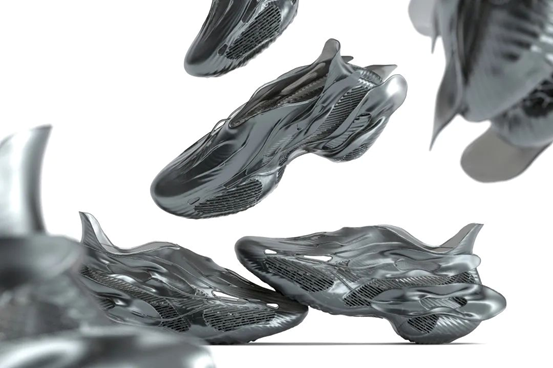
Renowned hype shoe designer brand SCRY's first fully 3D-printed hype shoe, created in collaboration with Polly Polymer
While HALS printing technology was developed to solve industrial-scale mass production challenges, Polly Polymer has also recently developed the quasi-industrial high-speed TAPS photocuring printing technology for commercial applications. Compatible with new 3D printing materials, TAPS achieves print speeds roughly 20 times faster than traditional equipment while maintaining low power consumption and high stability. For small-batch processing and personalized 3D printing needs, TAPS strikes a balanced position across efficiency, performance, and cost. Combined with Polly Polymer's self-developed software platform, it provides lightweight solutions for industries including medical, dental, cultural and creative, and industrial design. This year, Polly Polymer is building a "super factory" in Wuhu, Anhui — a "lights-out factory" with cloud-based intelligent control of production processes. For 3D-printed shoe soles, daily capacity already exceeds 10,000 units and can be rapidly scaled through production line replication. Current products serve consumer goods, medical, industrial, cultural and creative, and aerospace sectors. Notably, Polly Polymer has collaborated with a designer from a major luxury brand to launch fully 3D-printed integrated shoes, including unified soles that traditional techniques cannot achieve.

This year Polly Polymer will complete China's largest-scale polymer 3D printing intelligent cloud factory
To date, Polly Polymer has accumulated over 300 clients, mainly in footwear, medical, home appliances, and industrial products. In footwear, it has established partnerships with multiple leading brands, with capacity continuing to expand. Its accumulated library of over 2,000 material formulations and nearly 80 patents serves as both a moat and a foundation for expanding into new application areas. Going forward, Polly Polymer will accelerate the deployment of intelligent cloud factory capacity in medical, dental, automotive parts, cultural and creative, and other sectors. "We see opportunities to contribute in areas like critical national technology bottlenecks and new material applications in industrial manufacturing." Wang Wenbin is filled with optimism about both the industry and his company's future.
Championing Vitality
What do you think vitality is?
For me, vitality comes from genuine passion and a sense of mission. Mission is the starting point of any great endeavor.
I firmly believe that innovative-materials-based 3D printing will become a key technology in future manufacturing. This was my original intention in founding Polly Polymer, and it remains the reason I feel proud and excited about this work to this day.
The entrepreneurial journey involves countless difficulties and choices. These crossroads may affect a particular phase or may determine survival itself. Only by steadfastly guarding their mission can an entrepreneur make accurate judgments amid complex environments, continuously create value in this changing world, and possess enduring vitality.
— Wang Wenbin, Founder and CEO of Polly Polymer

Oasis Capital is a new-generation Chinese venture capital firm dedicated to discovering the most vital entrepreneurs of China's next decade and growing alongside them to create long-term value. "Championing Vitality" is Oasis Capital's vision and mission. This vitality is both the direction of structural transformation in the era and the resilience and evolutionary power of entrepreneurs. Oasis Capital focuses on early and growth-stage investments of $3 million to $30 million per deal, with emphasis on technology-enabled services in education, healthcare, and enterprise services, supporting China's technology-driven new service upgrade.