Chaos and Fractals (Part 1)

Simplicity Hides in Infinite Complexity

Fractals are the language of nature. Fractal geometry fills a gap left by Euclidean geometry for more than two millennia, offering a new way to describe the natural world. Behind infinitely complex phenomena lie remarkably simple rules. Simplified shapes are artificial, unnatural products; humanity's innate perception of "beauty" stems from complex structures at different scales. Video from TED: The Art of Roughness, a perfect fusion of science and beauty. I hope you can find time to lose yourself in it. Enjoy. Source: "Science Academy" WeChat public account (ID: kexuedayuan)
Author: Chengyu Su
Is the caprice of fate divine will, or the force of chaos?
The Book of Rites, compiled during the Western Han dynasty, records: "A miss of a hair's breadth leads to an error of a thousand li."
In the mid-17th century, the French mathematician Blaise Pascal quipped: "If Cleopatra's nose had been shorter, the whole face of the earth would have been changed."
More than three centuries later, American meteorologist Edward Lorenz told the world with ringing conviction: "A butterfly flapping its wings in Amazonia can set off a tornado in the United States."
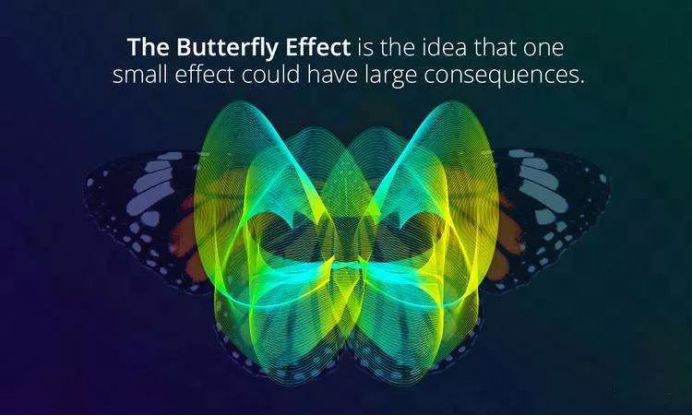
Image source: Baidu Baike
Perhaps life is like this. On the surface, we can only proceed along a single trajectory. Yet looking back years later, it seems every moment was a pivotal point in time. Each small decision ferments over the long term, ultimately producing unexpected results that shape our lives in all dimensions.
When you are old, looking back on your life, you will realize: when you went abroad to study, when you decided on your first career, when you chose a partner and fell in love, when you got married — these were all tectonic shifts of fate. Only at the time, standing at a three-way intersection watching the thousand sails, the day you made that choice seemed utterly dull and ordinary in your diary. You thought it was just another ordinary day. — The Girl Who Killed the Quail
Looking back, people always sigh at the caprice of fate. But is the unpredictability of heaven's way truly an inescapable destiny? For thousands of years, people have wrestled with this nearly ultimate question, attempting to crack fate's code and reclaim agency over their lives. No one expected that fate, that caprice, is the truth of the universe itself. The first glimmer of this truth hides within the fog of chaos.
What Is Chaos?
Chaos is a mysterious reality. It seems to mean a state of complete disorder, the hazy obscurity before heaven and earth separated, the emptiness at the birth of the cosmos. Chaos is synonymous with confusion and disorder. Throughout history, countless people have tried to enter the world of chaos, yet none have found the door back, and none have grasped its essence.
Image source: Visual China
Understanding of chaos's essence — from ancient awe before fate, through one bizarre discovery after another in the history of science — finally took flight in 1963, breaking from its cocoon as the "butterfly effect" danced with chaos.
The birth of chaos theory has been hailed as the third great discovery of natural science in the 20th century, after only general relativity and quantum mechanics. From then on, people finally touched the essence deep within the world. Based on research into the butterfly effect, fractal theory, chaos theory, nonlinear dynamical systems, and other complex theories emerged. These theories could finally explain the deeper laws that make the world turn, could finally take the pulse of capricious fate, and could even gradually unlock the code of life.
The butterfly effect tells us: A butterfly flapping its wings in the Brazilian rainforest may trigger a tornado in Texas. This effect is everywhere today.
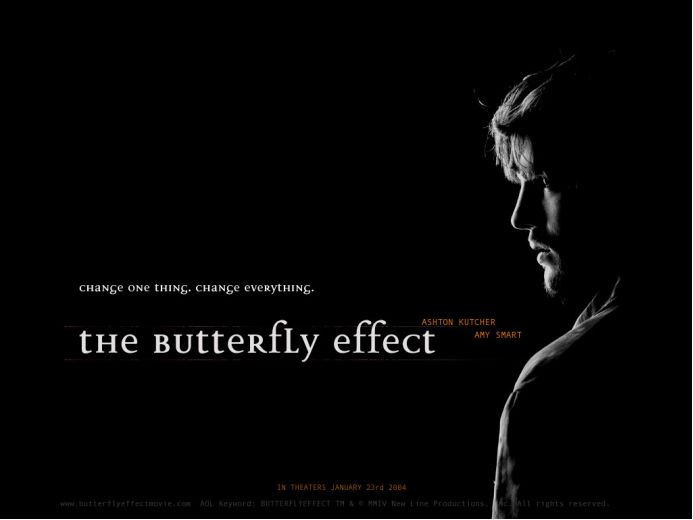
Some trivial changes can brew into great disasters in life. A private rumor can ruin someone's reputation, while the victim must spend far more than the rumor-monger to repair the damage. Some inside information about stocks can trigger panic among investors, causing catastrophic market drops. In history, bank runs, frenzied hoarding of supplies, and financial tsunamis triggered by a single private bank's collapse all stemmed from a tiny loss of confidence.
Yet the butterfly effect has a positive side too. If one can harness its force, it can produce magical effects of moving great weights with little effort. In the internet age, through the amplifying effect of networks, grassroots individuals have the chance to rise and become stars. A low-budget film, if recommended by a few elites, can explode in the market and become a classic. Investors who skillfully use leverage can move large sums of capital with little principal to create astonishing wealth.
Ultimately, as the butterfly effect reveals, minute changes in initial conditions cause dramatic fluctuations in outcomes. A complex system is destined to live with the butterfly effect from birth. The butterfly effect points to a defining feature of chaos: seemingly random, lawless behavior within deterministic systems; short-term predictability due to deterministic laws; and long-term unpredictability due to the butterfly effect.
Because of this, people's fates become bewilderingly complex. Small matters can cause enormous differences in our lives, even affecting the destiny of nations. Someone once inappropriately wondered: If the Vienna Academy of Fine Arts hadn't repeatedly rejected Hitler's application, would tens of millions of unjust deaths have been averted?
Though chaos's appearance is hazy, its heart is unexpectedly gentle and soothing. If you played a chaotic signal through a speaker, it would sound like background music to help insomniacs sleep. Let us together appreciate this enchanting music, together listen to and enter this story that has touched countless hearts through the ages. Its past and future are opening their arms to us.
The Miracle of Fractals — Curves of Fractional Dimension
The secret of chaos is incredibly hidden within the world of fractals.
Fractal, a term first coined by American mathematician Benoit Mandelbrot in 1973.
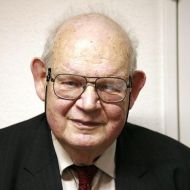
Mandelbrot (1924-2010)
In his masterpiece The Fractal Geometry of Nature, Mandelbrot founded fractal geometry. Fractal geometry and its related nonlinear theories quickly demonstrated powerful vitality, their influence rapidly spreading to every corner of science and society. Difficult problems in many disciplines were transformed by fractals' intervention. Scientists, as if waking from a dream, discovered that fractals had silently existed in the world for hundreds of millions of years, revealing their profound mysteries to nature from the moment Earth was born.
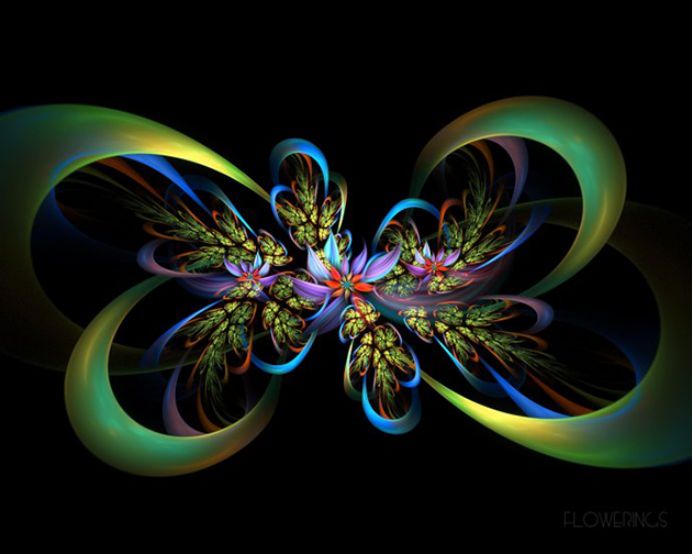
Fractals in plants (Image source: internet)
Common cauliflower in daily life, lightning after a thunderstorm, snowflakes dancing through the winter sky, spiral patterns on shells; from the structure and form of various plants to the crisscrossing blood vessels throughout the human body; from the gathering and dispersing white clouds in the sky to the rolling mountain ranges — they all more or less exhibit fractal characteristics. Fractals, which appear chaotic at first glance, turn out to be nature's fundamental form of existence, omnipresent and visible everywhere.
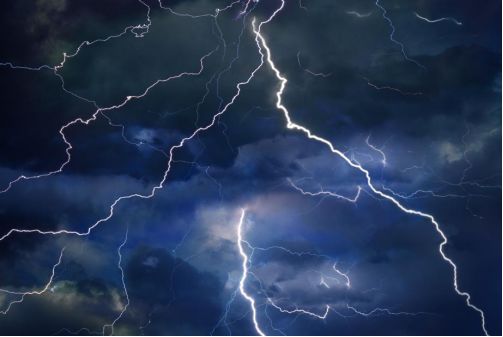
Image source: Visual China
Fractals are so widely distributed in nature, yet they passed by the wisest minds for thousands of years. Their discovery officially unveiled one of nature's most enchanting and moving secrets.
As early as ancient Greece, more than two millennia ago, people's most outstanding achievements came from number theory and geometry. In particular, the establishment of Euclidean geometry made geometry the most rigorous and graspable axiomatic system. Geometry studies shapes. To study different geometric objects, people tended to classify them. From points, lines, and planes to solids, human thinking gradually expanded. Gradually, people realized the crucial watershed for distinguishing geometric figures: dimension. Straight lines and curves are one-dimensional figures, planes are two-dimensional, and solids belong to three-dimensional space.
Image source: Visual China
Everything seemed so intuitive; history flowed peacefully. Until one day, a bizarre event shattered people's belief in dimension.
In 1890, Italian mathematician Giuseppe Peano constructed a strange curve that does not intersect itself, yet passes through every point inside a square. In other words, this curve is the square itself, and thus should have the same area as the square. This bizarre conclusion shocked mathematicians of the time and caused deep unease in the mathematical community: if so, what do we use to distinguish curves from planes? Is this curve one-dimensional or two-dimensional? Classical geometry was helpless before it. This monster, cast out from the fold, officially sounded the prelude to fractal geometry research.
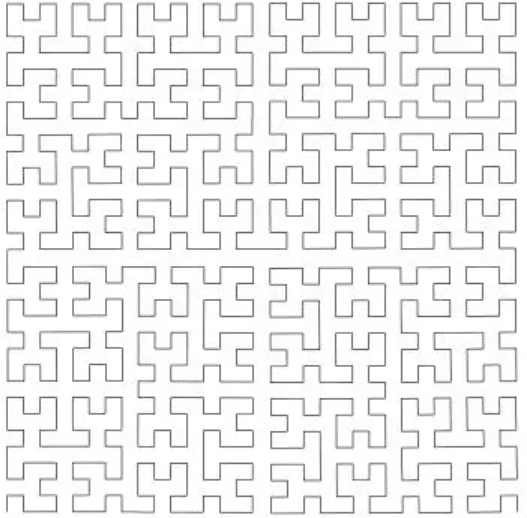
Peano curve (Image source: Baidu Baike)
The extension of the dimension concept owes much to German mathematician Felix Hausdorff. In 1919, he proposed a new definition of dimension. This definition laid the foundation for successfully dispelling the fog surrounding fractal curves.
Under traditional conceptions, the dimension of a space equals the number of variables needed to determine any point's position in that space. For example, the reason our living space is three-dimensional stems from our need for three values — longitude, latitude, and altitude — to determine an object's position in space. Such a definition accorded perfectly with human intuition and was therefore revered as canon for thousands of years. But this way of defining dimension excluded the possibility of fractional dimensions.

Image source: Visual China
Hausdorff took a different path, defining dimension from an object's self-similarity. Self-similarity, as the name suggests, means that "a figure can be viewed as composed of many parts similar to itself, of varying sizes." For example, a line segment is composed of two segments similar to the original, each half its length. A cube can be seen as composed of eight smaller cubes, each one-eighth its size.
In short, if a figure is scaled down by a ratio of N:1, and the original figure can be assembled from M such scaled-down figures, then the figure's dimension d — the Hausdorff dimension — is defined as d = ln(M)/ln(N). Under Hausdorff's definition, Peano's curve is exactly two-dimensional! Thus it is no surprise that it can fill a square.
The Peano curve is a self-similar curve. It reveals many characteristics of fractals: self-similarity, infinite levels of detail, infinite scalability with structure forever, and most astonishingly, it can have fractional dimension. For example, the famous Koch snowflake curve is 1.26-dimensional, and the Sierpinski triangle is 1.58-dimensional.
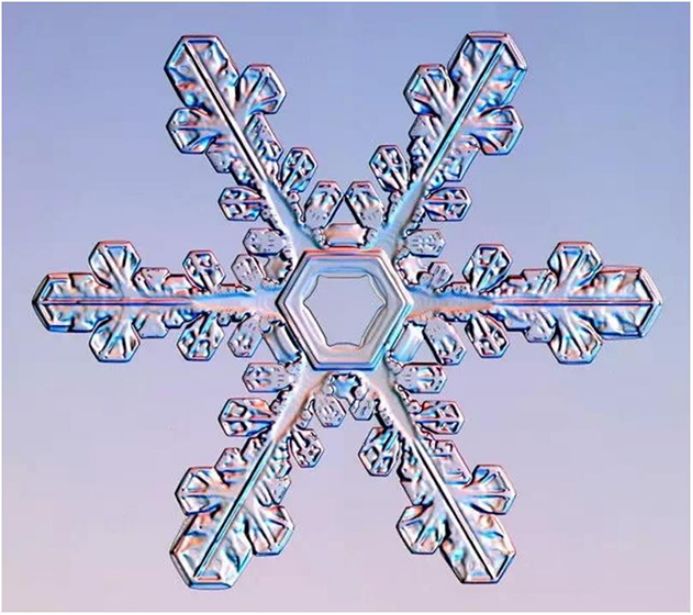
Fractals in snowflakes (Image source: internet)
Eighty-three years after the discovery of the Peano curve, Mandelbrot first proposed the concept of fractal geometry. In a public lecture, he posed a question that seemed tediously dull to his audience: How long is the coastline of Britain?
People would answer casually: Just measure it with instruments; as long as you measure precisely enough, you'll always get the result you want. However, contrary to everyone's expectations, if you measure the coastline's length with different scales of measurement, you get completely different results each time. The smaller the measurement scale, the longer the measured coastline becomes. As measurement precision increases, the length of Britain's coastline rapidly approaches infinity. Years later, scientists discovered that Britain's coastline is a complex fractal curve. Based on multiple measurements, the fractal dimension of Britain's coastline is approximately 1.25.

Image source: Visual China
More astonishingly, the secret hidden in Britain's coastline turned out to be intimately connected to the structure of human life. The discovery of fractals led people toward increasingly bizarre scientific explorations. Nature everywhere demonstrates great harmony and unity.
The Human Body: A Masterpiece of Fractals
Britain's coastline displays the astonishingly wondrous properties of fractals. The land area enclosed by the coastline is finite, yet it possesses nearly infinite length. But even more unexpectedly, Britain's coastline is intimately related to the structure of the human body.
Fractals play a crucial role in God's creation of life. One could say that without fractals, humanity — this great and intelligent being — might never have emerged at all.
To maintain the necessities of human survival, blood vessels bear the heavy responsibility of transporting nutrients. Blood vessels cover every part of the human body, from major arteries to capillaries, ensuring that every cell can exchange necessary components through blood flow. Major arteries handle the main blood flow, while capillaries can barely allow a single blood cell to pass. Considering that every cell needs direct blood supply, the total surface area of the circulatory system would be enormous. Yet surprisingly, such an extremely complex and meticulous blood network spread throughout the body occupies only 5% of the body's total volume.
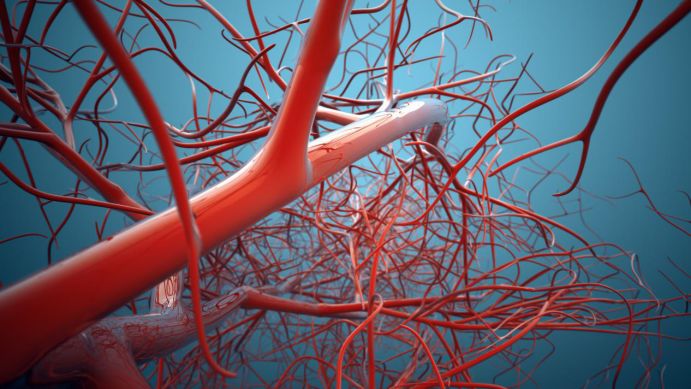
Image source: Visual China
Scientists discovered through careful research: the branching of blood vessels is in fact a fractal structure. Through precise experimental measurement, the fractal dimension of human arteries is approximately 2.7.
Going further, scientists found that the body's major organs and structures are all masterpieces of fractals.
Human lung cells, the surface of the brain, the structure of the liver, gallbladder, and small intestine, the urinary system, the distribution of neurons, the double-helix DNA structure, and even protein molecular chains all show obvious fractal characteristics: self-similarity. Even the morphological structure and genetic characteristics of each unit in an organism can be seen, to varying degrees, as a miniature of the whole organism. For example, the shape of the human ear closely resembles a curled-up fetus in the mother's womb.
Take the lung as an example. The lung's airways follow a repeated tree-like branching structure. In order to fully absorb air within a limited volume, the lung's surface area is roughly as large as an entire tennis court — undoubtedly thanks to the power of fractals. Experiments reveal that the fractal dimension of alveoli is approximately 2.97.
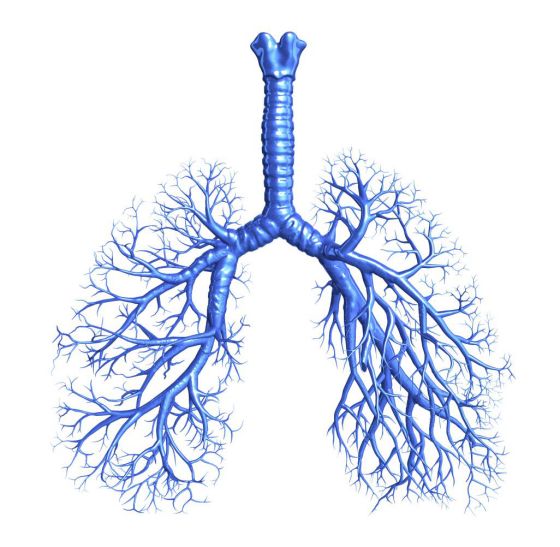
Image source: Visual China
The human brain is an even greater masterpiece of fractal art. The wrinkles on the brain's surface also display complex fractal structures, designed to achieve a larger surface area within a limited volume, thereby enabling more complex thinking capabilities. Scientists estimate the brain's fractal dimension to be roughly 2.75.
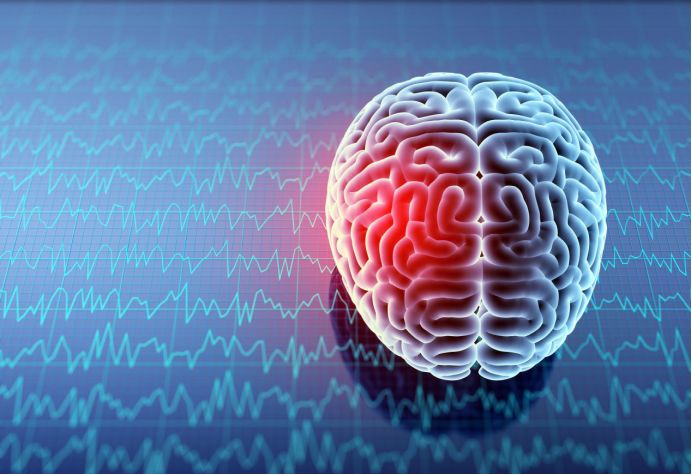
Image source: Visual China
The inheritance of life mainly relies on cell division and reproduction. The biological information contained in a single cell can be entirely used for self-replication and recombination, growing into a completely new life form — similar to the self-similarity of fractals. The overall macroscopic appearance is the fractal cooperation of every cell.
In the human body, besides spatial fractal structures of various organs of different sizes, the electrical pulses transmitted by the heart, heartbeat rhythms, brain waves — these waveforms that change over time — are also fractals. Moreover, people gradually recognized that fractals are even a characteristic structure of chaos. In fact, chaos, which appears disorderly on the surface, can to some extent be viewed as fractals in time. A system's chaotic motion is its essence; fractals are its manifestation. In other words, chaos theory and fractal theory have deep internal connections. If fractal geometry provides a practical language for describing chaos's internal structure, then chaotic motion is considered the root source that generates fractal structures.
Fractals have even more incredible functions. Beyond being the deep-level structure of the human body, they can also safeguard people's healthy lives. An ordinary person's heart beats regularly at a certain frequency every minute. People take for granted that a normal heart rate is a sign of good health. However, continuous tracking of populations shows that healthy people's heart rate curves display uneven, rugged characteristics, with both chaotic beats and fractal self-similarity. Contrary to people's assumptions, the heart rate curves of epilepsy and Parkinson's patients show more regular and periodic behavior.
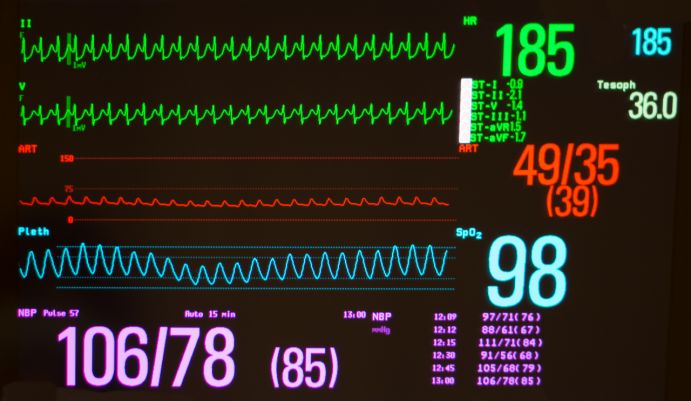
Image source: Visual China
Everything is breaking through traditional understanding of living systems. It turns out that healthy physiological characteristics are essentially chaotic. Those signals that appear regular in physiology may instead indicate abnormalities in the organism.
If we consider that many organs and tissues of the human body are fractal structures, then such results may not be surprising. The signals produced by these organs during normal operation should logically be chaotic. The complexity, oscillation, and possibility of switching between different states at any moment — these properties of chaos — give the human body high adaptability and flexibility to cope with various complex environmental changes. Chaos, seemingly trackless, helps the human body survive amid drastic environmental changes. Just as the human brain is also a chaotic system, various tiny external inputs and stimuli can help the brain produce vastly different reactions — perhaps this is precisely the source of human creativity. And because of chaos's unpredictability, human behavior can exhibit wisdom and unpredictability.
Fractals, and the chaos they generate, give humanity a high degree of self-evolution and self-regulation capability. And a living being with an open mind and adaptive capacity will surely be able to create an even more brilliant future.
References:
- The Story of Mathematics, Ian Stewart, Shanghai Lexicographical Publishing House, 2013.
- Order Out of Chaos: Man's New Dialogue with Nature, Ilya Prigogine and Isabelle Stengers, Shanghai Translation Publishing House, 1987.
- Complexity: The Emerging Science at the Edge of Order and Chaos, M. Mitchell Waldrop, SDX Joint Publishing Company, 1997.
- The Mystery of the Butterfly Effect, Tianrong Zhang, Tsinghua University Press, 2013.
This article is produced by the "Science Academy" public account (kexuedayuan). Please indicate the source when reposting.

Science Academy is the official science popularization micro-platform of the Chinese Academy of Sciences, hosted by the CAS Bureau of Science Communication and operated by the China Science Expo team, dedicated to in-depth interpretation of the latest scientific research results and scientific voices on social hot topics.

Oasis Capital is a new-generation venture capital firm in China, dedicated to discovering the most vital entrepreneurs of the next decade and growing alongside them to create long-term value. "Nurturing Vitality" is Oasis's vision and mission. This vitality is both the direction of structural transformation in the era and the resilience and evolutionary power of entrepreneurs. Oasis Capital focuses on early and growth-stage investments, with individual investments ranging from $3 million to $30 million, concentrating on healthcare, enterprise services, and other technology-enabled service sectors, supporting China's technology-driven new service upgrade.