Chaos and Fractals (Part 2)

Anything is possible.

Mandelbrot introduced fractals, and their beauty lies in this: a single formula generates all things. So it is with science, with life, and with investing.
Enjoy
Source: "Science Academy" WeChat public account (ID: kexuedayuan)
Author: Yiwen Huang
Fractals Are Angels, Chaos Is the Devil
Once people recognized the profound significance of fractals, they discovered that fractals are everywhere. Close at hand, the human body itself contains fractal structures in its various organs. Far away, floating clouds have boundaries with a dimension of 1.35 across a large scale. The coastline of Britain is a 1.25-dimensional fractal, while the surfaces of many mountains and terrains are 2.2-dimensional fractal surfaces.

Image source: Visual China
Fractal theory has dramatically broadened the horizons of various disciplines, gradually permeating physics, chemistry, geology, geography, biology, medicine, metallurgy, and other scientific fields. Scientists have gained unprecedented new insights and advances from this emerging theory: turbulence and phase transitions in physics, polymer chains, catalyst surfaces, and gels in chemistry, star cluster distributions and large-scale cosmic structures in astronomy, seepage flow and landform evolution in earth sciences, river systems in geography, human tissue structures in medicine, and damage and fracture in materials. Fractals have not only shone brilliantly in the natural sciences but have also conquered territory in economics and the humanities. Economists use chaos theory to predict economic futures and stock market trends. In human social activities and phenomena, self-similarity appears in many places — this is social fractal. When a writer uses a miniature work to reflect the changes of an era, that work is a social fractal element. Cao Xueqin's Dream of the Red Chamber, for instance, depicts the social fractal of the Qing Dynasty.

Image source: Baidu Baike
Mathematically, most fractals are generated through nonlinear iteration. Benoit Mandelbrot, the founder of fractal geometry, left behind what remains the strangest, most magical geometric figure — the Mandelbrot set. The Mandelbrot set has been called "the fingerprint of God" and "the devil's polymer." It is described by a simple nonlinear iteration: Z(n+1) = Z(n)^2 + C, where both Z and C are complex numbers.
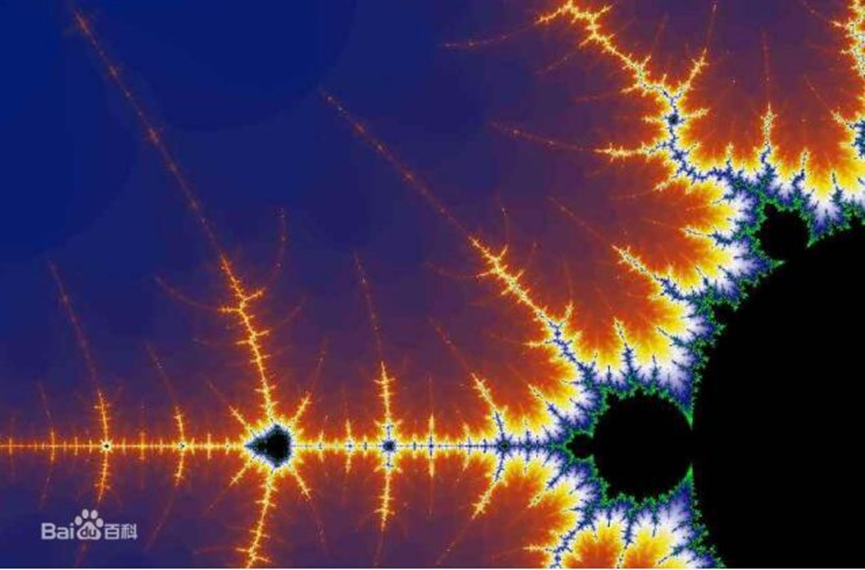
The Mandelbrot set
Starting from the Mandelbrot set, fractals have provided artists with abundant inspiration. Based on fractal principles, ingenious architectural designs have emerged endlessly. The establishment of fractal geometry theory has deeply influenced the development of architecture, expanding the possibilities of architectural form. Moreover, fractals have penetrated music and painting, greatly enriching people's aesthetic space. Fractals have become the angels of the universe, establishing order and vitality for all things; while chaos, like a devil in the darkness, brings confusion and challenge to the world. What force drives the world toward both disorder and order across eternal time? What force allows devil and angel to coexist in harmony? It turns out that the seemingly random, disordered behavior of chaos is only a surface phenomenon. Only by delving into its core can one discover its profound regularity.
Image source: Visual China
The term "chaos" (混沌) first appeared in Chinese in the legend of Pangu creating heaven and earth; in the Bible, it also refers to the emptiness and obscurity at the beginning of creation.
Since Newton established his three laws, the Western world once believed that the essence of the world was deterministic. This mechanistic cosmology reached its extreme when the mathematician Laplace arrogantly declared: if we knew the state of all matter in the universe at one moment, we could completely know its past and future. However, despite Newton's theory achieving enormous success, it remained powerless when calculating the motion of all planets in the solar system, and even encountered massive theoretical setbacks in predicting the fates of the sun, earth, and moon. This problem that stumped Newton became famously known to later generations as the three-body problem.
The great French mathematician Henri Poincaré once exhausted himself over the three-body problem. Even with extreme simplifications, the problem remained so complex as to be intimidating. He once expressed disappointment that its computational difficulty far exceeded imagination. People cared so deeply about the outcome of the three-body problem partly from the interest of challenging a difficult problem, and partly from concern for humanity's own fate. If Newtonian theory was certain and beyond doubt, then solving the three-body problem would reveal the ultimate destiny of the planet we inhabit.
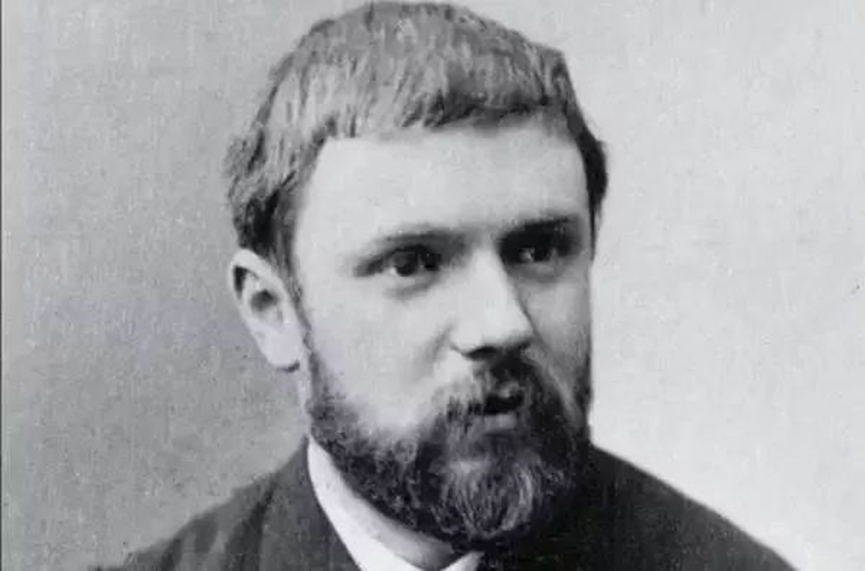
Poincaré
Although Poincaré failed to solve the three-body problem, he accidentally discovered a startling fact: the long-term orbital behavior of the solar system is unpredictable. Very small changes in initial conditions lead to enormous changes in subsequent motion.
In 1963, American meteorologist Edward Lorenz discovered a similar phenomenon. While using a computer to solve a simplified atmospheric convection model, Lorenz found that the solutions oscillated in irregular, even random ways. Minute fluctuations in initial values caused violent changes in the solutions. This strange phenomenon later became the familiar description: a butterfly flapping its wings in the Brazilian rainforest might trigger a tornado in Texas. This is the famous "butterfly effect."
Lorenz used three variables and three equations to describe the system's motion, plotting the trajectory of the three-variable system in three-dimensional space. The points' trajectories never intersect; they circle endlessly, displaying a kind of infinite complexity. The image remains within certain bounds, neither repeating itself nor escaping beyond the frame. The trajectory forms a strange yet definite pattern, like a pair of vortices in three-dimensional space, or like a pair of butterfly wings. This is the "Lorenz attractor," much discussed by later generations.
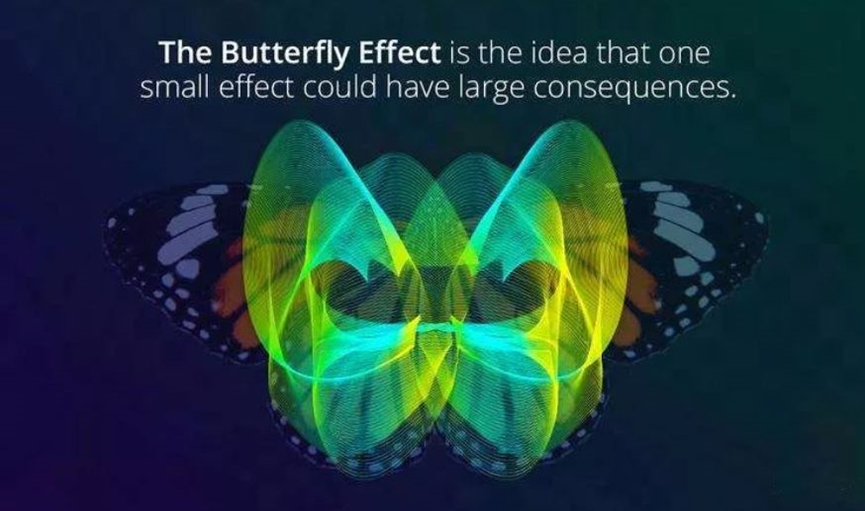
Image source: Baidu Baike
The butterfly attractor is one of the miraculous phenomena of nonlinear dynamical systems, yet scientists had long lacked an appropriate name for this broad class of problems. In 1975, Chinese scientist Tien-Yien Li and his doctoral advisor James Yorke finally named this singular characteristic of discrete dynamical systems "chaos" in their paper. From then on, chaos finally revealed itself, opening the door to modern dynamical systems research. Scientists finally broke through the linear, reductionist mode of thinking that had dominated science since Newton's time.
It was the appearance of this devil of chaos that made long-term weather forecasting impossible. In real life, actual weather measurements always contain errors, yet even a change in the 100th decimal place might produce completely different weather forecasts. The solar system has similar problems, making the prediction of humanity's ultimate fate an eternal unknown. In fact, people can at best predict the dynamical behavior of the solar system for the next 1,000 years.
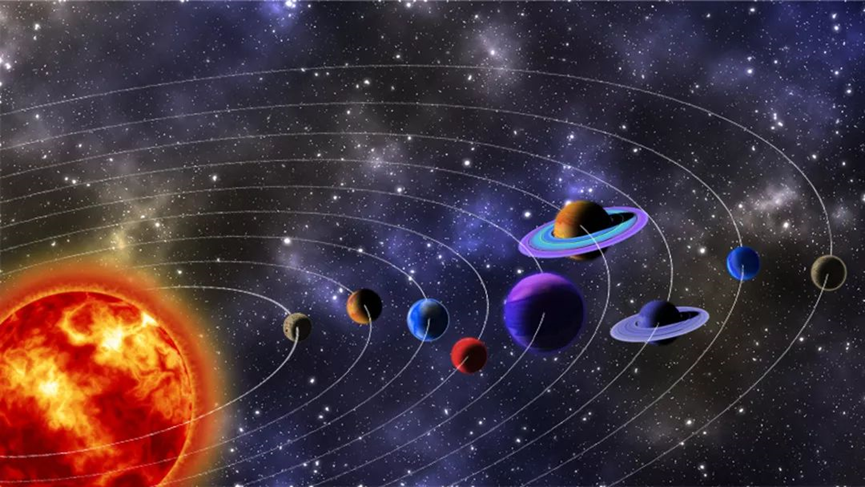
Image source: Visual China
Nonlinear systems, because chaos creates insurmountable difficulties, have led to chaos being regarded as the devil in natural science, obstructing humanity's ultimate cognition of truth.
Wonderfully, the devil of chaos only wears caprice on its surface; its core likewise follows order. The beautiful butterfly attractor provides ironclad evidence of chaos's transition from disorder to order. It is the bridge linking chaos and fractals. The attractor is actually a fractal with infinite structure. Mathematicians have found that the fractal dimension of the Lorenz attractor is approximately 2.06. Angel and devil were originally of the same family.
The Future: Everything Is Possible
The surface of chaos appears blurred and indistinct, yet its core is intimately connected with fractals.
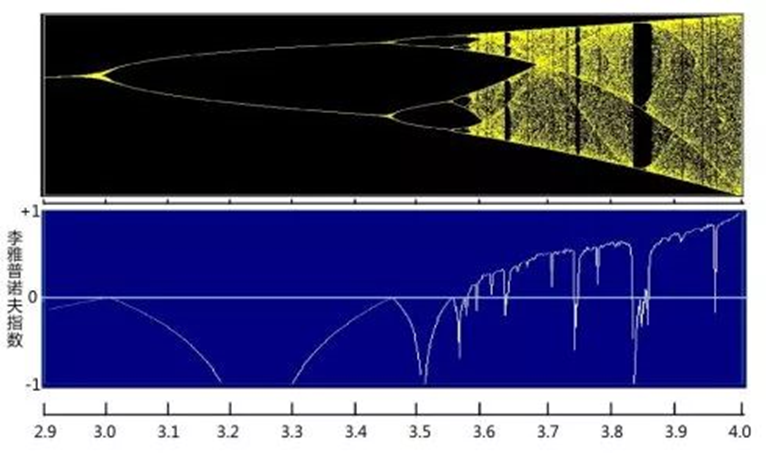
Whether in the Lorenz meteorological model or the three-body problem, both are deterministic differential equations that ultimately produce chaotic phenomena. Chaos is the result of long-term system evolution. Therefore, studying the long-term behavior of a dynamical system is the only way to reveal the essence of chaos. It turns out that a system's state moves from equilibrium toward chaos as certain parameters change. This fact is known as the period-doubling bifurcation phenomenon. When parameter values fall within a certain range, the system will tend toward a stable state in the long term. This state is the ultimate state people hope to predict. For example, a small ball moving through the air will eventually come to rest if no other forces act upon it. This resting state is the ball's destination. But when parameter values change, the system's ultimate state is no longer unique; instead, it may oscillate between two states. The system jumps from one state to another in a unit of time, then after another unit of time, jumps back again. Thus, the time for the system to return to the same state becomes twice that of a single state. As parameter values continue to increase, the number of ultimate states also increases rapidly, doubling each time. This is the period-doubling bifurcation phenomenon.
Period-doubling bifurcation (Image source: Internet)
The period-doubling bifurcation phenomenon is a harbinger of chaos in a system, ultimately leading to a transition from order to disorder, from steady state to chaos. When parameters change more dramatically, the period-doubling bifurcation phenomenon collapses; equilibrium points can no longer be distinguished and merge into a continuous region. At this point, chaos emerges. And the period-doubling bifurcation phenomenon possesses important characteristics such as self-similarity and universality. This geometric property, closely related to intrinsic randomness, reveals the internal connections between period-doubling bifurcation and fractals, chaos, strange attractors, and so on, becoming a symbol of the order inherent in chaos. Every coin has two sides. The emergence of chaos brings confusion, yet it also brings hope in certain respects. Since perturbations can produce destructive results, finding appropriate small perturbations can achieve great effects with little effort. This is the essence of chaos control.
In space travel, chaos control might enable interstellar travel using minimal fuel. The butterfly effect in chaos could further show great promise in medicine, such as controlling cardiac arrhythmias, suppressing epilepsy, and even transitioning turbulent flow to smooth motion, reducing danger for aircraft.

Image source: Visual China
Moreover, chaos is even a powerful tool for regulating national economies and buffering economic crises. As everyone knows, the stock market is a barometer of the economy. Traditional economics holds that stock markets follow random-walk Brownian motion, with fluctuations conforming to log-normal distribution. Due to this high degree of randomness, people cannot predict the future of stock markets, much less formulate appropriate policies to maintain their stability. However, after years of actual observation, stock market performance more often displays leptokurtic, fat-tailed characteristics, deviating to some extent from the random-walk hypothesis. In 1982, American economist Day introduced chaos to study economic performance. Subsequently, people began applying chaos theory across various markets to search for attractor characteristics, achieving extraordinary results. Economic chaos phenomena have become increasingly numerous. The existence of economic chaos, while not greatly improving economic forecasting ability, can substantially enhance the government's capacity to regulate markets. This provides more macro-policy basis for economic cycle fluctuations and stock market disaster warnings.
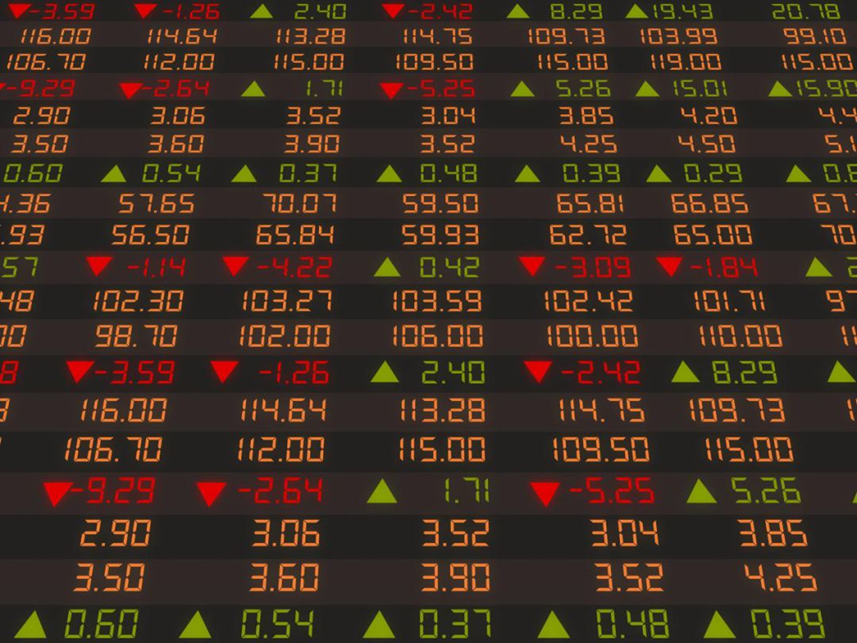 Image source: Visual China
The extreme instability of chaos and its sensitive dependence on initial values have also been applied to communication encryption. Once signals are intercepted and interfered with, irreversible errors are produced, creating enormous difficulty in deciphering signals and opening new horizons in communication technology. Fractals are angels; the mysteries and beauty they present provide humanity with abundant sources of inspiration. Wonderful fractals play a captivating musical movement, their profound essence completely overturning people's traditional understanding of things. Chaos is the devil; it has become synonymous with complex phenomena and marks one of the endings of Newton's deterministic scientific worldview. Chaos demarcates the boundaries of humanity's exploration of truth. Under chaos's shadow, people cannot predict the future of many complex systems. Yet this also stimulates humanity's continuous progress and inexhaustible creative capacity. The world's destiny rests in our hands; nothing is more depressing than a deterministic ending, and nothing more exhilarating than the possibility that everything is possible. Angel and devil together compose the rules by which the world operates. They are the two faces of the real world. Within the devil's heart hides the soul of an angel. Behind the angel lurks the devil's restlessness. Only by recognizing the complexity of the world and abandoning simplistic binary oppositional thinking can we truly enter the complex era of modern science and embrace a future of greater possibility.
References:
- Ian Stewart, The Story of Mathematics, Shanghai Lexicographical Publishing House, 2013.
- Ilya Prigogine and Isabelle Stengers, Order Out of Chaos: Man's New Dialogue with Nature, Shanghai Translation Publishing House, 1987.
- M. Mitchell Waldrop, Complexity, SDX Joint Publishing Company, 1997.
- Tianrong Zhang, The Mystery of the Butterfly Effect, Tsinghua University Press, 2013.
This article is produced by the "Science Academy" public account (kexuedayuan). Please indicate the source when reposting.

Science Academy is the official science popularization micro-platform of the Chinese Academy of Sciences, hosted by the CAS Bureau of Science Communication and operated by the China Science Expo team, dedicated to in-depth interpretation of the latest scientific research results and scientific voices on social hot topics.

Oasis Capital is a new-generation venture capital firm in China, dedicated to discovering the most vital entrepreneurs of the next decade and growing alongside them to create long-term value. "Participating in vitality" is Oasis's vision and mission. This vitality is both the direction of structural transformation in the era and the resilient, evolutionary force of entrepreneurs. Oasis Capital focuses on early and growth-stage investments, with individual investments ranging from $3 million to $30 million, concentrating on technology-enabled services in healthcare and enterprise services, supporting China's technology-driven new service upgrade.