Charlie Munger's Only Podcast Appearance

Counselor on Vitality / Counselor for Life Force (Note: This appears to be a title or role name without additional context. If this refers to a specific position or program, more context would help determine the precise translation.)

Charlie Munger lived a life of simplicity and focus. On October 29, 2023, he recorded his one and only podcast — a parting gift.
Below is an edited translation of excerpts from that podcast, in tribute to Charlie Munger.
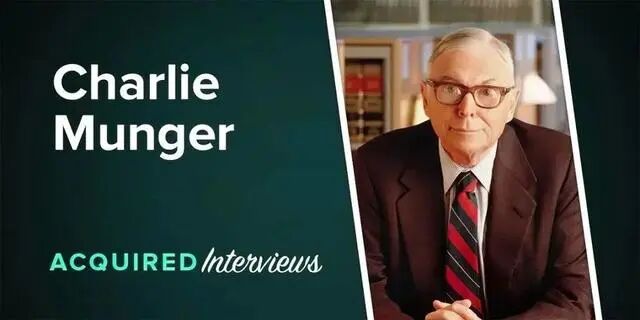
Welcome to Acquired, a podcast about great technology companies and the stories behind them. I'm Ben Gilbert. I'm David Rosenthal.
Host: This is a very unique episode for David and me. Our good friend Andrew Marx arranged for us to have dinner with Charlie Munger and a few others at Charlie's home in Los Angeles. You can hear Andrew asking Charlie questions in the background a few times. We're fairly certain this is the only podcast Charlie has ever done.
Charlie, along with his partner Warren Buffett, is one of the most prolific investors of all time. Charlie is 99 years old this year; he'll turn 100 on January 1st. Of course, our conversation is interesting because he's Charlie Munger, but also because the perspective of someone who's lived through 99 years of human history is inherently fascinating.
We talked with Charlie about Costco, of course, and his 50-year history of investing in retailers. We also heard his views on a number of other topics: what it takes to build a good partnership, problems in global securities markets, the concept of investing versus gambling, and investment opportunities in today's world.
Retail Investors Are Basically Gambling
Host: Charlie, I watched NFL games last weekend, and it seems like every other ad is about sports betting now. Is this good for America?
Munger: No, of course not. Were horse racing and casinos good for America? Of course not. They're just very popular, that's all.
Host: Warren's got a bet on.
Munger: Well, Warren never gambles. He's just their patron. Warren wants odds in his favor; he wouldn't risk anything on a one-in-ten shot. You want to be the house, not the gambler.
Host: The next topic is retail stock trading. For many Americans, retail trading is similar to gambling.
Munger: Well, that's why it's organized. Retail investors don't know anything about companies or anything that's going on. They just chase prices up and down. If I were in charge, I'd tax short-term gains and drive these speculators out of the market. It would be good for every market participant.
Host: What do you think of the algorithms used by quantitative firms like Renaissance Technologies?
Munger: Renaissance's first algorithm was very simple. It screened historical data. What could they determine?
They found that if a stock went up two days in a row, it was more likely to go down the next two days than to alternate up and down day by day.
They realized this came from "reward psychology" — deep down, humans are natural trend-followers, especially when making short-term bets. The quant firms programmed computers to automatically buy on the first up day and automatically sell before the close of the second day. Repeat this every day. Every day, the central clearinghouse would say, if we settle today it's $8.5 million, and the next day it might be $9.4 million.
The result is that the easiest trade is to get in front of it, but you know what the average purchase price index funds have to buy at is. They raised leverage year after year to generate returns, pushing it higher and higher. So their trading volume got bigger and bigger, but their profits got thinner and thinner, which created enormous risk for them. I would never do that myself. That was the only way they could get easy returns — massive leverage. If you're already rich, that kind of leverage will drive you crazy.
Why I Invested in Costco
Host: I'm curious, how did you first come to think about investing in Costco (previously Price Club)?
Munger: Rod Hills (one of Munger's partners) knew Sol Price (founder of Price Club). He understood Sol's business. He said to me, you've got to meet this guy. So I drove straight to his store and chatted with Sol. Of course, Sol was a very smart man — he'd been a lawyer until age 39, then opened a membership discount store serving government employees.
Host: Was this during the Fedco era?
Munger: He wasn't at Fedco anymore. In 1975, Hugo Mann from Germany acquired two-thirds of Fedmart.
Host: Did you invest in Price Club before it merged with Costco?
Munger: Yes, I bought their stock, but I bought it myself in the market. I didn't get any help.
Host: So how did you eventually meet Jim Sinegal (Costco's founder)?
Munger: Sinegal wanted Warren to become a Costco director. He was looking for investors with outstanding financial reputations.
Host: As an independent director?
Munger: Yes. He (Warren) didn't want to do it, said you have Charlie do it. I accepted the shorter flight to attend board meetings. That's how it happened.
Host: Did Berkshire ever try to become a shareholder or acquire a stake?
Munger: I once suggested to Buffett that he buy out the French shareholders when Carrefour left India, but Buffett rejected the idea because he didn't like retail.
Host: Was it just that he didn't like retail, or were there other objections?
Munger: He was afraid of retail. And he was right. Gradually, everything that was once powerful in retail disappeared. Partners left. Retail has too many competitors. Retail is too hard. He was worried.
Host: He had a bad experience with a company called Diversified Retailing, right?
Munger: No, we made a lot of money from Diversified Retailing. We didn't make money from the retail industry itself.
The whole story is very simple. Buffett and I bought this small department store chain in Baltimore. It was a huge mistake because competition was too fierce! Right after we signed, we realized we'd made a terrible error. So we decided to turn it around and bear the consequences of looking foolish rather than let it go bankrupt. During those recession years, we just kept buying. All the money went into these stocks, and of course we made it quadruple.
Host: But this led to Blue Chip? (In the late 1960s to early 1970s, Munger, Guerin, and Buffett gradually acquired controlling shares of Blue Chip Stamps. This small company helped retailers issue trading stamps. Consumers collected these stamps and redeemed them at stores.)
Munger: We should do something people don't know about. Yes, we spent about $20 million to buy a small savings and loan company. When we left that company, we took back more than $2 billion in marketable securities from that $20 million "small investment." Those securities became part of the capital base for investing in an insurance company in Nebraska. That's the perfect beginning everyone needs.
Host: In our episode about Costco, we started with a joke from a Berkshire meeting about ten years ago. Warren told a joke about you on a hijacked plane — the hijacker would grant you one last request, and you said you wanted to give a speech.
Munger: That reminds me.
Host: Buffett's response was essentially "shoot me." We'd love to have you tell us about the virtues of Costco?
Munger: Rarely in your life do you know you're right and that what you're doing will work. Maybe only five or six times in your life do you need to act on that, and in the early days you might try two or three times. Many people go bankrupt thinking everything is easy, when in reality it's very difficult and rare.
Host: What made you realize Costco was one of those rare moments in a lifetime?
Munger: They sell cheaper than anywhere else in America, and they're large, efficient stores. Costco has ample, spacious parking — all spaces are 10 feet wide. They give special benefits to people who come in through reward points. They make suppliers wait for payment until Costco has collected from consumers.
You have a business as big as Costco. Consistently executing an "extreme value" strategy, with a huge parking lot to boot — do you want to miss a case like Munger's?
The company consistently executes an "extreme value" strategy. Through low-priced, high-quality goods and a focused selection of 3,700 hit SKUs, it drives higher unit sales volume and faster inventory turnover. High sales and high turnover in turn push down cost of sales and operating expenses, creating a virtuous cycle. On the membership side, membership fees are the primary profit source — membership fee income roughly equals the company's net profit scale — driving sustained, high-quality growth.
Host: Have you ever seen another success using low SKUs (stock keeping units) and low costs?
Munger: Gelson's, a small grocery chain in California. They adopted a strategy similar to Costco's, but they weren't as efficient in execution as Costco, so they couldn't achieve similar success.
Bet Big on Your Best Ideas
Host: Looking back at these few great companies in a lifetime, you should bet big. As young investors, what advice would you give to David and me?
Munger: When you've held a stock for five years, you may gradually become part of it, or your understanding deepens. But when you realize you have an edge, you should bet heavily. You know you're right, but business schools won't teach you this. It's incredible. You absolutely must bet big on your best investments!
Host: How do you develop that level of conviction?
Munger: You keep working at it, you recognize it, and you understand it through extensive reading and thinking.
Host: You and Warren have had a harmonious partnership spanning half a century. Has anything changed?
Munger: In the early stages of working together, there were many simple but high-quality investment opportunities, though they were usually hard to identify.
Host: How did you maintain the harmonious relationship?
Munger: We're very similar. We both want our families to be secure, to do good work for investors, and so on. We have similar attitudes toward life.
Berkshire Should Have Used More Leverage
Host: Over these decades, have your ideas changed?
Munger: No. Warren still cares deeply about safety — more concerned with the safety of Berkshire shareholders than anything else. If we had used just a bit more leverage from the beginning, we'd now have three times the leverage with no greater risk. We didn't want leverage to compromise our defensive position.
Host: Berkshire's leverage, without exception, is capital with no prepayment requirements — "stable money." Suppose you open a new store, of course you use leverage. Without capital, who wouldn't want a business with no inventory, right? Owing suppliers massive amounts on day one, while the goods sell quickly. What do you think?
Munger: Such situations eventually reverse.
Host: What do you think of debt?
Munger: Many manufacturing companies today can force suppliers to bear all inventory costs. These manufacturers shift the inventory burden onto suppliers through their partnerships.
Host: Returning to the topic of partnerships — David and I have been partners in this podcast for ten years. Of course this is different from an investment partnership, but it's still a joint enterprise. After 50 years with Warren, what advice do you have for building enduring partnerships?
Munger: If you like each other and enjoy working together, that helps a lot. But I don't use any formula. Many long-lasting partnerships endure because one person is good at one thing, the other at another. They naturally divide the labor, and each likes what they're doing.
For example, at Costco, Jeffrey Brotman and James Sinegal. Brotman was very smart but not a retailer by background. When all the board members decided to make Brotman chairman and CEO, Sinegal objected. It was a very unpleasant board meeting — a major internal fight. Eventually Brotman backed down.
Host: Did this fight happen after you joined the board?
Munger: It was before.
Host: Do you think not living in the same city helped you and Warren maintain your long-term partnership?
Munger: It probably helped me. But Warren maintains very close relationships with everyone, and has lunch at Berkshire headquarters every Saturday. Warren and I spent a lot of time together when we were young, because there wasn't as much to do then. As you get older, there's more to do, and other things in life increase. It's different from when you're young.
Investment success is extremely difficult. In venture capital, succeeding again and again is nearly impossible.
Investing Keeps Getting Harder
Host: Regarding venture capital that you just mentioned — the market is flush with capital and highly competitive. The current environment is far removed from the "cigar butt" era of cheap stocks. Do undervalued, worthwhile opportunities still exist?
Munger: Some people will find opportunities, but it's getting increasingly difficult. One of the simplest cases, I think, was Home Depot deciding to copy Costco's business model and apply it directly to the home furnishings space. That was a good business decision, and Home Depot made a lot of money from it.
Host: Who else has copied Costco's model?
Munger: Another one is Floor & Decor. They copied Costco for their flooring products, though constantly adding various other categories might become a problem.
Host: Why hasn't Walmart competed effectively against Costco?
Munger: They were too attached to their existing ideas — that's everyone's problem. They simply couldn't accept new things because the space was already occupied by old ideas. They developed a habit of acquiring real estate, even where it was originally worthless, so occupancy costs were often zero. And they knew how to build large stores — that was their strategy.
So for them, paying to be in affluent locations felt offensive. Costco focused exclusively on good locations where wealthy people live, and Walmart took no action on this for years. That was a serious mistake.
Host: Did you know Walmart founder Sam Walton?
Munger: I never met him. I knew one of his sons. He divided Walton Enterprises into six parts, so they never paid much in taxes.
BYD Is a Miracle
Host: What are your views on the auto industry and auto manufacturing?
Munger: It's very difficult to enter the auto industry now and earn high profits. No one knows who the ultimate winner will be. The emergence of electric vehicles has completely transformed the entire industry, and entry requires massive capital investment. The way cars are sold has changed too, plus there are powerful unions in auto manufacturing. So he doesn't even pay attention to the auto industry.
Host: Due to this disruptive innovation in EVs, do you think the auto industry today is more investable than 50 years ago?
Munger: Maybe for one or two truly high-quality EV companies. Definitely not for the others.
Host: Do you think BYD is among those one or two?
Munger: BYD is a miracle. That guy (Wang Chuanfu) works 70 hours a week and has an extremely high IQ. He can do things you can't do. He can look at other automakers' parts and figure out how to manufacture them.
Host: You invested in Hyundai. How did that work out?
Munger: They're smart too. I lost some money but not much. I was stubborn and held on until I was almost back to even before selling.
Japan Was a No-Brainer
Host: Regarding Berkshire's investment in Japanese trading houses — why was Buffett's investment in Japan a no-brainer?
Munger: It was a no-brainer. If you're as smart as Warren, maybe two or three times a century you get an idea like this. Japanese interest rates were 0.5% per year for ten years. And these companies are deeply entrenched, established enterprises. They own all these cheap copper mines and rubber plantations. So you could borrow all the money ten years in advance, buy the stocks, and collect 5% dividends.
Massive cash flow without investing, without thinking — how often do you find an opportunity like that? If you get one or two such opportunities in a century, you're lucky enough. We could do it because of Berkshire's credit — but no one else could.
Munger: That reminds me — I've recently looked at Nike. But I don't like fashion companies. I'd invest in Hermès, but otherwise I wouldn't want to own a fashion company.
Great Brands Have Powerful Pricing Power
Host: What do you think of LVMH?
Munger: If you have enough time, patience, and exceptional ability, you might achieve something like LVMH's success over a lifetime or three to four generations. Yet even with all that time, building something as successful as they have is no easy feat.
Host: What do you think is the enduring value of the world's best brands like Hermès and LVMH? What makes them last?
Munger: They have brand loyalty, and it took them a century to build it.
The discussion shifted to comparing Kirkland Signature with the Hermès brand.
Host: What do you think of the value of brands?
Munger: It's hard not to like brands. We were fortunate enough to buy See's Candies for $20 million — that was our first acquisition. We quickly discovered we could raise prices 10% every year and nobody cared whether we raised them or not. We increased profits without increasing sales volume. Over roughly 40 years, we raised prices 10% annually. It was an extraordinarily satisfying company.
No new capital required — that's the beauty of it. Nothing fundamental changed from before we bought it to after. Still had two big kitchens and some leased shops. When Laurence See, the eldest son of Charlie See, passed away, the See family urgently wanted to sell because they needed to pay hefty estate taxes. When we bought See's Candies in 1972, its pretax earnings were only $4 million.
Host: So the buying opportunity only arose because the See family needed liquidity to pay estate taxes?
Munger: We knew about it because Charlie See met Robert Flaherty, an investment advisor at Blue Chip Stamps, on a cruise to Hawaii. We paid Robert a finder's fee, though we never paid one again after that.
Host: What do you think about pricing power determined by brand in categories like See's Candies or Hermès?
Munger: I think the chance of finding opportunities to buy companies like this is so low that I simply don't look for them. I only believe in and search for investment opportunities that I think I have a reasonable chance of finding.
Host: What about well-known brands in other categories? Packaged foods, for instance?
Munger: There are many professional investors who buy nothing but stocks of well-known brands. They typically start with Nestlé and just fill in the gaps. They may do slightly better than the market average, but they won't achieve outsized success.
Host: Why does Heinz have pricing power while Kraft doesn't?
Munger: That's interesting. Certain categories have brands that matter enormously to consumers. Take Heinz ketchup — people might switch brands based on the specific taste of a brand and are willing to pay more for it. So we could raise Heinz ketchup prices. But for other products, like Kraft cheese, people may not care as much about brand, so trying to raise prices could provoke market backlash, including from the end consumer — the housewife.
Host: Because sauce is a unique flavor that's hard to replicate, it's a business opportunity, and that brings pricing returns.
Munger: Yes. People get accustomed to it and develop a preference for it. This happened in Korea too — a Chinese person captured 95% market share of every major sauce.
Host: Is Coca-Cola the same way?
Munger: Yes, of course.
Three Elements of Success
Host: What do you believe at 99 that you wouldn't have agreed with at 70?
Munger: At 70, I knew investing was hard. Now I know just how hard. Yet some investment managers who charge high fees and carry will say it's easy and start fooling themselves. But investing is very hard.
Host: If you went back to being in your thirties or forties, would you still choose the investment profession?
Munger: Perhaps, because it suits my nature. But I truly dislike the high-fee, high-carry model. I'd much rather invest with my own capital. I think that approach is better because it brings greater freedom. One purpose of being wealthy is no longer needing to depend on others.
Host: If you and Warren Buffett were both 30 today and started working together, do you think you could build something like today's Berkshire?
Munger: No, we couldn't. Almost everyone who achieves outstanding results has three things: very smart, very hardworking, very lucky. If you start early and keep trying for a long time, maybe you'll end up with one or two of those.
Host: If you were starting over today, would insurance still be your choice?
Munger: It depends on temperament. Insurance is ideal for a certain personality type. It requires enormous patience and time to pay off. And you have to compete against rivals for long stretches — making money is very difficult.
Host: I've heard you say that once you have enough wealth to self-insure, you should try to stop buying insurance.
Munger: Think about people who cause problems through excessive drinking and then file massive claims with insurance companies. Why should you pay your share to cover the losses of people behaving foolishly?
Host: Do you have insurance now?
Munger: I don't have fire insurance.
Host: Do you have car insurance?
Munger: I have to. It's the only way to be legal.
Tech Giants Are the Biggest Winners
Host: Everyone is focused on technology now. I'm curious — you're not from a tech background. How did you think about investing in Apple? What gave you such confidence?
Munger: Every investor needs meaningful exposure to about a dozen companies to do better than others. You need to make at least two or three big bets to improve your performance. If you think that way, Apple is a very logical choice — that wasn't hard to see.
Host: Listing investment targets isn't hard — FAANG, meme stocks, Microsoft, Apple, Google, Facebook (now Meta). But picking one and putting tens of billions of dollars into it, creating hundreds of billions in value — that's very difficult for me. How did you choose?
Munger: We couldn't find anything else worth investing in.
Host: Because of valuation?
Munger: Yes. We bought cheap and got roughly 10x returns.
Host: Probably first bought around 2015. What's interesting to me is this concept — if you look at distressed debt, I think Warren pointed out in his last Berkshire letter that these were some very good decisions. Or if you look at venture capital, it's the classic power-law distribution. The performance of any of these assets comes down to a few very good decisions across an entire career.
Munger: Exactly.
Host: But no asset lets you apply these strategies repeatedly.
Munger: No, no — the opportunities haven't disappeared, they've just become very small.
Host: You mentioned this idea — when we talk about Apple, there are certain companies that matter enormously. Do you think these big tech companies are the biggest winners? All the pension funds, Berkshire, university endowments, everyone's retirement savings — they're all invested in these companies. Do you think this is the natural, deserved outcome? Did it have to end this way?
Munger: Yes, it's the natural outcome.
Host: What caused this result?
Munger: Human nature and competition.
Host: Which factor matters most?
Munger: This crazy risk-taking capital — when they all get stupid, it produces a natural result.
Host: Will there be a $20 trillion company in the future? And then even bigger ones?
Munger: Yes, I think so.
Bullish on China's Economy
Host: Will you continue investing in China? What's your position?
Munger: My position on China is, first, that China's economic prospects over the next 20 years are better than any other large economy's. Second, China's leading companies are stronger and better, and their valuations are much cheaper. So naturally I'm willing to include some China risk assets in the Munger portfolio. As for exactly how much risk — that's not a scientific question. I don't mind whether it's 18% or some other proportion. Whatever the Munger family thinks appropriate, I agree with.
Host: Would you hold TSMC at this point?
Munger: I like companies that truly own their brands, like Apple. (Does not answer directly)
Only Study Cheap Stocks and Great Brands
Host: I'm curious — what other large companies not yet mentioned have merits worth studying? Costco's merits, for instance?
Munger: I only study two kinds of companies. Well, I'm a devoted fan of Ben Graham. If a company's stock is truly cheap, even if it's a lousy company, I'll consider holding it for a while. I occasionally do this and have had some success.
But I'm a bit like Howard Marks — I've made one or two truly huge bets, not hundreds. Easy money from hundreds of bets practically doesn't exist.
Host: One is "cigar butts" (cheap stocks). What's the other?
Munger: Great brands, bought at appropriate prices. The trick is to catch truly cheap, rare opportunities and bet big. Costco's current stock price is okay, but it's getting increasingly difficult.
Host: Setting aside the stock's prospects, how do you view Costco's business over the next 10 years?
Munger: It can do very well.
It's Getting Harder for Young People
Host: One more question. What advice would you most want to give young people?
Munger: I don't give advice to just any young person. I'd think carefully about the timing and the person. I don't want to be a spiritual guru. The world is full of fraud and madness. It's getting harder and harder for young people.
Host: Everything seems overvalued. Where can you look for attractive opportunities? Is it even possible?
Munger: Of course it's possible. It can only be possible. In fact, it may already be happening.
Host: If capital is abundant but opportunities are scarce, how do you get rich?
Munger: That's the nature of things. Biological evolution produced highly evolved creatures like humans, but it did so through brutal competition and tens of thousands of years of mutual slaughter. In other words, nature's system of improving intelligence through competition is not pleasant for the losers.
Host: So over the past hundred years, we've brutally transferred all this value from labor to capital. Now, capital is all fighting over very small opportunities.
Munger: Capital was never that easy. It's just that if you look back very far, it was relatively easy compared to today.
Host: If it keeps getting harder, you get the result of natural competition.
Munger: Yes. What happens when modern democracy faces some challenges? God knows what will happen? Maybe like Europe — that's pretty abnormal.
Host: Some people think there aren't enough good ideas in the world to match the amount of capital that wants to invest in them. Is that too pessimistic?
Munger: Success was never easy. I thoroughly understand — it was never easy, and now it's getting even harder. You need to pay attention to how you deal with people and build a good reputation.
Host: I think what you're saying is not that there are no opportunities, but that expectations should be lower and wealth will be less.
Munger: The beauty is you only need to get rich once. You don't need to climb that mountain four times. You only need to do it once.
Host: Well, that's your two-sided philosophy. You have to wait patiently for huge opportunities, but when they come, you have to recognize them.
Host: One more Costco question I've always wanted to ask. The combination of low SKU count and high inventory turnover and so many other strategies — it's so elegant, so obvious. Why hasn't any other company done it?
Munger: It takes very strong execution. You really have to get your hands dirty, then analyze day by day, week by week, year by year, for 40 years. That's not easy.
Success = Business Model + Culture
Host: So do you think success has to depend on business model and culture?
Munger: Yes, culture plus model. Yes, absolutely. Very reliable, diligent, determined execution for 40 years.
Host: Take the ketchup story. You could raise ketchup prices by 3% and no one would notice. But if you actually did that, it would destroy everything.
Munger: I'd say the core principle is don't raise market prices. Work hard to keep prices low and do so for the long term.
Host: That brings me to the hot dog story. When Craig took over as Costco CEO, he did try to raise the hot dog price — is that story true?
Munger: I don't know. No one talked to me about it.
Host: Was it not discussed at the board level either?
Munger: No. They wouldn't consider hot dog pricing an important matter.
Host: One thing that fascinates me about Costco is they seem to only be able to grow 10% a year even though they have no capital constraints. Even if they could get massive amounts of money for free, they'd probably do the same.
Munger: What I can tell you is, it's hard to open too many stores in a year. New stores, new managers, new political environments, and so on. These are all difficult things. And there's so much to learn, to teach, and to put in place. So they don't want to do more than they can handle comfortably.
Host: One interesting thing I found about Costco is that despite having the lowest prices, most of their customers are wealthy people. Was this discovered over time as a surprise, or was it realized early on?
Munger: Saul Price realized this during the Price Club era. He always wanted rich people to work hard at saving money.
Host: Not just because they're the wealthiest customers — they're smart customers. They're discerning, wealthy customers.
Let's talk about some topics beyond Costco. At this year's Daily Journal annual meeting, you mentioned that young people know the rules, old people know the exceptions.
Munger: That's an old saying of Peter Kaufman's.
Host: What exceptions have you found most useful in life?
Munger: Take these Costco hot dogs, for example. That's an exception. Anyone else would have raised hot dog prices long ago. They just don't do it. They know the hot dog is one of the selling points that attracts many families to shop. Even when they have the opportunity to raise hot dog prices, they don't do it.
Wang Chuanfu Is a Genius, Better at Manufacturing Than Musk
Host: There's one thing I never fully understood. I know you're a big fan of BYD, this Chinese company that makes batteries and electric vehicles.
Munger: I may be a big fan, but what I'm sure of is that I feel very nervous when this company is racing on the track. This company has enormous ambition.
Host: Is that dangerous for a company?
Munger: Of course. That's what makes me nervous.
Host: So do you think this company should grow at a pace below its capabilities to achieve more sustainable growth?
Munger: If doing so is safer, easier, and so on, you can do that. But take Costco — their approach on extreme matters like hot dog pricing produced positive results. On some things, they wisely chose not to change their ways.
Host: This seems like a spectrum. On one side is Costco, not a fast-growing company because that's difficult. On the other side is a company like BYD, achieving crazy growth.
Munger: BYD will sell at least 2.5 million vehicles this year, most of them electric. That's unheard of. Far more than Mercedes.
Host: And far more than Tesla.
Munger: Is that so? Every company has encountered a lot of trouble and losses. They've also had terrible problems, made wrong types of vehicles, made many mistakes.
But fortunately, they're at the forefront of the electric vehicle industry. Its acceleration performance far exceeds other brands, making it more dynamic than most cars. I really like BYD's electric vehicles. In many ways, it performs better.
At a 90-degree turn, a BYD car can move directly to the parallel position on the opposite side and just keep going like that. The tires turn 90 degrees and move forward. If one tire goes flat, the other three wheels still work and can go a hundred miles.
Host: Would their economic model be better because there aren't too many parts?
Munger: Better, because they're simpler.
Host: Have you made similar investments before? You invested $270 million in BYD, and now it's worth about $8 billion.
Munger: Many "smart people" do VC-type investments. BYD was actually a relatively illiquid public company. Our investment was not VC-type. They took action very aggressively, like flooring the accelerator, going all out.
We once discouraged them from rashly entering the auto industry. BYD entered the auto industry by acquiring a bankrupt car company. I thought this was a grave for them — why do this? But they didn't listen to the advice and kept going.
Host: When he told you this plan, had you already invested?
Munger: Yes. After making huge mistakes, it worked out very well. It almost went bankrupt because of the early dealer system — almost.
Host: What attracted you to invest in BYD?
Munger: That guy (Wang Chuanfu) is a genius. He has a Ph.D. in engineering. He could look at parts from other companies and know how to manufacture them. I've never seen anyone like that. He can do anything.
He's a natural engineer and good at execution and problem-solving — that's very important. He's a collection of various talents, which is very useful. He solved many problems in the electric vehicle field, including technical challenges with motors, acceleration, and braking.
Host: How would you compare his BYD with Elon Musk's Tesla?
Munger: Wang Chuanfu is a fanatical person, obsessed with personally manufacturing products, so he's closer to the front lines. In other words, Wang Chuanfu is better at manufacturing than Musk.
The Newspaper Business Was a Gold Mine
Host: Charlie, you'll turn 100 on January 1st next year. That's an incredible day. Do you have any plans?
Munger: I'll throw a party.
Host: Has anything fascinated you lately, or anything fun?
Munger: For me personally, everything is interesting. Even though politics itself is terrible, it's still interesting.
Host: Looking back, when did you have the most fun during your time with Warren?
Munger: It was always fun.
Host: Was there a particular era you miss most, feeling like the good old days?
Munger: Well, there was a sweaty time.
Host: Salomon Brothers.
Munger: Yes. We had big problems to solve then. There could have been huge losses.
Host: When we examined Berkshire Hathaway on the podcast, our conclusion was that the entire franchise was at risk during the Salomon Brothers period — betting Berkshire Hathaway's entire reputation and future. Do you agree?
Munger: Not that serious. It would have survived.
Host: What would have happened if you wrote off the entire Salomon investment?
Munger: Everything would have blown up. We could have written off bad debts. We could have handled it well.
Host: Do you think that was your best time?
Munger: We had terrible problems with our investment in the Buffalo Evening News.
Host: The Buffalo Evening News.
Munger: Buffalo had two newspapers at the time. We launched a Sunday edition, which touched off a fierce competition. In the end, the competitor went bankrupt.
Host: You were all young and ambitious back then.
Munger: No, but I was very aggressive about making the Sunday edition work. Without the Sunday edition, I wouldn't have held that newspaper for 50 years — all the other papers had Sunday editions too.
Host: What made the newspaper business so attractive at that point in history?
Munger: The newspaper business was a gold mine.
Host: Acquiring the Buffalo Evening News and launching the Sunday edition was about monopolizing the local newspaper market. Right — if you're going to play a big game, you play it in one town. With a newspaper, you could do that. And I mean, for decades, newspaper EBITDA margins were 50% to 60%. Right?
Munger: No, those were the margins for small newspapers. For large newspapers, EBITDA margins were 25% to 40%.
Host: Sorry, I overlooked the size of the newspaper.
Host: Actually, do you still feel that eBay was committing crimes all along — did you demonize it in the past?
Munger: Indeed. So you take a big trucking company and deduct earnings from the depreciation on the trucks. Then you're lying about your profits.
GE Was Once a Great Company
Host: I mean, you were there when the concept of EBITDA margins was invented, with John Malone and TCI and Liberty, right? What were you thinking at the time?
Munger: Well, I never liked extreme maneuvers on their own. I didn't want to be known as a great manipulator like John, who paid less income tax than anyone — he just pushed everything to the extreme.
Host: Maybe one last question: What do you think are the greatest companies you've seen, ones you've held or haven't held?
Munger: Well, there are many great companies. General Motors was once a great company. Yes, GM at its peak was a great company — it just declined step by step.
Host: How much predictability do you think companies had? When you started out, there were many businesses where you could say with confidence what they'd look like in ten years. Do you think that number is the same now? Or do you think it's harder now?
Munger: I think most places are going to face much greater threats in the future.
Host: Do you think it was the same 50 years ago?
Munger: There's a difference. Berkshire owns a lot of what I call specialized industrial companies, companies that are shielded from truly intense competition simply because they've been around so long, and they're very good at what they do, and they have good reputations and high value and so on.
Host: Besides Berkshire and Costco, what companies today can you say with confidence will be doing as well in ten years as they are now?
Munger: I think many companies are quite good, but you usually can't say what will happen because you might get the kind of people who push everything just to maintain public relations. So no matter how excellent the business, there's a bit of phoniness to it.
Getting Along With Family
Host: Charlie, I have a personal question for you. David has a two-year-old, and I'm going to have my first child in a month. What advice do you have for us about building a family?
Munger: Well, you need to get along with every family member, you have to help them through difficult times, and they'll help you too. I don't think it's as hard as it looks. I think half the marriages in the United States work out very well. By the way, if both parties had to marry someone else, it would work out just as well.
Host: Well, you've said that the best way to get a good spouse is to deserve one. As long as both people feel that way, that's the secret to success.
Munger: Of course it is, and on things like raising children, you have to trust your partner.
Host: I agree with you, Charlie.
Munger: Good luck to you.
This article is selected from a Wall Street News compilation; click "Read Original" for the podcast link.