Cybersecurity Vendor "Yunqi Wuyin" Closes Angel Round of Tens of Millions of RMB | Led by Oasis Capital

Next-generation intelligent fuzz testing technology vendor

Cybersecurity startup Yunqi Wuyin (云起无垠) recently announced the completion of its angel round, raising tens of millions of RMB in a deal led exclusively by Oasis Capital.
Kevin Shen, founder and CEO of Yunqi Wuyin, said: "As an emerging investment firm, Oasis Capital focuses on the long-term structural drivers of social and economic development, with a dedicated and specialized investment analysis capability. It excels at first-principles thinking, helping entrepreneurs cut through the noise of information overload to identify fundamental problems and improve decision-making. This is precisely the kind of thinking that both investors and entrepreneurs desperately need in the era of information explosion."
An investment lead at Oasis Capital said: "As a pioneer in next-generation Fuzzing technology, Yunqi Wuyin detects the unknown and serves the full software development lifecycle. Its founding team brings a powerful blend of industry and academic expertise with real foresight — they've identified genuine market pain points, achieved technology落地, and are driving industry transformation. Oasis looks forward to working with Yunqi Wuyin to realize the boundless scalability of its vision for the industry."

Yunqi Wuyin was founded in July 2021 and positions itself as a next-generation intelligent fuzzing technology provider, aiming to support enterprises across their entire software development lifecycle through Fuzzing technology — helping them improve their overall security posture starting from the development phase itself.
From a technical taxonomy standpoint, Fuzzing broadly falls under the development security category. Fuzzing is an automated software security testing method. In essence, its core concept involves feeding a target system massive volumes of unexpected inputs, then monitoring and capturing anomalous results to uncover previously unknown security issues.
From an industry perspective, the development security tools that have historically enjoyed greater recognition are AST tools, primarily including Static Application Security Testing (SAST), Dynamic Application Security Testing (DAST), and Interactive Application Security Testing (IAST). By contrast, Fuzzing has largely remained in academic circles, with few standalone vendors in China. Based on our observations, development security has gained increasing attention domestically since around 2020, and companies specializing in various security testing tools have proliferated accordingly. Fuzzing, as an AST alternative, has also seen the emergence of domestic players. Yunqi Wuyin is one such company.
Kevin Shen explained that his decision to pursue Fuzzing as a startup direction at this particular moment stems from several factors:
First, regarding industry dynamics: as market demands have evolved, China's cybersecurity industry has gained increasing recognition from customers and investors in recent years. Development security has gradually become the next priority for clients after they've completed foundational security infrastructure. Additionally, the growing adoption and落地 of Fuzzing on the industry side has given startups greater confidence. Internationally, Fuzzing has already been deployed at leading organizations such as Google, Microsoft, and the U.S. Department of Defense (DoD), indicating strong growth potential for the technology. Moreover, Shen believes that the advancement and practical application of Fuzzing technology has made truly automated code security testing possible. For instance, the integration of intelligent coverage-guided techniques has significantly improved the granularity, efficiency, and effectiveness of Fuzzing.
From the perspective of evolving customer needs, Shen noted that clients previously relied primarily on AST products, but these tools could only identify issues in web scenarios. Fuzzing technology, by contrast, can extend to additional scenarios including APIs, protocols, and databases. Furthermore, compared with traditional testing techniques, Fuzzing can not only discover known (1-day) vulnerabilities but also automatically uncover more unknown (0-day) vulnerabilities. The fundamental reason lies in Fuzzing's finer granularity, greater number of test points, and more precise judgment locations when conducting software security testing.
He elaborated that fuzzing technology can automatically generate massive volumes of high-quality test seeds through template generation or traffic extraction. During testing, fuzzing technology can also intelligently guide seed mutation in productive directions through software coverage feedback mechanisms. Notably, fuzzing also detects memory corruption vulnerabilities by observing the program's Control Flow Graph (CFG). This vulnerability detection approach based on underlying system logic enables even subtle vulnerabilities to be identified promptly.
"This will draw more customer attention to the application value of Fuzzing, thereby creating greater market space for Fuzzing entrepreneurship," Shen said.
However, in terms of practical落地, translating Fuzzing from technology to product remains at an early stage in China.
In the domain of automated code security testing technology, Shen stated that Fuzzing has undoubtedly been the hottest research direction at the four top-tier cybersecurity academic conferences in recent years. Through continuous scholarly research, Fuzzing has already matured at the research level.
Yet the industry has long lacked easy-to-use products. This means that while more customers now recognize the value of Fuzzing, ordinary clients struggle to conduct automated code testing using open-source academic Fuzzing frameworks alone due to the absence of Fuzzing expertise and practical experience. From a product usability standpoint, for example, open-source Fuzzing versions lack basic modules such as UI interfaces and user reports, making it difficult for ordinary customers to apply these open-source frameworks to daily work tasks. In summary, Shen believes that despite Fuzzing's recognized superiority in academia, its inherently high technical barrier means that "out-of-the-box" fuzzing products have become a market imperative.
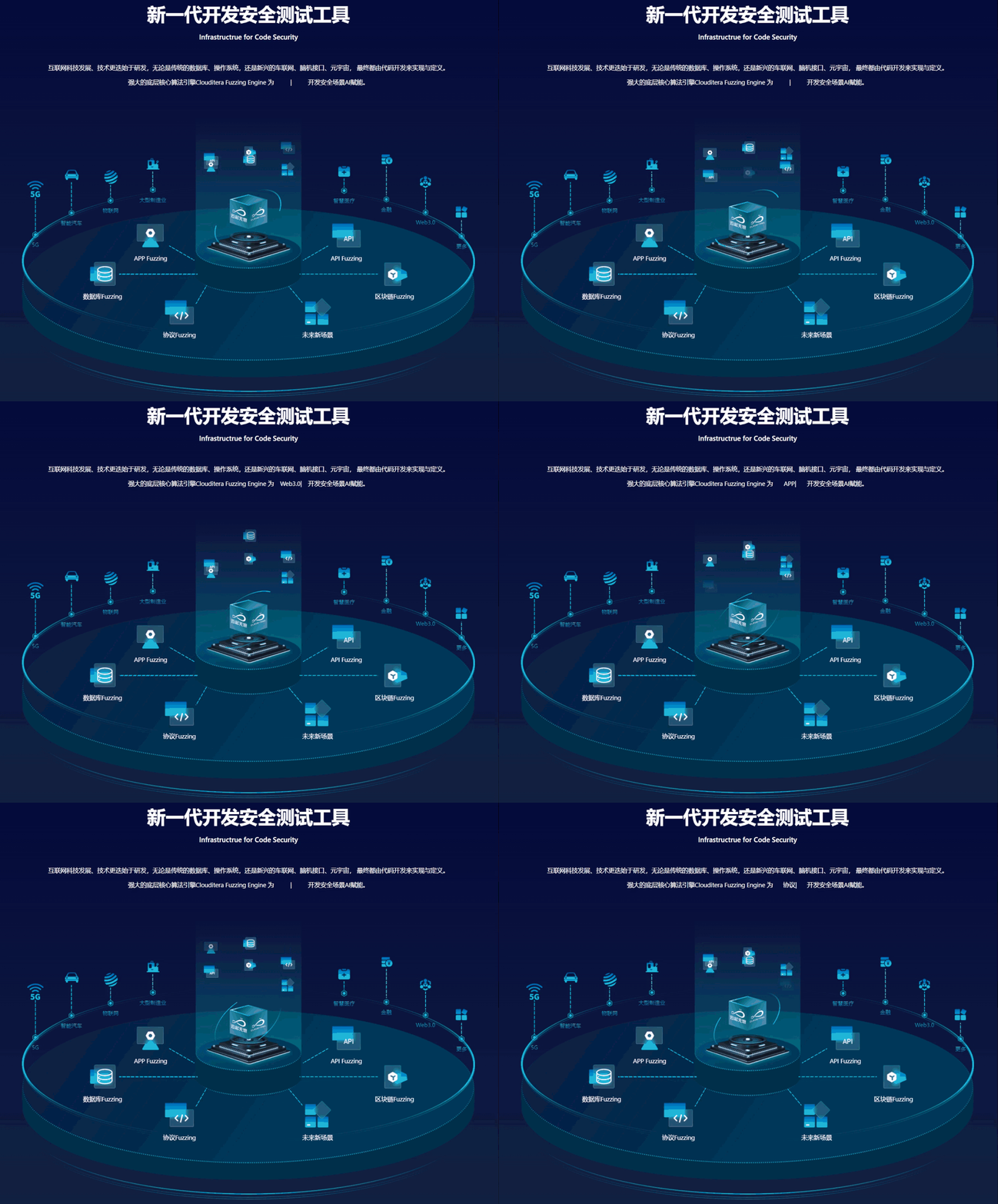
In terms of customer profiles, Yunqi Wuyin primarily serves two categories of clients: The first comprises enterprises with extremely low tolerance for code security vulnerabilities, such as automotive, Web 3.0, industrial control, military, and aerospace sectors. Product failures at these companies often result in massive recall costs, so they demand exceptionally high security standards and are willing to invest substantial resources in automated software security detection tools. The second category comprises DevOps customers, including financial and internet companies. These clients typically manage vast quantities of rapidly iterating code that manual code audits simply cannot keep pace with. To ensure rapid, secure iteration of their business operations, automated security detection is essential.
Currently, Yunqi Wuyin is progressively building out a more comprehensive product matrix — providing Fuzzing-based testing products for each phase of "development, testing, deployment, and operations," primarily including black-box Fuzzing testing and gray/white-box Fuzzing testing. The former mainly covers the development and testing phases, while the latter can span development, testing, deployment, and operations. In terms of go-to-market strategy, as trust with customers deepens, Yunqi Wuyin can expand from providing black-box Fuzzing products to gray/white-box Fuzzing testing, thereby increasing its product footprint and effectiveness within client organizations. In terms of use cases, these products primarily address scenarios including protocols, APIs, databases, and Web 3.0.
Overall, Shen believes that entrepreneurship in the Fuzzing domain requires not only technical capability but also deep customer understanding. To this end, he highlighted that one of Yunqi Wuyin's core competitive advantages lies in its established industry-academia-research integrated team. Broadly speaking, Yunqi Wuyin's founding team hails from Tsinghua University, Beijing University of Posts and Telecommunications, leading overseas universities, and top-tier internet companies. Technical team members have repeatedly won awards at world-class cybersecurity competitions including DEFCON CTF, HITCON CTF, and GEEKPWN, and have published multiple papers and given presentations at the four major cybersecurity academic conferences and at Blackhat USA. Core members of the sales team bring over eight years of sales and management experience, with a customer base covering connected vehicles, finance, internet, and telecommunications sectors. Founder Kevin Shen holds a PhD in cyberspace security from Tsinghua University, is a core member of Blue-Lotus and Tea Deliverers, won first place globally at the GeekPwn 2019 International Security Geek Competition, and was inducted into the "GeekPwn Hall of Fame."
In terms of near-term plans, Yunqi Wuyin intends to continue refining its products and expanding customer outreach.
Source: 36Kr
Celebrating Vitality
What do you think vitality is?
For entrepreneurs, vitality is the vision and courage to create the future, the resilience and confidence to overcome difficulties. Powerful vitality enables a company to navigate the highs and lows, twists and turns through its startup, growth, and maturity phases — continuously iterating and innovating while adapting to economic conditions, and ascending to new heights of enterprise development.
— Kevin Shen, Founder & CEO, Yunqi Wuyin





Oasis Capital is a next-generation venture capital firm in China, dedicated to discovering the most vital entrepreneurs of the coming decade and growing alongside them to create long-term value. "Celebrating Vitality" is Oasis's vision and mission. This vitality represents both the direction of structural transformation in our era and the resilience and evolutionary force of entrepreneurs.
Oasis Capital focuses on early and growth-stage investments, with individual ticket sizes ranging from $3 million to $30 million, concentrating on technology-enabled services in healthcare, enterprise services, and related sectors — supporting China's new service upgrade driven by technology.