Data Intelligence Search Engine "DataGPT" Revolutionizes Analytics Experience | Oasis Vitality

DataGPT Revolutionizes the Data Analysis Experience

> On March 21, DataPolar will host the "Data-Driven, Panoramic Transformation" DataGPT & Product 3.0 Launch Event**. As the theme suggests, a new wave of technology is already surging, and data-driven approaches will inevitably lead comprehensive transformation for enterprises and the era at large. Whether it's DataGPT or other technologies and concepts, change is underway.
After ChatGPT broke into the mainstream, it quickly sparked widespread "fever." This wave of generative AI, represented by ChatGPT, has pushed human-machine collaboration to a deeper level: now ordinary users need only an idea, or even a question, and AI can use that as a starting point to complete a series of astonishing creative tasks in a remarkably short time. From a longer-term perspective, this shift in human-machine relationships may prove more historically significant than the technical breakthroughs themselves. Currently, AIGC has profoundly transformed content production paradigms in text, image, and music; meanwhile, some companies are tackling even more demanding application scenarios. In this space, data intelligence search engine provider DataPolar is using "AIGC + data" to upend decades-old data analysis practices in enterprises: users simply ask questions in natural language, without needing to understand data structures or statistical analysis principles, and easily obtain AI-enhanced data analysis results — expert-level data insights to support business decisions.
80% of Data Needs Go Unanswered; Data Value Urgently Awaits Unlocking
If data is a gold mine, then data analysis is the process of mining and refining — the final step that unlocks data's value, the last mile of the data-driven chain. Yet data analysis has an extremely high barrier to entry, heavily dependent on professional analysts. With severe scarcity of specialized talent, data analysis teams' service radius is extremely limited, creating a profound contradiction in enterprise data analysis: data teams prefer to take on only general, highly reusable analysis needs, while business teams want to validate as many emerging questions with data as possible. According to statistics, 80% of data needs in enterprises go unanswered — from frontline staff and management alike. This status quo is a "chokepoint" problem hampering many companies' growth, severely limiting the pace of digital transformation. IDC predicts that global data volume will reach 175ZB by 2025, with China's data expected to hit 48.62ZB, making it the world's largest — yet enterprises currently utilize less than 30% of their data. "We have data, but the business can't see it" has seemingly become a universal affliction. How to bridge this last mile of data value, enabling everyone to contribute to mining the data gold mine, has become a shared focus and topic of discussion for many enterprises.
Lowering the Analysis Barrier: "Say One Sentence" to Gain Data Insights
DataPolar firmly believes that the more complex a product, the fewer its users; the simpler it is, the more users and use cases it gains. A key reason ChatGPT sparked global enthusiasm was its sufficiently simple interaction entry point. DataPolar operates on the same principle. When the cost of obtaining data insights drops to merely "saying one sentence," data analysis capability truly filters down to non-technical business personnel, making Gartner's vision of "citizen data scientists" genuinely possible.
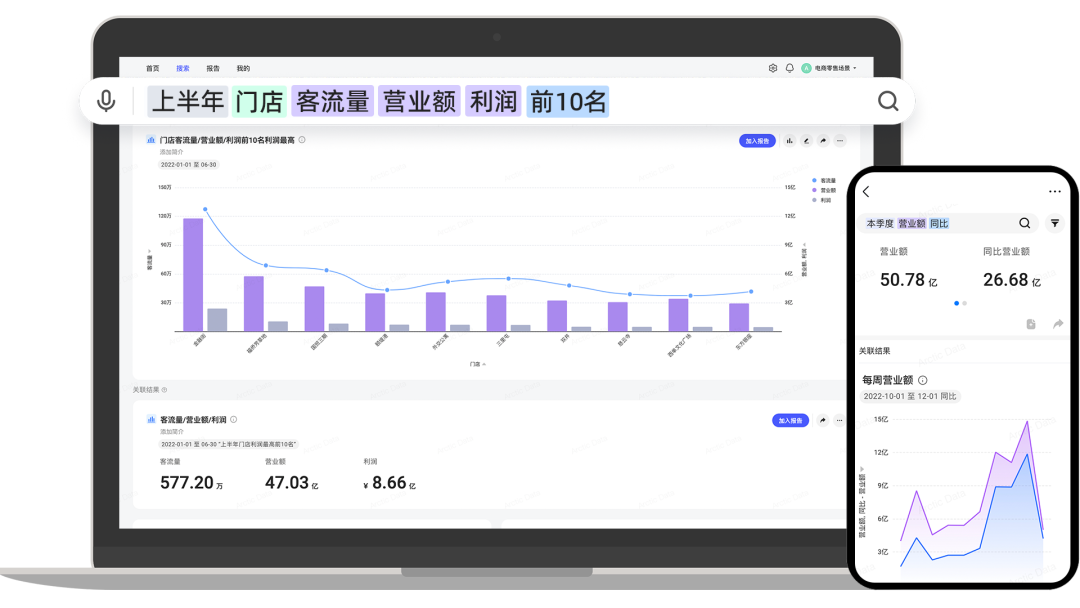
DataPolar first satisfies the "ask and receive" need. Users type or voice a question, and DataPolar converts natural language into database query language, visualizing results within seconds. Throughout this process, users need not know the underlying "rows" and "columns" of data, nor consider how to filter and aggregate — analysis and presentation are automatically completed by the machine.
Second, DataPolar enables "need and receive." Often, business users lack analytical thinking, don't know how to dig deeper into data, or how to interpret it. Leveraging AI technology, DataPolar intelligently extracts data insights, automatically performing multi-dimensional intelligent attribution, predictive analysis, correlation analysis, and other complex analyses. Users don't need to ask specific questions to understand trends, causes, anomalies, and risks behind the data, quickly grasping the full picture and forming insights to guide business decisions.
To make data analysis even simpler and closer to users, DataPolar continuously expands usage scenarios, integrating product capabilities into communication software and chatbots like Lark, WeCom, and DingTalk, and pioneering integration with office document software, embedding data analysis into enterprise employees' daily workflows. Users can access continuous, consistent data insights anytime across platforms, devices, and spatiotemporal work contexts.
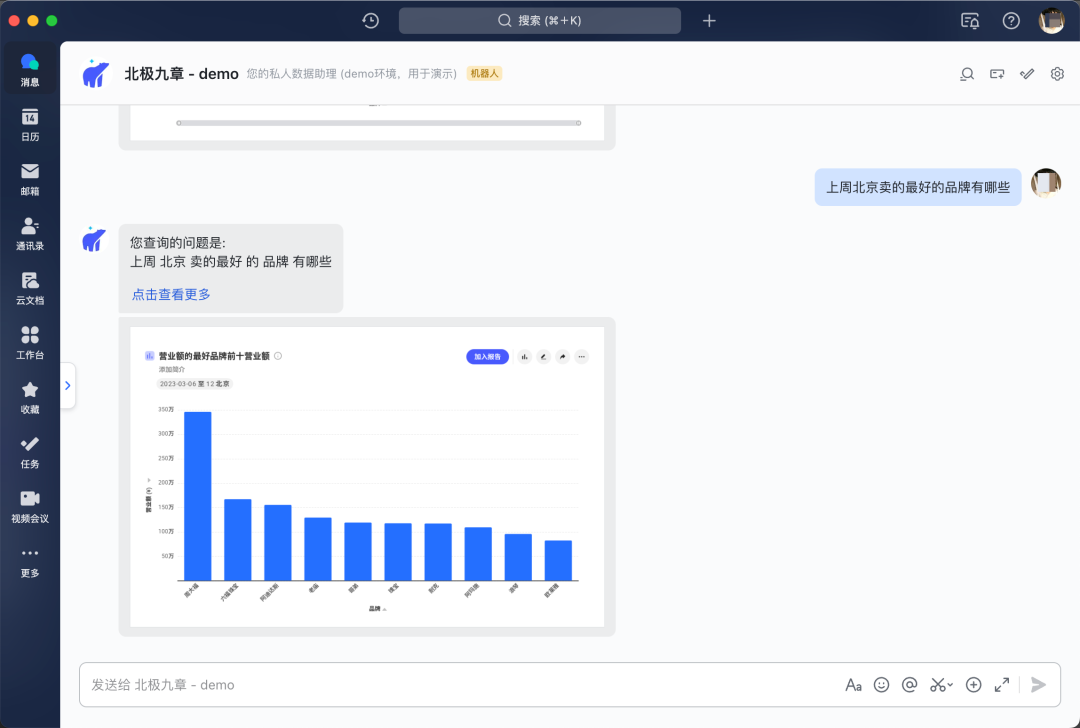
"It's like having a 7×24 on-call data analyst living in your phone," said a longtime DataPolar user.
On the technical front, DataPolar builds on proprietary natural language parsing capabilities, combining machine learning, training models with industry knowledge data, and incorporating human feedback. Based on daily interactions with users and new data, it continuously updates and iterates, optimizing its models to become better with use.
Harnessing Collective Intelligence: Everyone Participates in Data Construction
Not everyone can learn data analysis, but everyone can learn DataPolar. Currently, DataPolar serves dozens of enterprises including State Grid Corporation of China, Xiaohongshu, and a joint-stock commercial bank, spanning finance, internet, and retail. End users range from executives and department heads to sales, operations, store managers, and frontline sales associates. DataPolar has helped clients' business teams improve data analysis efficiency by several dozen times, driving employees to proactively use data to solve business problems and spontaneously cultivate a data-driven culture.
Harnessing collective intelligence also manifests in DataPolar enabling every business user to participate in data infrastructure building. In the past, IT departments invested heavily in building data systems, yet because they were distant from business scenarios, business users often found them difficult or unusable. DataPolar acts like a window, giving IT departments their first real-time, clear view of business users' data needs and usage patterns. Based on this feedback, IT departments can optimize data construction with the end in mind, better dialogue with and support business needs, transforming from back-office support into close partners of business teams and leaders of digital transformation.
Take Youngor, a large multinational apparel retail group, as an example. Previously, to effectively support sufficient and complex business scenarios, the headquarters data team built numerous complex components on their data platform, yet still struggled to meet the operational analysis needs of numerous stores and channels. After DataPolar's product went live internally at Youngor, work cycles previously spanning weeks were compressed to minutes. Business personnel achieved 70% self-service automation for daily business needs, and the data platform's effectiveness was greatly enhanced.
DataPolar has been repeatedly featured in research reports from prominent institutions such as IDC, iResearch, and iAnalysis, recognized for its vision and product strength.
DataGPT Once Again Revolutionizes the Data Analysis Experience
Currently, DataPolar is exploring the integration of large language model capabilities with its self-developed search and insight model to create "DataGPT," further enhancing the friendliness of human-machine interaction and the depth of data insights.
ChatGPT and other large language models excel at emotionally intelligent language capabilities, possessing superhuman abilities in certain semantic understanding and generation. DataPolar, meanwhile, has accumulated more precise search and insight models through years of practical industry application, providing reliable data analysis and insight results. DataPolar leverages large language models to enhance semantic understanding: first, AI improves conversational experience, enabling the machine to comprehend richer, more complex queries, accurately understand business questions, while沉淀ing industry general knowledge; second, AI assists data interpretation, automatically summarizing data insights and proposing action recommendations, helping users quickly interpret data, pinpoint problems, and optimize next steps.
DataPolar DataGPT once again revolutionizes data analysis methods: starting from the simplest data question, it completes a closed loop of "what — why — how to respond," as data analysis evolves from "PGC" (professional-generated insights by data analysts), "UGC" (user-generated insights by business personnel) to a new era of "AIGC" (AI-generated insights).




Oasis Capital is a new-generation Chinese venture capital firm dedicated to discovering the most vital entrepreneurs of the next decade in China, growing alongside them, and creating long-term value. "Nurturing Vitality" is Oasis's vision and mission. This vitality is both the direction of structural transformation in the era and the resilience and evolutionary force of entrepreneurs.
Oasis Capital focuses on early and growth-stage investments, with individual ticket sizes ranging from $3 million to $30 million, concentrating on robotics, artificial intelligence, technology, and other fields, supporting the upgrade of new services driven by Chinese technology.