Digitalization: The Gateway to a New World

Grateful for 2020, hello 2021

2020 was not an easy year.
Virus
To date, COVID-19 has infected 100 million people and killed 2 million across 223 countries and regions worldwide. That toll already exceeds many wars in human history — the Battle of Changping before Qin's unification of China, and the Battle of Berlin in global history, to name two. Meanwhile, markets grew more turbulent. After four circuit breakers, US stock indices hit new highs, with ever-increasing divergence and noise in trading.
On February 11, 2020, before the pandemic spread globally, we wrote to our investors that this would be a profoundly consequential, long-term global event. During that period, we predicted the commercial shifts to come in China: flexible manufacturing, rising chain-store penetration, communities becoming consumption centers, and more. Over the past year, we've watched these predictions materialize.
The community wars of 2020 unfolded exactly as we described in that letter:
"Due to China's rapid urbanization, a dual structure has emerged between city and countryside. In rural areas, we mostly organize by village; in cities, this unit dissolves and we navigate by 'landmarks.' For the first time in this pandemic, Chinese people have organized collectively for protection and management at the community level. 'Community' is gradually becoming the gathering point and source of identity for urban citizens. This will profoundly change consumption habits and scenarios for China's urban population."
Taoism teaches: "Long and short give shape to each other; yin and yang give birth to each other." Development is never unilateral — it emerges from the mutual interaction between subject and object. Virus and society are co-authoring human history.
So as the receptor of the virus, let us examine how society has responded.
Society
First, governments worldwide have broadly adopted loose monetary policy. More capital has flowed into markets, uncertainty risk carries excess premium, prices of top-tier assets have risen further, and industry consolidation has accelerated.
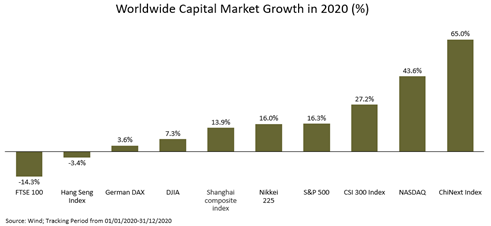
Second, in China's various market segments, capital continues to assign higher valuations to leading technology innovators.
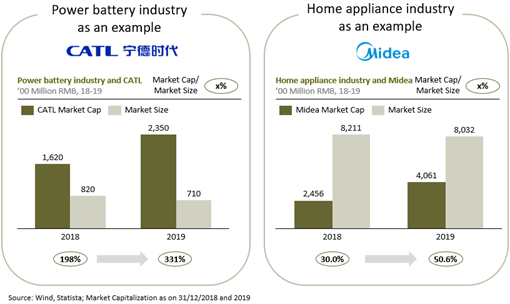
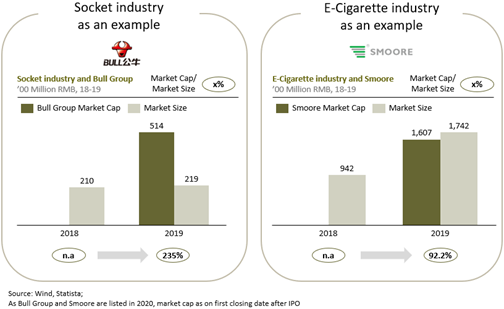
Beyond the further industry consolidation driven by Chinese capital markets' high valuations for leading tech companies, China's underlying economic structure is also upgrading from a high-growth model to a high-quality one. Policies like "domestic circulation" and "dual circulation" keep rolling out. But looking ahead, we must confront China's demographic structure and productivity efficiency challenges. Since the one-child policy, the number of newborns has steadily declined. Despite this year's policy pushes encouraging larger families, data from some cities in 2020 still showed decreases compared to 2019.
"Growing old before growing rich" — the sword of Damocles hangs over China.
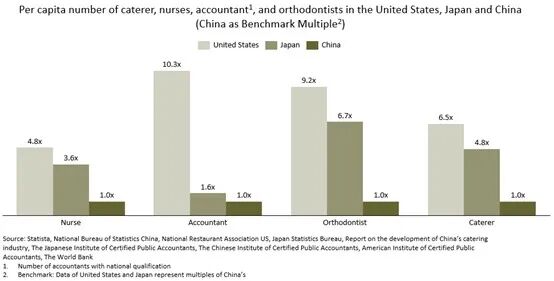
Solving this problem and completing industrial upgrading requires dramatically improving labor productivity and achieving overall efficiency gains through specialized division of labor. Yet whether in labor productivity or the number of specialized professionals, China still has enormous room for improvement.
And these limited specialized professionals are concentrated in first-tier cities, serving only 7% of China's population. The other 93% live in lower-tier cities with far less quality supply. How to mass-produce standardized "services" and drive industry efficiency gains — this is the problem China must inevitably face.
Problem definition creates value. The immense value created by great companies usually lies in deeply understanding and solving the problems of their era.
This is the source of Oasis Capital's core theme: "Technology-Driven New Service Upgrade."
Through years of observation, exploration, research, and practice, we have developed a deep understanding of the "technology" in this theme — namely, "digitization."
Digitization
In April 1913, Ford launched its first assembly line. A 20-minute motor assembly was broken down into 29 steps and reduced to 5 minutes. From then on, automobiles could be mass-produced; they were no longer luxury goods. "Industrialization" deconstructed manufacturing processes centered on "things," with "people" becoming nodes in the manufacturing flow. Through coordinated division of labor, efficiency increased dramatically. Over 100 years, most manufacturing industries achieved "industrialization."
Yet while "manufacturing" centered on objects could be deconstructed and rebuilt, "services" centered on people remained intractable. Industrialization enabled division of labor across space, but not across time.
Take healthcare. The patient journey can be endlessly decomposed, enabling collaboration among nurses, doctors, rehabilitation specialists, and other specialized roles. More devices are invented, each function's efficiency continuously optimized — yet we find that the quantity and efficiency of core functional roles like "doctor," "nurse," and "rehabilitation specialist" become the ultimate "bottleneck" of the industry.
Thus, distinct from "industrialization," the core of "digitization" is deconstructing and replicating expert experience and knowledge to break through industry bottlenecks.
Invisalign's success in the orthodontics market may offer more inspiration.
Orthodontics, as the primary dental issue for adults: in the United States, 42.31 million adults need correction, with 1.78 million cases annually. China faces a more severe situation, with nearly 300 million adults needing correction and over 3 million cases per year. Yet orthodontics is a classic "craft." Orthodontists use metal materials and extensive clinical experience to "create" a metal brace for each patient. Training a qualified orthodontist takes 7-10 years. Even in the United States, registered orthodontists number fewer than 10,000; in China, fewer than 5,000.

Invisalign offers a new solution. By extracting patient oral data, it creates a digital oral model for each patient. Orthodontists can remotely diagnose treatment plans, then use 3D printing to produce a lightweight, transparent, custom-fitted aligner. The transparent aligner greatly simplifies wear and daily life, expanding the addressable consumer base from youth to middle age.
Going further, as patient oral data accumulates, Invisalign's big data and AI teams continuously learn from orthodontists' treatment plans, gradually assisting in clinical decision-making. Eventually, doctors can complete case diagnoses in less time.
In this way, a highly expert-dependent industry has been reshaped by digital technology. Today, Invisalign has cumulatively served 9 million patients across 104 countries. The fastest-growing market in 2020? Asia.
Invisalign is not alone. Across traditional craft industries, new materials, communications, and digital technologies are reshaping the landscape. And with China's mature internet infrastructure and massive population data, digital industry leaders are rapidly emerging across sectors. These companies, combining ever-accumulating digital assets with self-evolving service processes, further accelerate industry consolidation and ultimately grow into hundred-billion-dollar companies. Glodon in construction digitization is one example.
Oasis
Oasis Capital is honored to participate in this transformation. In 2020, we invested in nearly 20 digital technology companies across digital production (MiaoXiang, ZhongYu, MiaoYou), digital orthodontics (4Smile, LM), and digital management (Chenfeng, Shouhoubao, Meike). We believe digitization has only just begun. In the coming year, we will more deeply advance our "digitization" strategy, working alongside outstanding digital companies across industries to reduce resource waste and improve environmental protection through technological innovation — serving global consumers at lower prices and higher quality.
A journey of a thousand miles begins with single steps. Oasis is still young. We will continue evolving, dedicated to discovering the most vital entrepreneurs of this era and the opportunities for industrial transformation. We are deeply grateful for entrepreneurs' recognition and trust in choosing Oasis to accompany them on their hero's journey.
Thank you again for your trust. We wish you and your families health and peace.

Oasis Capital is a new-generation venture capital firm in China, dedicated to discovering the most vital entrepreneurs of the next decade and growing alongside them to create long-term value. "Nurturing Vitality" is Oasis's vision and mission. This vitality is both the direction of structural transformation in our era and the resilience and evolutionary power of entrepreneurs.
Oasis Capital focuses on early and growth-stage investments, with ticket sizes from $3 million to $30 million USD, concentrating on education, healthcare, enterprise services, and other technology-enabled service sectors — supporting China's technology-driven new service upgrade.