
🎙️ Episode Introduction
As we grow more accustomed to explaining everything through logic, efficiency, and rationality, anxiety hasn't disappeared — it's become more frequent and more insidious, woven into the texture of daily life.
As a highly evolved species, humanity is entering an unprecedented phase: silicon-based systems and carbon-based life are accelerating along the same timeline, while the pace of technological capability has clearly outstripped the update cycle of human physiological and cognitive "hardware." Attention, emotion, and instinct — mechanisms that once sustained human survival over the long term — are now under sustained pressure in environments of dense computation and automation.
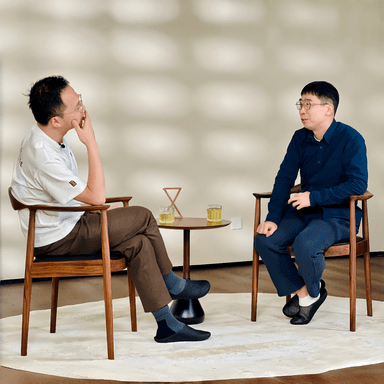
In this new episode of Signal and Noise, we're joined by Dr. Ding Liu, a neuroscientist based in China, to return to some of humanity's more fundamental questions from a neuroscience perspective: Why are emotions real? What does anxiety actually mean at the physiological level? What kinds of choices can instinct and intuition guide us toward?
In this conversation, we start from neuroscience to explore how instinct and emotion operate in today's technological environment, and try together to understand how humans can participate in judgment, make choices, and coexist with technology as AI continues to advance.
👤 Guest Bio
Ding Liu: Born in Zhengzhou, Henan province. He received his undergraduate degree from Henan University and his PhD from the Institute of Neuroscience, Chinese Academy of Sciences, where he investigated the neural mechanisms of working memory encoding. He then conducted postdoctoral training at Harvard University in the laboratories of Catherine Dulac and Nao Uchida, with a long-term focus on dissecting the neural basis of social instinctive behaviors. He has received honors including the Ray Wu Prize, the CAS President's Special Award, and the HHMI Jane Coffin Childs Postdoctoral Fellowship.
He will join the School of Life Sciences at Westlake University in August 2025 to establish the "Social Neural Circuits" laboratory. (Applications welcome.)
🕒 Selected Timestamps
01:10 Why study neuroscience? Where curiosity meets the condition of being alive
03:29 When we talk about "the world," are we really just talking about the brain's projection?
05:30 Is free will perhaps an illusion that doesn't actually exist?
11:41 The nature of anxiety: a "retreat" signal the brain emits when it can't compute a solution
18:44 Greed was once a survival strategy — why has it become a physiological burden in an age of material abundance?
25:57 The instinct to explain vs. the need for security: Have we over-strengthened meaningless "attribution"?
32:51 Why is "solving biological problems with biological methods" the most effective path to resolving internal friction?
46:21 Will the language and thought patterns of the "AI Native" generation be fundamentally reshaped by algorithms?
53:44 In the age of AI, why should organizations shift from "planning" to "flowing"?
56:25 Why does truth sometimes need to yield before goodness and beauty?
01:05:01 The pipeline theory of energy: Why does exhaustion disappear when you attend to something larger than yourself?
01:15:19 Rejecting the arrogance of elitism: Why the honest contributions of a "society of ordinary people" deserve more recognition
01:23:05 Living like a plant: sprouting in spring, shedding leaves in winter — vitality was never meant to carry baggage.
📚 References Mentioned
System 1 and System 2: From Daniel Kahneman's Thinking, Fast and Slow. System 1 refers to instinct and intuition; System 2 refers to logic and analysis.
Private Language: From Wittgenstein's Philosophical Investigations, referring to a purely personal language that "in principle only the speaker can understand and others cannot comprehend."
Pavlovian Conditioning: Classical behaviorist theory. Used in the episode as an analogy for humans' instinct to "attribute" patterns.
The Turkey on the Farm: From the allegory in The Three-Body Problem (originally from Bertrand Russell). An analogy for how humans mistake temporary, local patterns for eternal truths of the universe.
Brain-Body Interaction: A frontier field in neuroscience. Studies the real-time signaling between the brain's neural system and bodily organs (such as the gut and skin).
Adventists: From Cixin Liu's science fiction novel The Three-Body Problem. In the novel, the Adventists are the most radical faction of the Earth-Trisolaris Organization (ETO), who have lost all hope in human nature and yearn for the alien Trisolaran civilization to descend upon Earth to "judge" or transform human civilization.
Society of Ordinary People (中人社会): A philosophical and sociological concept. Advocates that society should serve and affirm the value of the broad middle majority, rather than focusing solely on a tiny elite.
Action-Habit-Addiction Chain: A biological behavioral evolution chain. It reveals the neurobiological process from an accidental behavior to stable habit to physiologically compulsive addiction, explaining why forcibly reversing instinct through "ideas" alone is often extremely difficult.
🎵 Music
Jordan Critz - Beau Et Rapide (Piano)
🎤 Production Team
Host | Jinjian Zhang
Produced by | Oasis Capital
Editing & Production | Shendu Studio Podcast Workshop
💬 Join the Conversation
Have you ever had a moment like this: abandoning the logical struggle, and simply through showering, taking a walk, or sleeping, finding that long-troubling problem suddenly resolved? Welcome to share in the comments your moment when "logic failed, and instinct saved the day."
Feel free to leave a comment below, or add WeChat VB20240606 to join the group chat.
Disclaimer
Any investment-related content in this podcast is for the purpose of exchange and sharing, for reference only, and does not constitute any market prediction, judgment, or investment or advisory recommendation. Thank you for your interest in this podcast's original content! If you wish to repost or quote from this podcast, please indicate the source. Please contact Oasis Capital to obtain permission before reposting.
View episode transcript on Xiaoyuzhou