
🎙️ Episode Preview
Can hundreds of thousands of hours of real-world data teach a robot to work? As embodied intelligence searches for its own Scaling Law, what truly determines the speed of intelligence growth — the model, the data, or a system capable of continuous evolution?
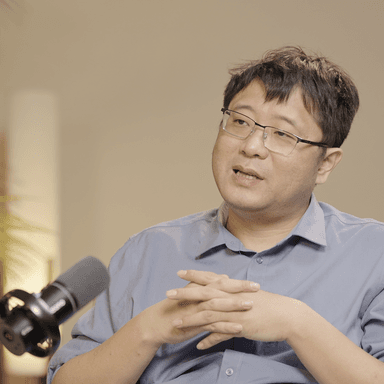
In this episode of Signal and Noise, we sit down with Cewu Lu, Vice Dean of the School of Artificial Intelligence at Shanghai Jiao Tong University, Changjiang Scholar Distinguished Professor, and Co-founder & CEO of Noematrix.
From 2015, when embodied intelligence attracted little attention, to today, when it has become a focal point for both technology and capital, Lu has spent a decade in this field. While the industry races to release models, he chose to spend nearly two years building an underlying system — from data collection and quality assessment to model training. Let ordinary people participate in real-world data production. Let AI manage the data in turn. Then let the model's needs drive the next round of collection. In his view, scaling intelligence is not merely about growing data volume, but about a production system that can iterate continuously.
Yet the choice of technical path has never been purely a scientific question. Why accept falling behind for a period in order to build the system first? How do you judge when a technology merits investment and when it should be abandoned? Lu habitually projects the future like a world model, yet believes major decisions ultimately require intuition to call.
In the latter half of our conversation, we move from how machines understand the physical world to how humans understand their own minds. Fear, unease, and pressure — perhaps these are simply "hardware noise" that humans cannot avoid. How does one train oneself not to be swayed by emotion and gain or loss? And how does the Tao Te Ching's "He who stands on tiptoe does not stand firm; he who strides does not go far" become his way of understanding entrepreneurship and technology cycles?
Plan for ten years, act in the present. What matters is not only seeing the direction of the future, but also knowing, in every present moment, what is worth doing and what should be let go.
👤 Guest Bio
Cewu Lu
Co-founder & CEO of Noematrix, Co-founder of Flexiv, Vice Dean of the School of Artificial Intelligence at Shanghai Jiao Tong University, Changjiang Scholar Distinguished Professor.
Long engaged in embodied intelligence, computer vision, and robotics research. Conducted postdoctoral research at Stanford University, advised by Fei-Fei Li and other professors. Co-founded Flexiv in 2016, and co-founded Noematrix in 2023. Named to MIT Technology Review China's "Innovators Under 35" in 2018. Received the Xplorer Prize in 2023. Research spans robotic grasping, imitation learning, and force control.
🕒 Selected Timestamps
02:33 Starting robotics in 2015 — too early?
08:36 When brilliant minds gather, how do you get them to work together?
14:50 How do robots get smarter through learning?
17:35 Ordinary people can take gigs collecting data for robots
20:14 More synthetic data — but has the information increased?
28:27 Why can't robots do good work without "feel"?
33:08 Build the data infrastructure before the model — accepting a period of slowness
35:58 After making a decision, how do you face the unease that follows?
40:52 You're a carbon-based lifeform; you can't be fully charged all the time
50:12 "He who stands on tiptoe does not stand firm": Stop running on your toes
📚 References
Fei-Fei Li: Professor of Computer Science at Stanford University, Co-founder & CEO of World Labs. Research areas include computer vision, robotic learning, and spatial intelligence. She was one of Lu's advisors during his postdoctoral research at Stanford.
Scaling Law: An empirical pattern describing how model capabilities change with increases in data, compute, and model scale; this episode explores whether this pattern extends to intelligence learning in the physical world.
Robot-Free Data Collection: Data collection that does not rely on the robot executing actions itself; humans use capture devices to record operations, which robot models then learn from.
UMI (Universal Manipulation Interface): A data collection approach in robot imitation learning that records human actions and visual information through a portable manipulation device, lowering the cost of acquiring robot manipulation data.
Reward Function: In machine learning, a function used to evaluate behavioral outcomes or feedback value; this episode uses it to explain how evaluation and reward mechanisms can improve the quality of distributed data collection.
Hybrid Force-Position Control: A robot control method combining position control with force feedback, allowing robots to balance precision, stability, and safety in contact and assembly tasks.
RoboPocket: A robot data collection solution jointly developed by Cewu Lu's team at Shanghai Jiao Tong University and Noematrix, comprising a phone-mounted capture terminal and companion app. It embeds data quality assessment and operation guidance into the collection process, enabling ordinary people to participate in data gathering.
AnyGrasp: A robotic grasp perception model for predicting executable grasp poses, with support for grasp tracking. The research team tested its grasping capability in scenes containing previously unseen objects.
RT-2 (Robotic Transformer 2): A vision-language-action model released by Google DeepMind in 2023. Trained on internet image-text data combined with robot demonstration data, it applies visual and linguistic knowledge to generate robot actions.
Force Feedback: A mechanism by which robots perceive forces generated upon contact with objects and adjust their actions accordingly. In tasks like insertion and polishing, knowing where an object is located is insufficient — the direction and magnitude of contact also affect operation outcomes.
Force Policy: A robotics research project focused on contact-intensive operations, with Cewu Lu among the paper's authors. The method combines global visual policy with high-frequency local force feedback control to improve stability and operation quality during contact processes.
World Model: A model used to represent the environment and predict how it changes. In robotics research, it can predict possible states or observations resulting from a given action, providing a basis for planning and learning.
"He who stands on tiptoe does not stand firm; he who strides does not go far": From Chapter 24 of the received text of the Tao Te Ching. "Qi" (企) means standing on tiptoe; these lines use the metaphors of tiptoeing being unsustainable and overstriding being impossible to maintain, illustrating the limitations of excessive effort and haste.
"The past mind cannot be grasped, the present mind cannot be grasped, the future mind cannot be grasped": From the Diamond Sutra, in the received chapter division belonging to "The One Appearance of All Beings, Chapter Eighteen." The meaning is that past thoughts have already passed, present thoughts are also changing, and future thoughts have not yet arisen — no thought can be held forever; the mind is not something that can be fixed and grasped.
"One should generate the mind without dwelling anywhere": From Kumarajiva's translation of the Diamond Sutra, in the received chapter division belonging to "The Purification of the Buddha-Land, Chapter Ten." "Without dwelling" means not attaching to or fixating on particular objects or appearances. The meaning is to earnestly respond to people and matters before you, while not binding the mind tightly to gain, loss, judgment, or some predetermined outcome — one can still set forth the intention to do good and put it into action.
🎵 Music
Jordan Critz - Beau Et Rapide (Piano)
🎤 Production Team
Host | Jinjian Zhang
Produced by | Oasis Capital
Editing & Production | Shengdu Studio Podcast Workshop
💬 Moment of Engagement
If you believe something is correct in the long term, but difficult to show impressive results in the short term — even requiring sacrificing immediate opportunities to build a solid foundation — would you choose to persist, or adjust course?
Share your experiences and reflections in the comments.
Disclaimer
All investment-related content in this podcast is for exchange and sharing purposes only, for reference, and does not constitute any market prediction, judgment, or investment or advisory recommendation. Thank you for your interest in this podcast's original content! If you repost or quote content from this podcast, please indicate the source. Before reposting, please contact Oasis Capital to obtain consent.
[View episode transcript on Xiaoyuzhou]