ENCOS Raises New Round, Oasis Capital Increases Stake | Oasis Vitality

Advisors on Vitality

Nanjing Inx Intelligent Technology Co., Ltd. (hereinafter referred to as "Inx") recently announced that, following the completion of its first angel round in October 2024, it has consecutively closed two new funding rounds.
Oasis Capital, which led Inx's angel round, continued to invest beyond its pro-rata allocation in this round.
This round also included Jinqiu Fund, Deshi Investment, Shenzhen Capital Group, Fosun Capital, and other well-known investment institutions, while Waterwood Capital, Ralph Ventures, and other angel-round investors continued to add to their stakes. Minglun Capital served as the exclusive financial advisor.
To date, Inx has completed three funding rounds in roughly half a year, with cumulative financing reaching hundreds of millions of RMB. Founded in September 2022, Inx is dedicated to providing the highest-quality joint modules, dexterous hands, communication modules, smart batteries, and other core components for the new generation of embodied and humanoid robots, along with systematic hardware solutions. The company's core team hails from Nanjing University of Aeronautics and Astronautics. Founder and CEO Zonghuang Zhu has multiple entrepreneurial experiences under his belt and has been deeply involved in robotics and joint modules since 2018. With solid technical strength, innovative capabilities, and acute judgment of industry trends, he has led Inx to become a widely recognized star company in the embodied and humanoid robot supply chain.
Starting with Integrated Joints
Joints serve as the core hardware component of robots, integrating functional modules such as drivers, motors, reducers, and encoders. They account for over 50% of a robot's total cost and directly determine key performance metrics including movement capability, load capacity, motion precision, coordination, and stability.
Inx's founder and CEO Zonghuang Zhu is an entrepreneur with exceptionally high sensitivity to technological innovation. In August 2021, Tesla announced its entry into the humanoid robot industry; in August 2022, Xiaomi unveiled its humanoid robot Cyber One; and in November that same year, ChatGPT burst onto the scene. At this intersection of technological transformation, Zhu keenly perceived the latent opportunities in embodied intelligence and humanoid robots: "The things robots will be able to do in the future, and their degree of participation in human life, will far exceed what people see today." Thus, from its founding in 2022, Inx firmly focused on R&D of joint modules for humanoid and quadruped robots, becoming one of the earliest Chinese innovative enterprises to target embodied intelligence scenarios and deeply cultivate the core components track. Although market attention toward humanoid and quadruped robots was nowhere near today's levels at that time, Inx laid out its strategy early with an entrepreneur's forward-looking vision — truly outstanding innovators can often anticipate opportunities as trends emerge and seize first-mover advantage through long-term strategic conviction.
It is precisely this focus, combined with exceptional independent R&D capabilities, that has enabled Inx to rapidly rise as a leading enterprise in the humanoid robot joint sector, with shipment volume, industry reputation, and customer coverage all ranking at the forefront.
-
Leading shipment volume: In 2024, Inx shipped over 10,000 joint modules in the embodied and humanoid robot space, and is growing at a staggering pace — shipments so far in 2025 have increased 10x compared to the same period last year.
-
Exceptional industry reputation: The CEO of a leading embodied intelligence robotics company commented on Inx: "During our supplier selection phase, we conducted comprehensive and rigorous validation of joint products from more than 30 companies, and Inx ultimately stood out. They not only demonstrated excellent R&D capabilities and product reliability, but also responded swiftly in after-sales service with efficient problem resolution. We've noticed more and more peers using Inx's products, which further confirms their absolute leading position in technology and service." The head of a national-level embodied intelligence innovation center also stated: "The main reason we chose to deeply collaborate with Inx is their comprehensive leading advantage across multiple dimensions including professional capability, product quality, and performance consistency."
-
Broad customer coverage: With outstanding product performance, solid quality, and excellent service, Inx has earned high recognition from over 90% of customers in the industry. In the widely followed humanoid robot marathon event in April 2025, more than half of the competing robots used Inx's joint modules, including the two champion and runner-up teams whose robots featured Inx joints throughout their entire bodies. Meanwhile, Inx's products have also gained considerable recognition overseas — Physical Intelligence, an American company representing the cutting edge of operational capability in the global embodied intelligence field, uses Inx joints in its robotic arms.
Currently, Inx has established a complete product matrix covering planetary and harmonic modules, addressing joint requirements across different body sizes and all body locations.
Building Deep, Going Far
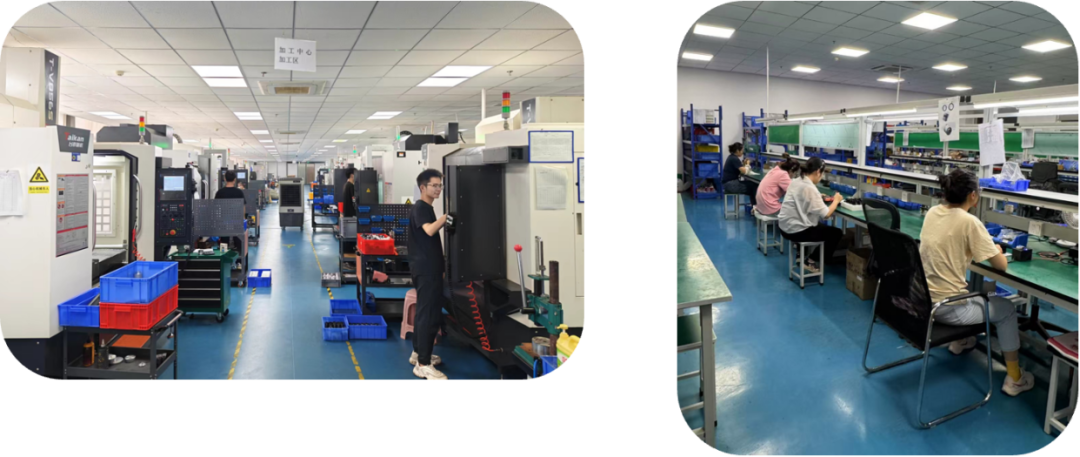
Inx is arguably the "heaviest" player in the joint module track, having built competitive moats through full-stack independent R&D and design capabilities for components alongside self-built integrated production systems. On the R&D side, all core components — drivers, reducers, motors, and encoders — are independently designed in-house, with exclusive technical accumulation in reducer structural design, motor design and process, and drive control algorithms. On the production side, the company operates 2,000 square meters of machining and assembly lines, equipped with full sets of CNC machines, grinders, cutters, hobbing machines, gear shapers, and other machining equipment, enabling autonomous processing of all components including gears, forming an integrated "R&D — Production — Testing" platform.
Inx chose to invest heavily in core technology and production capacity early in the industry's development — a decision requiring considerable courage for such a young team. Founder Zonghuang Zhu put it directly: "Why this choice? Because it's the right thing to do. Given the extreme demands on weight and space for humanoid robot joints, the coupling between components inside a joint is extremely high, requiring mutual spatial concessions and shared part designs, which significantly increases design and process difficulty. To create a good joint module product, you must innovate at the overall structural design level, with every component needing redesign — none can be omitted. And design alone isn't enough; matching production processes are required. Our team may be young, but we're willing to make heavy-asset investments, enduring hardship first to enjoy rewards later."
It is precisely this full-chain autonomy from design to production that gives Inx exceptionally high R&D efficiency, creating gaps in product performance and iteration speed compared to competitors and continuously solidifying its technology leadership position.
Building a More Complete Hardware Ecosystem
Inx's ambitions extend beyond joints to building a complete hardware ecosystem.
As an extension of its joint capabilities, Inx released its first dexterous hand product, the EC-DexHand-5F, in April 2025 — featuring 20 active degrees of freedom, dimensions equivalent to an adult human hand, and weighing only 0.85kg. The dexterous hand employs an original "independent ultra-mini joint module" solution, where each phalanx is an independent joint integrating motor, reducer, driver, dual encoders, and sensors, with independent force control and backdrive capability at each finger articulation point.
The product immediately attracted significant attention upon release, with its breakthrough design regarded by the industry as the ultimate solution for dexterous hands. The solution offers numerous advantages: true 20 degrees of freedom providing a sufficiently high ceiling for operational capability; each phalanx capable of independent closed-loop control based on precise current loops, effectively solving the data generalization problem between different dexterous hands from a data collection perspective and making the construction of general-purpose robot datasets possible; distributed drive-and-control design supporting flexible modular assembly and disassembly, substantially reducing assembly and maintenance costs.
Additionally, Inx has launched a series of communication modules and smart battery products specifically designed for embodied and humanoid robots. Its communication modules support various communication protocols, adapt to various actuators and sensors, support unlimited series connection, and achieve maximum communication frequency of 2000Hz, meeting embodied intelligence's demands for high real-time performance and high data volume. Its smart battery products are optimized for the sudden load changes characteristic of humanoid robots, providing extremely high safety, long endurance, and support for hot-swapping. Communication modules, smart batteries, and joint modules together constitute a complete power system solution.
Going forward, Inx will introduce more component products and form a series of system-level solutions including power systems, end-effector systems, and data collection systems, providing downstream integrators with one-stop hardware enablement.
Growing with the Industry
The industrialization of embodied intelligence is continuously accelerating. On one hand, industry participants are numerous and expanding, with large numbers of quality startups emerging, leading tech and manufacturing giants accelerating their布局, and sustained capital investment driving industry momentum upward; on the other hand, algorithm and hardware technologies continue to break through and improve, with vast application scenarios providing ample growth space for industry development, and integrators iterating products with increasingly shorter cycles.
Inx believes that embodied intelligence will land in stages through different product forms across different application scenarios: initially focused on demonstration and interaction, gradually progressing to being "capable of work" in specific scenarios, and ultimately evolving to possess general-environment mobility and manipulation capabilities, entering millions of households. During this period of rapid industry development, integrators urgently need quality upstream supplier partners.
Currently, Inx has already established a leading position in the embodied and humanoid robot space, becoming the preferred partner for many integrators. Going forward, Inx will continue to serve as the industry's "water carrier," providing downstream integrators with full-chain support "from technology to production capacity" at the hardware level, helping integrators focus on product innovation and scenario落地, jointly driving the scaled development of the embodied industry, and becoming a key enabler in the wave of industrial upgrading.
An investment principal at Oasis Capital stated: "We firmly believe in Inx's core value in the embodied intelligence wave.
Modular joints serve as the cornerstone of robotics industry development; their standardization and high performance are key to driving industry cost reduction and efficiency improvement while accelerating scenario落地. With its outstanding joint design and mass production capabilities, Inx not only provides the industry with highly reliable 'core building blocks,' but also significantly lowers the barrier to robot development through modular solutions, allowing downstream customers to focus on algorithm and scenario innovation. The company's continuous product iteration and rapid response capability have enabled it to steadily grow from a core component supplier into a platform-type provider of robotics hardware system solutions.
We believe Inx will continue to lead technological innovation and industrial democratization in robotics core components, playing an irreplaceable role in shaping the future robotics ecosystem."