Azure Star completes multi-hundred-million-yuan funding round to accelerate AI-powered stellarator fusion commercialization | Oasis Vitality

Counselor Vitality

Oasis Capital angel-round portfolio company BlueStar Fusion announces completion of its angel+ funding round.
Eleven months, three funding rounds, and a valuation exceeding 3 billion RMB — BlueStar Fusion, founded less than a year ago, has grown from a five-person team to nearly a hundred employees, and has advanced its high-temperature superconducting stellarator from physics design to engineering manufacturing. Its model coil achieved a peak field of 10.3 tesla under real operating conditions, setting a domestic record for its category.
The race for nuclear fusion is shifting from physical feasibility to engineering feasibility. BlueStar Fusion is using AI as leverage to push high-temperature superconducting stellarators into the device manufacturing and systems validation phase.
In the controllable nuclear fusion track, a young company is stepping into the spotlight.
36Kr has learned that Hefei BlueStar Fusion Technology Co., Ltd. (hereinafter referred to as "BlueStar Fusion"), which focuses on stellarator-based nuclear fusion, has officially announced the completion of its angel+ funding round at the scale of several hundred million RMB. The proceeds from this round will primarily be used for the manufacturing of the world's first high-temperature superconducting stellarator. BlueStar Fusion was founded in August 2025, and prior to this funding announcement, the company had almost no public exposure.
During the preceding eleven months of "stealth mode," BlueStar Fusion evolved from a five-person team focused on physics design into a nearly hundred-person interdisciplinary team covering the full chain of fusion device R&D, securing three consecutive funding rounds with a post-money valuation exceeding 3 billion RMB.
Its shareholder roster includes leading VC and PE institutions such as Gaorong Ventures, Boyu Capital, Oasis Capital, Weihe Investment, Huilong Ventures, and Minyin International, as well as AI industry player Xi Wang, alongside several well-known investors from this year's top-ten billion-RMB private equity performance rankings, including Liang Hong, founder of Shiva Investment, and Wang Yiping, founder of Evolutionary Asset Management.
On one side, primary-market capital with a long-term focus on technology growth and industrial opportunities; on the other, top-tier private equity firms known for returns and risk judgment — together, they are betting on the young team at BlueStar Fusion.
This startup, with its fast fundraising pace and high capital recognition within China's fusion track, is entering the competition for humanity's ultimate energy source.

How Did a Young Team Break Through So Quickly?
A Gen Z founder with the combined identity of "scientist + engineer + entrepreneur" is the impression left on outsiders.
"BlueStar Fusion's founder holds an undergraduate physics degree from Oxford University and pursued stellarator research during his PhD at Princeton University, taking leave to start his company and seize the moment to join China's fusion cause, bringing cutting-edge global stellarator theory and research experience back home." As a witness to this journey, Yan Jianwen, chairman of NeoFusion, commented, "In him, I see the passion, boldness, and execution of a new generation of Chinese Gen Z entrepreneurs — also crucial factors for the company's success."
The founder's qualities resonated with Yan: "I also started my business young, and seeing their team reminds me of myself back then. Fusion is a future industry that requires constant learning, iteration, and lifelong dedication — young people are the hope to come."
Another defining characteristic of this team is its convergence of specialized talent and integration of multidisciplinary knowledge.
According to sources, the company's core members hail from leading institutions at home and abroad, including Princeton, Oxford, Tsinghua University, University of Science and Technology of China, and Shanghai Jiao Tong University, with expertise spanning fusion physics, superconducting magnets, structural and precision manufacturing, cryogenic engineering, artificial intelligence, and other core technical directions — all calibrated to the R&D and iteration demands of the stellarator's complex systems.
But for an immensely complex fusion engineering project, specialized physics talent alone is insufficient.
To narrow the gap between "scientific concept" and "engineering realization," BlueStar Fusion established an advisory and review system composed of senior scientists, engineering experts, and industrial partners, forming an organizational structure combining "young cutting-edge R&D strength + mature engineering experience + supply chain capabilities."
Under this system, physics design, engineering design, model coil testing, supply chain development, fundraising, and talent pipeline building no longer follow traditional linear sequencing, but are run in parallel — effectively shortening the feedback cycle from proposal to hardware.
This parallel engineering approach has won recognition from industry chain partners.
"The BlueStar Fusion team comes from plasma physics backgrounds, but began exploring engineering pathways from day one, in parallel with physics design," assessed Liu Huajun, president of the International Applied Superconductivity Center. In his view, this young team has demonstrated rapid growth and engineering execution: "Throughout our collaboration, the founding team has maintained clear technical roadmaps, a strong sense of mission, and highly efficient execution."
Compared to the step-by-step style of traditional academic research projects, these young people are more accustomed to operating like a commercial team. Liu Huajun noted, "BlueStar Fusion can identify technical priorities from first principles and propose solutions. The founding team consistently participates in frontline discussions and makes rapid decisions, shortening decision-making processes and accelerating the realization of complex fusion engineering."

Behind the 3 Billion RMB Valuation: Ten Months from Proposal to Manufacturing
For fusion startups, capital attention ultimately must rest on engineering delivery capability.
In recent years, numerous fusion companies have proposed technical roadmaps and completed theoretical validation, but moving from experimental proposals to actual devices requires crossing multiple hurdles of R&D iteration, component manufacturing, and integrated system assembly.
This has been among BlueStar Fusion's most important tasks over the past eleven months.
Sources indicate that BlueStar Fusion's first-phase device has completed physics scheme design, proprietary AI technology platform development, host engineering scheme and expert review, and high-temperature superconducting model coil testing, with multiple key systems entering pre-research and procurement preparation stages. The project as a whole has transitioned from early-stage design and simulation validation into comprehensive engineering drafting, component processing and manufacturing, and integrated system assembly. Per plan, the company will complete construction of its first-phase high-temperature superconducting stellarator in 2027.
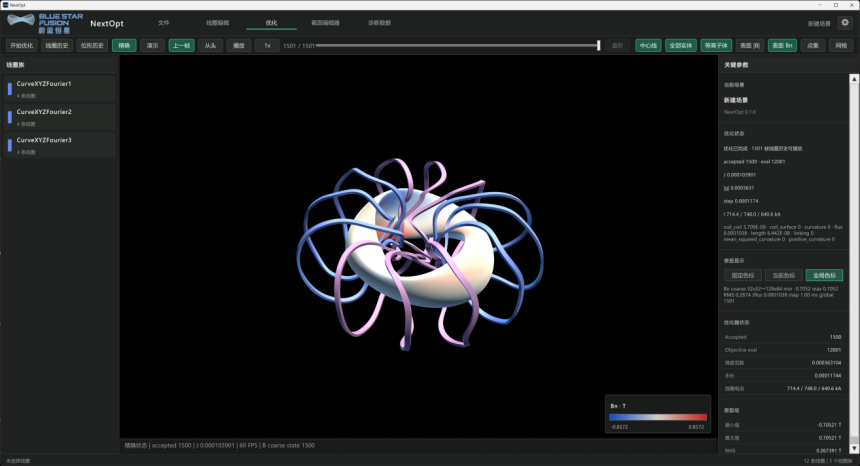
BlueStar Fusion's self-developed coil optimization AI tool NextOpt — live demo interface
For fusion projects, the gap between "completing design" and "completing the device" is an enormous engineering chasm.
A stellarator configuration that performs well in physics calculations must, once entering the real world, be translated into concrete coils, structural components, cryogenic systems, vacuum vessels, control systems, and assembly interfaces.
For example, whether coils can be manufactured, whether components can be assembled, whether manufacturing tolerances will alter magnetic fields, and whether magnets can operate stably under cryogenic and electromagnetic loads all directly impact the final device. These engineering problems are often greater challenges than the physics itself.
Precisely for this reason, BlueStar Fusion prioritized advancing high-temperature superconducting model coil experimental validation before initiating full-device construction.
The model coil serves as a crucial validation bridge between physics design and engineering manufacturing: it validates not only the magnet design itself, but the entire engineering system of materials, processes, manufacturing, assembly, and cryogenic operation.
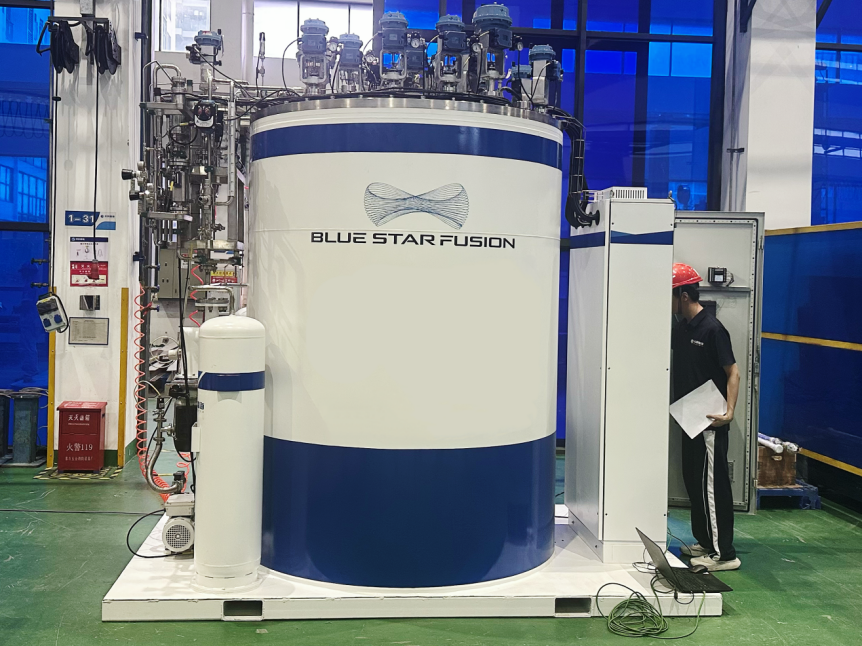
BlueStar Fusion cryogenic cooling system
Professor César Luongo, engineering expert at EUROfusion and former head of ITER's toroidal field coil department, offered a positive assessment after participating in BlueStar Fusion's host scheme review.
"I was responsible for the TF coils of the ITER tokamak, which employed a massive low-temperature superconducting magnet system. By comparison, high-temperature superconductors still need development, and no team worldwide has yet fully realized a high-temperature superconducting stellarator," César Luongo stated directly. "BlueStar Fusion's application of high-temperature superconducting technology is creative — its magnet architecture balances manufacturability, modularity, and system integration. This young team's novel application of high-temperature superconductors is genuinely exciting."
In Luongo's view, BlueStar Fusion's scheme proposes multiple innovative approaches in three-dimensional stellarator magnetic field reconstruction, computer-aided engineering analysis, and experimental validation, with particular emphasis on rapid iteration, serviceability, and component replacement capability — potentially reducing subsequent engineering development risks and leaving flexibility for future device upgrades.
This exploration has also received preliminary validation from experimental data.
BlueStar Fusion has completed testing of its high-temperature superconducting model coil under real operating conditions with cold helium gas plus conduction cooling. During testing, the model coil repeatedly reached design operating current, and in ultimate current-carrying tests demonstrated more than double the normal operating current capacity, showing substantial engineering design margin.
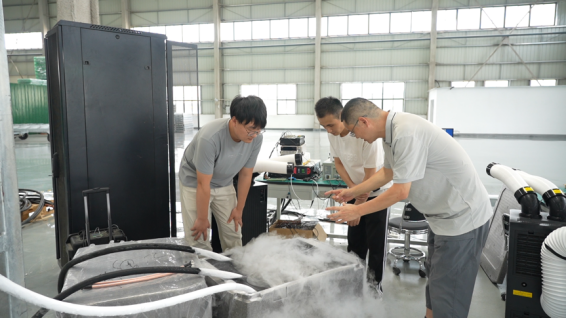
BlueStar Fusion cryogenic testing site
More critically, the coil's peak field reached 10.3 tesla, setting the strongest magnetic field record to date for a Chinese high-temperature superconducting stellarator model coil.
BlueStar Fusion has begun moving beyond blueprints and truly entering the manufacturing phase.

Why High-Temperature Superconducting Stellarators?
For this startup founded less than a year ago, its 3 billion RMB valuation has drawn market attention.
But a more worthwhile question than the valuation itself is:
What core value are these investment institutions and private equity leaders actually betting on with their long-term positions?
For decades, the tokamak has remained the mainstream route in global fusion research. From ITER to China's EAST to America's SPARC, nearly all landmark fusion projects have been built on the tokamak technical system, thus accumulating mature talent pipelines, industrial foundations, and engineering experience.
Looking at the present, the industrial logic of global fusion is shifting. Research institutions, government agencies, and investors in various countries are no longer confined to the foundational goal of achieving controlled nuclear fusion ignition; industry consensus is turning to a core proposition more aligned with industrial落地: how to build fusion devices capable of long-term stable operation with conditions for commercial power generation.
The stellarator, which once remained in laboratories for the long term due to the complexity of three-dimensional design and engineering manufacturing difficulties, is receiving growing attention as AI computing power and advanced manufacturing capabilities develop.
As early as 1951, Lyman Spitzer, first director of the Princeton Plasma Physics Laboratory, proposed the stellarator concept. Unlike the tokamak, which relies on plasma current to form part of the confinement magnetic field, the stellarator primarily uses external three-dimensional magnets to generate the required confinement field, thus possessing the inherent advantage of long-term steady-state operation. Meanwhile, high-temperature superconducting magnets can achieve higher magnetic fields, enabling more compact devices with greater long-term operating cost advantages. The stability and economic viability of high-temperature superconducting stellarators have given power and energy investors with a view toward commercialization enormous potential.
As the company's device operations advisor, Professor Chen Zhongyong, a fusion expert at Huazhong University of Science and Technology with years of J-TEXT tokamak operating experience, stated: "We chose the stellarator not because it's easy, but because it's worth it. Major plasma disruptions are the stumbling block to commercializing tokamak fusion reactors; stellarators have the inherent advantage of steady-state operation. BlueStar Fusion's use of high-temperature superconducting planar coils to construct stellarator configurations holds promise for important breakthroughs in stellarator magnet technology and stellarator configurations."
Over the past decade-plus, stellarator technology has continued to achieve breakthroughs.
Princeton University successively promoted open-source optimization codes such as Simsopt and DESC, accelerating stellarator design; in May 2025, Germany's W7-X stellarator device, during 43 seconds of long-pulse operation, achieved a triple product surpassing tokamak equivalent parameters, experimentally validating the superiority and high potential of the stellarator route.
Capital winds are shifting accordingly. Wang Xin, partner at Gaorong Ventures, told 36Kr that in recent years overseas stellarator technology has made considerable progress: first, two-dimensional modular magnets may solve manufacturing challenges; second, new design optimization methods and AI introduction have significantly improved design capabilities. With academic breakthroughs and recognition for stellarator research, global capital's understanding of stellarators is undergoing fundamental upgrading.
Industrial-side layouts likewise confirm this trend: Germany's Max Planck Institute for Plasma Physics (IPP) and Spain's WISER project have both selected stellarators as their primary fusion experimental route based on experience; meanwhile, European and American stellarator companies including Proxima Fusion, US-based Type One Energy, and Thea Energy have successively secured funding rounds of hundreds of millions of dollars, attracting tech companies and energy giants such as Google and RWE — the stellarator has become one of the mainstream routes in the fusion commercialization era.
However, the stellarator's greatest advantage — steady-state operation — is precisely what constitutes its most severe technical challenge.
To obtain more stable confinement magnetic fields, the stellarator employs highly complex three-dimensional magnetic field structures. Around this field system, R&D teams must simultaneously consider stellarator quasi-symmetry, magnetohydrodynamic stability, boundary magnetic field topology, particle transport, magnetic field ripple, coil curvature, electromagnetic stress, structural deformation, manufacturing tolerances, assembly space, maintenance access, and multiple other objectives.
In other words, a magnetic field excellent in physics may not be manufacturable as a set of coils; a set of manufacturable coils may not necessarily be assemblable and maintainable at reasonable cost.
Addressing this industry pain point, the company independently developed a full-process stellarator AI optimization platform covering configuration generation, automatic parameter tuning, configuration screening, and coil optimization. In this system, AI agents generate candidate proposals, search optimization paths, and automatically dispatch different levels of physics solvers and engineering analysis tools.
According to the team, for certain specific optimization tasks, this platform can shorten computation iterations originally taking months or even years down to a matter of days, with both optimization efficiency and final solution quality already surpassing traditional expert manual schemes. The stellarator's high-dimensional, multi-objective nature means enormous optimization space, and this system is a tool that can continuously search for better solutions.
AI's value lies in its ability to replicate expert experience and then perform large-scale, repeatable, high-quality optimization work.
Xi Wang chairman Xu Bing stated: "Based on the stellarator's high-dimensional, multi-objective nature, AI can help stellarators continuously optimize. Once the self-reinforcing closed loop of AI-designed fusion and fusion-feeding-computing-power is established, it will redefine the underlying physical boundaries of next-generation intelligence. Xi Wang and BlueStar Fusion are working together as the earliest promoters of this loop. The synergy of computing power and energy is the true moat for AI's long race."
AI is pushing up energy demand while also providing new tools to solve the energy challenge. This is particularly evident in the stellarator route.

Bringing Supply Chain Forward to the R&D Stage
From the project's inception, BlueStar Fusion's founding team recognized that engineering delivery capability is the primary factor affecting project progress.
A fusion device involves multiple highly coupled links: superconducting materials, magnets, cryogenics, vacuum, precision manufacturing, structural support, control and system integration, and more. Deviations in design, manufacturing, or assembly of any critical component may trigger engineering adjustments and scheme iterations, in turn affecting overall device progress.
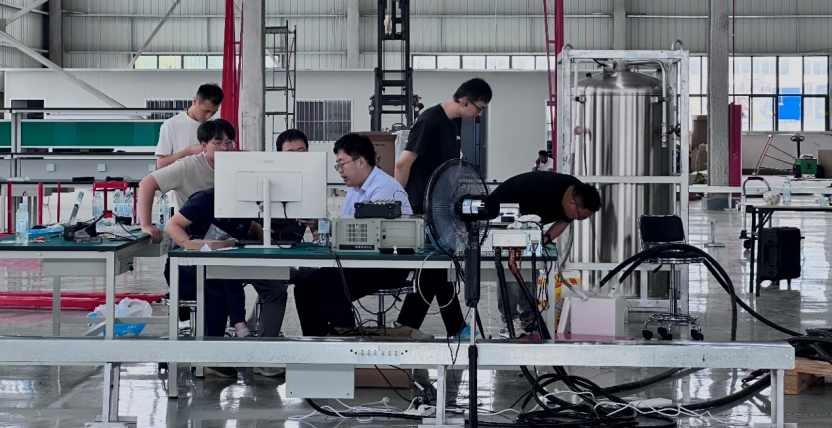
BlueStar Fusion team experimental scene
Unlike the linear R&D style of research institutes, BlueStar Fusion — based on the founding team's practical design experience across the full stellarator chain — brought core engineering validation links including materials, magnets, and model coils fully forward from the project's early stages, proactively bringing core supply chain partners into collaborative R&D design and joint innovation. This shift is not merely about advancing timelines, but reflects a restructuring of R&D logic.
Li Man, vice chairman of Eastern Superconducting, believes what differentiates this collaboration from typical procurement relationships is that BlueStar Fusion does not treat material supply as separate from R&D. For high-temperature superconducting tapes, the company's concern is not merely a single performance parameter, but how materials adapt to the stellarator's overall operating conditions and how they synergize with conductor structures, magnet manufacturing, and full-device design.
In this model, suppliers are not merely material deliverers, but co-participants in the R&D process.
From interface definition and testing conditions to engineering trade-offs, both sides collaborate from early stages, enabling rapid feedback among materials, magnets, model coils, and physics design. Issues exposed during testing can flow back in time for the next design iteration, driving continuous system optimization.
R&D and manufacturing are no longer a relay race, but a parallel sprint. This R&D approach has also driven deepening collaboration between both parties.
Eastern Superconducting has established a long-term strategic partnership with BlueStar Fusion, and will continuously supply kilometer-scale lengths of high-temperature superconducting tape over the next two years, while conducting joint R&D around related key technologies to jointly advance China's high-temperature superconducting stellarator industry chain.
In Li Man's view, truly promising hard-tech enterprises don't rely on visions to tell stories, but on continuous experimentation, review and iteration, and solving real problems. BlueStar Fusion is not only focused on breakthroughs in its own device, but willing to open resources and mobilize industry, with an eye toward China's long-term fusion industry development — demonstrating vision and commitment.

Conclusion
Jinjian Zhang, founder of Oasis Capital, stated: "We believe young entrepreneurs can use AI as leverage to reshape industrial landscapes. In nuclear fusion, the stellarator route is that fulcrum."
With its model of "AI foundation + engineering validation forward-deployment + industry chain collaboration," BlueStar Fusion is using superior execution to lead China's stellarator track, with planned goals including: building the first optimized stellarator quasi-symmetric configuration; being the first to introduce AI-assisted optimization across the full chain of stellarator design and engineering construction; and making a run at the world's first realized full high-temperature superconducting stellarator device.
To advance these goals, after entering the engineering manufacturing phase, BlueStar Fusion's capability boundaries must expand accordingly, with a comprehensive upgrade of talent deployment. The R&D system will gradually extend from its early focus on physics simulation and scheme design into engineering落地 domains including magnet preparation, mechanical structures, cryogenic vacuum, diagnostic control, systems engineering, and large-scale project management.
In BlueStar Fusion's planning, future needs encompass not only top scientists, but also engineering teams capable of delivering complex equipment. Meanwhile, the company will further unite with industry chain partners for joint攻关 on core modules and collaborative innovation, continuously building China's stellarator industry ecosystem.
Per plan, the results of its technical roadmap, talent deployment, and industrial collaboration will face a critical stage of validation in 2027.
At that time, BlueStar Fusion will need to answer the industry's most pressing question with real manufacturing progress, superconducting magnet prototypes, system integration test data, and full-device operational results:
Can this young team transform three-dimensional magnetic field designs from computers into an actual fusion device operating in the real world?
For the fusion industry, commercial落地 may still require time.
But at minimum, BlueStar Fusion has taken a solid step toward engineering reality for a future that long remained in laboratories.