Honest Move, Brilliant Move, Mediocre Move

"Let no thought abide in any thing, and thus let the mind be born."

Let the mind arise without dwelling anywhere.
—The Diamond Sutra
Even Ke Jie, the world champion, might offer an "outdated" interpretation of ben shou, miao shou, su shou — the fundamental move, the brilliant move, and the vulgar move. Here's what he says:
"Ben shou" (fundamental move): literally, a move that fulfills one's duty.
It often describes a middling choice in a given board position — neither bad nor good. But middling doesn't mean mediocre.
"Su shou" (vulgar move): literally, a crude or unrefined move.
In most cases it's pejorative, yet in certain situations, exchanging su shou might actually be the best available option.
"Miao shou" (brilliant move): an exceptional move.
It cannot be sought after, only encountered. It possesses extreme subtlety and uniqueness, and rarely appears in most games.
On miao shou, Ke Jie offers an insight only a master could articulate:
Many players become overly fixated on local positions during games, playing "false miao shou" while neglecting whole-board thinking. To play a true miao shou, one must accumulate experience and training through daily practice.
Ke Jie certainly has the credentials to explain these concepts. But the "person" most qualified is the one with the highest Go level: AI.
From AI's perspective, there is no distinction between ben shou, miao shou, and su shou. There is only the move with the highest win probability.
In a sense, the very concepts of ben shou, miao shou, and su shou are temporary explanations born of insufficient computing power — heuristic decisions made when first-principles problem-solving is impossible.
Such temporary scaffolding helps people think, but also becomes a cage that limits deeper thought.
Let me share a story I once wrote.
In 1846, Genan Inseki faced the 17-year-old prodigy Shusaku. Genan opened with the Ogeima (large knight's move), and Shusaku, playing Black, quickly "lost" the advantage of moving first. Entering the middle game, observers assumed the young man was in dire straits.
At this point, a watching physician declared: Shusaku will win. The crowd erupted — how dare a layman make such a claim?
The doctor explained, "I may not understand Go, but I noticed that after Shusaku placed a stone, Genan appeared expressionless yet his ears immediately turned bright red."
In the end, Shusaku won by two points. The turning point of the game was precisely the move the doctor had identified: move 127.
Later generations of players studied this move repeatedly, considering it a divine touch of peak brilliance. Lee Chang-ho, the "Stone Buddha," evaluated it: three parts strength, seven parts inspiration.
This summit confrontation across the board became known as the "Ear-Red Game."
One hundred seventy years passed. Go, regarded as a testament to uniquely human spirituality, was unexpectedly conquered by AI. In 2016, world-class player Lee Sedol lost to AlphaGo: an artificial intelligence Go program.
AI's Go strength has far surpassed humanity's. Professional players progressed from shock to acceptance to using AI as a training aid.
Someone had a sudden thought:
If we feed historical master games into "the machine," how would AI evaluate human brilliant moves?
Let's revisit move 127 of the "Ear-Red Game," Black 1 in the diagram below.
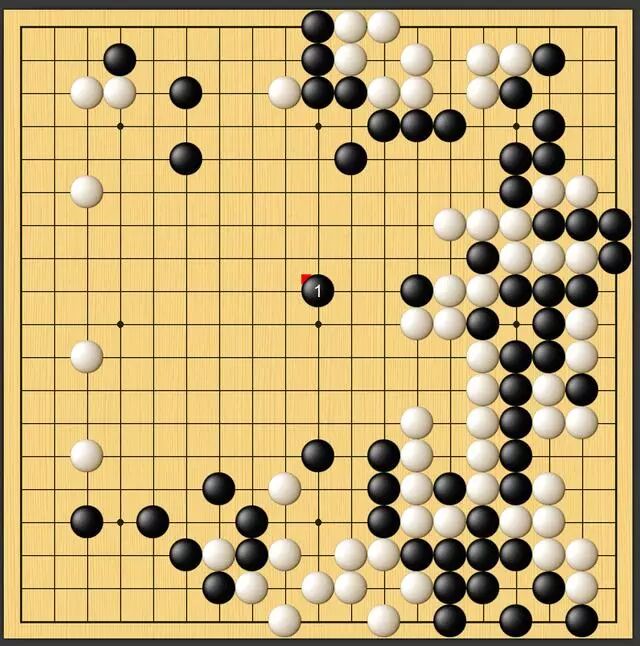
This move became legendary for its supposed triple purpose:
- It connected four stones below that were about to be cut; after Black 1, White could not successfully cut from any direction;
- It expanded Black's framework above;
- It restrained White's outward expansion, serving as the vital point for shifting territorial balance. This move fully demonstrated Shusaku's grand perspective and vision.
So formidable a move — yet when fed into the computer, the Go AI Jueyi declared:
This move is not brilliant at all.
For this position, Jueyi offered four choices. By comparison, the "Ear-Red move" was actually the worst.
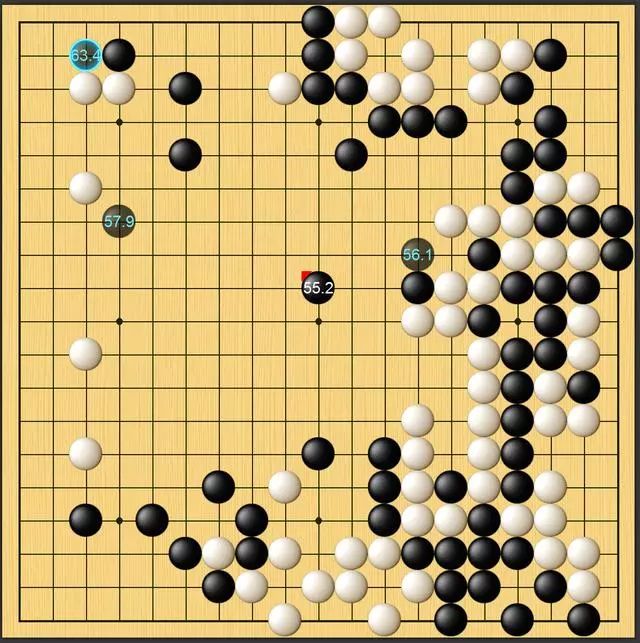
As shown above, the "Ear-Red move" had a 55.2% win rate. The other three choices were all higher; for instance, the upper-left move reached 63.4%.
So was the doctor's observation of red ears merely legend?
If it did happen, the cause of the flushed ears was not the brilliance of Shusaku's move 127, but rather the terribleness of Genan's previous move (White 126). Only after his opponent responded did Genan realize his mistake — hence his chagrin.
Here's where it gets interesting:
- A move celebrated for two centuries as a timeless brilliant move was actually a poor one, yet never questioned, instead repeatedly validated and extolled by generations of masters.
- The ear-flushing incident may have been real, but the explanation of "causality" was wrong.
Thus, the concepts of ben shou, miao shou, and su shou are essentially a kind of human hallucination. Within the bounds of human cognition, this hallucination feels so real, and often proves useful.
Yet once AI far surpasses human players, the conceptual distinction between ben shou, miao shou, and su shou becomes merely a human joke.
These concepts carry strong "emotional coloring." Judging a move as "brilliant" or "vulgar" is like a child watching a movie, urgently asking who is good and who is bad.
For AI, "correct/incorrect" matters more than "good/bad," and "correct/incorrect" isn't black-and-white but probabilistic calculation in shades of gray.
So AI selects, with every move, the point with the highest endgame win probability.
When writing about the development of Go AI, player O Meien offered these personal reflections:
1. Go AI uses Monte Carlo methods. Seemingly "not pursuing correct solutions," it actually approaches Go from the premise that "there is no correct solution." This mindset is rare.
Interestingly, O Meien himself plays using probability to build intuition rather than precise calculation.
He calls this the "empty pressure method." Using this seemingly unreliable approach, he actually captured the Honinbo title.
2. AlphaGo's deep learning is like the power of "childlike mind."
He believes playing Go is the moment adults return to childhood.
Childlike mind brings not only the joy of Go but also powerful Go "force."
Cho Chikun said Wu Qingyuan's moves always seemed to be reconnoitering; when opportunity came, he forced opponents into undeniable conversions — entirely improvisational good moves. Beyond Wu Qingyuan, no one could master such unfettered opening play.
Doesn't this resemble the bird's-eye view of Monte Carlo methods?
In Wu Qingyuan's Go world, there seemed to be no conventional rules — unrestrained, freely galloping.
"Stones he had previously abandoned somehow revived with changing positions; previously casual placements suddenly harmonized."
Wu Qingyuan favored a phrase: "Dark yet daily manifest."
This comes from The Doctrine of the Mean:
The way of the gentleman is dark yet daily manifest; the way of the petty person is showy yet daily perishing.
It means: the gentleman's way remains hidden yet grows increasingly manifest; the petty person's way displays itself yet increasingly vanishes.
Some believe Wu Qingyuan used this phrase as self-cultivation, referring to a gentleman's conduct.
But I believe it represents Wu Qingyuan's understanding of the unknown.
"Dark" refers to grayness, ambiguity, using probabilistic thinking to perceive unknown positions.
This is precisely what O Meien described:
Approaching Go from the premise that "there is no correct solution."
In 1933, Wu Qingyuan faced Honinbo Shusai Meijin, opening with star, 3-3 point, and tengen. The shock to the Go world rivaled AI's later disruption of human Go.
Not adhering to joseki, daring to challenge tradition — this was precisely Wu Qingyuan's strength. In youth he and Kitani Minoru issued the "New Opening" manifesto; in old age he persisted in studying "21st Century Go."
In 2016, Go AI defeated the human champion, mocking many naive human assumptions about Go, ignorant layered explanations. Many joseki, openings, even principles of Go were swept into the trash.
AI also validated Wu Qingyuan's pursuit of Go's way with its crushing win rates over humans.
"Ben shou, miao shou, su shou"-style explanations pervade human society; even science is no exception.
In the 2nd century CE, astronomer Ptolemy developed and refined the geocentric model. This model could preliminarily explain phenomena observed from Earth and was widely accepted in Europe.
To explain certain planetary retrograde motions (at times, from Earth's perspective, some celestial bodies appear to move backward), Ptolemy proposed the theory of "epicycles" — these bodies moved not only in Earth-orbiting paths but also along smaller orbital circles.
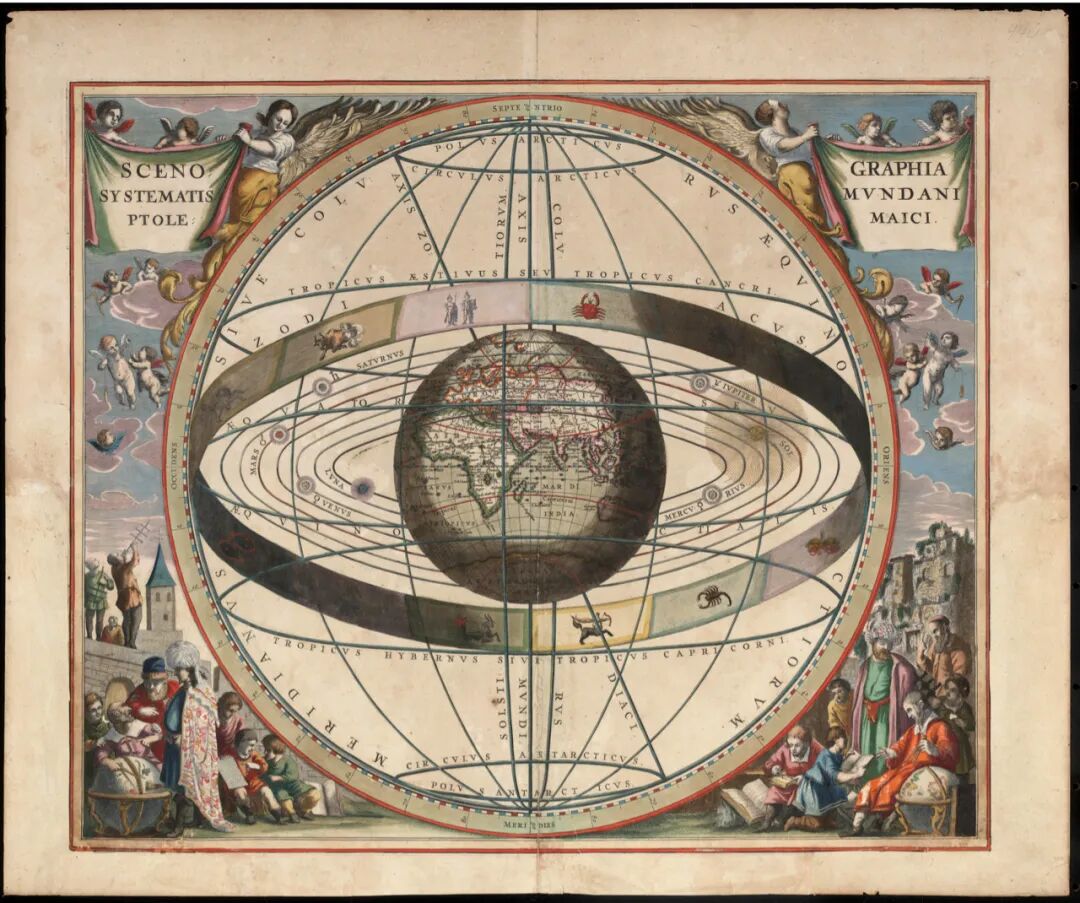
For over a thousand years thereafter, this theory accumulated patch upon patch, continuously adding more epicycles and deferents, "perfectly" explaining and predicting many phenomena — a veritable miao shou.
Until the 16th century. In the Renaissance, as science and technology advanced, evidence supporting heliocentrism gradually emerged, some inexplicable under geocentrism. Thus geocentrism gradually lost ground, supplanted by heliocentrism supported by Copernicus, Galileo, Kepler, and others. (Portions above from online encyclopedia.)
In fact, the motions of the sun, moon, and other solar system planets can be explained by either geocentrism or heliocentrism, equally valid. Yet heliocentrism requires only 7 basic assumptions, while geocentrism requires vastly more.
Copernicus noted this in the preface to De revolutionibus orbium coelestium, hence his preference for heliocentrism with fewer assumptions.
Concepts like "ben shou, miao shou, su shou" constitute excessive assumptions.
Consider: what is the purpose of playing Go?
To win. Specifically, to maximize the probability of occupying more territory than the opponent by at least half a point.
Once the purpose is clear, there exists a value criterion for achieving it. What relation does this have to elegance or vulgarity? Caring too much about "brilliance" — isn't that like posing instead of shooting when you should score? And if ben shou means a dutiful move, shouldn't every move be ben shou?
If unnecessary, one should not assume many things. We should apply Occam's Razor to shave away superfluous explanations like "ben shou, miao shou, su shou."
Isaac Newton said: "We are to admit no more causes of natural things than such as are both true and sufficient to explain their appearances. Therefore, to the same natural effects we must, so far as possible, assign the same causes."
This is perhaps the ancestral explanation of what we now call "first principles."
Russell said: "Whenever possible, substitute constructions out of known entities for inferences to unknown entities." "Ben shou, miao shou, su shou" are unknown entities with excessive evaluative dimensions, impossible to quantify, laden with preconceived assumptions, even mixed with superstition and emotion.
The very concept of "su shou" even incorporates something of "moral judgment." For instance, children learning Go might be told by teachers: better to lose than play su shou.
Concepts like "ben shou, miao shou, su shou" compose an overfitted model for explaining Go. Such models excel at post-hoc explanation in game commentary, facilitate enthusiasts' mutual boasting, and provide literary material for legends.
Yet for a Go master, removing these superfluous concepts and using simpler models with endgame win-rate calculations better grasps the essence of the problem, thereby achieving victory.
Excessive assumptions, overfitted explanations, bring people fatal illusions.
I once wrote in "The Way to Destroy a Smart Person: Turn Them Into an 'Explanation-Type Talent'":
So-called explanation-type talents are clever people who "observe surface patterns, produce layered explanations, and fall in love with their own explanations."
Explanation-type talents produce two things: security and hope. Both are illusions.
For those skilled at explanation, the three greatest traps are: all talk no action, confirmation bias, and post-hoc rationalization.
Humans are imagination-based animals. Explanations of the past, illusions of the present, and predictions of the future mostly belong to the realm of imagination.
People often involuntarily "explain the future" as they "explain the past." Yet:
- For the past, statistics matter more than explanation;
- For the present, action matters more than explanation;
- For the future, conviction matters more than explanation.
- Only when you understand statistics, action, and conviction does explanation become important.
Memes, suspense, stories, legends — they stem from human obsession with causality. Art exaggerates the energy of "explanation-type talents."
Excessive explanation of reality is like spending too much time photographing at a scenic spot without appreciating the view.
- When trying to solve physical world problems, explanation is often useless;
- When trying to solve human world problems, explanation is often useful.
An entrepreneur must simultaneously solve both problems, so they must understand both "first principles" and the art of explanation.
Even with wrong explanations, explanation-type talents may still make money and succeed — the evolutionary price human society pays for "explanatory diversity."
Those who don't rely on luck prefer to explain their success with luck; those who succeed by luck desperately seek explanations beyond luck.
If an "explanation-type talent" bravely questions their own explanations and openly accepts others' explanations, they evolve into scientists or philosophers.
If you spend too much time using "words" to explain what you're doing, it means you haven't done it well enough. Conversely, if you've done something well, even if you can't explain it clearly, others will explain it colorfully for you.
For creators, rather than wasting time explaining your vision, just build it, then say: Look!

Oasis Capital is a new-generation venture capital firm in China, dedicated to discovering the most vital entrepreneurs of the next decade and growing alongside them to create long-term value. "Participating in and supporting vitality" is Oasis's vision and mission. This vitality is both the direction of structural transformation in the era and the resilience and evolutionary force of entrepreneurs.
Oasis Capital focuses on early and growth-stage investments, with individual investments ranging from $3 million to $30 million, concentrating on healthcare, enterprise services, and other technology-enabled service sectors, empowering China's technology-driven new service upgrade.