James Anderson's Letter to Investors 2021

Timeframe, Possibility, Extreme Uncertainty

James Anderson is a partner at Baillie Gifford and the fund manager of the firm's flagship Scottish Mortgage Investment Trust (SMT). Born in 1959, Anderson graduated from Oxford University with a degree in history, then pursued graduate studies in Italy and Canada, earning a master's in international affairs in 1982. He joined Baillie Gifford in 1983, became a partner in 1987, and took over management of SMT in 2000 — delivering roughly 1,500% returns to shareholders over two decades. Anderson retired from Baillie Gifford on April 30, 2022, making this his final letter to investors. After so many years of writing measured, conventional letters, allow me to be direct in this 22nd and final one. I have made many mistakes and misjudgments over the past 20-plus years, but I have become increasingly convinced that my greatest failing was not being radical enough. Frankly, the world of traditional investment management is irreparably broken. It needs new thinking — far beyond what Alice in Wonderland described as "six impossible things before breakfast."
Some Convictions
Let me begin with what I believe. Needless to say, my successors should be skeptical of believing these convictions for decades to come. The world changes, and we must change with it. This is indeed an appropriate moment for farewell. The investment world underwent profound change in the mid-1980s. The value investing theory pioneered by Benjamin Graham, championed by Warren Buffett, and embraced by the media — it describes nothing like Alice's rabbit hole, and barely captures the late 19th century. To illustrate what has happened to the world of growth stocks that Graham defined as doubling profits in ten years, let us look at some recent data:
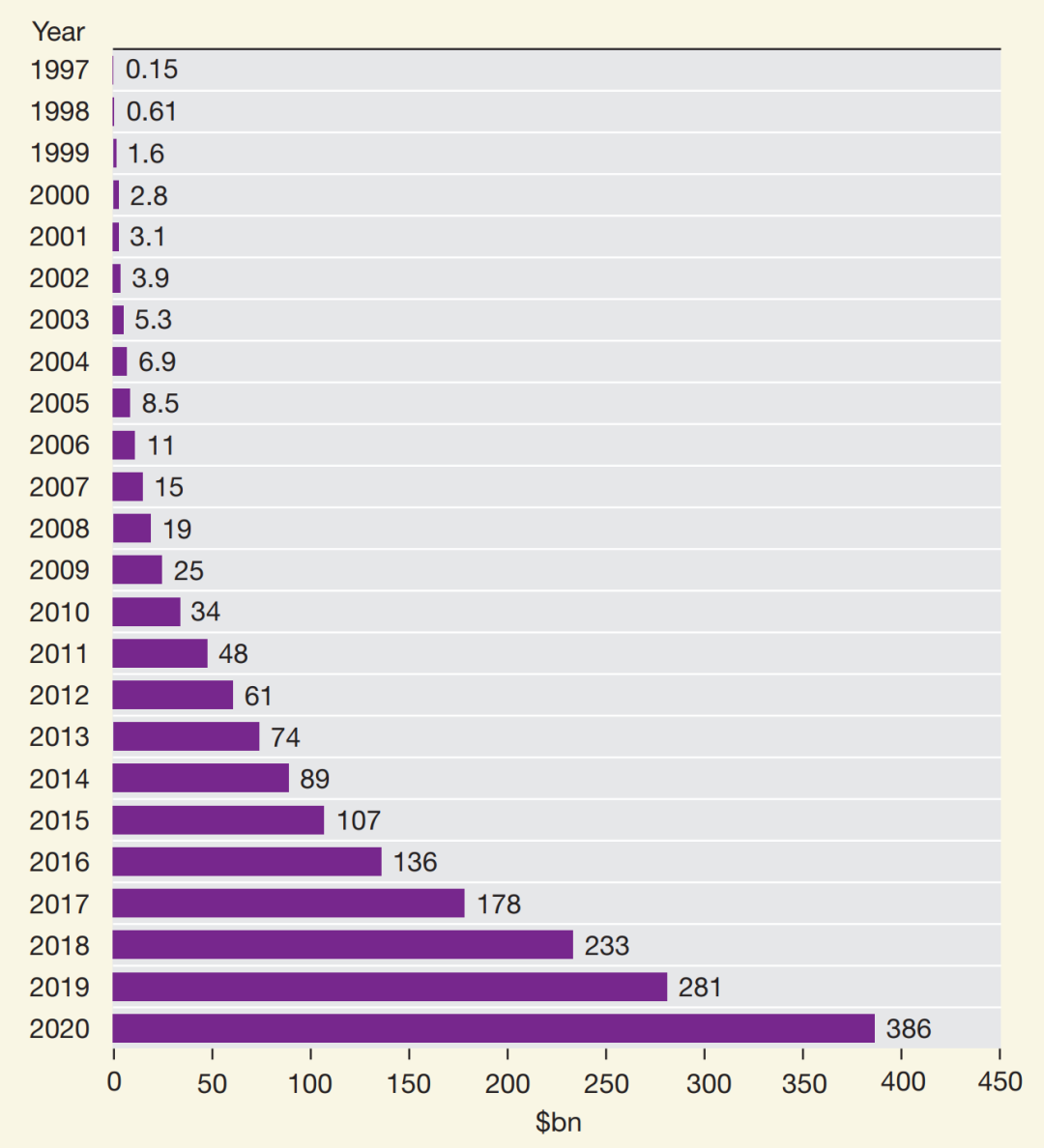
I trust many of you will recognize these as Amazon's annual revenue figures. The numbers actually understate Amazon's achievement, because third-party accounting standards are relatively conservative. Amazon maintained a 41% compound annual growth rate for over two decades. The free cash flow metric that Graham and his ilk preferred reached $31 billion in 2020. Since the advent of digital technology, this pattern of sustainable high-speed growth and scale effects has become increasingly pronounced — the earliest classic case being Microsoft, which continued to grow rapidly 35 years after its IPO.
The lesson of investing lies in these extremes. What the CFA program drills into young people — that along the classic bell curve (normal distribution) you can select a risk-return point to suit your portfolio — is unrealistic, because the CFA neither accepts the profound uncertainty of today's world nor acknowledges that extreme return distributions mean seeking companies with extreme and sustainable growth characteristics is central to investing. The constant temptation is to distract oneself searching for short-term, marginal opportunities in mediocre companies. This temptation must be resisted. It requires powerful conviction. Drawdowns are frequent and severe — 40% pullbacks are the norm. Stock charts look like smooth rises from lower left to upper right, but once you own them, it is nothing like that.
So how do we identify these stocks with exceptional potential? How do we acquire the conviction that allows the magic of compounding to work? With Jeff Bezos stepping down as Amazon CEO, let us review what we noticed, how we endured volatility, and where we fell short.
Great investments typically share these characteristics: the company has unlimited growth opportunities and never limits itself; it is led by its founder; it has a distinctive operating philosophy, usually original and derived from first principles. I believe these qualities were all visible in early Amazon. Reading Bezos's 1997 letter to shareholders reveals an ambitious, patient, and uniquely thoughtful person. Frankly, our failure to recognize this earlier was not for lack of clues but due to our own limitations. We were too familiar with market volatility, too focused on short-term performance, too concerned with drawdown control — it was difficult to become committed holders. It was not until around 2005-06 that our investing became less poor, that we could recognize Amazon's potential and endure the various fluctuations and noise. And there was plenty of noise: Amazon's stock fell 46% from its peak in 2006; I grew accustomed to peers declaring on conference calls that Amazon was their favorite short; they particularly disliked the costs of Amazon Prime and a service called "Other," which later became AWS. We gradually learned and understood Amazon, but when our position exceeded our 10% holding limit, we were forced to reduce it multiple times. I apologize for this — I believe that approach was flawed. Only in recent months has our enthusiasm for Amazon cooled slightly. Amazon is now considered a safe, acceptable value investment. The founder is no longer CEO. Though the path ahead remains bright, we worry that the Day One passion is gone.
Time Horizons, Probabilities, Radical Uncertainty
The reasons for being obsessed with long-term investment decisions are too numerous to describe here. But one seemingly crucial implication has been overlooked. Efficient market theory holds that all available information is reflected in stock prices, so only new information matters. This is used to justify chasing corporate earnings announcements, macroeconomic news, and the like. In turn, the forces chasing short-term returns reinforce this.
So far, this is standard criticism. We share it — and then the problem arises. If you believe all information is reflected in prices, while simultaneously believing short-term investment performance is paramount, this leaves a thinking void. There is no obvious basis for interpreting the future. This sounds abstract, but it is not. Let me use Tesla to illustrate this puzzle. When we first invested in Tesla seven years ago, we believed — or rather, observed — that the laws and pace of battery performance improvement and electric vehicle manufacturing learning were clearly evident in reality and well documented in academic research. Since then, the speed of improvement and confidence in the data have only increased. This made it inevitable, given investment horizons, that EVs would someday outperform and underprice internal combustion engines, to say nothing of being cleaner. When 15%-plus improvement speed confronts 2-3% snail's pace, the crossover occurs.
Since Tesla was the only major player in the Western world, our investment decision was straightforward. We needed only to listen to experts and wait. Most investors do not listen to experts but to brokers and media, confused by panic buying and selling and numerous short sellers. Headlines tell them that Tesla will have a rough quarter next quarter, that Elon Musk has run his mouth again. For us, this was an obvious market inefficiency offering high-probability, high returns for patient investors. Too many investment decisions are based on marginal judgments. The probability that EVs will prevail has only grown larger. We did not need insight, did not need clever models to discover this — only patience and trust in experts and in the company. The uncertainty lies elsewhere — geographically elsewhere. Given the intense competition in the China market, whether our investment in NIO will succeed greatly or even survive is entirely uncertain. Tesla's returns must also account for the China market, especially now, especially for Tesla's autonomous driving ambitions. This will change Tesla's economics. Despite our best efforts, we are unlikely to estimate Tesla's probability of prevailing in an entirely new industry, nor the precise outcome of cash flows should it prevail. Oddly, brokers, hedge fund specialists, and commentators all claim to be able to interpret Tesla's future and assign a precise target price. Perhaps they are all geniuses. We are not. We must respect and embrace uncertainty, strive to identify where extreme upside may occur, and then observe patiently.
This Is Not Growth vs. Value
Tesla is merely one example — albeit a vital one — of the central question of investing in our time. The core question of investing is not the choice between growth and value, not the level of market valuations, not 2021's economic growth or COVID's trajectory, but rather understanding change — how it happens, how much occurs, and its effects. Refusing to accept this reflects a super-desire for safety and symbolizes the broad crisis of economic thought captured by mathematical equilibrium. If we shift our attention to studying profound change, we will less readily believe there are eternal truths of investing to default to as rules. The dangerous cry is not "this time is different," but the refusal to acknowledge that the world, and investment as its reflection, is not what it was before. The only remaining valid principle is that the long-term value of a stock depends on its long-term free cash flow generation. But for what those cash flows will be, we have only the most minimal and vague clues. In an era of profound change, those who still wield short-term PE multiples to judge valuation will inevitably eat dust.
The Future
The coming decade will certainly bring more turbulence, more inspiration, and more massive change than we have ever witnessed. I envy the opportunities and experiences that await my successors. Even in 2020, as the COVID tragedy spread, there were already many signs of what was to come. I do not mean the proliferation of digital platforms to overcome pandemic constraints, but rather more exciting and more important emerging forces. Renewable energy, making our society better, has achieved extraordinary things and is gradually becoming mainstream; synthetic biology has shown promising results, making medical innovation a series of beneficial outcomes for humanity rather than a complex and frustrating drain of resources. The future is infinitely bright, and the threat to old empires is imminent. Without participating in venture capital, we would find it difficult to cultivate great enthusiasm in these areas. We are forever grateful that we found our way into the primary market to interact with those of extraordinary vision and energy. Frankly, five years ago I would have been astonished by the access and opportunities we now take for granted. We are fortunate. It is a privilege. Our former board member, John Kay, taught us many things, but none more valuable than the role of indirection. By engaging with visionary entrepreneurs and their companies, we seek insight into the future. Usually we are overwhelmed, confused rather than comprehending. This is our plan. Investment outcomes are merely the end result of a process of thought and effort.
We need to remain eccentric. In fact, we need to become more eccentric, more radical. We have always claimed that in managing SMT, we must learn from the exceptional leaders we are fortunate to encounter. If I may, I would like to cite two of them in closing. The first is Noubar Afeyan, founder of Flagship Pioneering and chairman of Moderna. A year ago at this time, I might have needed to elaborate on Moderna's mission, but that is now unnecessary. The observation I wish to quote extends far beyond Moderna and vaccines:
"Let me say something blunt... To achieve extraordinary discovery, we must be willing to embrace unreasonable propositions and unreasonable people, because I do not believe that completely reasonable people doing completely reasonable things can produce massive breakthroughs."
No industry questions unconventional ideas more than asset management. We need to reconstruct new concepts from first principles. We need to help create great companies that embrace the extraordinary. Clearly, no one has demonstrated and articulated this better than Bezos. In his recent and, sadly, final letter as CEO, he concluded:
"We all know that distinctiveness — originality — is valuable. I am actually asking you to do something: embrace and realistically view how hard it is to maintain distinctiveness! The world wants you to be typical, in a thousand ways it tries to make you so. Do not let it happen."
I do not think Tom and Laurence need this advice, nor do I think either will ignore Mr. Bezos's point. But please help SMT become more unconventional, more distinctive, because the pressures of the investment world pull at us constantly.
James Anderson
May 12, 2021

Oasis Capital is a new-generation venture capital firm in China, dedicated to discovering the most vital entrepreneurs of the next decade and growing alongside them to create long-term value. "Championing Vitality" is Oasis's vision and mission. This vitality is both the direction of structural transformation in our era and the resilience and evolutionary force of entrepreneurs.
Oasis Capital focuses on early and growth-stage investments, with individual checks of $3 million to $30 million, concentrating on technology-enabled services in healthcare, enterprise software, and related fields, supporting China's technology-driven new services upgrade.