Liu Ding: Artificial Intelligence vs. Biological Instinct

When Human "Hardware" Lags Far Behind "Software"

For this new episode of Signal and Noise, we invited Dr. Ding Liu, a neuroscientist based in China, a postdoctoral fellow at Harvard University, and an assistant professor at Westlake University.
The more we grow accustomed to explaining everything through logic, efficiency, and rationality, the more we find that anxiety hasn't disappeared — it's become more frequent and more insidious.
As a highly evolved species, humanity has entered an unprecedented phase: silicon-based systems and carbon-based life are accelerating along the same timeline, yet the pace of technological iteration has clearly outstripped the update cycle of our physiological and cognitive "hardware." Attention, emotion, and instinct — mechanisms that once sustained human survival over the long term — now face sustained pressure in environments of dense computation and automation.
In this conversation with Dr. Liu, we start from neuroscience to explore how instinct and emotion operate in today's technological environment, and try together to understand how humans can participate in judgment, make choices, and coexist with technology as AI continues to advance.
Scan the QR code to listen.
If you have any thoughts you'd like to share, feel free to leave a comment.
What follows is an excerpt from our conversation — passages we found particularly illuminating, shared here in written form.
Enjoy

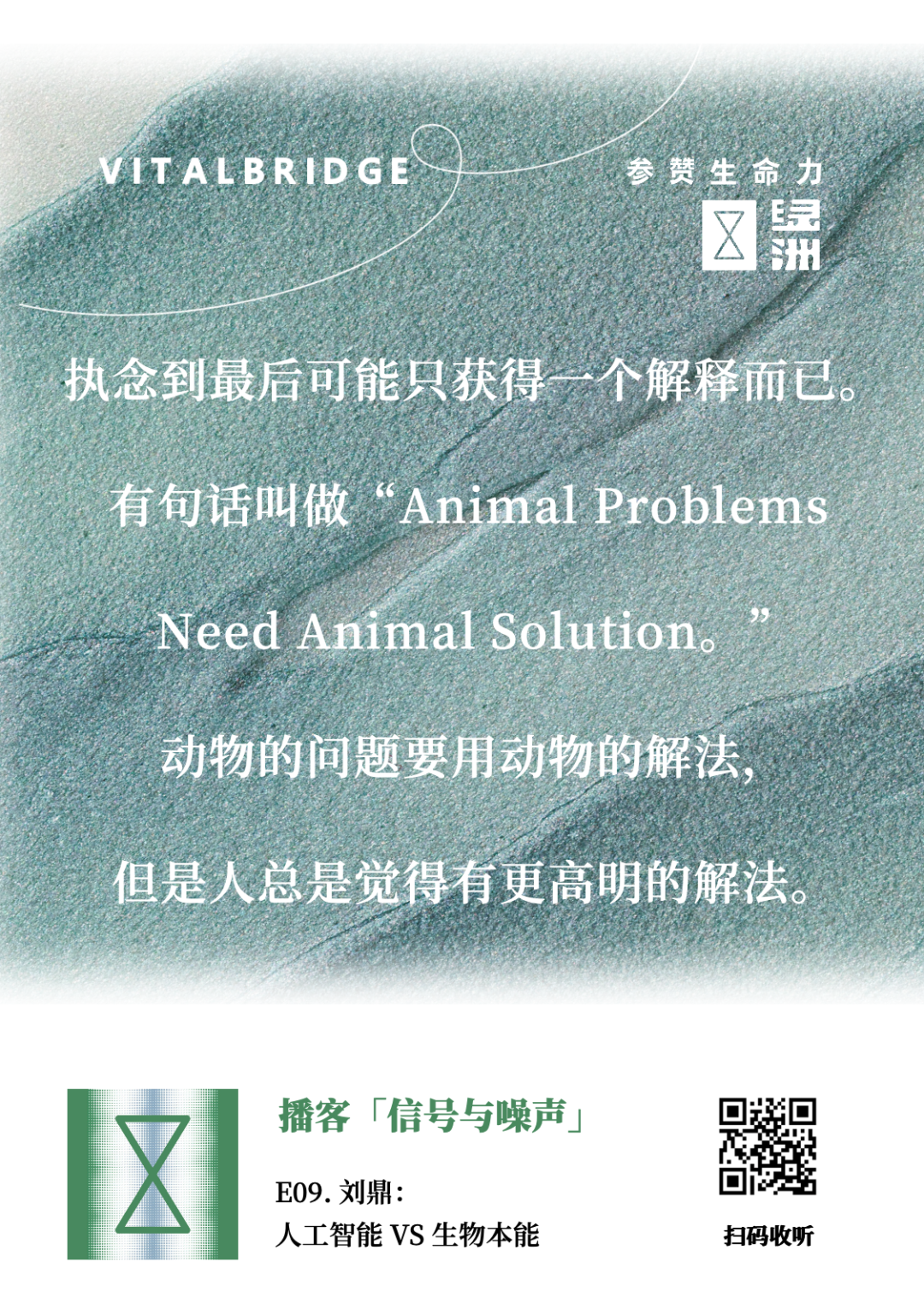
Ding Liu: Humans have this fixation — they need to have an explanation for things. But this fixation might only lead to getting an explanation, nothing more. There's a saying: "Animal Problems Need Animal Solutions." But people always think there must be a more sophisticated answer.
Oasis Capital: From this perspective, what would not be an animal problem?
Ding Liu: All problems are animal problems.
Oasis Capital: Haha, so from this angle, life should be pretty joyful — it's essentially animal problems with animal solutions, right?
Ding Liu: Right. So sometimes the things that twist us up might be self-inflicted.
Oasis Capital: From your perspective, we are products of the brain. So when the brain sends certain signals, we only need simple methods to process them — no need for excessive attribution or over-interpretation.
Ding Liu: I think so. Look at the emotion of "happiness," for example. You might feel happy eating a good meal, or happy winning a Nobel Prize. To the brain, it's just dopamine being released. It doesn't much care about the cause.
But because we're domesticated by concepts — humans acquire language from childhood, and language reshapes the brain's entire value system once again.

Ding Liu: Anxiety is probably a typical case.
Isn't there a saying that "the opposite of anxiety is specificity"? When you haven't figured out a method or solution, you feel anxious — meaning "I can't solve this problem yet, I'm still computing." The subjective feeling of not being able to compute it out is called anxiety.
Oasis Capital: Let's set aside why humans feel anxious for a moment. If anxiety is a state function that appears in the brain, what's its purpose?
Ding Liu: Two purposes. First: I can't compute this, give up. Second: I'm running at high speed right now, please give me more support.
Oasis Capital: But our education often teaches us not to give up, not to lie flat — we must stand up. So we become even more anxious.
Ding Liu: So humans layer another set of human values on top. We have this "frustration education" that says: you must grow stronger through adversity. When you have negative emotions, you need to work even harder.
But this doesn't exist in animal logic. After two or three attempts, if it doesn't work, the brain adjusts and says this path is wrong — don't do this thing. Like Pavlov's dog: bell, food. When the bell stops bringing food, after repeated trials, the dog stops salivating. Because it knows the bell is futile, no meat is coming.
Oasis Capital: But human education would tell this dog: keep trying, maybe next time the bell will bring meat. Ultimately, your resilience is too weak — you need to persist. So first, when we talk about persistence and balance, is this a delusion, or a mistaken input of values? Or is it some kind of balance? How do we distinguish this?
Ding Liu: This might be metaphysics — it's very difficult. Some people do manage to solve things through persistence.
But just because some people succeed this way doesn't mean everyone should do the same thing. Everyone should have their own formula.

Ding Liu: Look at human vocabulary — words describing negative emotions far outnumber those for positive emotions. This reflects that we were born from an evolutionary process of constant fear.
Negative emotions are even more meaningful to us than positive ones. Negative emotions have many dimensions. "Anxiety" is one. "Fear" and "anxiety" are completely different things. Then there's "guilt," "envy," "jealousy"... Think about positive emotions — they're quite pale. "Happy," "excited," "joyful" — they all feel rather similar.
Oasis Capital: And we've found that communication between people is largely built through negative emotions. Like "I've been so anxious lately," "Me too" — people say this to each other. Also, "greed" and "fear" — are these the two core emotions for all animals?
Ding Liu: Fear definitely is. Greed is probably an evolutionary necessity — when resources are limited, if you're not greedy, you die.
Oasis Capital: I see, so it's actually a survival strategy — it's meant to help you survive?
Ding Liu: Right. I've been thinking about something quite interesting regarding "greed" these past two days. In evolutionary history, there's never been such extreme material abundance as now. So we've always survived by being very greedy — just barely making it. We achieved a kind of objective self-discipline through material scarcity. There wasn't that much food, so I could only eat so much.
But now with extreme material abundance, this greedy attribute has created many new problems. Take the simplest example: after food surplus, people become obese, develop diabetes, and face various issues like the "three highs." Because the human brain is still the brain from millions of years ago, but our society and our concepts have changed. There's a huge gap or tension between them. So our brain's needs haven't actually changed much from before.
Oasis Capital: So it's like — imagine we trained a large model using internet data from 20 years ago, when the internet was far less developed. Then 20 years later, the environment has completely changed, but we're still using that same model to generate tokens and compute.

Ding Liu: Do you know how pets were formed? The violent cells in wolves were removed during evolution, and they became dogs — highly social animals. But they survived very well; this became their survival strategy instead.
Now these animals express violence by barking at each other — through ritualized violence. For example, when two armies face off, they beat drums and clang gongs. It's actually a strategy to minimize energy expenditure while intimidating the opponent into retreat without fighting. Many animals have evolved this trait — replacing real violence with logic.
I once heard an interesting formulation: war often arises from the inability to precisely calculate or assess outcomes. If I knew for certain I would lose, I wouldn't fight.
Oasis Capital: Right, actually during the Spring and Autumn and Warring States periods, many persuaders functioned to communicate simulated war outcomes: if you fight, you'll lose 50 cities; if you surrender without fighting, you'll only lose 25 — do you choose to fight or not? If you agree not to fight, you can exchange that for ten years of peace.
Back then, especially before Sun Tzu, there wasn't really any military strategy to speak of. Everyone's calculation was simply how many people you have, how many I have — it was a simple math problem with an easy solution, so agreement was easily reached. But later, with more methodologies, especially cases of winning with fewer troops, people became less able to reach consensus.
But if violent tendencies are reduced — you see some people are very violent, but they might also show another trait: perhaps they're very resilient, or very tough when facing difficulties. This could become an excellent quality in entrepreneurs. If you remove the violent cells, would the whole person collapse too?
Ding Liu: That's possible. You put it very well — certain external qualities we display might internally correspond to multi-functional mechanisms. Violence, for example, might be an expression of some life force, showing that I won't bow down before difficulties. In the face of difficulty, is expressing violence a good quality? It becomes a virtue instead.
So in neuroscience research, we also study more carefully whether violence is the same or different across different contexts. How can we make violence emerge only when needed, or produce this resilience, while suppressing it when not needed?
Oasis Capital: When you mentioned these things just now, you used the word "instinct." What does instinct mean?
Ding Liu: Simply put, it's what you can do without learning. It's in your hardware, in your DNA.
Oasis Capital: Factory settings.
Ding Liu: Right, factory settings. Everything is instinct. I am an animal. All problems are animal problems.
But then we can talk about a chain: "action-habit-addiction." Maybe it starts as an action — like eating late-night snacks — but later it becomes a habit. Good habits can stabilize without becoming addiction, but some cross the threshold into addiction, and addiction becomes harmful.
A classic example is weight loss. Previously, a person's weight had an equilibrium point — eat too much, and you'd expend more; you couldn't absorb that much. Eat too little, and you'd eat more next time. This was the body's own wisdom. But now the logic of weight loss has become: there's no standard for what's the best weight to reach, because this wasn't produced by evolution but by concepts. So people will unlimitedly pursue more, and this becomes terrifying — leading to anorexia and various physiological problems. This is because our instincts cannot protect against this layer. It's a deformed problem that arises when concepts are imposed.
Oasis Capital: What's interesting is that you didn't use "brain" just now — you used "concepts." Because concepts are what we're conditioned by, a kind of software, even exploiting or hacking certain instincts. The final result is that the root belonging to "instinct" starts growing wildly, and some things develop abnormally. Some people get fixated because they've put all their concepts and attention on one thing.
Ding Liu: Yes, when repeatedly reinforced, it grows bigger and bigger — the inner little monster gets cultivated. But conversely, some professions need to cultivate monsters — writers, for example, and actors.
Oasis Capital: Because for them, to express something, they need to have it themselves.
Many founders are the same — they're actually quite "crazy." Without that "craziness," sometimes you can't truly empathize with users' underlying needs, especially in consumer goods — sensitivity to underlying needs is crucial. This is professional competence for entrepreneurs, but for most people, it's extremely draining.
Ding Liu: Or perhaps it's a kind of talent — luck just happens to land on a person like this, who's particularly sensitive to some aspect that others can't perceive. It brings pain, but also creativity.

Ding Liu: I'm curious — our lab's motto is nine characters: "Life force, curiosity, human warmth." I noticed you also mentioned your company's values include "life force"?
Oasis Capital: Ours are "kindness, joy, life force" — very similar. But how did you settle on those nine characters?
Ding Liu: First, "life force" is an intuitive feeling. The people around me who do good research — first, they're very vigorous, energetic people. They're this kind of person, and they bring this state into their research life. They're full of curiosity and energy, and they can endure through setbacks.
So I often tell students: you don't become a good scientist after doing research; rather, the seed of a good scientist is already in your life. Even when you're not doing research, you embody this vigorous life state. It's the energy of this life state that guides you to do research — research is just one of your practices.
So on one hand, "life force" simply means: is your physical fitness good? Can you still find time to think after work, still interact with others? But on another level, "life force" speaks to a possibility, a greater pursuit. You can't limit yourself to your work — you want a larger fulfillment, or progress, a perfection of life. Your perfection of life comes from doing this work, discovering interesting things, so your limitations become smaller and your picture becomes bigger.
Returning to what we discussed earlier: when your anxiety isn't just focused on yourself, when you can extend from your own life to others' lives, the matter itself becomes larger.
Oasis Capital: I understand "curiosity" — you mentioned the curiosity for research. But why "human warmth"?
Ding Liu: Human warmth is meant to pull curiosity in the opposite direction, because sometimes in research we develop an occupational hazard — we become too较真 [fixated on being right], wanting to get to the bottom of everything. Why A and not B? Prove it to me. Is there another level beneath?
Of course this matters for research — you need to be precise. But this state can't be brought into life. If you bring it into life, you become a very mean, very petty person. In dealing with people, you need kindness and beauty as support. In research you seek truth, but if you also seek truth in dealing with people, that's not quite right.
So "human warmth" means: you're not just a good scientist, you should also be a good person — or rather, you should first be a good person, then a good researcher.
Oasis Capital: So be kind in person, be true in work — don't get it backwards.
Ding Liu: Right, be tolerant in person, rigorous in work.
Oasis Capital: Rigorous, so human warmth keeps everyone grounded.
Ding Liu: And able to bear life's complexity. Some things may not need to be figured out completely. If someone bumps into you, hits you, maybe just let it pass — no need to hit back. This is maturity. What is maturity? Having different standards and behavioral norms to constrain yourself in different situations. Professional settings have professional norms, but in life, you need norms for being human.