Jinjian Zhang: High-Frequency and Low-Frequency in Investing | Oasis Signals

*The Signal and the Noise* series
In Jinjian Zhang's view, every technological revolution is essentially a leap in frequency, and AI will push the world's frequency up by another order of magnitude. The world will enter hard mode — or, as many already feel, it seems to have entered hard mode already.
In this article, Zhang systematically breaks down this problem from a signal-processing perspective and offers his solution.
If we say five years is a cycle, then from his late-2018 essay Signals and Noise in Investing to now marks exactly one cycle. During this period, we have simultaneously experienced the certainty of innovation driven by artificial intelligence and the uncertainty wrought by global turbulence. Over these five years, a few shared sentiments have likely emerged.
First, the world has gotten harder. I used to play Warcraft III, which offered three difficulty settings: easy, hard, and insane. In recent years, someone seems to have cranked the world from hard up to insane. In this wave of AI entrepreneurship, we can clearly feel that starting a company has become more difficult.
For one, the quality of entrepreneurs has risen. This cohort is significantly stronger than previous ones, especially the young founders born around 1995. Their knowledge, capabilities, underlying sense of security, and confidence in globalization all surpass those of the entrepreneurs I met in the early 2010s — likely shaped by their upbringing. Standing out among this crowd has become increasingly difficult.
Second, the capital environment keeps worsening. Below is a chart showing valuation markdowns for startups worldwide over the past five years:
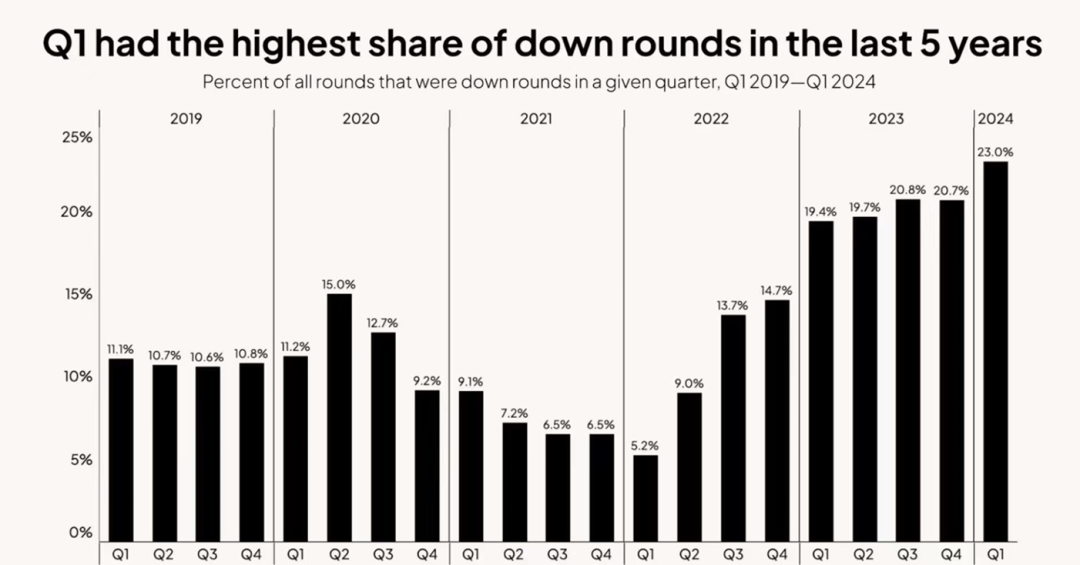
We can see that valuation markdowns in the primary market have grown more frequent in recent years. In 2023, 20% of global startups saw their valuations marked down — already a staggering proportion. Many thought, things can only get better, 2024 will surely see a decline. But clearly, our understanding of "the extreme" was insufficient. In Q1 2024, the markdown rate rose to 23%.
This capital environment also affects entrepreneurs' mindset. In China circa 2012, all roads led to Rome; every industry could be rebuilt from scratch. During the O2O boom, beyond the familiar food delivery and ride-hailing, there was on-demand car washing, dog washing — no door too obscure to knock on, only minds too timid to imagine. I remember one startup offering at-home nail services valued at $1 billion, and this wasn't the only player — three major competitors were locked in a funding war, routinely raising hundreds of millions. Such scenes are unimaginable today, yet were commonplace back then.
Moreover, over these 12 years, as Chinese entrepreneurs continually emerged, grew, and succeeded, opportunities for newcomers have dwindled.
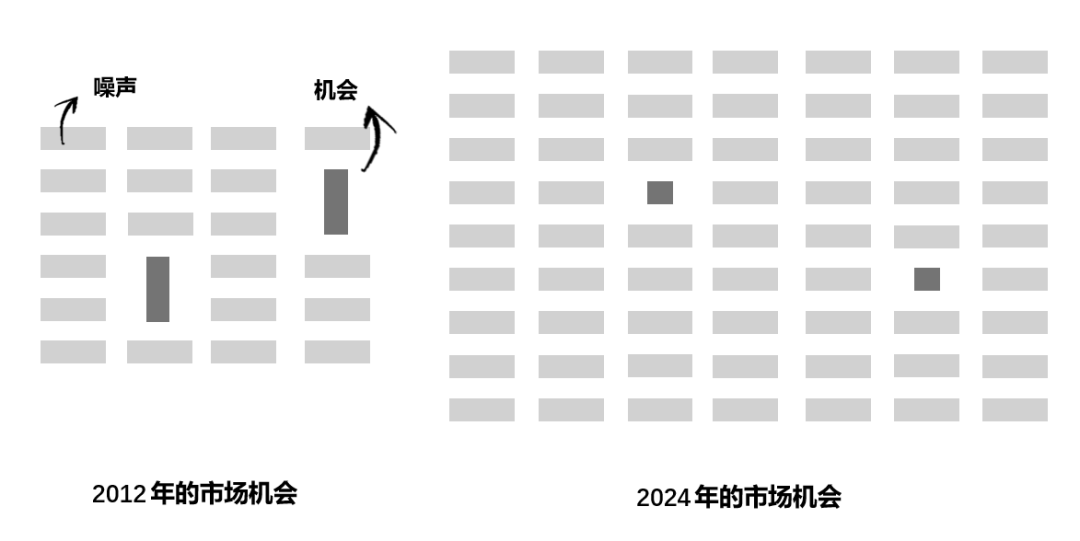
If one in ten opportunities was genuine a decade ago, today it may be one in a hundred — and even that one likely survives in the cracks: for consumer opportunities, will the tech giants pursue it? If not, is the market large enough? Can it go global? If globalizable, will US and Chinese investors buy in? One cut this way, another that way, and today's opportunity is reduced to a tiny point in the interstices. Call it an opportunity or not — it's ambiguous.
Second, time has sped up. After Covid-19 in 2020, the world seemed to accelerate. A year used to feel interminable; now half a year passes in a blink. Previously, a user acquisition strategy could last a year, a market红利 three years. Today, many MCN companies adjust their strategies hourly, rivaling quantitative funds.
With time's acceleration, extreme phenomena have multiplied. Events that once unfolded over three to five years now occur within a single year:
-
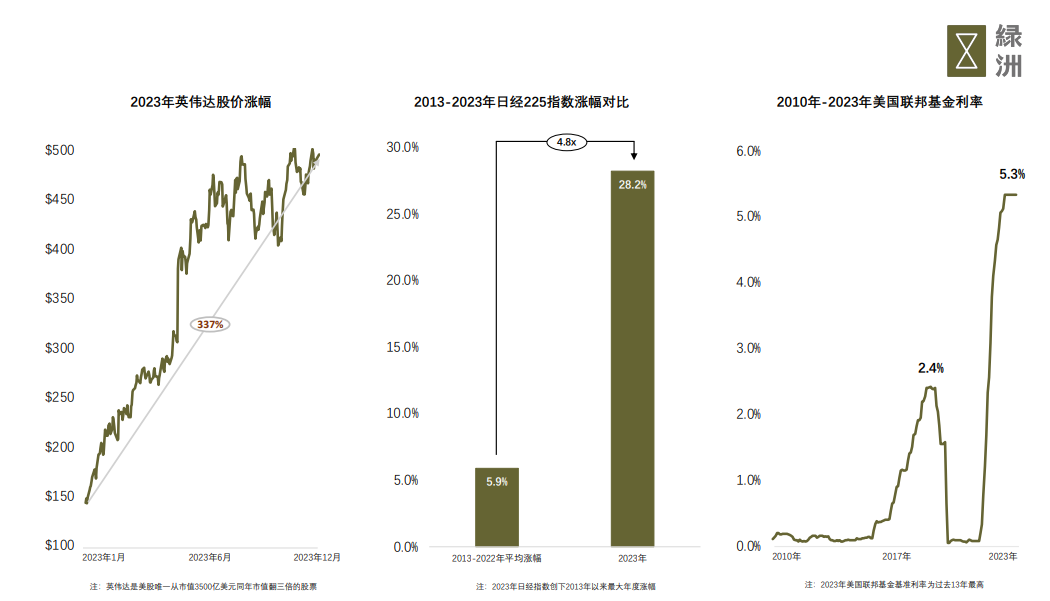
Last year, NVIDIA's stock tripled. This was the first and only time in history that a $2 trillion company tripled in one year.
-
Over the past year, the Nikkei rose 30% — five times its average annual growth rate over the past decade. Japanese equities now fluctuate roughly on par with Bitcoin.
-
After years of near-zero rates, US Treasury yields hit 5.3% last year, triggering the SVB collapse and a cascade of events early in the year.
So what's behind this? Why has the world grown harder and faster?
We must first clarify: when we speak of "the world," what exactly do we mean?
Consider three scenarios — same day, same place: you open short videos; you sit quietly in thought; you open your work email. Same you, same mood? If not, why three completely different experiences under identical temporal and spatial conditions? Because the same you has entered different information streams, and our world is constructed from precisely these streams. Same scenario, different information — different "world."
A friend of mine listens to podcasts during his commute, reads WeChat articles before bed, and is constantly responding to WeChat messages and calls — a ceaseless intake of information. I suspect this portrait fits our generation. We think we live in life itself; in truth, we live in life's information streams. We actively observe the world while passively being fed by information. The world enters through all our sensors, constructing our present thoughts, ideas, and feelings. This is our daily existence; this is the "world" we discuss.
Yet our understanding of information is profoundly limited. We carry built-in "filters," defaulting to exclude what we dislike. Thus the same event, recalled by different participants, often yields contradictory accounts. Even when information reaches our sensors, we tend to be sensitive to changes in content, not changes in frequency.
For example, below are two partners, each with emotional cycles — periods of proactive engagement alternating with passive resistance. As entrepreneurs, we typically notice their state changes rather than their frequency changes.
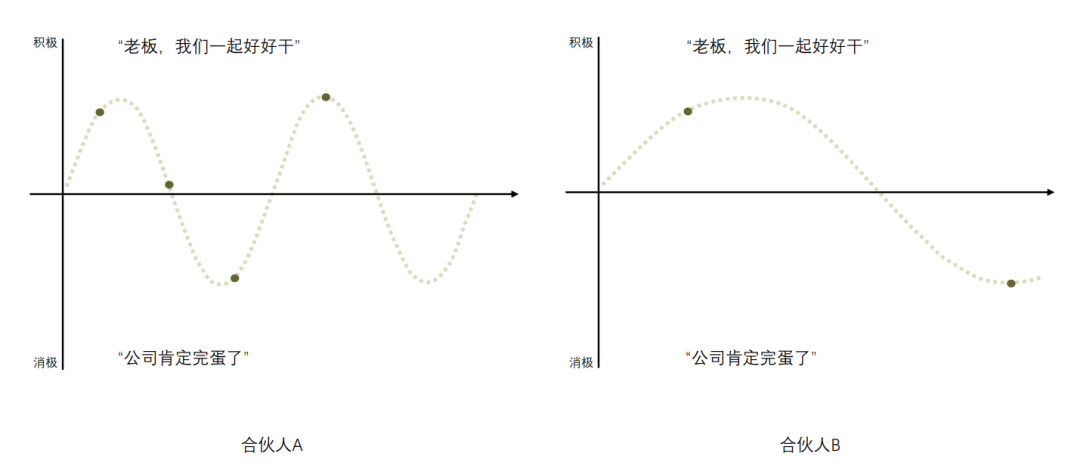
When choosing partners, some entrepreneurs might consider these two individuals similar — both have cycles. But in actual work and life, what drains us is precisely frequency. If a partner says after three years of fighting together that he's tired and needs rest, you can understand and accept this, even help him through his low period. But if he cycles weekly, fifty rounds a year, even the most resilient founder would break.
From a signal-processing perspective, frequency represents energy; higher frequency means higher energy. Thus a high-frequency phenomenon requires more energy to sustain — what we experience as more draining.
So with the same partner, three good years and three bad years pose little problem; but back-and-forth volatility is deeply exhausting. Two hours watching a documentary can be healing; two hours of 15-second short videos can leave you depleted. Chasing every traffic hotspot in content creation is exhausting; speaking about something you genuinely believe in long-term can be nourishing. Warren Buffett could expound his philosophy for decades — he was likely the one being nourished. Had he commented on market hotspots daily, he probably would have burned out long ago.
So returning to our starting point: our world is constructed by information. Therefore, our world's frequency is determined by information's frequency. Higher information frequency means higher world frequency. The chart below shows the evolution of daily global information volume across the telegraph era, email era, and WeChat era (the frequency diagram isn't strictly to scale, as each technological revolution brings hundredfold leaps in frequency).
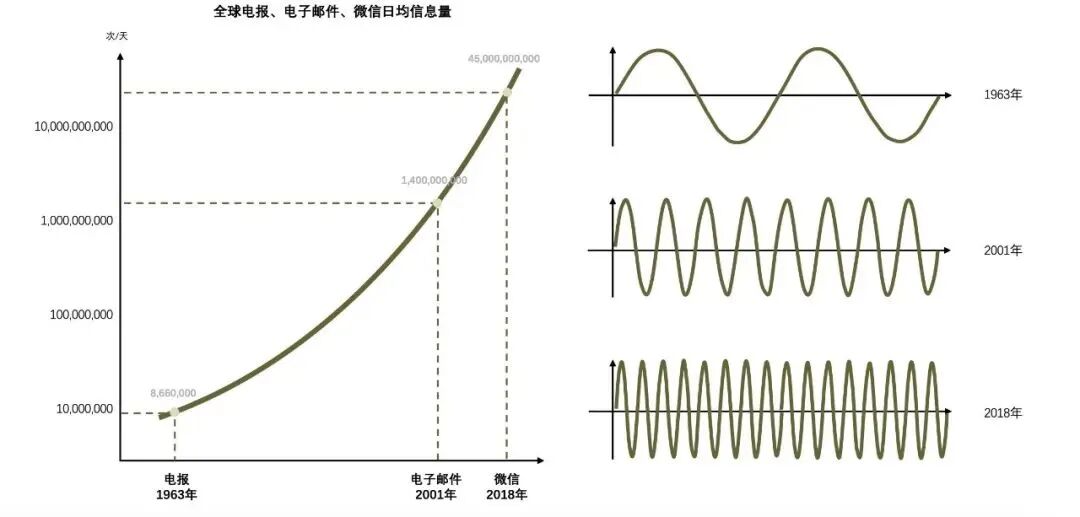
Once, a letter from home was worth ten thousand in gold; today, opening WeChat, our daily replies exceed a lifetime's correspondence in antiquity. Once, an official demoted from Beijing to Nanjing needed three months for the journey; today, not even three hours. Each technological revolution is fundamentally a leap in information frequency, re-accelerating the circulation of time and space.
When frequency leaps, our experience of many things transforms. During the May holiday, a friend sent me a video: at a family gathering, he wore Apple Vision Pro, simultaneously watching a match while caring for his child. He was proud of this scene; I found it deeply sad. At that moment, he appeared to be with his child, but his heart wasn't present. We often have this experience — talking with someone, and suddenly sensing they're "not here." Their body is present, but their heart isn't. Some parents claim to have spent a day with their child, yet spent it messaging and scrolling, their attention never truly on the child, their heart never truly there.
Technology's frequency leap makes focused attention ever harder. If once a unit of attention lasted two hours, today it may last two seconds. The world's rhythm accelerates while our attention grows scarcer, our sense of presence weaker.
Previously, simply stepping away from a computer lowered one's frequency, as information frequency dropped. Now one must put the phone aside. And in these past two years, we face another major frequency leap. AI will push the world's frequency up another order of magnitude. In the future, your agent will accompany you in real-time, conversing, feeding back on work — you'll be in the information stream constantly, living in an ever-accelerating high-frequency world.
Are we ready?
When the Industrial Revolution arrived, everyone believed it would liberate human labor. In fact, humans work far longer hours than serfs did. Over the next decade, our attention will be sliced finer; work and life will merge more completely.
Moreover, the world's high-frequency transformation will produce many phenomena:
(1) Systems grow fragile. In recent years, more people sense that the world seems like a giant makeshift operation. As a system's frequency increases, it gradually loses robustness — like a large ship rocking ever more violently, its problems becoming increasingly exposed.
(2) More experiences of inadequacy. Previously one had the mental energy for many things; now fatigue comes easier, concentration scatters more readily. As social frequency rises, daily energy expenditure increases — you need three to five times past energy to complete a day's tasks.
(3) More stimulation. Faced with depletion, most people's response isn't quieting themselves but numbing through overstimulation — binge eating, extreme flavors. Stir-fry chains, barbecue chains, hot pot proliferate; escape rooms, haunted houses multiply. Many seek intense stimulation to recover the feeling of being alive. In Southeast Asia, standard bubble tea contains twice the sugar of China's; we find it too sweet, they find it just right — a microcosm of this trend.
(4) Major flows across industries and regions. When someone cannot adapt to this high-frequency environment, they find ways to descend to familiar frequencies. Some choose industry descaling — abandoning tech for civil service exams. Some choose geographic descaling — fleeing first-tier cities for hometowns. Last year, the three northeastern provinces saw net population inflow — not elderly returnees, but waves of exhausted young people. They haven't given up; they simply want to return to familiar frequencies. This trend will intensify over the next three to five years.
So how should we respond to this frequency leap?
Consider the diagram below. The upper left shows past social change — a straight line in the frequency spectrum, representing unchanging frequency. Entrepreneur A captured an opportunity at the corresponding spectral position and built their industry, shown as the small black box in the upper right. As the era progressed from upper left to lower left, change accelerated and frequency rose; the opportunity in the spectrum shifted rightward.
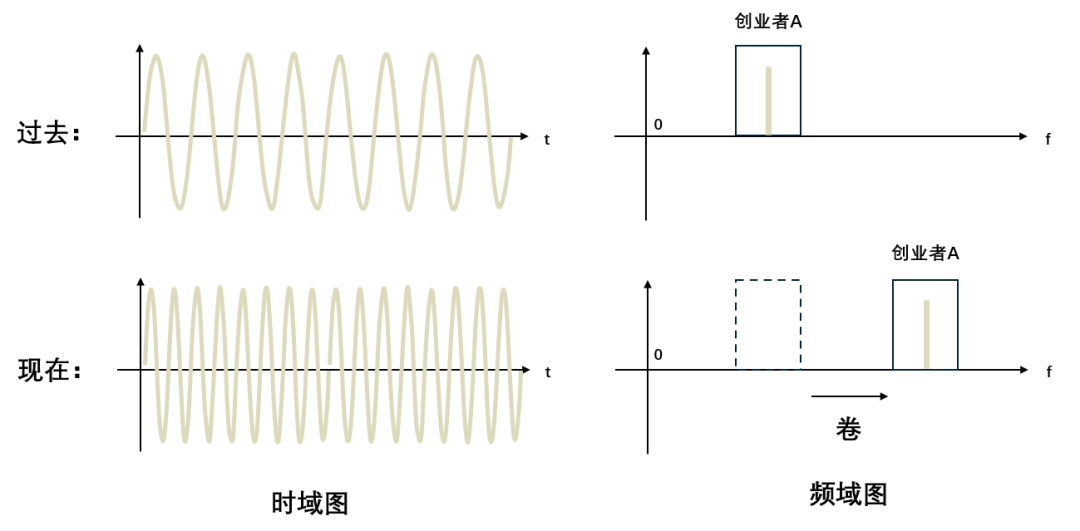
Now this entrepreneur finds their former opportunity gone. Once a monthly hotspot; now ten daily hotspots on Weibo. So they strive to shift right alongside social change — pushing their team harder, faster, more adept at processing complex information — so they can remain with this opportunity. This is the choice of the vast majority today, what we call "grinding" or "hustling" (卷).
But is grinding the only path?
In signal and systems theory, there's a formula called the Fourier transform. Its essential meaning: all functions in the world can be decomposed into superpositions of periodic functions with different cycles. Simply put, everything has rhythm — a superposition of different frequency cycles. You don't perceive this rhythm because you haven't decomposed the underlying periodic patterns. For example, the green curve below appears complex, but after Fourier transformation, you discover it's simply the superposition of one high-frequency pattern and one low-frequency pattern.
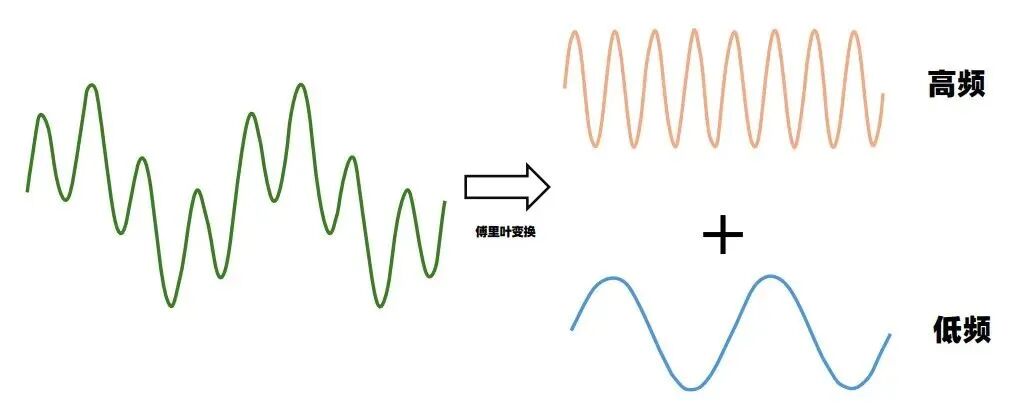
How does this map to reality? Suppose I'm a bubble tea shop owner; the green line represents overall business trends. Decomposed further, we can split influencing factors into two functions. The high-frequency function corresponds to weekly operations and management strategies; the low-frequency function corresponds to product positioning or customer demographics. Our observation of the world is always a superposition of different trends — some long, some short, some fast, some slow. The frequency at which you think determines what mode of game you're playing.
And here's what's interesting about this signal: since wavelength times frequency equals a constant, lower frequency means longer wavelength and greater propagation distance. This is why city TV towers must be tall — tower height is proportional to wavelength; the taller the tower, the longer the wavelength, the greater the urban coverage.
Thus the lower the frequency, the more unadorned, the more cycle-transcending.
Returning to our previous diagram, facing an ever-accelerating world, we now have an alternative solution: through Fourier-transform thinking, decompose change into superpositions of high and low-frequency signals, then focus ourselves on the low-frequency signals. We call this process "steadiness" (定).
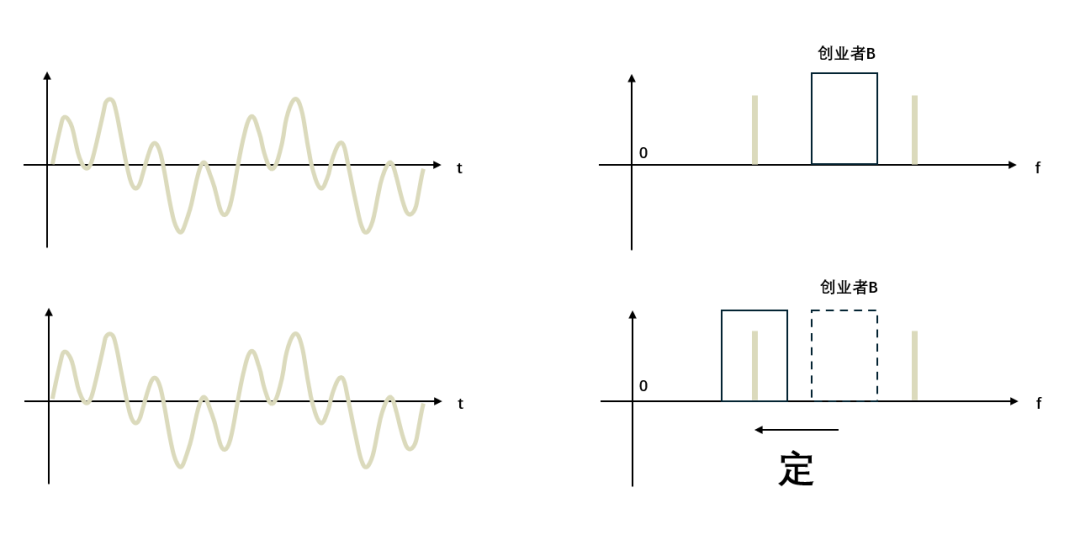
Now this entrepreneur realizes that what matters isn't keeping pace with ten daily hotspots or precise daily data control. Rather, it's focusing energy on this more slowly changing long-term trend — externally perhaps a vision, internally perhaps original intention.
So at every moment we have two choices. One is "grinding" — continuously raising our frequency to match social change. The other is "steadiness" — returning to the most fundamental, essential trends. Consider: what are the key problems in your industry? What are your core personal capabilities? If only one person remains in my industry in the future, how do I deserve to be that person? How can AI amplify my strengths and compensate for my weaknesses?
Over the past year, we've seen many AI companies, met many great minds, conducted many interviews — colleagues constantly networking in the market. But I told a young colleague: ignore all that, just read papers seriously. Half a year later, I saw him in a meeting with more senior colleagues, asking sharper, more profound questions. This is the difference between grinding and steadiness.
The future world rewards steadiness, because grinding has no end — grinding optimizes toward infinity, while steadiness optimizes toward zero. Grinding has no ceiling; steadiness has a floor. A person can process information, chase hotspots, meet ten people daily today — but in a world of agent-to-agent communication, can we out-grind an agent?
The higher the frequency of the era, the more frantic the pace, the more we must steady ourselves and look long-term. Long-term endeavors are difficult precisely because short-term returns are invisible. Yet this very invisibility lets you defeat the impatient. Because as frequency rises, once consensus forms, market feedback comes larger and faster. If the past world was like Amazon stock — climbing steadily step by step to today — the present world is more like NVIDIA stock: flat for years, then suddenly gaining a decade's worth in one year.
So find the fundamental macro-trend, then simply do good work and wait quietly for the wind.
Finally, beyond external trends and directions, I hope everyone can find their own internal low-frequency signal.
For me, the most important low-frequency signal in my life is "vitality" (生命力). I entered this industry in 2012; over these dozen-plus years, observing founders' rises and falls, I ultimately discovered that what truly creates success isn't resources, experience, or capability, but resilience in adversity and self-transcendence after achievement. Many major life decisions aren't logic-based. Rather, when you quiet down, a force rises from within — a warm current guiding your direction. This most authentic inner power, at Oasis Capital, we call "vitality." I hope you sense it, respond to it, ignite it.
So what is a person with "vitality"? Observing many founders, we've found two common traits among those with strong vitality:
First, seeking truth from facts. For such people, whether praised or criticized, whether told what they want to hear or not — they don't process this through an ego filter. Their response: you're right, we'll fix it immediately; you've identified a critical issue I overlooked, let's solve it together. Like machines, they don't focus on feelings but on the insight and action behind the information.
Second, unconditional, complete self-love. You'll find that excellent founders mostly love themselves. I once knew an entrepreneur whose company faced major setbacks. I asked where he was that evening; he said eating hot pot alone. I found this strange — facing such crisis, how could he eat hot pot? He replied: feeling a bit down today, eating hot pot to cheer myself up. In his first three years of entrepreneurship, he took some detours. A person who doesn't love themselves might think: I'm so stupid, without these detours I'd have taken off long ago. But a self-loving person thinks: not bad, kind of interesting — without these detours, I wouldn't know what to write in my book someday.
So a person with vitality is externally truth-seeking, because only truth-seeking solves problems. But truth-seeking requires courage, requires overcoming fear — so internally, the truth-seeking person is self-loving.
In closing, I hope that in this world of frequency leaps, you become a person of vitality and steadiness. Contemplate the essence of things. Return to simple living.
Source: 42章经