Jinjian Zhang: The Process of Living Out Your Vision Is Participating in the Vitality of Life

Alive, Denoised, Focused

On October 9, 2019, Oasis Capital was founded.
Jinjian Zhang explained in a WeChat post that the name meant "nine out of ten perfect." But before their first check even cleared, the pandemic arrived. An early Oasis investor recalled that on Valentine's Day 2020, Oasis sent out an email packed with data analysis, arguing that the pandemic would profoundly shape what came next. After reading it, the investor thought Oasis — having just started out — might be overthinking things, and called Zhang to reassure him. Zhang smiled and said: "Plan for the worst. But this is also the fog of war — the perfect landing for Oasis."
It was this worst-case-scenario investment strategy that made Oasis's second USD fund raise remarkably smooth — reportedly, every existing investor increased their commitment. In spring 2022, Zhang, now sitting on $300 million, was ready to make big moves when he was notified to quarantine at home, becoming one of the first people flagged for isolation.
What caused even more anxiety: the "great monetary easing" was over. In early 2022, under pressure from high inflation and a series of complex factors, the dollar entered a rate-hiking cycle. The IPO market froze, cutting off unicorns' runway for valuation growth and exits. Venture capital, once a lucrative "art of investing," rapidly regressed into "alternative investment" fraught with uncertainty, quickly losing market trust. That year, "down round" financings rose from 8% to 20%.
"I thought I was riding the wind and waves, but it turned out to be a raging storm — did I grab the wrong script?" Zhang's rhythm of life shifted from "investor" back to "Sichuanese" — spending more time reading, spacing out, and chatting with friends about "wild fantasies" (摆玄龙门阵, a Sichuan idiom for someone lost in their own world, spinning imaginative tales). Looking back at the investment consensus of 2022, it was basically "there will be no more USD VC in China," and quite a few funds left that year. "Many friends recommended going to the United States; quite a few funds went to Europe or Singapore. But we grew up alongside a new generation of founders. We know how hard they work, how strong they are. We're betting they can win. We're staying right here."
With the benefit of hindsight, another storyline was quietly unfolding: In 2017, the Transformer architecture emerged. In 2020, GPT-3 was released, demonstrating the power of autoregressive architecture and generative capabilities, marking the official opening of the AI era. At that point, Oasis was still four months away from declaring "ALL IN AI," six months from ChatGPT, and a year from Figure AI's angel round.
During one casual chat, a friend from his math competition days nudged him to look at Diffusion models: "This algorithm is completely different from how we used to approach images." Zhang — who loves discussing philosophy and vitality, and is actually a STEM guy disguised as a humanities student, having been admitted to Fudan University's Intelligence and Image Laboratory as a math competition保送生 — took the advice. That nudge set Oasis on its large model research journey, and the two storylines began to intersect.
"Sichuanese people are optimists. We want to share the future and optimism with more people," Zhang said. In November 2022, Oasis Capital held a landmark investor meeting — one of the very few USD funds to hold an in-person domestic AGM that year. They invited both investors and portfolio founders, along with renowned economist Lan Xiaohuan, to "cheer everyone up." It was at this meeting that Oasis formally established "AI" as its core investment direction, and even predicted the release of a new GPT model. "Everyone got completely wasted that night."
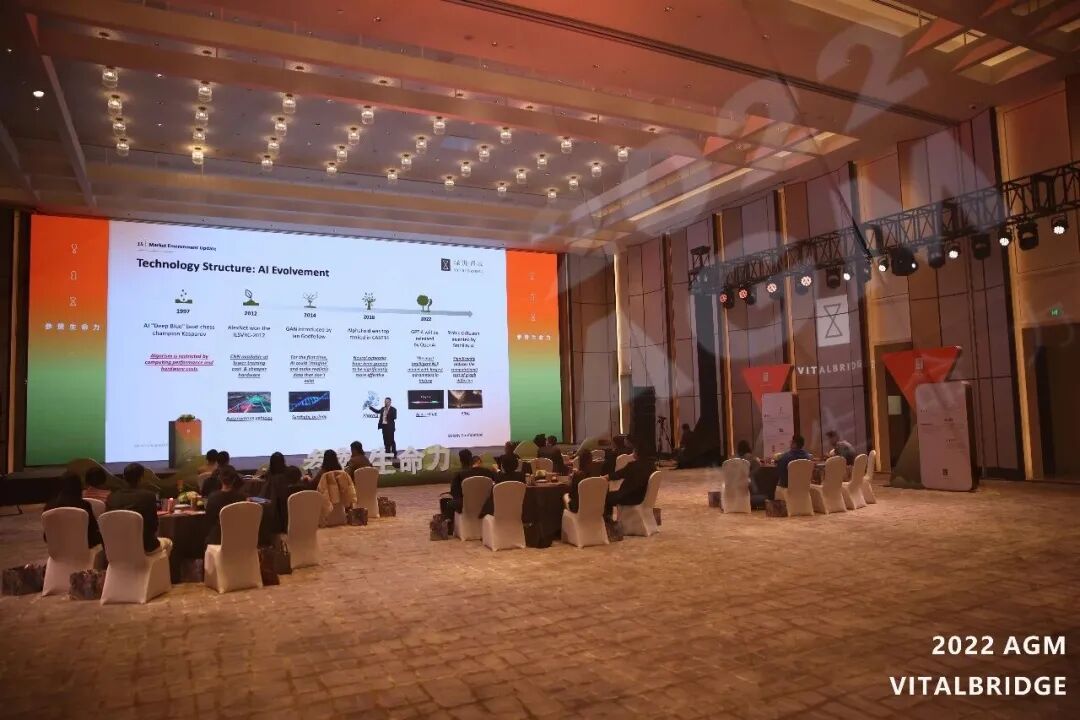
At Oasis Capital's 2022 AGM, Jinjian Zhang announces ALL IN AI
After locking in its AI theme in 2022, Oasis closed more than 10 investments in early 2023 — a period when, to put it bluntly, "Chinese AI" was basically a punchline. Everyone was still basking in the "GPT moment," and most believed domestic large models were merely "clumsy imitators." Before the DeepSeek moment, legions of observers were actively disproving the entire investment narrative. Even though Zhang had always been an optimist, for a considerable stretch he remained a "minority voice," where "conviction" seemed untimely. People praised him as "the most aggressive AI investor," though it was hard to say whether that was fundamentally different from "Don Quixote tilting at windmills."
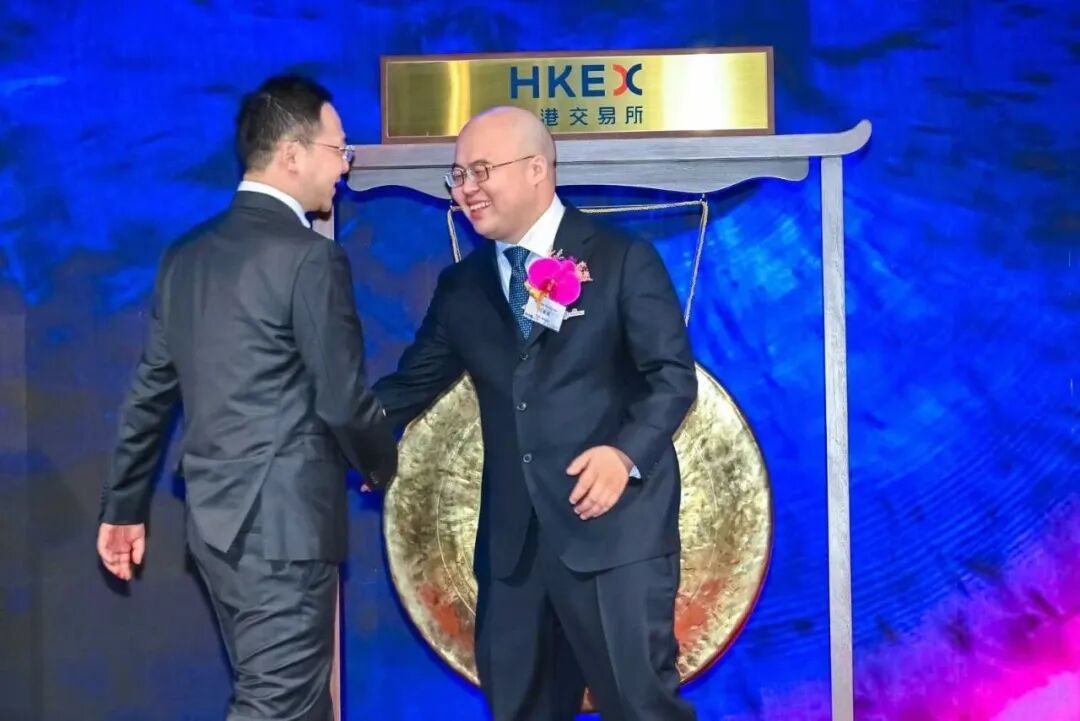
On January 9, 2026, Oasis Capital harvested its first AI IPO: MiniMax, the largest single investment in Oasis's new fund, officially listed on the Hong Kong Stock Exchange, surging 109% on its debut. On February 20, the first trading day of the Lunar Year of the Horse, MiniMax's market cap broke HK$300 billion, making it the fastest tech innovator to reach that milestone post-IPO.
In mid-January, Oasis angel-round company Spirit AI announced a SOTA global open-source model in embodied intelligence. Vast, LimX Dynamics, Hillbot, and Hypershell announced major funding rounds in quick succession. It appears that Oasis's post-2022 ALL IN strategy is demonstrating robust vitality.
This is the story of Oasis Capital. The story matters, of course — it offers a lens for understanding the current Chinese venture capital environment and the trajectory of China's AI industry. But what truly interests us are the questions they wrestled with during those uncertain times, what they let go of, and what they stubbornly believed in.
With these stories and questions in mind, I sat down with Jinjian Zhang for a 10,000-word conversation immediately after MiniMax's bell-ringing ceremony.
The following is an excerpt, compiled by ChinaVenture.

Of the Six Little Dragons, only Zhipu AI and MiniMax
were born before ChatGPT
ChinaVenture: Many people are curious about the story of Oasis Capital's investment in MiniMax. I believe you must have been deeply moved when recalling it, which is why you wrote that memoir-style essay Those Who Lived Through It. The article runs several thousand words, but three memories about Junjie Yan stand out most:
First, your very first meeting with Yan — the two of you excitedly chatting in a teahouse until midnight, your brain racing so fast you wanted to go home and rest, while he was still energized and ready to head back to the office — a moment so overwhelming you wanted to "kneel down and applaud." Second, after investing, you happened to mention how aggressively a competitor was coming at them, "great marketing, smooth fundraising," but Yan just kept eating and calmly replied, "I don't pay attention to that" — which suddenly made you understand what "focus" means.
The third memory feels like an "Easter egg." You asked Yan if he'd ever met anyone more focused than himself. Yan said he'd once arranged dinner with someone he'd never met. He arrived early and saw a guy in a T-shirt, instinctively assuming he was an assistant. The guy started asking him technical questions, and Yan thought, this assistant really knows his stuff. Half an hour in, Yan asked, "When is Mr. Liang arriving?" The guy said: "I am Liang Wenfeng."
These three stories are perfect for answering what kind of person Yan is. And what kind of people these exciting AI founders are.
Jinjian Zhang: Yes. I wrote that article on a plane.
ChinaVenture: The phrase "kneel down and applaud" really stuck with me. And I'll be a bit forward here — my first thought was the meme "If you get it, clap," and I subconsciously felt such phrasing carries a whiff of "strongman worship," as if in that moment you'd surrendered your critical thinking to emotion.
Jinjian Zhang: In all previous media narratives, investors are portrayed as omniscient predictors, like we're so fucking awesome, picking projects like choosing concubines — but that's not how it is. I believe founders and investors are equals, a mutual selection process, where we eventually cooperate and embrace each other. But in expression, I like to overcorrect, using one extreme to push back against another. Like how I never use photos of myself in suits, whether for awards or other occasions — I oppose "elitism."
ChinaVenture: That reminds me of your portrait on the Oasis Capital website. Most investor headshots project restraint, wisdom, rationality — but yours shows you laughing heartily.
Jinjian Zhang: Haha, when we decided to start Oasis, someone asked me what the first thing was. I said: photos! I spent a month finding a photographer, gave her three keywords: kindness, joy, vitality. She said she'd find the feeling. A month later, she said she was ready, and that's how that photo came about.
ChinaVenture: So I figure there must be other investment stories you haven't had time to write down yet.
Jinjian Zhang: When Stability open-sourced in October 2022, we immediately realized this would bring massive transformation — why? Because I believe all the greatest discoveries are essentially shifts in humanity's worldview. Like when Newton got hit by the apple, he couldn't directly calculate gravitational acceleration g=9.8, so to solve it he invented calculus. Compared to previous linear algebra, calculus was fundamentally a revolution in worldview.
Those formulas remembered by history aren't simple equations — they扭转了人类看待世界的方式. The industrial age relied more on statistics; later we embraced Bayesian probability, which acknowledges uncertainty in things. Now we see possibilities emerging from large models. Our era's core keyword has shifted from "induction" to "deduction" to today's "generation."
So what struck me most about Stability was that in image learning algorithms, it was the first to propose: the image itself has always existed, merely covered by noise. We don't need to actively seek the image, seek the signal — the only thing to do is remove the noise. This aligns perfectly with our worldview all along — remove noise, wait for signal, let vitality emerge naturally. Because vitality already exists; you simply need to return to it and flow with it.
After a friend pointed it out, seeing Stability made us realize this was a disruptive shift, and we began learning in reverse. Of course, we didn't immediately understand everything after GPT-3's release — we weren't that far-sighted. What we did was see this technology, look back at our past observations and research, and then dig deeper into the Transformer model.
The Transformer model is fascinating too. Attention mechanisms, gradient descent — these techniques existed in the scientific community over a decade ago. Self-Attention, unlike RNNs that process tokens sequentially and struggle with long-range dependencies, uses self-attention to weigh the importance of each token relative to others. This allows the model to dynamically focus on relevant parts of the input. Buddhism has a term, "awareness" (jué). Sometimes when you quiet your mind and observe yourself, you can judge whether something is right or wrong. So we believed this was a revolutionary change, and afterward we began focusing our research on it.
In November 2022, we clarified that our investment direction going forward would be AI, and we even shared this with our investors. We even predicted that GPT-4 would be released in December — it wasn't; what came out was GPT-3.5.
Of course, many investors were puzzled at the time: "Why suddenly invest in AI? We still haven't exited our 2015 investments." Honestly, some strategic choices can't be fully explained — that's probably what's difficult about investing, and also what makes it charming. I believed, I invested, the team believed.
Once we believed, we went to find others who believed too. We believed that the believers were already there waiting for us. Speaking of which, people now overlook a crucial point: among the AI Six Little Dragons, only Zhipu AI and MiniMax were founded before 2022. We believe this era rewards those who "truly believe." What does belief mean? It's daring to persist when everyone else is bearish — that's belief. Though these two companies received much support, the most critical factor is the timestamp — they were indeed founded before 2022. Based on that alone, they deserved support.
ChinaVenture: So before you met Junjie Yan, you had already met many AI entrepreneurs?
Jinjian Zhang: I met a lot at the time.
ChinaVenture: You encountered Junjie Yan only after having already met numerous star entrepreneurs, and you needed to "filter him out." This is actually something easy to be "careless" about, because Junjie Yan's profile could be described quite ordinarily — "big company departure entrepreneur."
Jinjian Zhang: Haha, that's your perspective. I focus on two points: First, I believe AI is an opportunity for young people. Oasis Capital has always had a principle: we don't invest in entrepreneurs born before 1980. The oldest founder we've invested in this wave is Will (Wei Zhang) of LimX Dynamics, born exactly in 1980. I've always believed that AI requires the drive and innovative power of young people. Oasis may also be the earliest Chinese institution to systematically invest in post-95 entrepreneurs — whether Simon (Vast), Gao Yang (Spirit AI), Renjie Guo (Lexiang), or Zonghuang Zhu (Inxbot). We've invested in a cohort of post-95 entrepreneurs. So in terms of selection, I lean toward younger entrepreneurs, and those fitting this core judgment were only Zhilin Yang and Junjie Yan.
Second, in entrepreneurship, technology is just one of many success factors. Like how many people now don't invest in scientists — the core reason is that scientists often treat technology as everything, but entrepreneurship actually requires multiple capabilities: technology, capital, organization, product, operations. I discovered an interesting phenomenon: founders from the SenseTime ecosystem generally value company operations more than other founders. Perhaps because SenseTime is an excellent technology company, those who came out of it — Junjie Yan, Hang Zhou, Yu Liu, and many other entrepreneurs — all particularly emphasize company operations.

The Future Is Multimodal
Large Language Models and Embodied Intelligence Converge
ChinaVenture: Your recollections remind me of Yuval Noah Harari's Sapiens. The book mentions that the reason Homo sapiens stood out among all human species was that it actually underwent three population revolutions. These three revolutions were the Cognitive Revolution, the Agricultural Revolution, and the Scientific Revolution. The Cognitive Revolution began 70,000 years ago, marked by humans beginning to believe in "fictional" things — our ability to tell stories about possibilities that hadn't actually happened, and choose to believe in them. It was based on this capacity that large-scale human cooperation became possible. Otherwise, limited by the human brain, we could remember at most 100 to 150 people, making larger organizations difficult to form.
That Oasis could firmly invest in AI before ChatGPT's release, and that Zhipu AI and MiniMax could choose large model entrepreneurship even earlier and earn trust, was actually supported by this kind of "fictional narrative."
But since it's "fictional," there will inevitably be controversy. Since you advance investments through "fictional" deduction, you necessarily encounter two problems: First, how do you persuade your colleagues to believe this "fictional" narrative? Second, you yourself don't have full confidence either. Like radar detecting stealth targets, you need feedback from entrepreneurs to verify whether your "fiction" is reliable. How did you verify this judgment from Junjie Yan?
Jinjian Zhang: These two questions are excellent. To the first — honestly, there's no way to make everyone believe.
ChinaVenture: Was it forced through?
Jinjian Zhang: At first, yes — pushing everyone to research and meet founders, and the founders would in turn influence the team. We're all pragmatic people; belief gradually iterates. The real challenge wasn't looking at AI — after all, that was already a media hotspot then. The real challenge was our March 2023 decision to elevate embodied intelligence to equal priority. Thus Oasis formed the theme for all subsequent projects: AI and embodied intelligence.
When we decided to believe in embodied intelligence, that term didn't even exist — we internally called it "humanoid robots." At the time, one colleague immediately proposed resigning on the spot, feeling that Oasis didn't trust him, that we were "banishing" him from the hot AI track to look at embodied intelligence. Haha, we communicated for a long time before he stayed, and now he definitely believes.
So in major industry waves, this kind of ideological conflict is very common. Of course, there's a lot of hindsight bias here. In a parallel world where the AI track failed, our persistence then would have been wrong. We can't guarantee our judgments are correct. We can only pragmatically say: the charm of VC is right here — seeking non-consensus, investing in awesome people, believing in the power of belief.
ChinaVenture: "Embodied intelligence" is a typical example. Before 2025, we usually viewed robotics and artificial intelligence as two "parallel" tracks, describing robots' future with Transformers, with focus on flexible materials and mechanical structures. After 2025, people began to realize that humanoid robots are actually a natural extension of large models, which made "embodied intelligence" a more mainstream term.
Jinjian Zhang: Yes. Because we believed in AI, we invested in large models; because we believed in AI, we also invested in embodied intelligence. In our view, embodied intelligence and large language models complement each other, both pointing toward AGI.
Because intelligence isn't acquired through pure learning — experience is also crucial. You can't learn to swim on shore, nor can you become an athlete just by being in water. Perception-action-feedback is a closed loop. Most of our life experiences aren't actually based on the mind, but on multiple senses. For example, the temperature of tea you feel — this concrete experience constitutes true intelligence. Human skin carries 90% of perceptual function; a 1-degree temperature rise feels sweltering, a 1-degree drop feels uncomfortable. Humans are actually quite fragile.
So we believe that to achieve AGI, we must break through multimodality. Here "modality" includes not only virtual modalities like video and voice, but also physical modalities like temperature, humidity, and touch — not just vision and hearing, but all sensory experiences together constitute another modality. These two modalities simply take different paths, ultimately both leading to AGI. AGI is necessarily an intelligence form spanning all modalities.
I studied signal processing. The essence of signal is frequency; different frequencies correspond to different wavelengths, corresponding to different information carriers. The frequencies we can perceive are actually extremely narrow within the entire spectrum. Take the eye: it can only see visible light, yet the visible light range is very narrow. X-rays, gamma rays, alpha rays — none can be directly perceived, but AI can. If AI can perceive information humans cannot access, its world will be completely different from ours, like the difference between a sighted person and a blind person. So AGI is necessarily multimodal — this is our core judgment.
This answers your second question. What most moved me about Junjie Yan at the time was that he believed in multimodality from the very beginning.
Also for this reason, starting from March 2023, we invested in both AI large models and embodied intelligence. For example, Spirit AI — this was the first embodied intelligence brain company we invested in. At that time, people's understanding of robots was still whether they could dance, whether they could walk. But we felt what truly mattered was comparison to humans. Humans have two nervous systems: one is the somatic nervous system controlling consciousness — what we call the brain. Here we invested in Spirit AI and Hillbot. The other is the autonomic nervous system controlling behavior — what we call the cerebellum, where we believe LimX Dynamics is the best. Then we discovered that embodied intelligence supply chains highly overlap with new energy vehicles, with one of the few important increments being integrated joints, so we invested in Inxbot, currently the largest domestic manufacturer. For these, we were basically first-round investors.
But we think it's only just begun. In embodied intelligence, we've seen a new direction: human augmentation. You can imagine one path augmenting machines, another augmenting humans. For example, HyperShell — we were the first dollar investor. Many people were questioning "what is an exoskeleton," but we saw their future possibilities. Also our recent investment in Taichu, understanding humans through EMG data — still very early, but we're optimistic. The two directions rise spirally, then combine with multimodal large models, ultimately both pointing to AGI.
ChinaVenture: Your story reminds me of Dr. Bicheng Han, founder of StrongBrain Technology. Why did he start a company? Back when he was interning at a research institute in the United States, he happened to discover that next door was Nobel Medicine laureate Linda Buck's laboratory. Her research direction was why humans can smell. It turned out that odor molecules change receptor protein structures, then send electrical signals to the brain.
Dr. Bicheng Han realized in that moment: if we could simulate that electrical signal, people could perceive the corresponding smell even without actual odor molecules. In that instant, he felt three things: first, neuroscience is fascinating; second, neuroscience isn't out of reach; third, the human brain processes far more information for decision-making than we imagine, and 99% of it happens passively.
Jinjian Zhang: Yes. What should the future look like? For instance, if someone sells you their NFT, you could own all their interactive experiences. That's inevitably going to happen. Because humans, as described in The Matrix, are essentially collecting data. And what's computers' biggest deficiency right now? True randomness. The random numbers in today's computers aren't autonomously generated by the machine—they're produced by motherboard sensors detecting temperature fluctuations.
So I believe this is how the era unfolds. The AI progress we're seeing now is just the beginning. MiniMax's achievements today are merely a small step toward AGI. We're honored to participate in this wave of history.

Investment Decisions Come in Only Two Types:
Heart-Fluttering and Heart-Settling
ChinaVenture: As I mentioned earlier, humans distinguished themselves from other Homo sapiens through the cognitive revolution—learning to create "fictions" based on facts and observation. What strikes me most about Oasis Capital's AI investment story is precisely this: your exceptional ability to make bold fictions, and your courage to let those fictions guide your actions, to invest in that possibility.
Perhaps it relates to the Sichuan upbringing—growing up with a love for bai longmen zhen (a Sichuan idiom for wildly imaginative conversation). Think about it: bai longmen zhen is fundamentally a kind of "fiction" and narrative, and AI happens to be the best vehicle for realizing such "longmen zhen."
Jinjian Zhang: Right. I think "Dao, longmen zhen, relaxation, courage, optimism" are all Sichuan spirit. But as the article wrote: the difference between fiction and vision lies in whether you dare to live it out. If we hadn't invested in MiniMax, hadn't invested in HyperShell, hadn't invested in Qianxun and LimX Dynamics—then our "fictions" would just be chong kezi (a Sichuan idiom for empty boasting).
ChinaVenture: Yes. Though vision and bragging are both "fictions" at their core, the critical distinction is how much your experience informs them. So I'm curious: in your process of investing in Junjie Yan, how much did past experience play a role? How much of what you saw in him came through rational analysis?
Jinjian Zhang: I think rational analysis probably accounted for just a small fraction.
ChinaVenture: Less than 50%?
Jinjian Zhang: Investing is fundamentally a foundation model at work. Everyone you've met, everything you've experienced—it all matters. It continuously trains your "investment large model." You've met many entrepreneurs; some you passed on who succeeded, some you backed who failed. It's like supervised fine-tuning (SFT), constantly optimizing your model.
When Junjie Yan appeared as this "prompt," my model output the "token" "Yes." How much does this "token" relate to past experience? You could say it does, or you could say it doesn't. But I lean toward: life is the convergence of all experiences. Who you are in this moment is the sum of all your past experiences. And in that instant of interacting with an entrepreneur, rationality might account for only 20%-30%; 70%-80% is the passive output of your "investment large model."
Just like our conversation today. Your summary of "Sichuan people's longmen zhen, fictionalism"—I'd never thought of it that way before, but it makes perfect sense. Did experience bring me this insight? Not entirely. It's meeting enough investors and entrepreneurs, combined with my own cognition, that produced this resonance in that moment. That's roughly how I see it.
ChinaVenture: A person is the sum of all their experiences; a person is also the sum of all their social relationships. These two sums combined determine your decision outcomes.
Jinjian Zhang: Right. The sum of all your experiences is equivalent to your "memory"; the sum of all your social relationships is equivalent to the contextual "context." Combine these two, and your decision "token" is essentially determined.
ChinaVenture: So returning to that teahouse where you made the final call to invest—the conversation must have been thoroughly enjoyable.
Jinjian Zhang: Enjoyable. I believe all good conversations are enjoyable.
ChinaVenture: Enjoyment comes in many forms. There's surprise, there's meeting expectations, and there's superficial pleasure that leaves you with nothing afterward. Which type was your chat with Junjie Yan?
Jinjian Zhang: I've thought about this. I believe all decisions fall into just two categories: heart-fluttering and heart-settling.
ChinaVenture: Which was Junjie Yan?
Jinjian Zhang: He was the "heart-settling" type. I believe the best opportunities in life are the ones that settle your heart. If an opportunity makes your heart flutter, you actually shouldn't invest. Because fluttering is a stimulus—it's the result of chemical reactions.
ChinaVenture: Specifically, during that teahouse conversation with Junjie Yan, what details made you feel settled?
Jinjian Zhang: It was the focus he demonstrated throughout. I kept trying to steer the conversation toward industry competition, because MiniMax was facing many competition-related issues at the time. You can imagine: they were dealing with so many difficulties then, yet Junjie Yan showed no complaints, no negative emotions. You could even say he simply didn't care about such trivial matters.
I believe the scariest thing in this world isn't being criticized or accused—it's being forgotten. When no one cares about you, no one mentions you, that's the worst. Junjie Yan was in exactly that situation at the time. But he never mentioned these difficulties at all. He only talked about what AGI looks like in his view, how far we are from AGI now, which technical paths are correct, and what needs to be done today.
ChinaVenture: Do you think he was pretending not to care, or genuinely didn't care?
Jinjian Zhang: I believe he genuinely didn't care.

The Most Precious Quality in Young Entrepreneurs
Is Courage That Hasn't Been Worn Away
ChinaVenture: Then let me press further. This quality of Junjie Yan's seems somewhat different from the "young person" traits you advocate? He's stubborn, focused on his own business, attentive to company operations—these details reveal a rather mature interior, even worn down of some youthful edge that young people should have. By contrast, at hackathons and AI Demo Days today, it's all post-95s and post-00s putting their headshots out there, boldly roasting, flaunting their individuality.
Jinjian Zhang: You've asked an excellent question. But we need to first clarify: what's the biggest difference between young people and the older generation? I believe it's that young people haven't had their courage worn away—they dare to believe in those "fictional" things.
When we're young, we dare to do anything—dare to pursue the class beauty, dare to say we'll become the richest person someday. But after a few years of work, no one dares say they'll become the richest person anymore; it feels too distant. And young people today increasingly dare not dream, because on platforms like Xiaohongshu and Kuaishou, they've seen what the richest person looks like, feel their family background could never reach that, and abandon their dreams early.
I believe the core trait of young people is daring to think, daring to act, daring to talk big. And what is the essence of this "wildness"? It's the courage and confidence to believe in fictional things—and Junjie Yan precisely has this trait.
ChinaVenture: Like you, daring to believe in the "fictional" vision you've constructed, and resolutely pursuing its realization?
Jinjian Zhang: Right. He dared to believe he could build a global company, dared to believe he could advance toward AGI, dared to believe he could enter the industry's first tier. At the time he might not have dared say he was the best, but he absolutely dared say he could make the first tier. Including later when we were dining together, he said "mountains can indeed be moved." This is what young people should look like—belief without frivolity.
ChinaVenture: I've attended many Demo Days. Many young people also dare to dream, but their "daring" stops at the level of "dreaming"—exhibiting some so-called, sensory "edgy vibe" and going no further. Junjie Yan's "daring" is built on systematic cognition. He's willing to think through problems that others see as having high barriers, too much sunk cost, and uncertain expected returns—that's why it appears "daring."
Like writing: if someone praises me for "daring to write, daring to speak," I'd feel what I wrote probably isn't very good, because anyone can talk tough, but saying things others can't observe—that's where real value lies.
Jinjian Zhang: I still believe what most people lack is "daring." Take our conversation today: if you input both our backgrounds into AI and have it generate interview questions, I'm sure it would produce many good ones. But whether a person dares to be themselves, dares to stick to their own judgment—that's the core of whether readers will be moved by this dialogue.
I believe ideas will become increasingly less scarce, especially in the AI era. And the ultimate standard of "daring" is whether you truly put it into action. Many young entrepreneurs only mouth grand narratives, but when it comes to actual execution and resource allocation, they shrink back. If you dare to do the most awesome thing, you dare to raise the most money, hire the best people, bet on the biggest direction. But many hesitate and tremble at actual decision points—just like many investors who talk a lot about AI but can't make decisive calls when they actually meet founders.
"Daring" isn't a slogan. It's precisely rational decision-making and resolute execution after long-term practice.

What They Represent
Is "China Innovation, Going Global"
ChinaVenture: After Oasis Capital's investment, at what moment was MiniMax's "courage" validated? And at what stage did it test your own nerve?
Jinjian Zhang: I think it was MoE (Mixture of Experts). MiniMax was the first team in Asia to actually put MoE into production. When MoE first emerged, there was huge controversy in the industry. Many people questioned: MoE involves multiple models calling each other, activating different models for different scenarios — can that still be called a large model? Wouldn't that be a step backward? The mainstream industry view at the time didn't accept MoE. But Junjie Yan insisted, "We're going to be the first team in Asia to use MoE," and in the end they actually did it, and succeeded.
I still remember how many shareholders questioned this direction at shareholder meetings, thinking it might be the wrong choice. But the facts proved he was right.
Another example is data. Some competitors emphasized "we need to scale up user acquisition to get more data, then use that data to train better models, creating a closed loop." But Junjie Yan's view was the complete opposite. He said, "Most data is useless. Only the most extreme data has value — everything else is garbage data." So the reason their product was so good back then was because they really hired many professional people to do data labeling — only people with real "taste" could produce better results.
He had many such contrarian views. At the time they sounded counterintuitive, but in retrospect they were all correct. For a large company to bet on such innovation carries enormous risk, because many investors don't understand it and are easily swayed by industry consensus. You could say that in the capital markets, MiniMax was never really the hottest large-model unicorn before its IPO.
ChinaVenture: Have you ever seen him discouraged? When I was writing The History of Venture Capital, it mentioned that when Yiming Zhang was fundraising, nobody believed his story before the Series C. He failed at seven or eight roadshows a day and could only call his investor Wang Qiong to vent — he couldn't tell his family, afraid of worrying them; couldn't tell his colleagues, afraid of affecting team morale. The investor became his best confidant.
Has Junjie Yan ever had moments like that?
Jinjian Zhang: Rarely. I think his emotional management is very strong. Let me tell you another story: There was a period when fundraising was especially difficult. An overseas investor wanted to put in a large sum. The online communication went very smoothly — the other side said, "Come over here and we'll finalize things." This money was very important for MiniMax at the time, because this investor had the capacity for follow-on funding. Junjie Yan and I discussed late into that night, talked for two or three hours, and finally decided, "Let's go." But after three days of thinking, Junjie Yan messaged me:
"I've decided not to go... We represent 'China Innovation, Going Global.' I feel this isn't right."
ChinaVenture: Later events proved this decision was incredibly wise.
Jinjian Zhang: Right, so I was quite moved, because I actually thought he could go — the other party was probably just a financial investor, not that sensitive. But after three days of careful deliberation, he still stuck to his principles. Only at that moment did I understand what conviction means — conviction is knowing who you are, doing what you should do, and not doing what you shouldn't do. Looking back today, I'm incredibly grateful he made that decision. If it were me, I probably couldn't have done it.

Nobody at the Celebration Talked About the Past
Everyone Was Thinking About the Future
ChinaVenture: After MiniMax rang the bell for its IPO, did you all have a dinner together?
Jinjian Zhang: We did.
ChinaVenture: I'm curious — at this celebration dinner, as participants in the entire entrepreneurial journey, what scenes did you all talk about together?
Jinjian Zhang: It seems like nothing special — we didn't specifically talk about the past of investing in MiniMax.
ChinaVenture: That can't be right. Usually at occasions like this people talk about these things.
Jinjian Zhang: Really, we didn't. That evening's dinner had several special characteristics: First, I've attended many IPO dinners, and they're all like weddings with assigned tables — Table 1, Table 2... fifty-plus tables, everyone has a fixed seat number. But MiniMax's IPO dinner had no table assignments. They just put out four or five long tables. Everyone wore a wristband to get in and sat wherever they wanted.
ChinaVenture: Like a buffet reception, where you can move around freely and chat.
Jinjian Zhang: Right. Originally there was also a lawn area outside where Junjie Yan prepared to speak, but it was too cold outside and everyone was hungry, so everyone decided to go in and eat first, then talk after. We ate for over an hour, and when we were almost done, Junjie Yan finally said a few words indoors. After he finished, someone said, "Let's go outside to exchange gifts and give acceptance speeches." We walked to the door and found it was still very cold outside, so we said, "Forget it, it's too cold outside, let's just chat here."
At that moment there were only five or six long tables in the venue, the space up front was a bit cramped, but everyone just chatted freely there. This really represents the state of a new generation of founders — very flat, no hierarchy, no unnecessary formalities.
ChinaVenture: More like attending a friend's party, congratulating a friend on accomplishing something big.
Jinjian Zhang: Yes, I've never attended an IPO dinner like this. At the traditional assigned-table dinners, the people at Table 1 would talk about "how I saw his potential back then, how I supported him," Table 2 would talk about "how I managed to invest" — each table had its fixed topic. But MiniMax's dinner had no table assignments. Everyone sat freely like friends, and what they talked about was "what else can we help him with in the next stage." What you asked about — "recalling the investment past" — we really didn't talk about it.
We were even connecting with projects on site. Someone said, "Congratulations on investing in MiniMax, what other good projects have you invested in?" Others talked about "what's your layout in embodied intelligence?" People started connecting resources and exploring cooperation right there on the spot.
ChinaVenture: This is actually the best state for investors — not wallowing in past success, but using past success to open doors for future collaboration.
Jinjian Zhang: Yes. That evening several of us investors kept talking about what projects we'd invested in this year and what we planned to invest in next.
ChinaVenture: And the way you describe it further strengthens my confidence in 2026 — this is bull market behavior. Only in a bull market do people think "what's next." If it were the industry downturn of the past two years, people would only talk about stories from the past, reminisce about former successes, and encourage each other by saying "let's just survive the future." But now everyone talks about the future as soon as they meet — this is a very obvious bull market signal.

Focus, Focus, and More Focus
ChinaVenture: Let's talk about the future. You just mentioned many special qualities of Junjie Yan. Do you think he has influenced Oasis Capital's investment logic?
Jinjian Zhang: The biggest lesson MiniMax taught us is "the power of focus."
ChinaVenture: There's a saying in the industry now that "among the unicorns that came out of the SenseTime ecosystem, Junjie Yan is impossible to replicate." After having invested in such a "top-tier target," do you feel it will be hard to find entrepreneurs like him in the future?
Jinjian Zhang: No. My feeling is that this era is giving faster and faster feedback to "focused people," so we're even more confident now — boldly support those who dare to believe and focus on their convictions, and they will definitely grow. Junjie Yan's achievements today didn't happen overnight. He wasn't like this six years ago, five years ago. Including Spirit AI — when they first started fundraising, it was extremely difficult to even move forward at a 300 million RMB valuation. Now their valuation is 8 billion, and they're developing very well.
Many things are dynamically changing, but what doesn't change is "focus and belief." Courage, focus, belief — among these three traits, courage is the most important, because only with courage do you dare to believe. The prerequisite for "living it out" is "daring to step out." To make it in this world, you first have to "step out." Courage is the starting point of everything.
But behind these words are thousands of experiments and reflections, tempered through countless trials. These words are an abstract summary of the continuous development of human intelligence.
ChinaVenture: Do you think Junjie Yan's story can be replicated?
Jinjian Zhang: I believe there are many such stories in China waiting to be discovered. Junjie Yan is just the beginning. suho, Kuan Sun — they're all such stories. Kuan Sun wanted to build exoskeletons for ten years. For this goal, he specifically went to the UK to study exoskeleton-related subjects and quit his previous job. He discovered that exoskeleton core technology is related to human kinematics, so he specifically studied knowledge in this field, then came back to start his business. You think someone like that isn't focused enough?
suho was Fei-Fei Li's top student, a core contributor to ImageNet, but later felt there might be another path to AGI, so he went to get another PhD — only then did he found his own company. I believe there are many such entrepreneurs in China, waiting for us to discover together.

The Best State for VC
Is Meeting More Vital Entrepreneurs Every Day
ChinaVenture: But there's also a practical problem: by doing subtraction, you've stripped away what you were originally good at, and you've also removed the most traceable, easiest-to-find-reference narratives in the venture capital industry — from the very start you've forced yourself onto a "risky path." This inevitably makes people curious: what was the strongest impulse that made you choose to leave your original institution and start your own fund?
Jinjian Zhang: The biggest trigger at the time came from miHoYo. We were in classes together back then, before Genshin Impact had launched, and we met every week to exchange ideas. I found that our topics were still "how much money the company made when it went public," but the miHoYo team was already thinking about problems like "after the Genshin Impact demo came out and people criticized it for 'copying Zelda,' how do we do global innovation?"
Actually, a company's value depends on what problem it's solving. Solve the problem of information access, and you get Google. Solve the problem of human connection, and you get Meta.
I think these people are truly remarkable. In 2018, they were already thinking about how to go global and solve more important problems.
ChinaVenture: As we wrote in the preface to the VC 2.0 chapter of The History of Venture Capital in China, the VCs who chose to start their own firms in those years were all stuck on a three-word question: "Who am I?"
Jinjian Zhang: Yes. So at the time we put forward the concept of "participating in and enhancing vitality" — the essence of entrepreneurship isn't resources or connections, but returning to life itself, living in the state that life ought to be. That's what we mean by "participating in and enhancing vitality." The concept of "participating in and enhancing" carries a sense of surrender and alignment — you have to surrender to vitality in order to align with it.
Each of us is a vessel of our own vitality, living it out in our own way. The most compelling part of being a VC is getting to meet entrepreneurs with greater vitality every day, resonating with people who are truly alive, participating in and enhancing that vitality.

What's the biggest lesson in filtering entrepreneurs?
ChinaVenture: Have there been lessons along the way? Your initial investment thesis must have gone through trial and error and adjustment. Was there one particularly big lesson that caused Oasis Capital to revise its investment methodology?
Jinjian Zhang: The biggest lesson is that the AI era demands even higher "focus" from entrepreneurs — they have to keep solving one real core problem. For example, we've invested in some entrepreneurs who were very well-resourced and capable, among the earliest to do things with AI. At first they were solving Problem A, then someone said "Problem B also has demand," so they went to solve Problem B, then later Problem C, wielding "AI" as a hammer and looking for nails everywhere. They could make a bit of money in each direction, but in the end they missed the explosive growth that comes from solving the core problem.
ChinaVenture: This is actually the "curse of the pioneer" — your capabilities and resources are strong enough that you no longer have a clear upward path, because you don't need to try very hard to get positive feedback, and opportunities are no longer a "scarce resource." Before you know it, you've scattered your energy.
Jinjian Zhang: Right, many pioneers encounter this problem. When you have abundant resources and capabilities, you have many choices, but this is precisely when focus matters more — it's the dividing line between good and excellent. When there are many resources and many opportunities, can you keep focusing on one core problem?
For example, embodied intelligence and AI — in our big narrative, they're both important paths toward AGI, and MiniMax represents the large model direction. We started investing in embodied intelligence in 2023, and over these three years we haven't chased hot sectors, but have stayed focused on deepening our presence in this field, building networks, and cultivating relationships with scientists. Gradually more and more people have actively sought us out to be their first investor. That's actually because our sustained focus in this industry makes them feel "Oasis Capital truly understands this sector and believes in these people."
ChinaVenture: But here's a practical problem. The entrepreneurs you just described — "solving Problem A, then going to solve Problem B" — we could describe them as "deal-assemblers." They have strong deal-assembly abilities, lots of resources in the industry, and launching a new project means mobilizing their own resources and assembling a team to fit new demands. And in the embodied intelligence field specifically, there are especially many such deal-assemblers.
Moreover, in the embodied intelligence industry specifically, deal-assembly itself isn't wrong — it's even an advantage. The reason embodied intelligence has developed so well in China is precisely because it requires integrating resources from the automotive supply chain: body joints, batteries, engines, materials, and so on. This demands people who are very familiar with automotive supply chains to assemble resources from model development, commercial deployment, government relations, and other parties. This itself has value.
Jinjian Zhang: The problem you're describing is something we reflected on for the entire past year. There were many obviously "deal-assembly" projects that invited us to co-invest, with valuations rising dramatically in the middle — very tempting. But in the end we didn't invest.
The reason we didn't invest is that this type of "resource-driven" entrepreneur is a completely different category from the "vision-driven" entrepreneurs we prefer. In China, both types of entrepreneurs have soil to grow in and can achieve decent investment returns. But we have to make trade-offs — we chose "vision-driven." When you've made that choice many times, it becomes hard to appreciate the value of the other type. Judging whether a "deal-assembler entrepreneur" can succeed has its own criteria, completely different from judging "vision-driven" entrepreneurs. A fund can hardly use two sets of criteria to invest.
ChinaVenture: The key thing is that this seems to make Oasis's selection range in the embodied intelligence field very limited — entrepreneur screening becomes harder.
Jinjian Zhang: That's why a fund needs to be disciplined, long-term, and focused.
As long as we meet the right entrepreneurs, we'll firmly believe in them and invest in them. It's not that everyone we didn't invest in is a "deal-assembler" — we just have limited ability and have only discovered a portion of people. There are many more excellent entrepreneurs that need everyone to discover together. This year the Hong Kong market is very strong; this is a beginning, China's Nasdaq. We look forward to more globally innovative and vision-driven companies being discovered.

Where life is lived out, that is Oasis
ChinaVenture: One last question — Oasis has always emphasized the concept of "signal and noise," believing that the core of investing isn't "discovering hot spots" but "removing noise." So now it's 2026. What "noise" are you most wary of lately?
Jinjian Zhang: Right now the most noise is coming from the consumer electronics space. The hottest direction in the market is "everything is AI, AI is all hardware." I think there's an enormous amount of noise in this. As more and more funds pile in, many projects' valuations have been inflated to unsustainable levels, but very few have genuine core value. I think the real signal is still those projects that focus on solving long-term core problems — that's what matters most.
ChinaVenture: When you first started your firm, you described yourself as a radar. You believed that when learning something new, if it becomes increasingly difficult and increasingly granular, that probably means you've become surrounded by noise. Conversely, when the more you learn, the simpler it becomes, and the more commonalities you see — that's when you've found the real signal.
This thinking first appeared back in 2018. It's now been seven years, a full fund cycle. Has your methodology changed?
Jinjian Zhang: No change — exactly the same as before, just more practiced. The core logic is "remove noise, wait for the signal to emerge on its own, be with the right people, and wait quietly for the flowers to bloom." AGI is the most important core problem of this era. Many people are working on solving it, and we invest in those who focus on believing in this problem and are committed to solving it.
ChinaVenture: What is the long-term signal of AI for entrepreneurs?
Jinjian Zhang: AI is not a technological transformation. AI is a social transformation. In the next 15-20 years, we'll have to traverse the history that the Industrial Revolution took 150-200 years to cover. The core problem in this is the question of agency. One aspect is the construction of AI's agency — including intelligence, embodiment, and infrastructure — helping AI coexist with humans in the physical world. This is the major trend, the main thread. The other is the construction of our own human agency: Who are we? Where are we? What is our relationship with society and with others? This is the problem we ourselves need to solve.
In the past, our agency often came from parental approval, teacher approval, or external validation. Going forward, we need to seek our own self-approval more. So what is the self? How do we approve of ourselves? How do we live out ourselves? This is another major trend, another main thread.
We believe opportunities all derive from these two main threads.
For Problem One, Oasis's strategy is to continue investing in AI and embodied intelligence — we believe it's just beginning. At the same time, we'll pay attention to some frontier sciences, because certain disciplines will undergo enormous changes due to AI breakthroughs.
For Problem Two, Oasis's strategy is "participating in and enhancing vitality." We do podcasts, we publish books — actually, we want to help more people realize that the big shots are all ordinary people. So-called professionals and successful people are all ordinary people. They're just as confused, just at a loss, as we are. They're not "other people's children."
If there's any difference, it's their belief, courage, and focus. They lived out themselves. They turned illusion into vision. This process of living out the vision is participating in and enhancing vitality.
This is also the meaning of Oasis.
Accompanying more entrepreneurs to live out their vision, inspiring more people to live out themselves.
Those places where life is lived out — that is Oasis.