Jinjian Zhang: A Brief Discussion on Research

*Signal and Noise* Series 1

Abstract:
"Research" is a concept most people invoke in daily conversation, and the "core" competitive advantage of countless funds. Yet most funds lack analysts with genuine research capabilities; even among the exceptional ones, there are rarely more than three such people. On one hand, China's private equity market has grown so rapidly that systematic research methodologies remain underdeveloped. On the other, historically weak asset liquidity meant institutions could rely on direct judgment—analysts needed to discover assets rather than assess their value. As asset and information liquidity improve, the ability to discover assets is no longer scarce, and institutions can no longer process information at sufficient scale. A fund's core competitive advantage shifts from asset discovery to asset pricing. The future battle between funds will be a battle of information filtering and processing capabilities—the prerequisite for consistently correct asset pricing. Thus, the selection and cultivation of analysts becomes one of a fund's core competitive advantages.
Since entering this profession, I've been deeply influenced by Shujun's work in the social sciences. Combined with my seven years of training in signals and systems, I've found a "research methodology under information constraints" that has yielded some positive feedback. Drawing on years of scientific research methodology as a foundation, combined with the particularities of investment research, I want to address three questions:
- Where do the problems lie in currently prevalent research methodologies?
- What is the core positioning of analyst research within fund investing?
- How should a research system be built, and what natural science methodologies can we borrow from?
Preface: There is a vast chasm between natural and social sciences. For instance, spatial discontinuity in natural sciences has no obvious counterpart in social sciences. Yet social sciences are in fact the concrete manifestation of natural sciences. The modes of thinking in natural sciences have long guided research and revolution in social sciences. Natural sciences encountered the wave-particle duality of light at the frontier of theoretical and quantum physics; social sciences encountered "if you see all forms as non-forms, then you see the Tathagata" in Śākyamuni's Diamond Sutra. In recent years, with breakthroughs in fundamental research and theoretical physics—particularly the proposal and popularization of string theory—the abstract representations of social sciences have gradually converged with those of natural sciences.
Investment, as the discipline in social sciences most relevant to each of us, has research as a crucial component. Research capability has become a core competitive advantage for major funds. Yet research capability, as prior knowledge in investment decision-making, is abused as posterior knowledge by numerous funds. Many funds treat research as a necessary rather than sufficient condition, using results to construct logic rather than tracing causes. They extensively employ "analogy" and "induction," leading to numerous commonsensical errors that are "logically correct but result in wrong conclusions."
Given this, as the first piece in the "Research Methodology" series, this article aims to use knowledge from signal processing in natural sciences as a foundation to analyze the essential nature of "research."
I. The Definition of Research
Wiktionary defines Research as follows:
Research comprises "creative and systematic work undertaken to increase the stock of knowledge, including knowledge of humans, culture and society, and the use of this stock of knowledge to devise new applications." It is used to establish or confirm facts, reaffirm the results of previous work, solve new or existing problems, support theorems, or develop new theories.
From this definition, we can see that "research" is a "creative, systematic process of value accretion." The "accretion" manifests in confirming facts and eliminating false results.
In the history of scientific research, two important theorists stand out: Karl Popper and Thomas Kuhn. Popper noted: "What makes a theory scientific is that it can be falsified, not verified." In The Structure of Scientific Revolutions, Kuhn argued that scientific revolution depends on paradigm shifts. A paradigm is a particular way of understanding the world.
Thus, we can simply summarize the essence of research as "an active, systematic paradigm for eliminating the false and preserving the true."
II. The Positioning of Research in Investing
So how do we achieve "active, systematic elimination of the false and preservation of the true" in the investment process?
The investment process is an information game in social sciences. Abstract information can be represented as fundamental business conditions, founder backgrounds; concrete information can be represented as resource endowments, capital scale, and so on. The investment decision process is essentially an information processing procedure. In signal processing, this can be roughly simplified into the following model:

Applied to the investment decision process, this can be simplified to the following model:

In an investment institution's information processing, project information enters as input to the investment committee, which serves as the fund's "processing system," outputting a signal: invest or reject.
The premise of the investment committee's decision is the authenticity of the input signal. In other words, the committee assumes all information is true, with no noise from conflicts of interest or cognitive limitations. However, since the committee outputs a binary result, this system is in fact extremely sensitive—minute information changes can directly affect the output. The signal-to-noise ratio becomes a critical metric. To further improve output, the information system adds a filter at the input stage to remove noise and preserve signal. The model can be further optimized as follows:

In actual signal processing, signals pass through Fourier transformation from time-domain information to frequency-domain information, then through filters to remove noise, as shown:
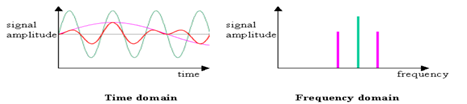
The left figure shows time-domain information: green is the signal, pink is noise, and their superposition forms the observed red information. If we directly input the red information into the system, the system may produce erroneous judgments because the information contains substantial noise. Particularly after the blue dividing line, the red information deviates directionally from the green signal, severely interfering with the processing system.
Therefore, in science, time-domain information is transformed via Fourier transform into frequency-domain information (right figure). We can see that the inseparable time-domain information becomes pulse signals in the frequency domain. Furthermore, we can use filters to separate out the green signal, then restore it to the time domain to preserve the complete signal.
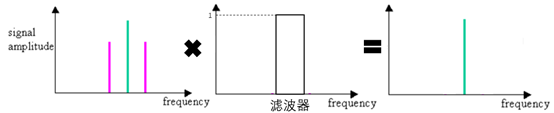
The development of signals and systems is not merely the development of information processing methods, but more importantly the development of filters—particularly digital signal transmission methods, which dramatically improve filter efficiency and thus the signal-to-noise ratio.
Returning to the investment information processing model, funds add investment manager/analyst roles before the investment committee to handle information processing. Essentially, the analyst serves as the filter:

Given this, the analyst's role may seem peripheral—anyone can do research—but in fact the analyst's function is crucial to the entire system. I just demonstrated the correct filter usage; if the filter is slightly misaligned, it may filter out the signal and leave only noise, as shown below:
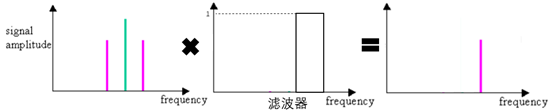
Therefore, in signal processing, filter usage is an extremely important step. Thus from Karamay in the north to the Xisha Islands in the south, regardless of radar configuration or purpose, filters and core algorithm processing are standardized and centralized. An unverified filter is a disaster for the system, severely affecting its output.
Returning to investment decisions, if analysts lack systematic training, they will supply substantial noise to investment decisions, or even filter out signals. Because everyone's background differs—like occupying different positions in the frequency domain, some high-frequency, some low-frequency, some all-pass—there is no better or worse, only different use cases. Specifically, some people familiar with urban life more easily capture aesthetic demands in consumption upgrades; some familiar with rural life more easily capture the emotional expression of small-town youth. No better or worse, just characteristics.
Particularly as the processing system ages and distances itself further from original information, the analyst's role becomes even more important.
However, every analyst must understand their own characteristics, just as a filter must understand its use case. If you use a high-pass filter on a low-pass signal, crisis ensues—and in the end you think it's a decision-making problem when it's actually a signal mismatch.
So every analyst needs a clear understanding of their important positioning within the system, and continuous self-awareness of their research characteristics and methods.
III. The Basic Steps for Analysts
An analyst's research growth path resembles the tuning process of a filter. This is because analyst cultivation is a systematic gradual awakening, not an instantaneous enlightenment. We can roughly divide it into the following steps: establishing feedback mechanisms, setting baseline parameters, and stability testing.
3.1 Establishing System-Level Feedback Mechanisms
In signal processing, we first need to understand what filter to use (low-pass, band-pass, high-pass), then select the appropriate one. So every filter has its own characteristics and needs to find applicable scenarios.
As an analyst, one must understand one's personality traits and thinking methods. Such characteristics can be summarized as follows:
- What time scale of information is the analyst sensitive to (short-term, medium-term, long-term)
- What demographics does the analyst understand better (rural, second- and third-tier cities, megacities, second-generation wealthy)
- What types of changes is the analyst more attuned to (emotional changes, detail changes, macro changes)
With these three questions answered, the analyst can understand their own characteristics and conduct research in their areas of strength. In the research process, feedback mechanisms must be established. The purpose of feedback mechanisms is to help analysts better understand their own characteristics. Research without feedback mechanisms is like an unverified filter—you can see the information output but cannot confirm whether it's signal or noise. This feedback mechanism is essentially training the analyst's filtering results by backtracking from already verified outcomes. So in the first stage, analyst research should focus on areas where the system can provide feedback.
In the system process, how do we provide feedback?
Buddhism speaks of "formation, existence, decay, and emptiness"; the second law of thermodynamics tells us the world is entropy-increasing and ultimately headed toward destruction. Therefore, any organization, however great, eventually converges on death. The only organizations that have endured for millennia are religions—and even then, Catholicism experienced the Protestant Reformation, and Zen Buddhism branched into five schools.
Thus, investment feedback is discussion within a certain time cycle; it cannot be indefinitely extended. Infinite discussion is a false proposition. Just as when we say someone is in good health, we can only say they're healthy at this age, not for their entire lifetime, because they will eventually die.
Yet talking about death is easy; talking about life is hard. Exposing enterprise risk is easy; pricing risk is hard. Analysts easily fall into criticizing companies—criticizing the currently unsuccessful, questioning the currently successful. Therefore, as analysts, grandly discussing future death is meaningless; we need to discuss vitality. Where are the opportunities, how is risk priced, in a certain cycle which enterprises survive and why. What are the reasons for enterprises that have already died, and what can be learned.
This way, analysts can learn when enterprises are alive and when they die. Only predicting an enterprise's death while it is alive is not instructive.
Meituan and Xiaomi's stock prices have fluctuated considerably recently, but this doesn't affect that they are both great companies and organizations, doesn't affect their role in the era. Even if short-term returns change, as long as they're profitable relative to initial investment, they should be studied and contemplated.
3.2 Setting Baseline Parameters
After understanding one's own characteristics, the second stage is setting baseline parameters. The analyst establishes basic direction, logic, and research domains according to their characteristics—like the basic configuration of a filter.
3.3 Stability Testing
For every analyst, the system needs to periodically test their stability. Because people's backgrounds and experiences constantly change, they may become numb to things they were once sensitive to, or sensitive to things they were once numb to. At this point, the analyst's personal characteristics begin to shift—like a high-pass filter migrating toward low frequencies—and we need to detect and adjust this early.

Oasis Capital is a new-generation venture capital institution in China, dedicated to discovering the most vital entrepreneurs of the next decade and growing alongside them to create long-term value. "Participating in and enhancing vitality" is Oasis's vision and mission. This vitality is both the direction of structural transformation of the era and the resilience and evolutionary power of entrepreneurs. Oasis Capital focuses on early and growth-stage investments, with individual investments ranging from $3 million to $30 million, concentrating on technology-enabled services in education, healthcare, enterprise services, and other sectors, empowering China's new service upgrade driven by technology.