Li Ming, Shouhoubao: Intelligent Customer Service Helps Businesses Win in the AI Era | Oasis Capital Vitality

Counselor Vitality

On August 8, the 2024 China Digital Service Industry East China Summit was held in Hangzhou, themed "Digital Service Upgrades and Service Innovation Driven by Large Models." Li Ming, founder and CEO of Shouhoubao, was invited to attend and delivered a keynote speech titled "Intelligent Customer Service: Helping Enterprises Win in the AI Era."
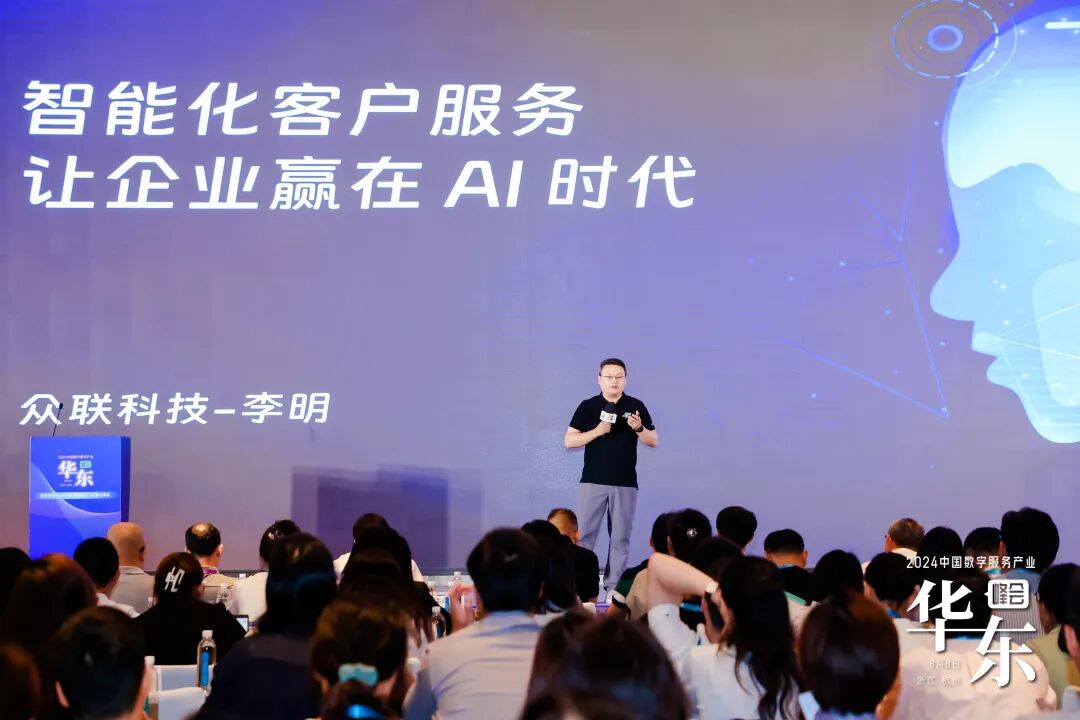
From phone calls, email, and voice to today's AI era, the scenarios and battlegrounds of customer service keep shifting. Lately there's been a lot of chatter that AI will eventually handle all customer service. I don't think that's going to happen. When new technology emerges, everyone desperately wants it to solve every problem at once — preferably at zero cost. That's a major misconception. Even the most advanced technology requires us to have a clear understanding of the problem before we can solve it. The stronger your ability to leverage and build with new technology, the more problems you can solve.
Over a year of co-creation with customers, we've developed four insights on "customer service + AI"
-
Relationship: AI isn't here to eliminate anyone, but it will reduce opportunities for work that lacks distinctive value.
-
Value: Using AI for innovation isn't value in itself — value comes from efficiency gains when you actually put it to work.
-
Technology: What determines our success isn't the capability of public-domain models, but our ability to apply them.
-
Approach: Don't go for everything at once or wait indefinitely. Progressively deploy AI scenario by scenario.
Three methods for enterprises to introduce AI into customer service
Where: Finding opportunities across all scenarios
In the past, when building products, we aimed for something universal. But after a year of AI practice, we've realized that AI must solve problems with relative depth. So in our work we've mapped customer service scenarios into five major domains — customer connection, customer experience, business processes, service operations, and integrated collaboration — encompassing over 40 business scenarios. Some enterprises might start with customer connection, others with process optimization. The key is identifying which points best fit your own practice within these business scenarios.
What: What AI can help enterprises improve
AI brings three core capabilities that previous digital technologies lacked:
First, AI Inside capability — the basic AIGC ability to understand and synthesize outputs.
Second, AI Copilot capability — the assistant function. It can play an assistant role in specific scenarios like customer service and knowledge bases, with the ability to connect and combine content across multiple applications and types. It can pull data not just from systems like Shouhoubao but also connect with other business applications, gathering data from multiple sources to better assist operations through Q&A and other interactions.
Third, AI Agent capability — when facing complex business situations, it can combine AI capabilities with business process operations to accomplish tasks. It's a "doer" that can encode the actions an excellent person would take when facing a problem into an intelligent agent. For example, when alert information appears in reports, AI can automatically summarize the data, create a task, assign it to the appropriate person, and conduct regular follow-ups.
How: What steps to take toward full-scenario intelligent customer service
We've matched business scenarios in the customer service domain with AI capabilities, including intelligent customer connection centers, intelligent process management centers, intelligent resource management centers, intelligent customer operation centers, and intelligent data BI centers. Dozens of applications are already available for rapid enterprise deployment — such as intelligent knowledge bases that support frontline staff in quickly resolving issues, intelligent personnel enablement that helps service professionals grow, content creation and automated outreach that assist proactive customer engagement, and goal-setting and reminders that track task execution.
Of course, achieving full-scenario intelligent customer service isn't accomplished by simply introducing an API or a tool. Enterprises need proprietary AI technology solutions that span from models to action, including perception systems, thinking systems, and action systems. Therefore, enterprise-grade AI construction, especially for customer service, requires "two multis and two specials."
-
Multi-model: Different models have different commercial strategies and capabilities, so the ability to integrate multiple models is essential — including both public and private models, with the flexibility to choose based on specific needs.
-
Multi-scenario: In customer service, it's difficult to create a single robot that meets all scenario requirements. Additionally, the more specific the problem and the narrower the scenario, the lower the chance of AI hallucinations. Our solution is to break it down into multiple scenarios, creating various robots for various applications.
-
Proprietary data: Enterprise knowledge bases, business data, forms, documents, and other proprietary data connected to our AI to rapidly achieve AI transformation.
-
Specialized configuration: This includes configuring robots, setting permissions, reviewing access logs, establishing keywords, and more. Specialized configuration serves as the master control for enterprises creating agents and setting rules — without this AI steward, it's difficult to meet enterprise needs. Some of this configuration requires technical staff, while other parts can be handled by business users. For instance, enterprises may have fixed response patterns similar to an internal encyclopedia; through Q&A management, they can prevent confusing or incorrect answers from proliferating across various materials.
Our intelligent customer service capabilities have already been deployed at many enterprises. For example, we built an end-to-end digital customer service system for BSH Home Appliances, using AI to reshape service processes including intelligent spare parts recommendations and intelligent customer tags. This helps service engineers prepare parts in advance and better understand customers' purchase history and repurchase behavior through customer tags, enabling targeted service marketing. CAS Micro Intelligent Logistics, a leader in smart logistics equipment, produces non-standard products that previously required complex engineer training. Now, through intelligent knowledge bases and intelligent Q&A, training costs are significantly reduced and work efficiency improved. Delixi Inverters primarily applies knowledge base and AI customer service capabilities — a very typical B2B scenario that effectively helps enterprises address high user inquiry volumes, heavy customer service department pressure, low response efficiency, as well as complex product information and high, lengthy personnel training costs.
As adopters of new technology or drivers of AI transformation, we must always maintain clear strategy — not innovating for new technology's sake, but using new technology to solve old problems. And technology alone cannot solve all business needs; the clearer the business strategy, the greater the effect AI can achieve. Going forward, we look forward to co-creating with more enterprises, deeply rooted in real scenarios.