MiniMax-01 Open Source: A New Architecture Opens the Agent Era | Oasis Vitality

Counselor Vitality

Since early 2023, we've believed that the core of this AI revolution lies in Agent ("The Most Aggressive AI Investor"); over the past two years, we've interviewed nearly a hundred professors and scholars researching Agent worldwide, sensing the living intelligence of Agent, which has only strengthened our conviction ("AI Agent: A New Form of Life").
Today, the official release and open-sourcing of MiniMax-01 makes that belief tangible. It breaks through the constraints of traditional architecture, pushing Agent cognition and capabilities to new heights with ultra-long context and innovative design. Just as vitality is the driving force behind all growth, the evolution of Agent will become the wellspring of social, technological, and creative advancement. We firmly believe that Agent, as the vessel of this new life form, will lead us into an era brimming with even greater vitality.
Enjoy.
MiniMax has released and open-sourced its all-new MiniMax-01 series, comprising two models: the foundational large language model MiniMax-Text-01 and the vision multimodal model MiniMax-VL-01. Paper link: https://filecdn.minimax.chat/_Arxiv_MiniMax_01_Report.pdf
A Brand-New Architecture, Performance on Par with GPT-4o
In the MiniMax-01 series, we've made bold innovations: for the first time at scale, we've implemented linear attention mechanisms — the traditional Transformer architecture is no longer the only option. The model packs 456 billion parameters, with 45.9 billion activated per forward pass. Its overall performance rivals top overseas models, while efficiently handling up to 4 million tokens of context — the longest globally, 32 times that of GPT-4o and 20 times that of Claude-3.5-Sonnet.
Ultra-Long Context, Ushering in the Agent Era
We believe 2025 will be a year of rapid Agent development. Whether it's single-Agent systems requiring persistent memory, or multi-Agent systems with massive inter-Agent communication, increasingly long context is essential. With this model, we've taken the first step, and hope to continue building the foundational capabilities required for complex Agents using this architecture.
Extreme Cost-Performance, Continuous Innovation
Thanks to architectural innovation, efficiency optimization, an integrated training-inference cluster design, and extensive internal concurrency and compute reuse, we're able to offer text and multimodal understanding APIs at the industry's lowest price range. Standard pricing is 1 RMB per million input tokens and 8 RMB per million output tokens. We welcome everyone to experience and use it on the MiniMax Open Platform.
MiniMax Open Platform: https://www.minimaxi.com/platform
MiniMax Open Platform (Global): https://www.minimaxi.com/en/platform
The MiniMax-01 series is open-sourced at https://github.com/MiniMax-AI, with ongoing updates to follow.
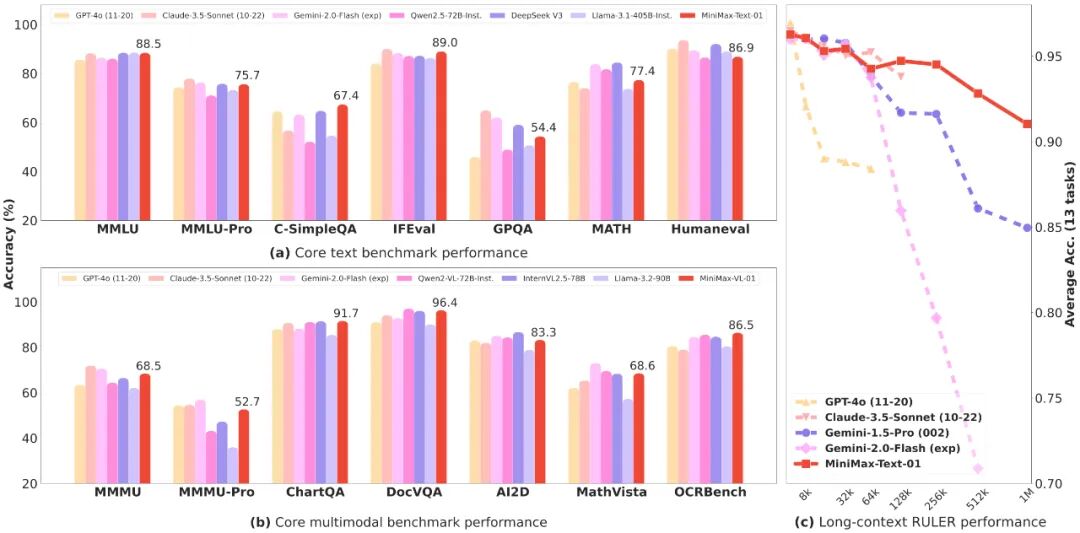
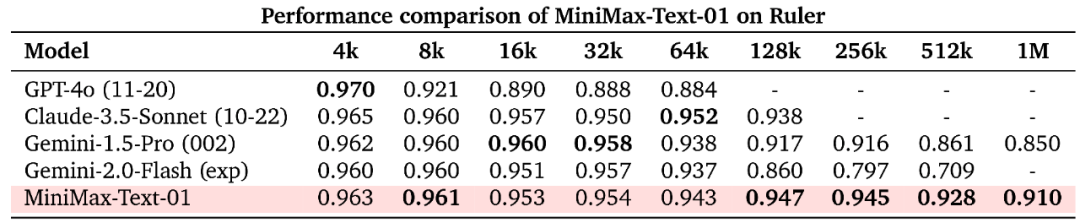
Based on mainstream industry benchmarks for text and multimodal understanding, our results are shown below. On most tasks, we've caught up to the two most advanced overseas models: GPT-4o-1120 and Claude-3.5-Sonnet-1022. On long-context tasks, we compared against Google's Gemini, previously the best long-context model. As shown in Figure (c), as input length increases, MiniMax-Text-01 exhibits the slowest performance degradation, significantly outperforming Google Gemini.
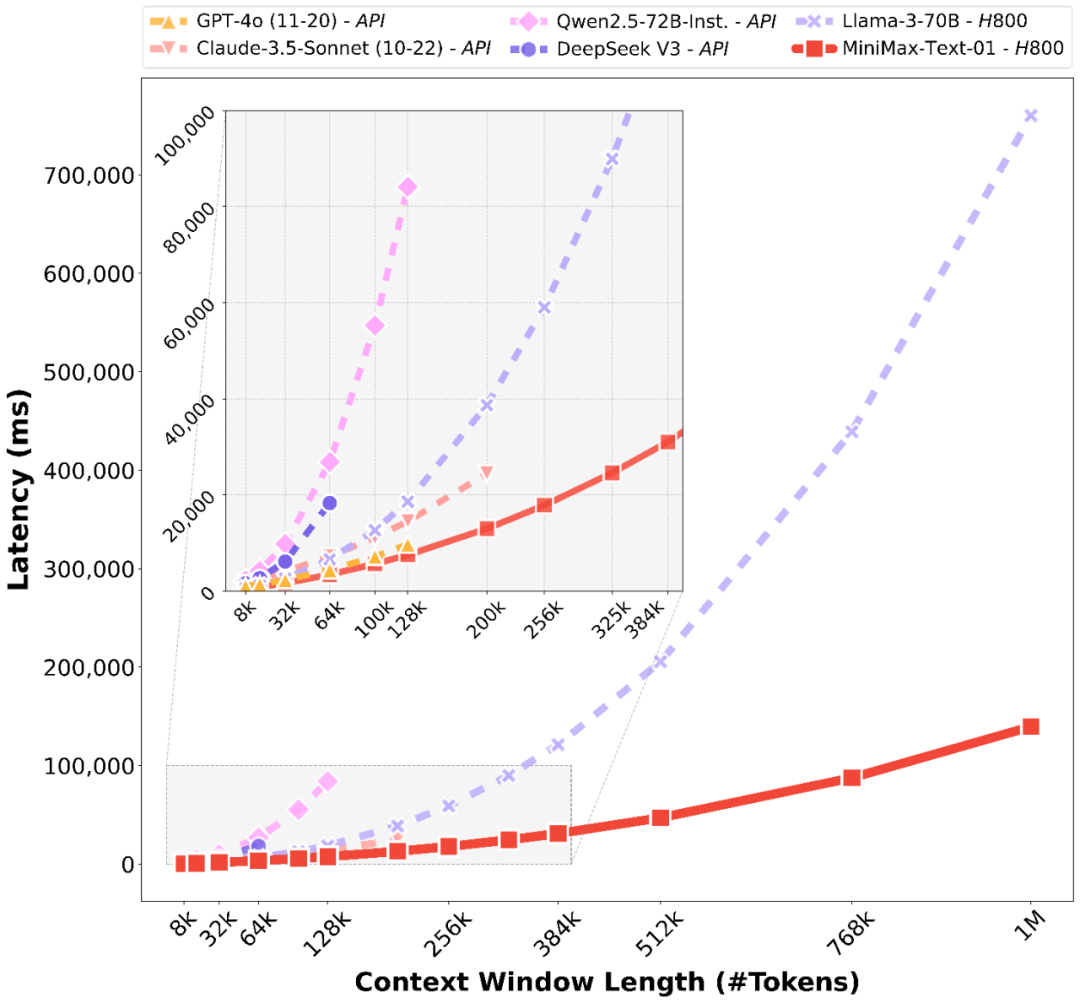
Benefiting from our architectural innovation, our model achieves very high efficiency when processing long inputs, approaching linear complexity. The comparison against other top global models is as follows:
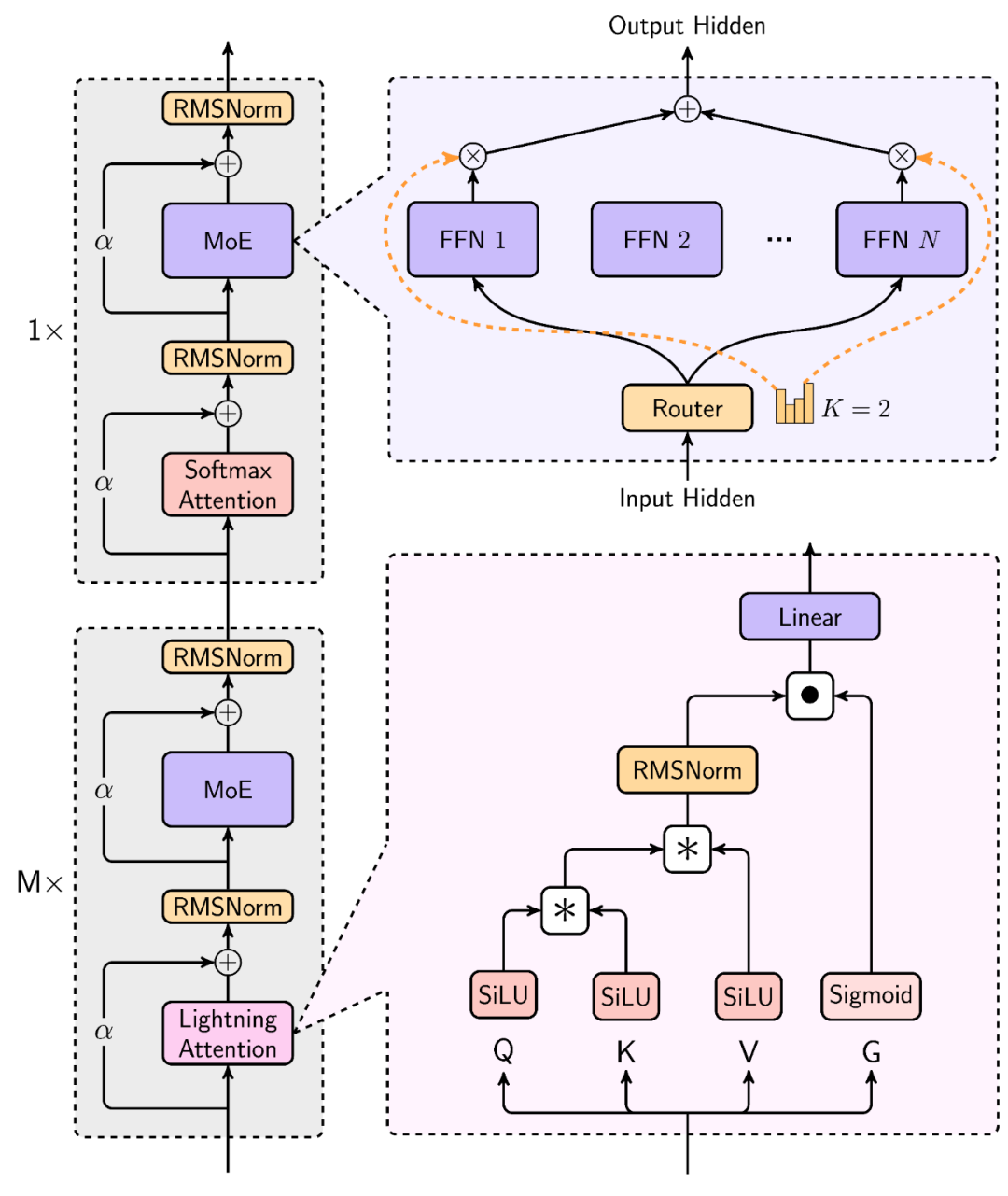
Our architecture is structured as follows: out of every 8 layers, 7 use Lightning Attention-based linear attention, and 1 uses traditional SoftMax attention.
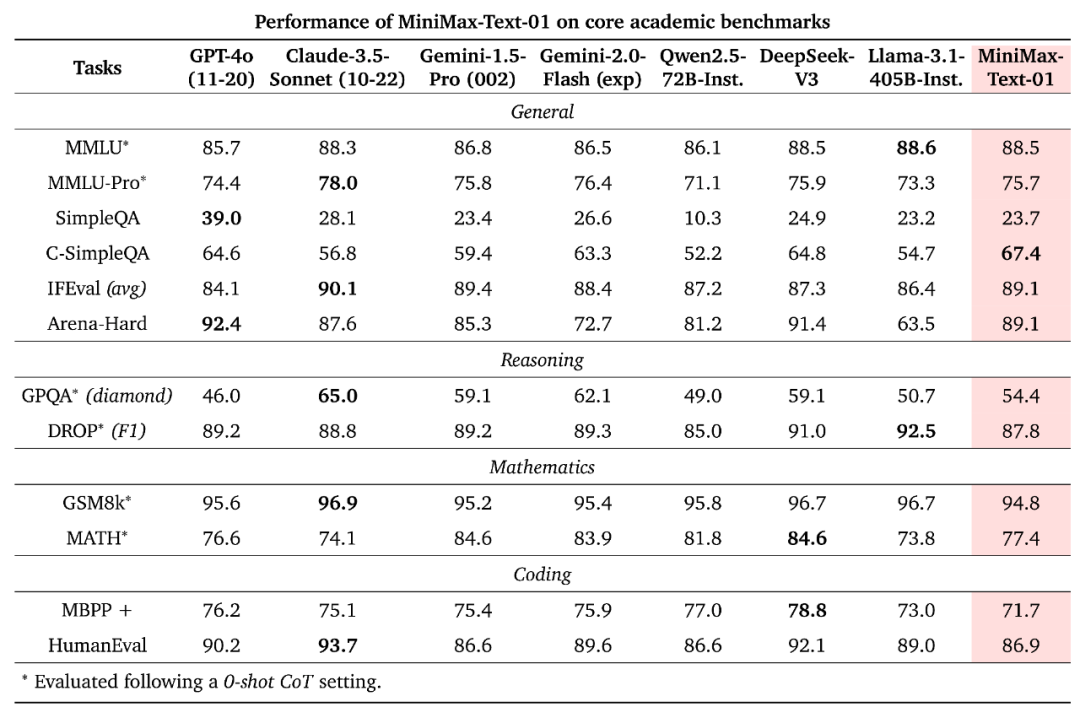
This marks the industry's first expansion of linear attention mechanisms to production-grade model scale. We've taken a comprehensive approach spanning Scaling Law, integration with MoE, structural design, training optimization, and inference optimization. Since this is the first time anyone has built such a large-scale model with linear attention at its core, we've essentially rebuilt our training and inference systems from the ground up — including more efficient MoE all-to-all communication optimization, optimization for longer sequences, and efficient kernel implementations for linear attention at the inference level. On most academic benchmarks, we've achieved results on par with the top tier overseas:
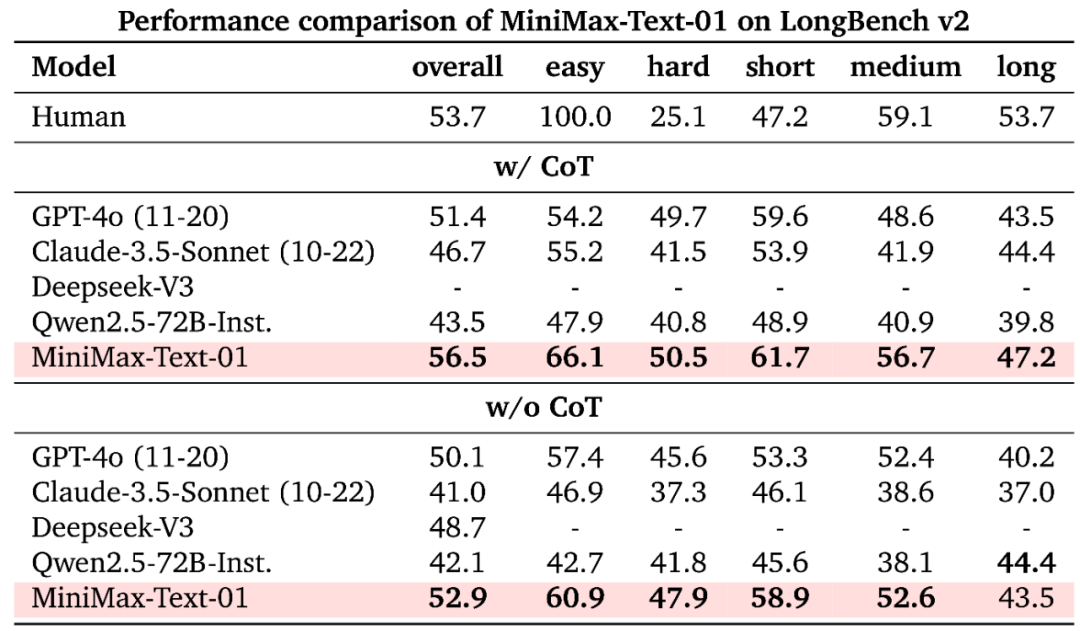
On long-context benchmarks, we lead significantly:
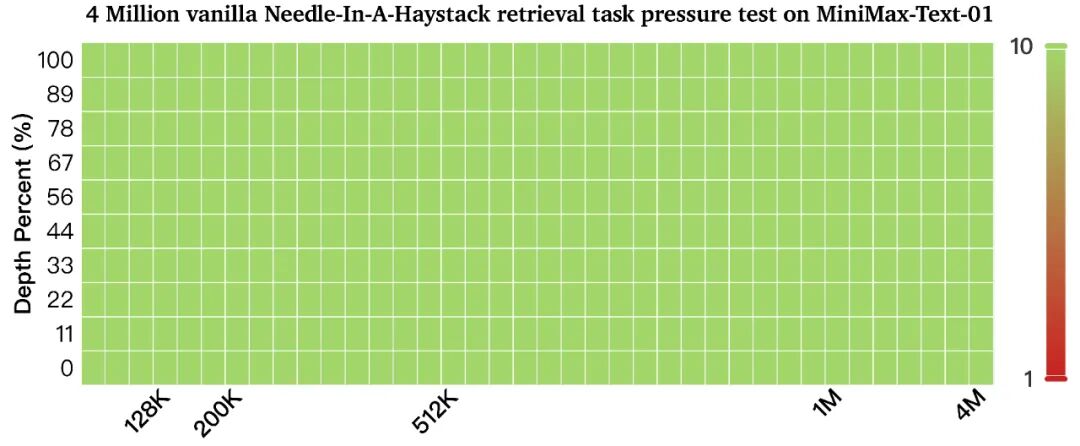
On the 4-million-token Needle-In-A-Haystack retrieval task, we score perfectly across the board:
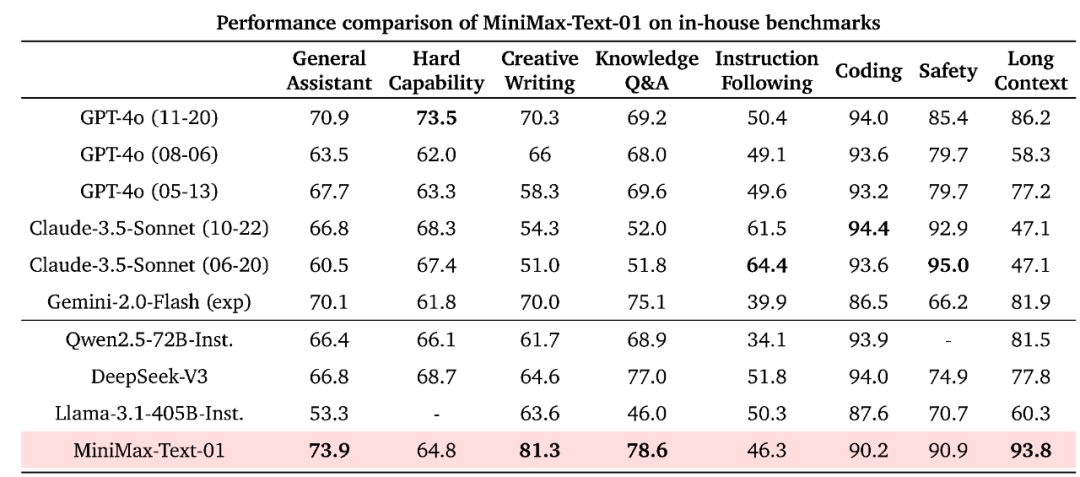
Beyond academic datasets, we constructed a test set based on real-world assistant scenarios. In this setting, MiniMax-Text-01 demonstrates significantly leading performance. Specific comparisons are as follows:
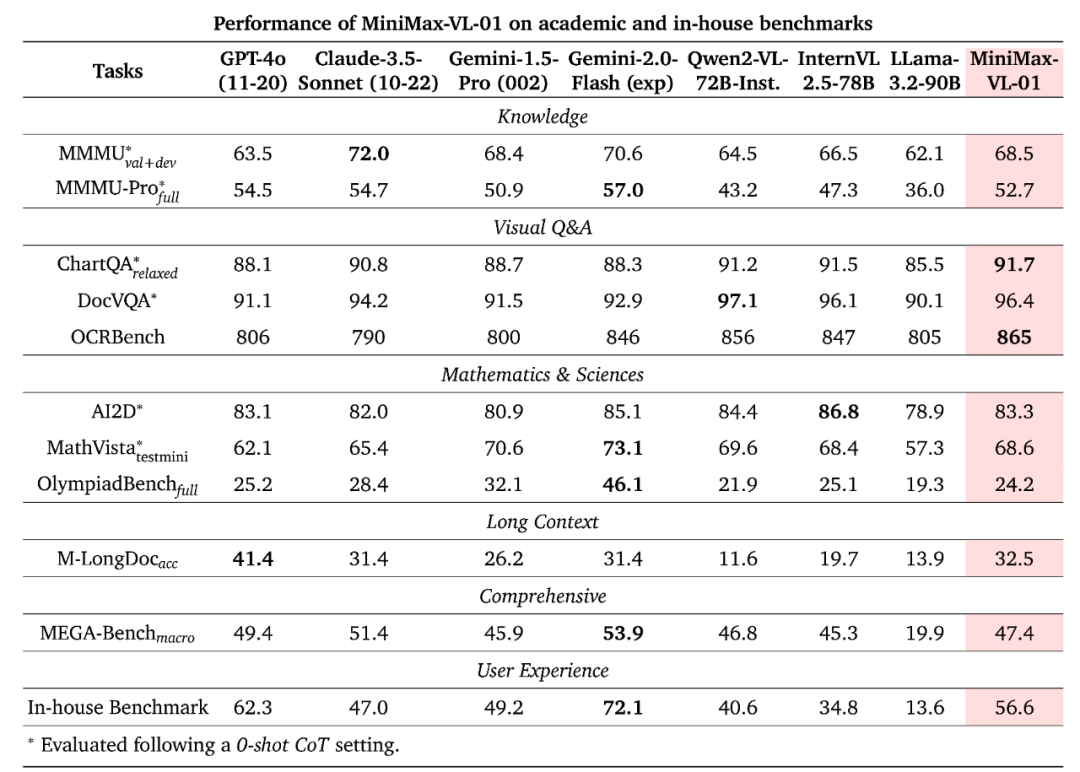
On multimodal understanding benchmarks, MiniMax-VL-01 also shows strong results:
To facilitate further research by developers, we've open-sourced the full weights for both models at https://github.com/MiniMax-AI. Subsequent updates to this series, including code and multimodal enhancements, will be uploaded promptly. We've chosen to open-source for two reasons: first, we believe this may inspire more research and applications in long-context modeling, thereby accelerating the arrival of the Agent era; second, open-sourcing pushes us to innovate more aggressively and conduct higher-quality model development going forward. Beyond open-sourcing and our extremely cost-effective APIs, access is also available through Hailuo AI (domestic app and website hailuoai.com) and our global site (hailuo.ai). For technical suggestions or collaboration, please reach out to us at model@minimaxi.com.