MiniMax's Junjie Yan: Today's AI Apps Won't Become Super Apps, But That Doesn't Matter | Oasis Vitality

Counselor Vitality
Like most people, Junjie Yan's first reaction to OpenAI's newly released "AI intelligent assistant" GPT-4o was "stunning." The MiniMax founder and CEO was captivated by the demos — the silky-smooth voice interaction, real-time visual understanding, language detection, even the "sound of breathing."
MiniMax is one of the rare companies in the industry working on both models and products. Currently, it ranks among the best-performing AI companies in China. Its products fall into two main categories: entertainment, represented by STARFIELD, which competes with Character.AI and currently leads domestically; and productivity, represented by Hailuo AI, which competes with ChatGPT, is still in its early stages, but is the product he values most right now.
Despite AI attracting massive global attention over the past year, its future as a tool for ordinary people remains distant. Yan did some calculations: the best productivity products domestically currently have only 4 million DAU, while internationally it's 10 million. This means AI's penetration on mobile is probably less than 1%. There's still much work to be done.
Two days after the GPT-4o launch, this notoriously mysterious and low-profile executive made a rare appearance on GeekPark's livestream, joining GeekPark founder and president Peng Zhang for a nearly two-hour real-time interview. Using the launch as a starting point, he discussed technology and costs, industry inflection points, the open-source versus closed-source debate, paid user acquisition and product-market fit, super-products, and other key issues.
Below is a transcript of the live conversation, edited and published by GeekPark:
Voice Assistant Effects Are Stunning, Can Boost User Penetration, and Aren't Technically Difficult to Achieve
Peng Zhang: You must have followed both the GPT-4o and Google I/O launches in detail. Their styles are quite different. Which one left a deeper impression on you personally? Which did you prefer? Could you share your reasons?
Junjie Yan: On one hand, I'm a user myself — I use these AI products daily. On the other hand, I'm also an industry insider, so I have these two strangely different perspectives.
Watching the GPT-4o launch, as a user, I found it incredibly impressive. Especially those two demos — one where the AI understood breathing sounds, and one where it took photos and did things with them. I thought, how can AI be this fluid? Everyone felt that real-time voice interaction was being achieved for the first time. It was genuinely successful, and clearly GPT's launch generated more buzz and reach than Google's. Users definitely found OpenAI's launch more stunning.
But that night, I started thinking about how this was actually implemented. After about half an hour, I realized it's actually quite straightforward. Why? Because speaking is much slower than typing. For example, current language models can process roughly a dozen to twenty-something tokens per second. But speaking, you can only say 3-5 characters per second, roughly 4-5 tokens. So voice speed is far slower than standard language model processing speed.
This means that as long as you align the voice modality — just as was done previously with images and text — onto the language model, and restructure it into pure streaming interaction, this transformation is very natural.
So I feel this demonstrates two things: first, OpenAI can still think about things from the most fundamental level. Second, the technical difficulty of this is far less than that of Sora or the original GPT-4. That's my take on the OpenAI launch.
Peng Zhang: What about the Google launch?
Junjie Yan: I didn't watch Google's live, but watched the full two-hour video the next day. At the beginning, the DeepMind lead talked a lot about technical aspects, which felt like a middle-aged man bringing his whole family to do research — he had to satisfy shareholders, users, and market expectations for Google all at once.
Peng Zhang: And he couldn't let society question your ethics either.
Junjie Yan: Right, it's like they set many goals, with thousands of R&D staff working for about a year to produce a lot of things. Each point probably wasn't the best, but to do so many things simultaneously, from chips to products, perhaps only Google has the R&D muscle for that.
But what truly impressed me was their AI search. AI search has been hot these past few months — overseas there's Perplexity, including ChatGPT itself, and many domestic assistants, everyone is doing search, even claiming to replace traditional search. Frankly, I think there's still a massive gap between current products' search capabilities and what Google demonstrated.
Because I think the core elements inside may only be available to Google. For example, a lot of real-time local information — this has tremendous value for high-value scenarios. If I were a user, I'd be very willing to use such search; this experience absolutely cannot be achieved by plugging third-party search engines into ChatGPT. Frankly, I think this is Google's real moat.
Second, among other AI search products currently available, there's only single-step reasoning. Google demonstrated multi-step reasoning, which is a significant improvement to search experience. Google was also the first to do this. It's not inherently difficult — the original language model just needed to support it — but it shows Google has thought very deeply.
Finally, this may be a uniquely Google advantage. Actually including OpenAI, almost all companies' video understanding is fairly mediocre. Even what GPT-4o demonstrated, its Camera wasn't actually processing video, but still images. To achieve truly smooth video understanding with good results, it seems only Google has done it. Gemini 1.5 is quite good at this.
I was thinking why this matters so much, why Google insisted on doing it. It's understandable — Google has massive amounts of YouTube video, but these videos couldn't be surfaced before. Because previous search only had a title, or very simple tags. Now this technology can add these videos into search results, which is very unique.
Overall, what struck me most was that with AI, search can genuinely be qualitatively improved, and Google has already gone very far down this path.
Peng Zhang: It feels like most of us are audience members who go "wow" after watching the launch "magic," but you're from the "magicians' guild" — you watch and then think about how the "trick" works. For example, voice seems impressive but isn't as hard to implement as imagined. So some people say OpenAI's progress this time was mainly engineering — they chose a clear goal, perhaps even imagined the launch scenarios very well, then their engineering capabilities combined with technical capabilities to perfectly nail that point. Unlike Sora last time, which was an essential technical change. Is this understanding correct?
Junjie Yan: Different people probably have very different understandings of systems, algorithms, and engineering. Let me share my technical perspective.
Though I don't know exactly how OpenAI did it, I suspect their voice technology can be divided into two steps: first, using large models for voice synthesis. Second, combining the large model's voice synthesis with the language model. The first step actually saw lots of progress last year, but the problem during interaction was that you had to first convert sound to text, then use the language model to generate a response, then run it through the model again.
Peng Zhang: So it wasn't end-to-end implementation, but took several steps.
Junjie Yan: Right, this caused latency and information loss. This time OpenAI went further, directly combining the voice model and language model together.
Technically this is relatively easy to do, because both voice and language models are Transformer models. Essentially it's aligning the voice model's encoder onto a language model. This already happened with images; now it's just swapping images for sound. And because voice processing speed is far lower than text processing speed, restructuring it into streaming is very natural.
The result is that previously, ChatGPT's voice interaction — including Hailuo AI's voice interaction — had roughly two seconds of latency. Now with pure streaming, latency is only 300 milliseconds, about the time of one character.
Peng Zhang: So this voice technology path isn't actually difficult, and was proven feasible and clear quite early. Does this mean it won't be OpenAI's exclusive technology, but can rapidly spread to more companies?
Junjie Yan: I think if a company or organization could previously independently build good language models, and independently build voice models using this LLM approach, if both of these are in place, combining them is relatively straightforward. Though behind this there are also many engineering pipeline optimizations involved.
But more core is what your goal is. For example, why did OpenAI want to reduce voice latency to 300 milliseconds? Fundamentally, because on mobile, every time you reduce latency, it brings particularly large improvements to user experience. Why can't online meetings replace in-person meetings? The core reason is the few seconds of delay. And the limit of latency optimization is one character's time, 300 milliseconds — under this goal, you'll eventually derive the most reasonable technical path.
Peng Zhang: I'm quite struck by the latency issue. Previously, a voice赛道 entrepreneur told me that if latency exceeds one second, users will feel like the other person isn't in the same space talking with them. So when the voice assistant has no latency, you feel it move from the cloud into your room — that feeling is incredibly impactful. How strong is the improvement to user experience? Will voice become the mainstream interaction method?
Junjie Yan: A very obvious change over the past year has been in cars — you can see voice penetration in new energy vehicles has significantly increased, which shows that in a scenario, if you can make voice interaction very usable and practically valuable, user penetration will increase. This has already been achieved in smart car cabins. The same will happen in real life, which is why AI companies are increasingly prioritizing voice interaction.
Large language models have been the buzzword of the past year, but right now only about 40 million people worldwide use AI products daily — and of those 40 million, over 30 million are using ChatGPT. Within that 30 million, roughly 20 million access it via web and a little over 10 million via mobile. Meanwhile, there are probably 400 million people globally using their phones every day, so AI penetration on mobile is likely under 1% — an extremely low figure. Truly mainstream products, like short video, long video, or social media, all have penetration rates of 50% or higher.
I think any company serious about building AI products in the future needs to think through one core logic: how to drive user penetration higher. Really, the only way is to make more scenarios usable and more people able to use it. I believe voice fits this trend — it brings in people who find typing inconvenient and unlocks more scenarios. This is the kind of effort AI companies need to make to improve penetration.

Image: An OpenAI researcher conversing with GPT-4o during the product launch | Source: OpenAI
Zhang Peng: Do you think it will increase stickiness among existing users, or acquire more new users?
Junjie Yan: Both could happen. We've found that many scenarios simply only emerge with voice. For example, inside Hailuo AI, many parents have it tell bedtime stories to their children. This clearly expands the user base. Another example — we've found many users practicing spoken English with it. From this angle, it should boost user activity. And there's my own personal experience: during this past Spring Festival, I visited my grandfather back in my hometown. He's 80 years old. He installed Hailuo AI on his beat-up Android phone and would talk with it for long stretches, discussing historical figures. Previously, you'd never imagine an 80-year-old using AI this way. And when they use the product, they genuinely treat the AI like a person — he'll say things like "can you speak louder," subconsciously anthropomorphizing it. This is also why we're so convinced about artificial general intelligence — it's something that serves ordinary people. The problem is that industry-wide penetration really isn't that high yet, and simpler interaction is a crucial piece of that.
Zhang Peng: You've said you believed in multimodality very early on, because every time a product expanded its modality, it expanded to a new batch of users. After ChatGPT improves its voice technology, what changes do you predict for its DAU, user time-spent, and other metrics?
Junjie Yan: Actually it's impossible to guess right now, since it hasn't launched yet. I think time-spent will increase, but whether user penetration will change significantly — I'm actually somewhat skeptical.
Zhang Peng: Voice interaction does have a human threshold. Many veterans from the previous generation of voice interaction have reviewed their experiences — people open a voice assistant and suddenly don't know what to say, then stop. This has nothing to do with technology. It actually requires users to have fairly strong intent and motivation to use it.
Junjie Yan: Right, I think it's more friendly to younger users or much older users, but less so to those in between. The reason is that people willing to use AI, or who've even heard of AI, have probably at least tried something already.
Multimodal fusion is a "must-answer question" for the large model industry, determining the success or failure of efficiency-focused products
Zhang Peng: You're also building in the large model space, actively benchmarking your technical capabilities against OpenAI and Google. After watching these two launches, do you feel more excitement or more challenge?
Junjie Yan: I think having someone running ahead of you is a good thing — it shows the ceiling of this industry is far from reached. Personally, I'm very much looking forward to OpenAI releasing GPT-5 or whatever comes next. Even as an industry insider, I hope OpenAI can maintain this pace of progress. There's no competition anyway, actually no competition at all. But this isn't because we don't want to compete with them — it's that they're too strong to compete with. At least for now, the ones truly consolidating algorithms into products and genuinely pushing the boundaries of AI are mainly OpenAI. If they can very quickly expand AI's frontier, it at least shows there's underlying momentum for AI user penetration, and that this momentum is sustainable. OpenAI probably has 10x the R&D resources of Chinese companies. If even they can't innovate, that would be the truly scary thing for this industry.
Zhang Peng: Do you have methods, a path, a plan — will we see user experiences in your products similar to what OpenAI showed today? Roughly how long?
Junjie Yan: First, I definitely think this is achievable. I don't know how they did it, but I think my analysis just now is probably right — at least that approach can work, at least there's a fairly clear path. Actually for me, the main challenge isn't the voice model — it's making the language model as good as possible. The real reason is that current multimodality still uses the language model as its core. Earlier this year when we were working on our previous version ABAB6.5, we actually got trillion-parameter-scale MoE working — and this was still a language model. Also, last year, each modality was independent. Though they shared the same framework, all Transformers inside, similar code, their data and models were separate. Now as I'm designing the next-generation model, our core focus for the second half of this year is how to have a language model with higher ceiling, and how to bring these different modalities together. We haven't fully finished the design — there's still a lot of experimentation needed. But it's basically already visible. This next model will have two phases: first, the design phase with many hypotheses that require experiments to validate. Second, assuming your hypotheses are sufficiently validated, bringing everything together for final model training. The trade-off here is: how good do these hypotheses or designed validation experiments need to be? This is what we're going through right now.

MiniMax's efficiency-focused product "Hailuo AI" | Source: MiniMax
Zhang Peng: Lately we've heard Google talk a lot about "One network, Multi-modality" — multimodality implemented within a single neural network. MoE is currently a very effective method for training trillion-parameter models, but for the next step of multimodal fusion, how will the approach differ from before?
Junjie Yan: These are two dimensions. First, the intermediate step involves massive transformers, and to improve efficiency — both training and inference — the mainstream choice is MoE, like GPT-4. Rumor has it Gemini-1.5 looks similar. If you're building a model in the hundreds of billions to trillion parameter range, this is basically the inevitable choice.
Second, you have different modalities — how do you integrate them into this large MoE-based backbone? That's multimodality. What's already known is how to integrate visual understanding with the backbone, like GPT-4V: you start with a massive MoE, align the visual components, and you get reasonably good visual understanding.
The unknowns are two-fold:
First, what GPT-4o demonstrated: aligning audio into this as well — that's one of the things GPT-4o did.
Second, the generation side — can image generation, video generation be integrated? At least for now, video hasn't been achieved; Sora is a separate model. Why? Because video tokenizers use lossy compression, and you basically need diffusion to recover to a reasonably normal state — can't just integrate it wholesale yet. Of course many people are working on it; probably next year it will come together. But video generation currently doesn't know how to integrate.
For image generation, I'm not sure. In the previous generation DALL-E 3, it wasn't integrated either — also a separate model. But looking at GPT-4o this time, I feel like they may have integrated it, though I'm not entirely certain. I think the underlying technology is basically this.
Zhang Peng: Then will this unified multimodal fusion capability become the next-stage goal for the large model field, especially Chinese startups? Is this something everyone must keep up with, must solve?
Junjie Yan: I increasingly think it's a must-do. Actually this splits into two product types. Currently there are two kinds of AI products: those serving entertainment needs, and those serving efficiency needs. Entertainment aside — that's more about operational attributes, product attributes, more comprehensive product capability.
Efficiency-oriented ones definitely need to do multimodality, because historically, for all efficiency products, people basically only end up using the best one. If there are two products, one that can do many things and one that only searches text, people will definitely use the one that can do everything. Of course this assumes this multimodal track exists. Whether this track exists also requires a lot of effort.
Zhang Peng: Can we understand Sora as an "optional question" — you can skip it — but unified multimodal fusion as a "must-answer question" — if you don't answer well, you're out?
Junjie Yan: I think your summary is quite good, hadn't thought of it that way before, but it really is more like a must-answer question.
Sora actually has different use cases — PGC use as a tool, and UGC use involving a lot of product and content elements, not something every AI company needs to do.
But for tool-type, efficiency-type, assistant-type products, once any company achieves multimodality, others must follow. Because there's basically just this much technology.
The "Intelligent Voice Assistant" Battle: Complex Competition and Cooperation Between Giants and Startups
Zhang Peng: This time around, we're seeing voice assistants — Apple wants to integrate it into Siri, Google wants to embed it deeply into the Android ecosystem — it seems like it could become a really important entry-point-level thing. Will this ultimately be a game for the giants? Is there still room for entrepreneurs?
Junjie Yan: First, almost all of the user experience of this product comes from model capability. It doesn't really depend on whether the product is from a giant or a startup — it just depends on what level of technology is behind it. What it tests is whether you can build the model with the best experience. This involves how you build your technical model, how you do good alignment, how you optimize latency, how you improve engineering efficiency, how you reduce compute costs, and so on.
Second, on the business side, this product will definitely consume costs behind the scenes. Because the essential difference between current AI products and early mobile internet products is that before, we didn't need to consider the cost of maintaining users every day, but now we do. So how to monetize this generation of products is relatively straightforward. And the commercial value of a product on the phone largely depends on how much user time it captures, because user time always has standardized monetization methods.
For a product like this, if it can solve most needs within it — say, when I want to search, I don't need to open Baidu. Or when I want to watch a video, I don't need to go into Douyin. As long as it captures enough user time, its monetization efficiency will be high enough, and its monetization is directly proportional to time spent.
So this ultimately becomes: product competitiveness depends on technical capability, and business competitiveness depends on how much of the user market you capture.
Zhang Peng: Let me make it more concrete. Apple is the complete controller from hardware to software, Android has natural advantages at the operating system level, and OpenAI is a new type of startup based on large model capabilities. If all three companies are competing for this most critical voice assistant entry point in the future, who is most likely to be the winner? Can a startup win this position?
Junjie Yan: I think there are all kinds of games, competition, and cooperation here — it's already happened in search. We can see that Apple has integrated Google's search, and Google pays Apple a lot of money every year. Why is Google willing to pay? Obviously because the commercial value of Google doing search within Apple is greater than what Google itself pays.
But I think no matter what, if we look at first principles, whoever can actually build the thing and make the experience significantly better — at the very least, you should have a place in this space.
I think this favors companies that own devices more, and here's why: say I buy a Xiaomi phone, I only pay Xiaomi once. After that, whatever value this Xiaomi phone creates basically has nothing to do with Xiaomi. The only thing related is the revenue share from distribution in the Xiaomi app store — everything else is basically unrelated.
Zhang Peng: There are also some content ads on the negative-one screen, but those are pretty thin.
Junjie Yan: The content quality on the negative-one screen is obviously not as high as Douyin or Xiaohongshu. Actually, phones provide a lot of user time — say I install Douyin on my Xiaomi phone, a user spends a lot of time on Douyin, but all the money has nothing to do with Xiaomi, it's all captured by Douyin.
I think one benefit of a strong AI assistant is that it can indeed let the phone's operating system layer capture a lot of user time, because it can satisfy many diverse needs. This is essentially pulling a lot of value from apps back onto the phone itself.
Zhang Peng: Recently we've also seen rumors that Apple and OpenAI might collaborate at the intelligent assistant level. So according to your reasoning, a company that has done extremely well in large models, combined with a phone giant that has control over the ecosystem hardware and software — ultimately everyone comes together and creates new value distribution in the future ecosystem — this is logical?
Junjie Yan: Yes, it's actually about the distribution of user time, and this in turn tests the technical and product capabilities behind it.
Zhang Peng: Conversely, if OpenAI doesn't partner with Apple but instead becomes the strongest Super App, challenging the existing ecosystem as an independent force and even reconstructing the original value chain — do you think this kind of possibility exists?
Junjie Yan: This mainly depends on scale. An app with 10 million DAU obviously doesn't qualify. At Meta's level of 1 billion DAU, there would probably be fundamental changes. But even for OpenAI, there's still a 100x gap to that.
Zhang Peng: Right now, building a so-called unified Super App or super entry point is still very difficult to achieve. What's more realistic today is how to grow DAU from 10 million to 100 million — this is also something that gives OpenAI a headache.
Junjie Yan: I guess this is also why they care so much about voice — because this thing really could increase penetration rates.
Investing in General Foundation Models and Building General Products Is the Only Way to See the Real Future
Zhang Peng: Recently in the entrepreneur community, there was a big debate around foundation models versus open-source models. The essence was: either you build your own intelligent engine, or you buy one and modify it. Actually, model and product driving each other together — doing both foundation models and products simultaneously and rolling forward — is the best. But many entrepreneurs say this is very risky: one iteration of the model falls behind, or one product PMF failure, and you're done. What do you think of these two paths?
Junjie Yan: I think this is inherently a very risky thing. Forget about doing both model and product simultaneously — doing just models, or just products, is already very risky in itself.
Zhang Peng: Entrepreneurship is basically a game of life and death.
Junjie Yan: Yes, it's truly brutal. For example, looking at American companies: OpenAI does both, Anthropic previously only did models — yesterday they recruited Instagram's CTO over, so I wonder if they might also do products now. I think at least for model companies, doing their own products is almost an inevitable choice. We've been relatively resolute about this; some companies end up going this route later, but it's inevitable.
Conversely, it's the same for product companies. For example, on our domestic open platform, there are many product companies and clients — actually quite large in scale, roughly close to a thousand. There are big companies and small startups. Honestly speaking, for all these companies, if their products become very large, they also want to control the model themselves. This is also an inevitable path.
So the core consideration here is: if you think this is the right thing to do, it essentially comes down to how many resources you have now, and maximizing optimization of whatever target you want to optimize. For us, our goal is to maximize user experience optimization, and we think both of these things (model and product) are important — we can only do both to best match the target we want to optimize.
Different people define different goals and different paths, and many different companies emerge.
Zhang Peng: So model-product integration is ultimately the final goal we're pursuing; it's just that many people, based on today's available resources, find the burn rate too high and the risk too great — but this is just a stage-specific choice.
Junjie Yan: There's also a more fundamental reason. For example, say there's a need to be met, and this thing needs to be met through the model — if (model and product are in) one company, your path is just optimizing this business metric. But if (model and product are in) two companies, what you're doing is converting this metric into a requirement for the model, and having the company that provides your model optimize this metric.
A lot of information is lost in this process, and it makes the cycle longer. This is definitely not the way to maximize business metrics.
Of course, Microsoft is the exception here. The core reason is that Microsoft's scenarios — Bing search, Office — are all things that can become very standardized, basically mainly relying on the general capabilities of the model. OpenAI's general model is the best, so it can be used for these products. In this situation (model and product separate), it's reasonable, but in most situations it's not the optimal choice.
Zhang Peng: You raised a very good question: should we build products based on model capabilities, or should we modify models based on product goals? Let me use an analogy — if the model is a gun and the product is the target, should we today build a more general machine gun that can hit targets in more domains, or should we build a high-precision sniper rifle that just hits one specific target?
Junjie Yan: Actually there's a layer of meaning behind this. At this point in time, there's some technical dividend behind AI. This dividend is that there are so many smart people in the world, so many resources, so much community working on this. The value or capability of this is far greater than any single company, greater than OpenAI's, and obviously greater than any Chinese startup.
So a company's R&D level isn't something a company produces in isolation — it's that company's own capabilities plus what the entire industry integrates together. It's just that different companies utilize this with different efficiency. Including OpenAI — many of their things aren't original; maybe Google built them, but they integrated them well, scaled them up, and that's how they got to where they are.
Actually, making models general is a relatively easy way to absorb progress from the entire community. This itself has enormous dividend.
Zhang Peng: Today you should stand in that position, bring out more capabilities, and let more people co-create with you — whether users or other entrepreneur peers in the industry. OpenAI has this kind of feel. But if today you're just doing one product and maintaining your own "vegetable garden," you might lose the opportunity for the world to co-create with you.
Junjie Yan: Objectively speaking, it's not the world co-creating with us — it's us co-creating with the world.
Zhang Peng: I see Sam Altman also constantly reminding people not to patch based on specific problems with today's models — that's actually a waste of time. Because technology is rolling forward, right when you've finished patching in this time and space, the garment may have already been changed — this kind of problem occurs.
Junjie Yan: Objectively speaking, what products can be built is actually determined by the technology cycle.
For example, in this current generation, basically all the products we've seen are primarily text-based interaction, and product functions are basically at the assistant level. Whether entertainment or efficiency, they're basically in the copilot (assistant) framework. It's just different people, based on different understandings, different resources, different teams, assembling different things.
Suppose we have better models with significantly improved capabilities — say all tests can be done very well, it can work independently, it's not a copilot but maybe an auto-pilot (full assistant) — this would obviously produce many completely different product forms.
But this isn't designed by product people; it's when you push technology to a certain stage that the product naturally becomes clear.
Technical Costs Could Drop 100x in Two Years — This Is Much Easier Than Exploring the Technical Ceiling
Zhang Peng: I want to shift to something more concrete. I was doing some math with an investor the other day — a product with tens of millions of DAU today can easily burn through 2 million RMB a day in costs. That's steep. If GPT-4o were to scale to more users and achieve stronger stickiness, how high would its daily costs get? You must have some sense of the cost structure — can you walk us through it?
Junjie Yan: Actually, voice is cheaper than text, because voice is slower. Text generates maybe 20 tokens per second, but voice is only 4-5 tokens per second. And humans listen slowly too — I can read a thousand words in a minute, but listening to a thousand words takes much longer.
So assuming the same usage time, voice is actually cheaper.
Zhang Peng: That's counterintuitive.
Junjie Yan: You'd think sound is more expensive, but it's cheaper. That's the first point.
Second, optimization and cost reduction have always been classic research areas in academia. I worked in this area myself many years ago. But it's not actually the most cutting-edge field in industry — the highest-end work is about pushing the boundaries of what's technically possible.
Once you can expand those boundaries, reducing costs by 10x becomes straightforward. From the earliest machine learning era, like when I was doing my PhD, through the 2012–2022 decade of CNNs, there was a very standard pipeline for quantization, pruning, and distillation.
With the Transformer generation, you can actually reuse much of that previous pipeline. Quantization; caching strategies when you have very long context windows; attention optimization — there are many methods. It's not that difficult. You just need to execute each step well enough, and the compounding effect becomes significant.
Zhang Peng: So compared to exploring new frontiers, digging deep to extract value is actually pretty easy right now?
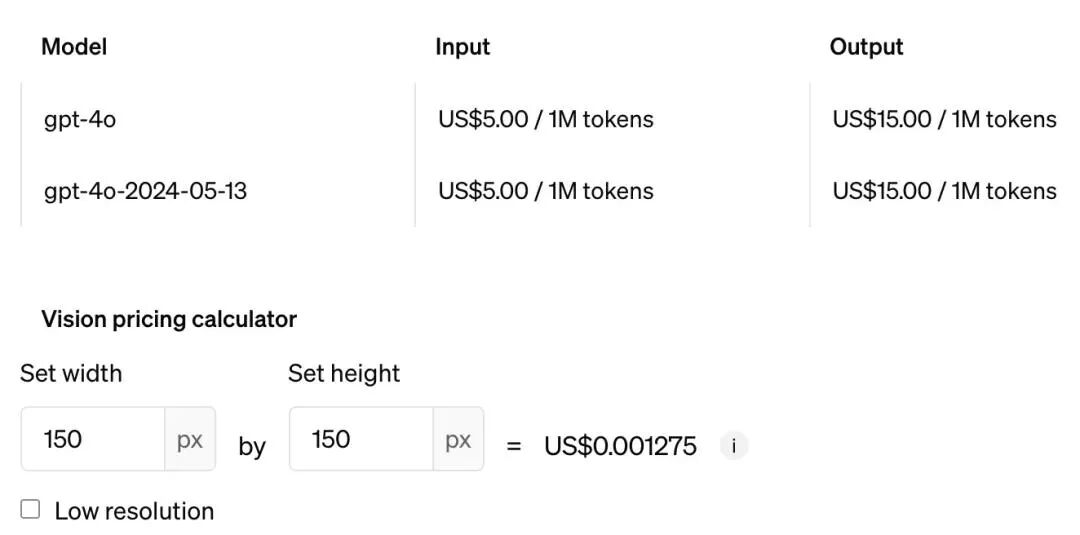
Junjie Yan: Just think about it. When GPT-4 first came out in March last year, it was slow and expensive. But now look at GPT-4o, and GPT-4 Turbo before it — faster, cheaper, and better. This all happened in just one year. Prices may have dropped 10x, but OpenAI's actual cost reduction was even greater than that.
We've roughly calculated that with two years, costs could drop nearly 100x. I think the upper limits of technology are relatively uncertain and require more exploration. But cost reduction — there are definitely ways to do it. This has already happened three times in academia.
 GPT-4o costs | Image source: OpenAI
Zhang Peng: Today some people are desperately optimizing technical costs, while others are pushing model capabilities to reach the very top. Is the latter more important in your view?
Junjie Yan: I think the outcome matters most, but in terms of process, the two transform into each other. This is actually a very important law in large models: efficiency and effectiveness can be converted into each other. Assuming the same training precision, if your compute is 1/10 of someone else's, that means your efficiency is very high — which means you can push the model's upper limit higher. Or conversely, if you want to reach that high ceiling in capability, you must make your efficiency very high for it to be possible.
Everyone's resources are finite. Only with sufficient efficiency can your ceiling be higher. It's not that you push to the boundary first and optimize later — you have to do both simultaneously.
That's also why most R&D gets harder as you go higher: it demands integrated thinking.
Zhang Peng: So when Sam says "give me however many trillions and I can rapidly achieve AGI," is that unrealistic?
Junjie Yan: If we use an analogy: TSMC is at 7nm now, so next comes 5nm, then 3nm, then 2nm, generation by generation. They can't skip 5nm and 3nm and suddenly claim they can do 2nm. That doesn't seem right — it's hard to skip intermediate steps.
Zhang Peng: Grand goals still require step-by-step progress. You can't expect to reach the destination directly — that's also the nature of entrepreneurship.
Junjie Yan: Though maybe they're so strong that I haven't grasped their essence. But under normal circumstances, this is how it should be.
Domestic AI Products Are Forced to Buy Traffic, Because Technology Hasn't Created Sufficient Differentiation
Zhang Peng: Speaking of costs, we've seen AI products in the industry start buying traffic recently. I feel like in the mobile internet era, companies would at least achieve PMF before scaling through paid acquisition. Now products need to spend money just to test PMF. On one hand, China's internet traffic has ossified, concentrated in the hands of giants. On the other hand, AI capabilities are limited and can't be pushed directly to users. Will this rising PMF cost from traffic buying become a major challenge for this generation of AI entrepreneurship?
Junjie Yan: We've been burned by this. You find that in China, this is very different from the United States. American products like ChatGPT obviously didn't buy traffic. Early Character.AI didn't either. Tool-oriented products like Midjourney clearly didn't buy traffic — they focused more on operations. But conversely in China, basically all products buy traffic. This is a very obvious difference.
American companies rely more on technical and product capabilities, and generally don't buy traffic. But there's a cost to this: R&D costs in the US remain very high. In China it's the opposite — engineer dividends and product dividends are relatively abundant, but traffic is concentrated at the top.
But the deeper reason for traffic buying is that so far, in assistant-type products, no company has managed to create real differentiation. Everyone is on the same dimension, with relatively homogeneous products and relatively homogeneous technical capabilities. To acquire more users, you have no choice but to buy traffic. This is the current dilemma for this product category.
People have various explanations for this. Some believe that acquiring queries is important — if you convert the value of queries themselves into monetary terms, buying traffic is worth it. It depends on how you look at it. When technology isn't standout, there's simply no alternative.
Zhang Peng: I think you've chosen a kind of "simplicity" — make your technology the absolute best and most leading, and the world becomes simple for you. If you can't achieve that simple lead, the world becomes complex. You won't save much on costs; maybe they'll be even higher. It's just a question of betting here or betting there.
Junjie Yan: Right, so we don't believe in buying user queries.
I think PMF works like this: when you start a company you write a BP explaining your PMF. We actually didn't understand this at first, and still haven't written one. I think you can make some assumptions: the core is that for products like this, as long as you have user time, you can monetize. Essentially, PMF is quantified by user time — that's the standard metric. Currently these products have no monetization logic, but if this can scale larger or reach a certain state, something will emerge.
Zhang Peng: Actually I think at different stages, people need to face different things. It's not that you must have pure technical faith and therefore do PLG and absolutely refuse to buy traffic. I also think back to when DiDi had no PMF in many cities and was burning money, until one day it suddenly burned user habits and industrial logic into existence, and PMF appeared. Do you think the AI industry will follow the same path as ride-hailing back then?
Junjie Yan: I don't think so, because ride-hailing is a very typical business with network effects — more drivers means more users, and vice versa.
Large model products so far have no network effects. There may be weak economies of scale. But you need to break this down by product type — efficiency, entertainment, etc.
For pure efficiency products, user experience improvement doesn't mainly depend on having more users. It depends more on R&D velocity and model iteration efficiency. Your technical improvement and user growth don't fully correlate. But for entertainment products like STARFIELD, if you have more and more content, economies of scale are quite significant.
Zhang Peng: I think entrepreneurship today is harder than the mobile internet generation. When you buy traffic, all of it is basically in the giants' hands. Even your PMF is transparent to them — because your continuous spending proves you've found PMF, and they can follow at any time. Entrepreneurs are always playing with open cards. Giants have more money, more people, and traffic. Your product testing is essentially paying "tax" to them. This is the very real truth of this world. As an entrepreneur, how do you maintain hope?
Junjie Yan: This is indeed a critical question, and a very fundamental one.
At the level of conviction, I'd say this: if you haven't done much technical innovation or product innovation, or haven't found sufficient non-consensus in a reasonable timeframe, then this isn't something you should be doing — it should be done by the big companies. You can't blame big company monopoly for that.
What we need to think about is: as an independent company, where can you truly innovate? Is it R&D efficiency, insight, product experience, or what? If you don't have it, the startup deserves to fail, and you can't blame others.
Zhang Peng: Very pragmatic thinking. Competition from big companies actually validates whether a startup truly has value.
Junjie Yan: Yes. Though domestic traffic is monopolized by giants, overseas traffic is relatively open — at least many markets allow free competition. So I think while it's difficult, space still exists.
Virtual Social Is More Popular Than Smart Assistants, But the Super App May Not Emerge From Either
Zhang Peng: Speaking of products, MiniMax is also one of the earliest and best AI product companies domestically. Can you introduce your two flagship products, STARFIELD and Hailuo AI? How are they developing?
Junjie Yan: STARFIELD is basically a fantasy-oriented product. If you look at its time spent, user distribution, and retention data, it's actually quite similar to novel-reading products.
Something like Hailuo AI, which we call an intelligent assistant — but it's actually undefined. The reason is that the largest product in this category right now only has 4 million DAU, which isn't large enough to define the industry.
Our fantasy product is actually pretty far ahead. In terms of user volume, it's probably about 100 times larger than our assistant product. Our assistant product is just getting started.
Zhang Peng: With a fantasy product this good, what do the conversation turns and session length look like?
Junjie Yan: I'd say it's pretty staggering — very long sessions.
Zhang Peng: Why did you decide to build something like STARFIELD, a fantasy product, back then? What was the decision-making logic?
Junjie Yan: When we started the company a little over two years ago, large language models weren't yet a consensus bet. We believed that making AI general-purpose and accessible to the masses was important, and we happened to see a very clear technology inflection point, so we started the company. At the time, we didn't know what the technology would become, what the products would look like, or how commercialization would work.
STARFIELD's predecessor was Glow. When we built Glow, there was no ChatGPT and no Character.AI. We didn't do a lot of analysis, spot an opportunity, and decide to go after it. Our products were discovered through trial and error.
 STARFIELD, an entertainment product under MiniMax | Image source: MiniMax
Zhang Peng: So the logic was: you had faith in AGI, developed model capabilities, and then followed those capabilities to see what you could build — is that right?
Junjie Yan: That's basically what happened. Why this product ended up as Glow instead of ChatGPT was because in October 2022, our first-generation model was only about 30B parameters. It could only do entertainment because it wasn't good enough.
Zhang Peng: You had to treat hallucination as a feature, not a bug.
Junjie Yan: The reality was, in the very beginning we only had pre-training — alignment hadn't even been figured out yet. So this kind of thing was discovered through trial and error, very randomly, and it just turned out this way. If we had been stronger then, maybe we could have built ChatGPT, but unfortunately our capabilities just weren't there at the time.
Zhang Peng: At the end of the day, entrepreneurship depends on actual circumstances. Your technology wasn't ready then, so it was normal that you couldn't build it. This actually shows why technology is the most important part of AI products.
Junjie Yan: Right, because technological development has its own dividends.
Zhang Peng: Now you have Hailuo AI. Did you also change its name? I remember last year you were still calling it "Hailuo Wenwen"?
Junjie Yan: Yes, we did. We renamed it to make the product more mass-market. First, we felt "Hailuo Wenwen" was four characters — cutting it down to two characters, "Hailuo AI," would give us broader user coverage. Second, we found that users' deeper needs weren't entirely coming from Q&A, so we went with this name.
Zhang Peng: If the deeper needs weren't just Q&A, did that mean you were already thinking about the future "intelligent assistant" direction at that point?
Junjie Yan: Yes.
Zhang Peng: With the releases of GPT-4o and Astra, the "intelligent assistant" space may see more and more competitors. How do you view the development goals for this category of products?
Junjie Yan: The core thing for this category should really be just one: improving the efficiency with which users solve problems, or rather, response satisfaction.
If we look at it objectively, when you ask ChatGPT a question, what's the probability it gives you a satisfactory answer? Our own testing shows it's only 60%. This is also why AI user penetration is only 1%. Probably only users who are particularly enthusiastic about AI will still choose to believe it, tolerate it, and even guide it to get some answers after it's given them countless wrong responses.
For example, when we use products with larger user bases, like Baidu Search, Xiaohongshu search, or even Douyin search, we can probably get what we want to see — the satisfaction rate is clearly higher than 60%. Only with this can products reach broader audiences.
This is also why, as a practitioner, GPT-4o didn't impress me that much. Because it didn't actually improve the metric that really matters for this category of products: user satisfaction. If this metric moves from 60% to 90% or higher, it becomes a product you can trust. This is also the direction we're working toward with Hailuo AI.
Zhang Peng: I believe your ultimate goal is still to create a Super App, or to use AI-native approaches to solve major problems for mainstream users. Do you think that whether it's STARFIELD or Hailuo AI, they could be candidates for that Super App? Or is it that we can't necessarily see the final form of the Super App today — that it will emerge randomly as technology develops, as you put it?
Junjie Yan: Our basic assumption is actually this: first, none of the existing products are it. Second, we believe each of our current products can grow to a large enough user scale, deliver greater value to users, and bring us sufficient commercial success and returns. That's what we're working toward.
As for whether our current products are the ultimate Super App — I actually don't think it matters. Why? Because AGI is a long-cycle endeavor; it's clearly not happening in 2024 or 2025, so we don't need to put that much pressure on ourselves.
What we really need to do is make sure technology advances fast enough, while building products based on current capabilities that make the company run more efficiently, create certain value for users, and generate commercial returns for the company. At the same time, we need to maintain the ability to build more products, generation after generation, rolling upward. That would be enough.
American companies may not follow this path. But as a Chinese company, this is at least a path with precedent.