New Model Drop: MiniMax M2, Built for Agents | Oasis Capital Vitality

Counselor Vitality

On October 27, Oasis Capital portfolio company MiniMax officially open-sourced and released its new model, MiniMax M2. Built specifically for Agent and coding scenarios, the model strikes a rare balance between cost, speed, and capability — one that carries real practical significance.
We believe that on the path to AGI, MiniMax is not only a builder but also a driving force.
Below is the launch thread written by MiniMax founder Junjie Yan (IO) for the new model's release.
Enjoy
From Day 1, we've held fast to our vision of "Intelligence with Everyone."
Today, we are officially open-sourcing and releasing MiniMax M2, built for Agents and code, at just 8% of Claude Sonnet's price, 2x the speed, and free for a limited time!
- Top-tier coding ability: Designed for end-to-end development workflows, with outstanding performance across Claude Code, Cursor, Cline, Kilo Code, Droid, and more;
- Strong agentic performance: Excellently plans and stably executes complex, long-chain tool-calling tasks, coordinating Shell, Browser, Python code executors, and various MCP tools;
- Extreme cost-performance & speed: Through efficient activated-parameter design, achieves the optimal balance of intelligence, speed, and cost;
Our internal team has been building all kinds of Agents to help tackle the challenges that come with rapid growth. These Agents are increasingly capable of handling complex tasks — from online data analysis and technical research to daily programming, user feedback processing, and even HR resume search and screening.
These Agents, alongside our team members, are driving the company's development and building an AI Native Company — progressing from developing AGI to advancing together with AGI. We've become increasingly convinced that AGI is productivity, and Agent is a powerful vehicle for it, representing an upgrade from the simple Q&A of conversational assistants to Agents independently completing complex tasks.
But we found that no existing model could fully meet our needs for these Agents.
The challenge is that a good model needs to strike the right balance across effectiveness, price, and inference speed — almost an "impossible triangle": the best overseas models can deliver decent results, but they're very expensive and relatively slow; domestic models are comparatively cheaper, but lag in effectiveness and inference speed.
This has led to existing Agent products being either quite expensive or relatively slow if they want to achieve good results. For instance, many Agent products charge monthly subscriptions of tens or even hundreds of dollars, and completing a single task often takes hours.
We've been exploring whether we could build a model that achieves a better balance across effectiveness, price, and speed, so that more people can benefit from the intelligence gains of the Agent era, continuing our vision of Intelligence with Everyone.
This model would need highly diverse capabilities — programming, tool use, reasoning, knowledge, and more — alongside very fast inference speed and very low deployment costs.
That's why we developed MiniMax M2, and open-sourced it.
Looking first at the three most important Agent capabilities — programming, tool use, and deep search — we compared M2 against several mainstream models:
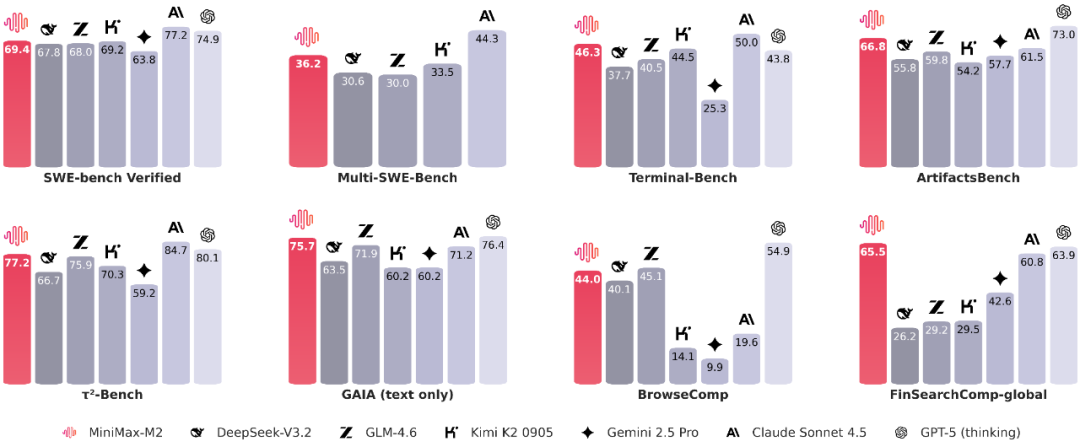
We found that the model's tool use and deep search capabilities are very close to the best overseas models. It trails the best overseas models in programming, but is already among the top tier domestically.
There are some algorithmic and conceptual improvements here that we'll share in due time. But the core point is simply this: to build a model that meets these requirements, we first had to actually use it ourselves. To that end, our colleagues from development to business to backend worked alongside algorithm teams, investing significant effort in constructing environments and evaluations, and increasingly integrating it into daily work.
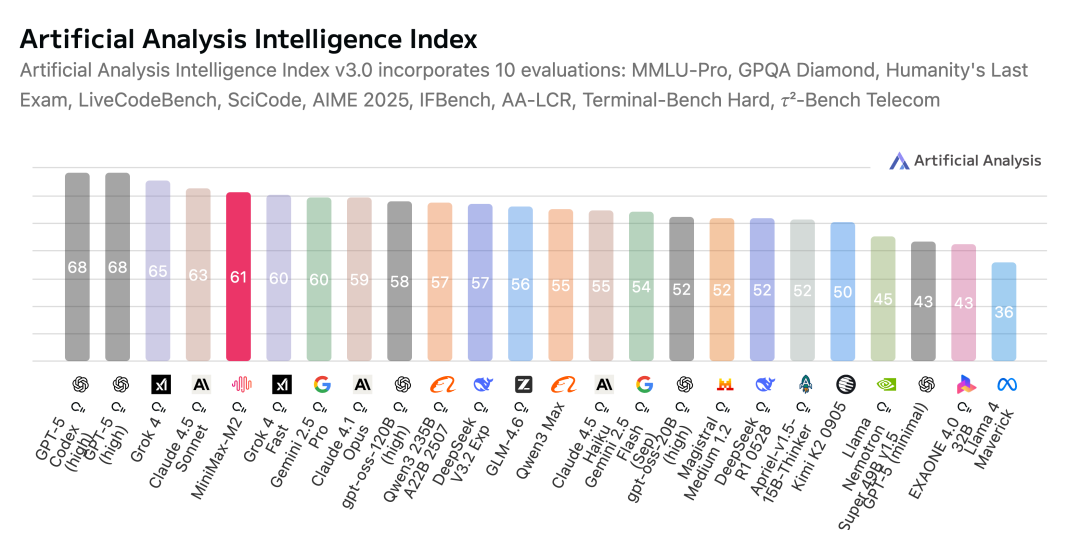
Once we got these complex scenarios right, we found that transferring our accumulated methods to traditional large-model tasks — such as knowledge and math — naturally yielded very strong results. For example, on the popular Artificial Analysis benchmark, which aggregates 10 test tasks, we ranked in the global top five:
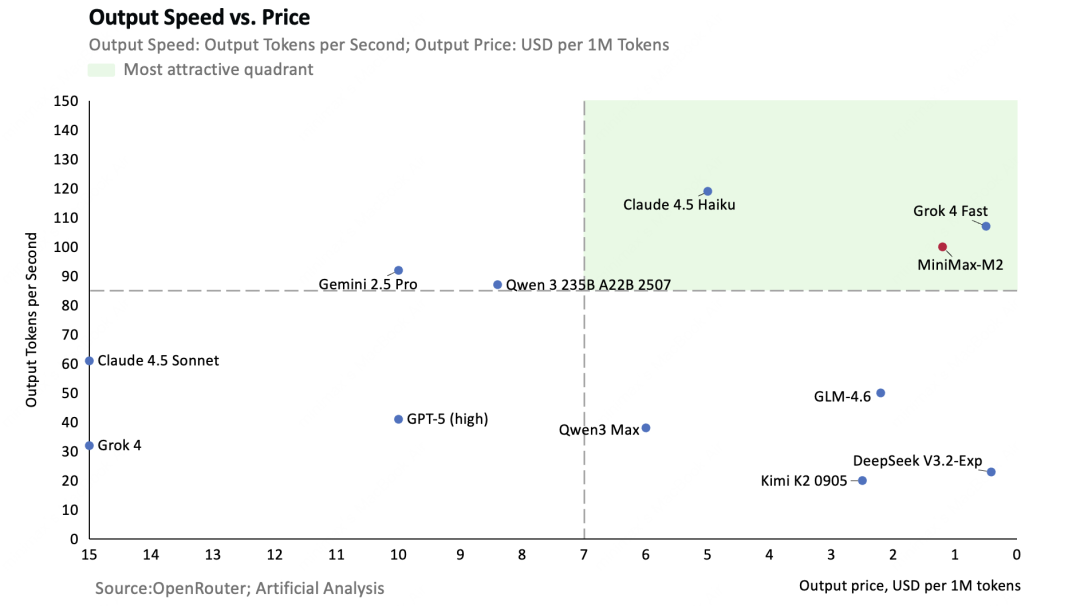
We've set the API pricing at $0.30 per million input tokens / ¥2.1 RMB, and $1.20 per million output tokens / ¥8.4 RMB, while offering online inference service with TPS (tokens per second) around 100 (still rapidly improving). This price is 8% of Claude Sonnet 4.5, with nearly double the inference speed.
Over the past weekend, many enthusiastic developers at home and abroad tested the model extensively with us. To make it easier for everyone to explore its capabilities together, we're extending the free testing period to November 6. We've also open-sourced the full model weights on Hugging Face for developers interested in self-deployment; both SGLang and vLLM already provide support.
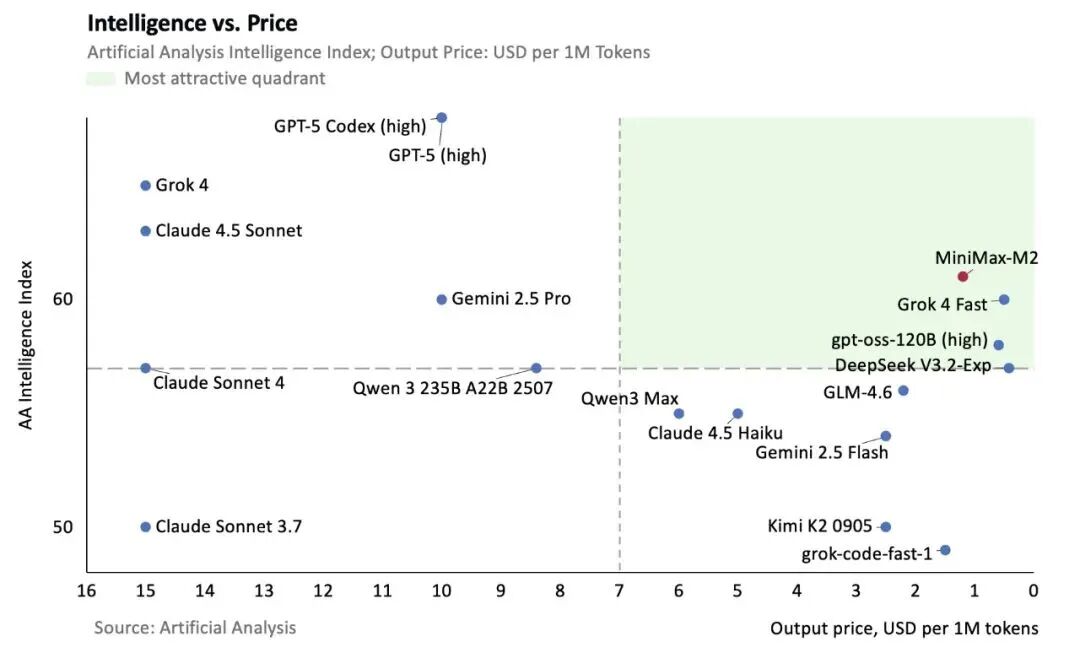
At this price and inference speed, we believe M2 represents an excellent choice among current mainstream models. Here's analysis from two angles.
First, price vs. effectiveness.
A suitable model should be both effective and accessible — that is, falling in the green zone below. Here we use the average score across 10 test sets on Artificial Analysis to represent effectiveness:
Second, price vs. inference speed.
In model deployment, there's often a tradeoff where slower inference speed can yield lower pricing. A suitable model should be both accessible and fast. We compared several representative current models:
Beyond these standard benchmark analyses, we also conducted 1v1 practical performance comparisons against Claude Sonnet 4.5 and several open-source models:
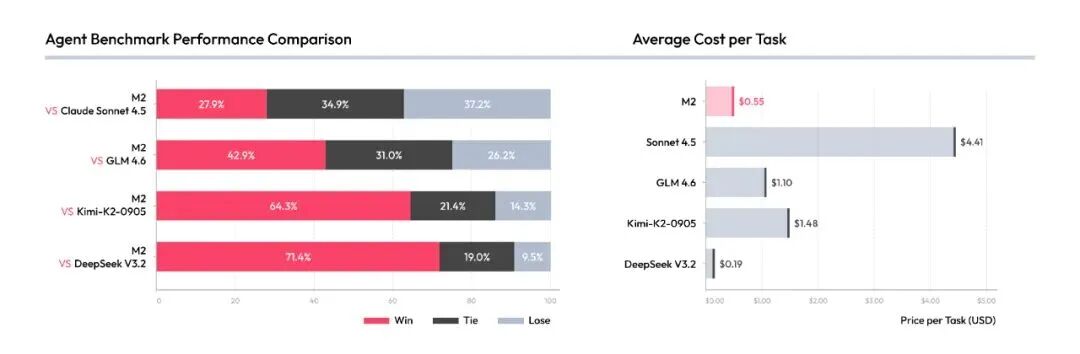
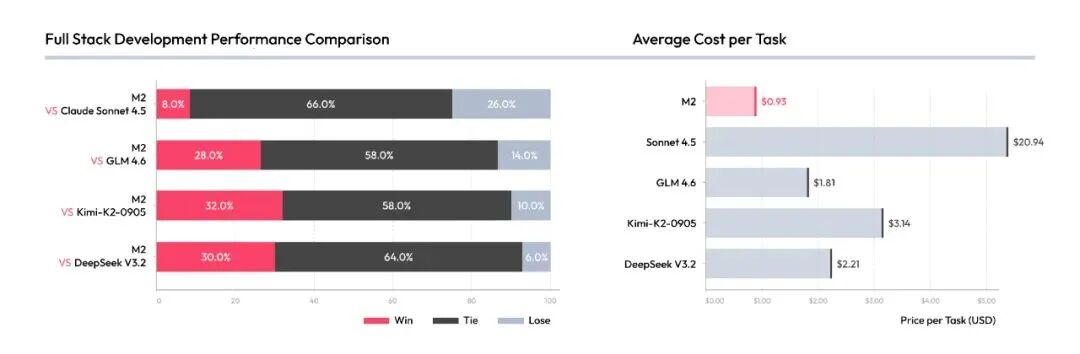
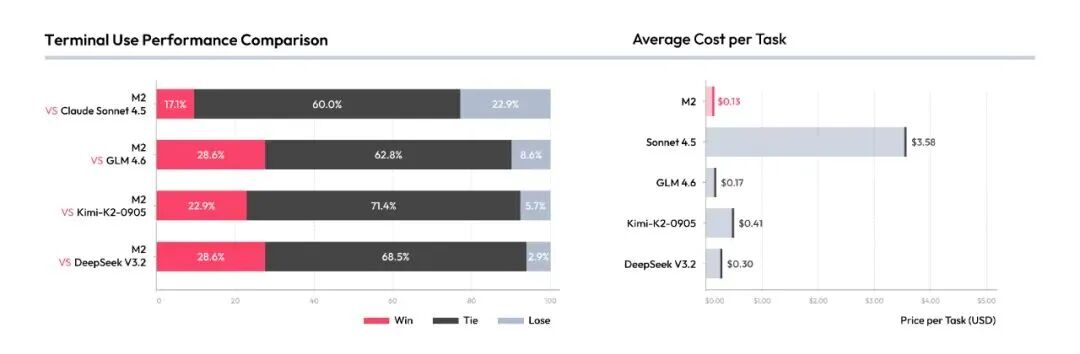
These test sets will be published on GitHub this week.
To make Agent-related capabilities more accessible, we've launched our M2-powered Agent product domestically and upgraded the overseas version.
In MiniMax Agent, we offer two modes:
- Lightning mode: An efficient, high-speed Agent for rapid output in conversational Q&A, lightweight search, and lightweight coding scenarios, with powerful agentic capabilities that elevate the experience beyond typical conversational products.
- Pro mode: Professional agent capabilities with best-in-class performance on complex, long-horizon tasks, excelling at deep research, full-stack development, PPT creation, report writing, web page building, and more.
Benefiting from M2's inherent inference speed, the M2-powered Agent not only offers excellent cost-performance but also significantly smoother completion times for complex tasks.
We're currently offering MiniMax Agent for free, until our servers can't handle it anymore.
How to Use
- MiniMax Agent, a general-purpose Agent product powered by MiniMax-M2, is now fully available and free for a limited time:
- MiniMax-M2 API is now available on the MiniMax open platform, and free for a limited time:
https://platform.minimaxi.com/docs/guides/text-generation
- MiniMax-M2 model weights have been open-sourced and can be deployed locally.
Local Deployment Guide
Download model weights from the following Hugging Face repository:
https://huggingface.co/MiniMaxAI/MiniMax-M2
We recommend deploying MiniMax-M2 with vLLM or SGLang.
vLLM: Please refer to the vLLM Deployment Guide.
https://huggingface.co/MiniMaxAI/MiniMax-M2/blob/main/docs/vllm_deploy_guide_cn.md
SGLang: Please refer to the SGLang Deployment Guide.
https://huggingface.co/MiniMaxAI/MiniMax-M2/blob/main/docs/sglang_deploy_guide_cn.md
We recommend the following inference parameters for best performance:
temperature=1.0, top_p = 0.95, top_k = 20
Tool calling guide: Please refer to the Tool Calling Guide
https://huggingface.co/MiniMaxAI/MiniMax-M2/blob/main/docs/tool_calling_guide_cn.md
Intelligence with Everyone.