MiniMax Releases M2.7: When Models Start to Self-Evolve | Oasis Vitality

The way productivity is organized is about to change

Capable of producing answers, yet unable to complete tasks reliably — this has been a persistent problem across four years of model iteration.
The root cause lies in the dominant path of model development.
In 2017, OpenAI proposed in Deep Reinforcement Learning from Human Preferences that human preferences could replace hand-crafted reward functions, enabling models to learn complex behaviors without explicit objective functions. This idea laid the groundwork for RLHF and dramatically improved the usability of conversational models. Within the "generate, score, update" loop, models could gradually converge on outputs that best matched human expectations.
But in reality, completing a task depends on far more than just the result.
During execution, problems constantly emerge — requiring real-time state assessment, tool sequencing adjustments, intermediate decision-making, and more. Without optimization mechanisms for these steps, models remain stuck in a state where they can produce answers but follow unstable paths, unable to reliably finish tasks.
In short, RLHF teaches models how to give answers. How to act and solve problems? Models have no idea.

If the problem lies in the process of action, then the optimization target cannot stop at "answers."
MiniMax released its new model M2.7 yesterday, working precisely along this line of thinking. Just one month after M2.5's release, MiniMax completed the M2.7 iteration. This time, the model no longer focuses solely on answer generation. Through an Agent Harness approach, the system provides an execution environment, evaluation mechanisms, and state management, enabling the model to continuously record trajectories during task execution and adjust subsequent behavior based on outcomes.
Execution, evaluation, and correction thus form a loop.
In fact, the industry has previously attempted to introduce process feedback mechanisms. OpenAI, Anthropic, and DeepMind explored process supervision, self-refinement, and multi-round reasoning structures respectively. But these methods largely remained limited to correction capabilities within single tasks. M2.7 is the first to incorporate process feedback into the system itself. During the execution of multiple tasks, the model gains the ability to continuously optimize, truly achieving "self-iteration." In internal evaluations, this multi-round optimization can run for over a hundred consecutive iterations, yielding approximately 30% performance improvements across instruction following, office collaboration, and coding.
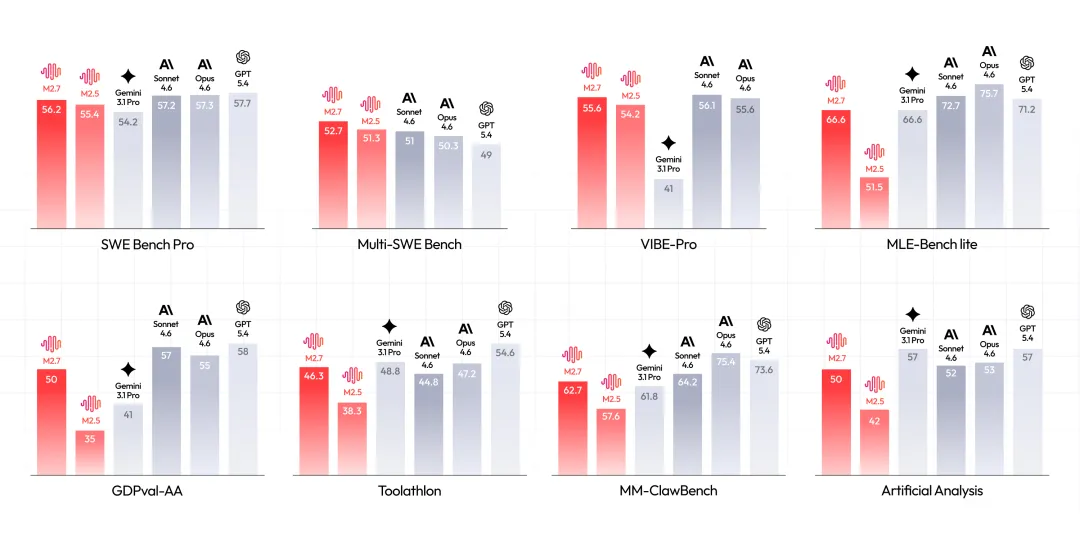
Compared to M2.5 released in February, document processing capability has reached 1495 Elo on GDPval-AA, placing it at the leading edge among open-source models; the Artificial Analysis Intelligence Index score rose to 50, an 8-point improvement in one month, ranking it among the top globally; hallucination rate sits at approximately 34%, remaining relatively low among comparable models.
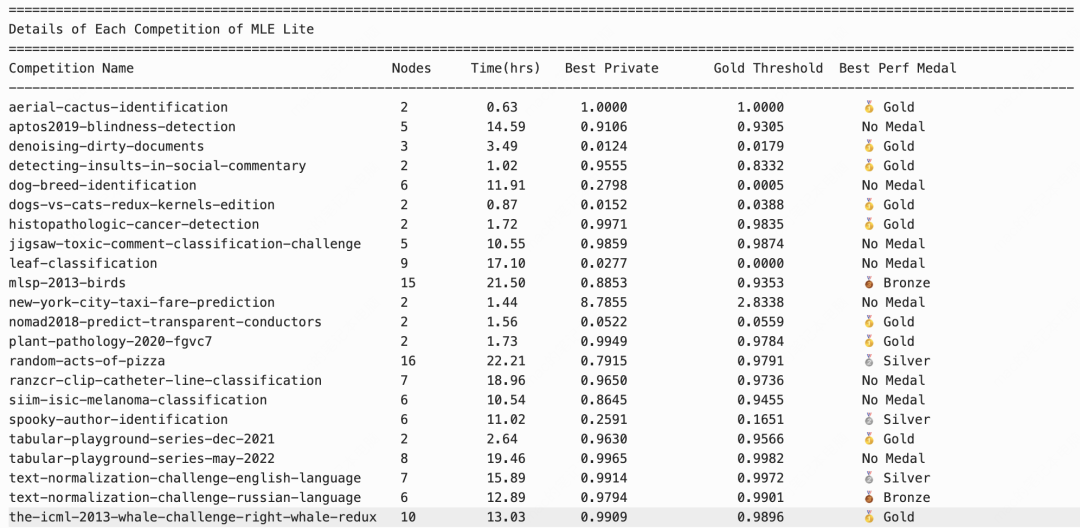
Even across 22 high-difficulty problems in MLE Lite, M2.7 ultimately achieved 9 gold, 5 silver, and 1 bronze — a 66.6% medal rate, second only to Opus-4.6 (75.7%) and GPT-5.4 (71.2%), tied with Gemini-3.1.
Furthermore, on SWE-Pro, which more closely mirrors real engineering tasks, M2.7 achieved 56.22% accuracy, tied with GPT-5.3-Codex; it also scored highly on VIBE-Pro, a benchmark for end-to-end project delivery. Internal testing data indicates that in certain R&D scenarios, this "optimization during execution" capability can already cover approximately 30–50% of actual workload.
This capability holds up in more complex, integrated tasks as well.
Across 40 complex skill scenarios, the model maintains 97% instruction-following accuracy; on MM-Claw's "lobster test," it achieves 62.7% accuracy, approaching Claude Sonnet 4.6, with some users even calling it the most "lobster-compatible" model available right now.

Zoom out on the timeline, and this kind of structural technological shift is not unprecedented.
In the early steam engine era, workers had to manually regulate machines; after the governor appeared, machines could self-adjust based on state. Kubernetes followed the same logic — engineers no longer needed to manually operate systems, only define targets, and the system would automate deployment and maintain operational state.
M2.7's update, more than a model iteration, represents a shift in evaluation standards. In the past, models competed on question-answering ability; the next phase's core development direction is taking responsibility for both the process and outcome of task execution.
When models begin evolving themselves, Agents will no longer serve merely as human assistive tools.
The very organization of social productivity is about to fundamentally change.
(Click "read original" for details on this update)