MiniMax Founder Junjie Yan's WAIC Keynote: AI for Everyone | Oasis Vitality

Counselor Vitality

From July 26 to 29, 2025, the World Artificial Intelligence Conference (WAIC) took place in Shanghai as scheduled.
This year's conference, themed "Intelligent Era, Shared Future," brought together thinkers and practitioners from the cutting edge of technology worldwide, and delivered a systematic response from China.
Junjie Yan, founder and CEO of MiniMax — an Oasis Capital portfolio company — was the only invited speaker from a domestic large-model startup to address the main forum. He attended the opening ceremony and delivered a keynote speech titled Everyone's AI.
This was a question posed by the era:
When generative AI becomes deeply embedded in every node of life, decision-making, and creation — when models move from the cloud into everyone's hands — how should we understand what "AI belongs to everyone" truly means?
It was also a clear response:
What MiniMax advances is the genuine lowering of technical barriers, making models an accessible capability interface that anyone can harness. In the current wave of technology sweeping the globe, this is not merely a proposition of product evolution, but a return to the essence of AI — it should serve human expression, understanding, and growth.
This is the responsibility MiniMax bears as a technology driver, and it is also the conviction Oasis has always held:
AI is not merely a technological leap, but a reshaping of social structures.
Below is the full transcript. Enjoy.
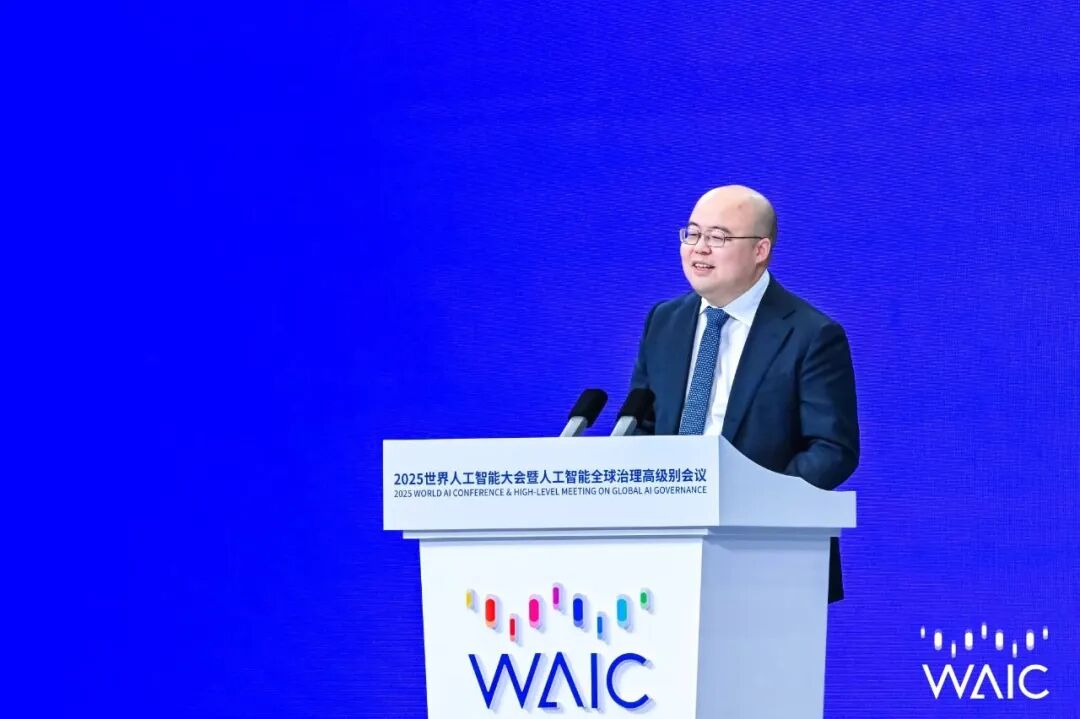
Hello everyone. The topic I'm sharing with you today is "Everyone's AI." I chose this topic because of my personal journey. When Mr. Hinton was designing AlexNet, I was among the first PhD students in China to conduct deep learning research. When the AlphaGo match captured global attention and brought AI into everyone's view, I was working at a startup. And the year before ChatGPT emerged, we founded MiniMax — also among China's first large-model companies.
Over the past 15 years, as I wrote code daily, read papers, and ran experiments, one question has always stayed with me: What exactly is this much-hyped artificial intelligence? What connection does AI have with society?

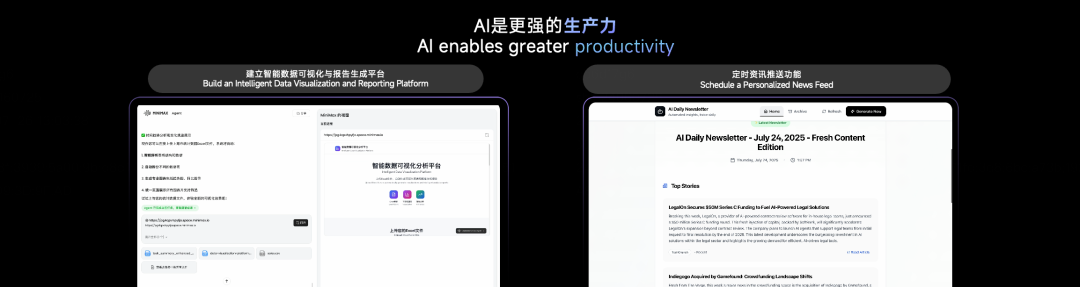
As our models have improved, we've found that AI is gradually becoming productive force for society. For example, in our AI research, we need to analyze large amounts of data every day. Initially, we wrote software to analyze this data. Later, we realized we could have AI generate software to help analyze all the data. As a researcher, I care deeply about tracking daily progress across the AI field. At first, we considered building an app to track developments across domains. Then we realized we didn't need to build it ourselves — having an AI agent automatically track everything would be far more efficient.
AI is stronger productivity, and increasingly, stronger creativity. For instance, 15 years ago when Shanghai hosted the World Expo, there was a wildly popular mascot called "Haibao." Over the past 15 years, Shanghai has developed in every dimension. If we wanted to continue using the Haibao IP to generate a series of derivative images with more Shanghai character and contemporary style, AI could do it better. As shown on the screen — Xujiahui Library × Haibao, Wukang Mansion × Haibao — AI can generate all kinds of creative images in one click.

Another example: the recently viral Labubu. Previously, making a creative Labubu video might take two months and cost several hundred thousand to a million RMB. With increasingly powerful AI video models, like the Labubu video shown on the right side of the screen, it can basically be generated in a day at a cost of just a few hundred yuan.
Over the past six months, our video model Hailuo has generated over 300 million videos worldwide. Through high-quality AI models, most content and creativity on the internet will become increasingly accessible, with low barriers allowing everyone's creativity to fully flourish.
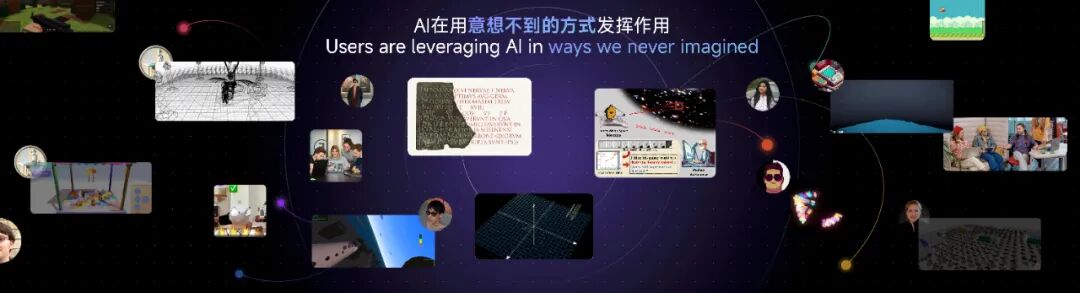
Beyond unleashing productivity and creativity, we've found that AI usage has already exceeded initial designs and expectations. All kinds of unimaginable application scenarios are emerging — deciphering ancient scripts, simulating a flight, designing an astronomical telescope. Such unexpected scenarios become increasingly feasible as model capabilities grow stronger. With just a small amount of collaboration, anyone's ideas can become reality.
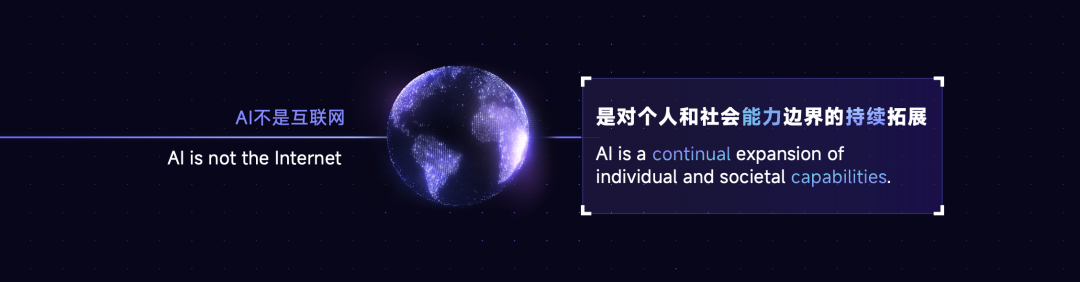
Faced with so much change, an idea began to emerge in my mind: As an AI entrepreneur, an AI company is not simply replicating an internet company. AI is a more fundamental, more basic productive force — a continuous enhancement of individual capability and social capability. Two points are particularly critical here: first, AI is a capability; second, AI is sustainable.
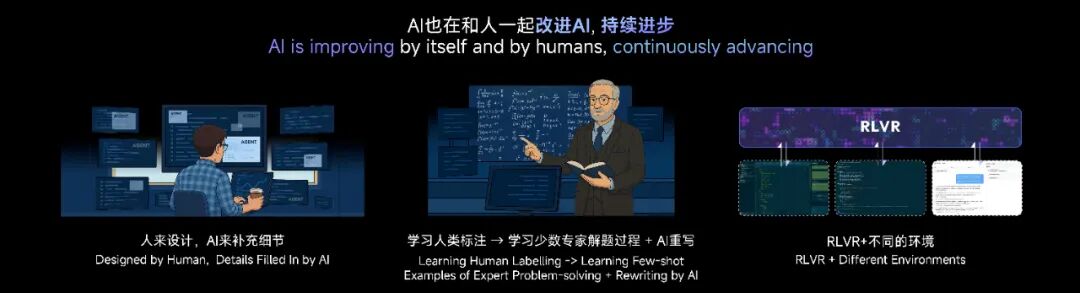
Humans struggle to break biological laws — we cannot learn new knowledge without cease and continuously grow smarter. But AI can. When we build better AI models, we also find that AI progresses together with us humans, and together we make better AI. Inside our company, employees write a lot of code and conduct many research experiments daily. About 70% of that code is written by AI, and 90% of data analysis is done by AI.
How can AI become increasingly specialized? About a year ago, training models still required substantial basic annotation work, and annotators were an indispensable role. This year, as AI capabilities have grown stronger, large amounts of mechanical annotation work has been completed by specialized AI, while annotators can focus on more valuable expert-level work to help models improve together. Annotation is no longer simply giving AI an answer, but teaching AI the process of thinking — letting AI learn how humans think, thereby making AI capabilities more generalizable and increasingly approaching the level of top human experts.
Beyond having experts teach AI, there is another path of progress: learning extensively through environments. Over the past six months, across various environments — from programming IDEs to agent environments to game sandboxes — when we place AI in an environment that can continuously provide verifiable rewards, as long as that environment can be defined with clear reward signals, AI can solve the problem. This reinforcement learning has also become sustainable and increasingly large-scale.
Based on these observations, we have a very confident judgment: AI will become increasingly powerful, and this enhancement is almost limitless.
The question that follows is: AI is so powerful and its impact on society is growing — will AI be monopolized? Will it be controlled by one organization, or by multiple organizations?
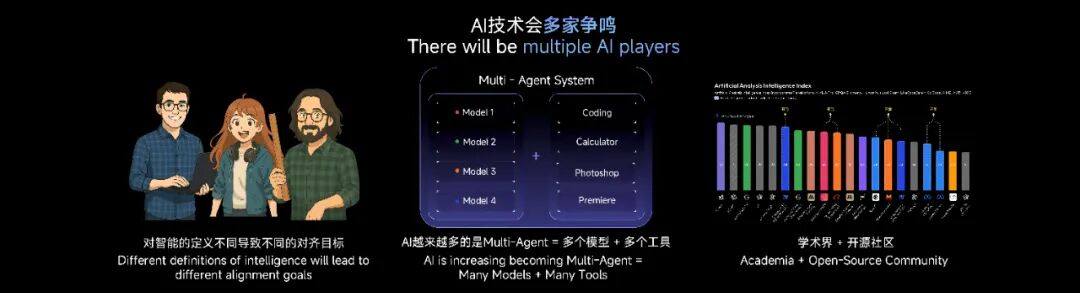
We believe there will certainly be multiple players that continue to exist in AI. There are three reasons. First, all models we currently use depend on alignment. Clearly, different models have different alignment objectives. For example, some models are aligned to be reliable programmers, making them particularly strong at agent tasks. Some models are aligned for human interaction, making them more emotionally intelligent and capable of fluid conversation. Some models may be full of imagination. Different alignment objectives reflect the values of different companies or organizations. These values ultimately lead to very different model behaviors, giving different models their own distinct characteristics and enabling their long-term coexistence.
Second, the AI systems we've used in recent months are no longer single models, but multi-agent systems involving multiple models. Different models can use different tools, allowing AI intelligence to grow increasingly capable of solving more complex problems. The result is that the advantage of any single model gradually weakens within such a multi-agent system.
Third, over the past six months, many highly intelligent systems have not been owned by large companies. The reason is that open-source models have emerged like bamboo shoots after rain over the past year, becoming increasingly influential. This chart shows AI rankings from the past year. You can see that the best models are still closed-source, but the best open-source models are growing more numerous and continuously closing the gap with the best closed-source models.
Based on these three reasons, we believe AI will certainly be controlled by multiple companies.
At the same time, we believe AI will become increasingly accessible, with usage costs becoming more controllable.
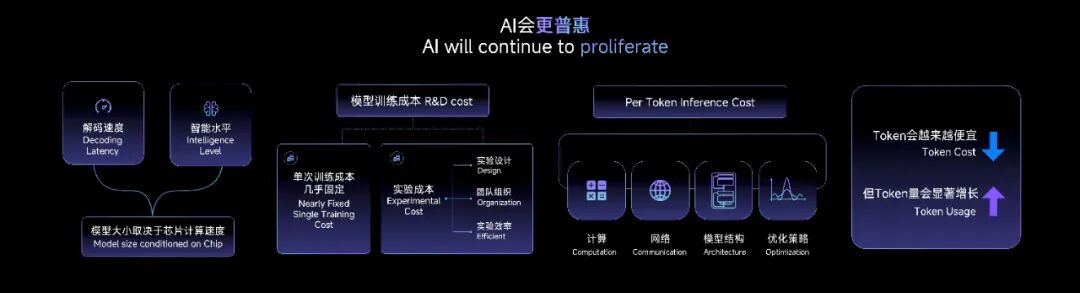
Over the past year and a half, AI model sizes haven't changed particularly much, even though we have more compute available. Why? For all practical models, inference speed is a critical factor. If a model computes too slowly, it reduces users' willingness to use it, so all companies focus on balancing model parameters with intelligence levels.
Previously, model size growth and chip progress speed were basically proportional. We know chip progress doubles roughly every 18 months, and models maintained a similar growth trend. Now, although everyone has more compute, model parameters haven't grown larger. Where is this additional compute going?
First, training. The pace of scale growth has slowed over the past six months, and the cost of training a single model hasn't actually increased significantly. This compute is going toward more research and exploration. And we know that research and exploration depend not only on compute, but also on efficient overall experimental design, efficient R&D teams, and some brilliant ideas. The result is that the gap between companies with massive compute and those with less may not be that large in training. Companies without as much compute can make their experimental exploration more efficient by continuously improving their experimental design, enhancing their thinking capabilities, and optimizing organizational form.
Second, inference. Over the past year, the inference cost of the best models has actually dropped by an order of magnitude. Through extensive compute network systems and optimization algorithms, we believe the inference cost of the best models could drop by another order of magnitude in the next year or two. In summary, we believe the cost of training a single model will not increase significantly.
We believe abundant innovation can make AI R&D an industry that doesn't burn through cash, though compute usage will still increase. Though tokens will become very cheap, the number of tokens used will increase significantly. Last year, a single chatbot conversation consumed a few thousand tokens. Now, a single agent conversation may consume millions of tokens. And as AI solves increasingly complex and practical problems, more people will use it.
Making AI affordable for everyone — this is our judgment on AI's development. Intelligence with Everyone — this is also our original purpose in starting this company. We believe AGI will certainly be achieved, and it will certainly serve and benefit the masses.
If AGI is achieved one day, the process will certainly be realized together by AI companies and their users. And this AGI should belong to multiple AI companies and their broad user base, not just a single organization or company.
We are also willing to work toward this goal for the long term. Thank you, everyone!