Oasis Capital in Conversation with Professor Wu Yi: The Golden Age Brought by the Bubble

Open Source Drives Progress

Even AI, with its advanced brain, still needs an agile body.
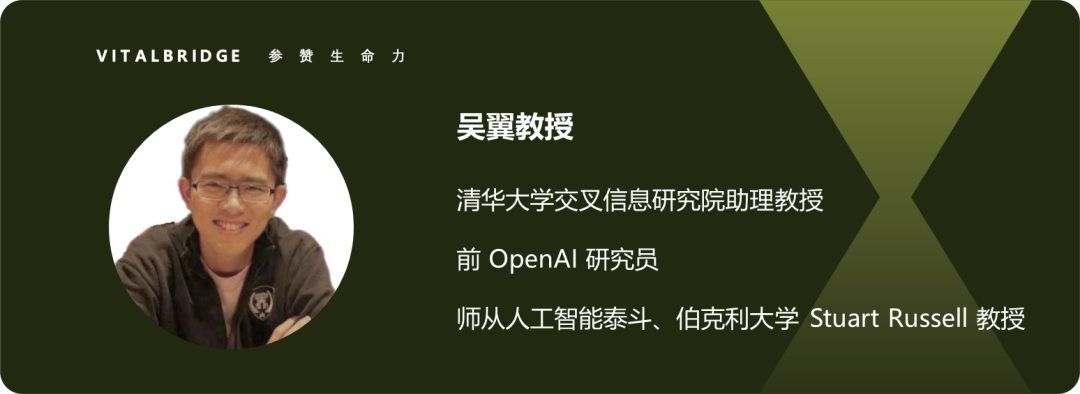
We spoke with Professor Yi Wu, assistant professor at the Institute for Interdisciplinary Information Sciences, Tsinghua University, former OpenAI researcher, and student of AI pioneer Professor Stuart Russell, about the latest developments in robot control. Enjoy.
Oasis Capital: Has the recent wave of AI enthusiasm had any impact on your research, or changed your thinking in any way?
Professor Wu: I think the changes have been quite significant. Looking back at my research trajectory, I started with reinforcement learning and planning algorithms, moved to multi-agent reinforcement learning, and eventually converged on the generalization of reinforcement learning. Reinforcement learning itself is a field prone to overfitting — as long as you can memorize the best policy, say for playing chess, and that policy keeps winning, you just remember it. Generalization doesn't matter. Multi-agent reinforcement learning is more complex: getting multiple policies to be simultaneously optimal is already difficult, and if one of those agents is a human, the human's policy might not be optimal at all. That's when you start considering whether AI can generalize across different people and interact with them. I studied human-AI interaction, whether in games with people or in real-world robot interactions, to investigate how reinforcement learning can learn more human-like behaviors. ChatGPT's language capabilities represented a leap forward for human-AI interaction. Previously, people could only use very simple language commands with machines — "press the red button," "press the blue button," "walk forward 3 meters." ChatGPT can translate complex utterances like "I'm thirsty" into actionable tasks for AI: understanding you probably want water, finding the kitchen, locating the refrigerator, opening it, and getting you water. That made me realize that a fully interactive intelligent AI assistant was achievable — not just someone to talk to, but something that could handle any time-wasting琐事 in life or work. ChatGPT made previously unattainable goals feasible. I was pretty thrilled about that.
Oasis Capital: What progress has your research direction seen recently?
Professor Wu: We're mainly working on human-AI interaction. For example, we had a gaming project at NeurIPS last year. In many real-time strategy games, it's extremely cumbersome for humans to efficiently micromanage many units, so we explored having AI follow human commands to help complete complex micro-operations. The way people communicate with each other is abstract and high-level — you rarely hear expressions like "walk forward 3 meters, turn left, walk another 3 meters" in everyday conversation. So we started researching how to use abstract commands to direct AI, building a project where you can talk to AI and command it to do things. Now you can simply tell a unit "go mine," and you don't need to worry about which specific units go, or which mine to target. Or if you want to build a frost wyrm unit, you just say "Build Dragon," and the AI handles where to place it, what prerequisite actions are needed, and so on.
Beyond that, we've done many other projects — like having in-game AI infer human intentions from their behavior and assist them in achieving goals, using language to control robots, and making robotic dogs wave like pet dogs. The core of all this research is creating an "assistant" that can understand human abstract commands and complete tasks in both virtual and real worlds.
Oasis Capital: What's your ultimate research goal?
Professor Wu: Everyone having a "personal assistant." We want to build a general-purpose AI brain, so that one day everyone can have their own customized assistant, like Jarvis from Iron Man.
Oasis Capital: In your field or in industry, which open-source work has impressed you most?
Professor Wu: The algorithms don't differ that much, but many projects have produced impressive results. For example, Google's SayCan Robot, which took a year to build, successfully got a mobile robot to understand commands and fetch things from the kitchen. It definitely has limitations, but being the first to do it was no small feat. Robot control has become extremely competitive since deep learning and reinforcement learning entered the picture, but that competition has also spawned many fun projects. Another noteworthy project is recent work from Stanford, where 25 AIs talk to themselves in a game, simulating life. These projects aren't technically difficult in themselves — it's that people previously didn't dare to imagine or thought impossible things, and now teams are actually spending time and effort to build demonstration models that let the world see with their own eyes. My research philosophy is the same: the most important thing in AI is to show people something, not just demonstrate algorithmic innovation. I tell my students, "The era has changed with large language models. You can still do traditional algorithms, but when such a powerful tool is right in front of you, why not use it?" Looking back ten years, many people then also said deep learning couldn't do this or that. But since it had already shown strong capabilities, you could at least use it as a tool. The results speak for themselves — now virtually every field uses deep learning to some degree. I believe large language models are a powerful tool for this era. I'm not saying they're universally applicable; they definitely have limitations. But it's foreseeable that over the next 10 years, they'll become a baseline tool used across all fields, bringing many paradigm shifts.
Oasis Capital: In what directions is robot control getting competitive?
Professor Wu: Robot control is a broad field, and different robots vary enormously. Reinforcement learning has made robot control increasingly capable. Take drones, for example — high-speed drones can now perform many complex, agile maneuvers, with greater speed, mobility, and faster reaction times, becoming increasingly impressive. Or consider robotic dogs, which have become trendy in academia recently, probably because they're the most accessible mobile robots for academic researchers to purchase (laughs). Controlling robotic dogs is inherently difficult, making them suitable for breakthroughs via reinforcement learning. Now trained robotic dogs can traverse various terrains, climb mountains, navigate water, jump over obstacles, or even stand up and walk. Our group recently built a dog that can stand up and walk, then discovered UC Berkeley published a paper where their dog could stand up, walk, and even jump. We made a dog that chases balls, then found Berkeley made a goalkeeper dog that can jump to make saves. You can feel how competitive this field is. After large language models emerged, and partly because of Google's SayCan robot project, the field of direct language-to-robot control has also become very competitive. But language-to-robot control is harder because of the language component. Robotic dogs don't have a language component — it's mainly control — so the competition there is even more intense. Though we're comparing with the world's best research groups here; directly competing with them does make the whole field feel extremely competitive. In reality, the barrier to entry in robotics is quite high, and there aren't many groups that can achieve deep expertise in each sub-field. But it's true that under deep learning and reinforcement learning technologies, every sub-field has advanced considerably.
Oasis Capital: What's your view on open-source LLMs from organizations like yours — will they democratize access, or will we see something like OpenAI dominating alone?
Professor Wu: I think one leader may emerge, but monopoly is unlikely. Because the core of LLMs lies in data, frameworks, and compute. To use an imperfect analogy: take facial recognition from before. Initially some institutions were way ahead — like SenseTime, which had technical advantages. But over years of development, everyone's capabilities have largely converged. From a practical standpoint, once everyone reaches a certain level, even a slightly worse model is good enough. If you're 10 or 20 points ahead, that's genuinely impressive. But if you're only 5 points ahead, you might have monopoly status in some scenarios, but macroscopically, you're easily replaceable. Large language models are like deep learning back in the day. In 2012, 2014, only a small group of people knew deep learning, and only they were doing it, accumulating lots of expertise. As open-source progressed, OpenAI might have led by two body lengths originally, now perhaps only one. In 5-10 years, they might only lead by half a body length, or a fraction. Technically, I think everyone will eventually be roughly comparable. Commercially, OpenAI might maintain a 0.5 body-length advantage. And in vertical domains or products, there will definitely be companies that surpass OpenAI. Plus, from a political perspective, if monopoly emerges, governments will regulate.
Oasis Capital: You're one of the few Chinese who've worked at OpenAI. Can you share your experience and impressions?
Professor Wu: I was in the multi-agent team, working on a project called "Hide and Seek," which should be the most-viewed video in OpenAI's history.
OpenAI was quite unique for me. I'd previously spent a year at Facebook AI Research part-time, and the two felt quite different. Facebook AI Research was very much like a lab — it had tons of top PhDs and the best researchers of that era, doing top-tier research projects. OpenAI started similarly; much of the foundational work in reinforcement learning was done by OpenAI in 2016-2017. But around 2018-2019, when they started OpenAI Five and Dota, the company's internal goals shifted. You can see from that point that OpenAI's paper output dropped significantly, but they started rolling out big news — like the robotic hand solving Rubik's cube, hide and seek, Dota, and GPT-2. The company's style changed. OpenAI has always been a team of only about 100 people, split into several small teams, each doing one big thing. But the "big things" they did weren't really products — they were research projects. An AI that plays Dota could hold a press conference, but it wasn't made to make money. OpenAI used a team approach to do large-scale research projects. That struck me as different.
Oasis Capital: From that perspective, OpenAI doesn't really seem like a lab — more like a company with product thinking aimed at end users or customers?
Professor Wu: DeepMind is somewhat similar in this regard, but OpenAI takes it further — doing research with a product mindset. Of course, there are inevitable downsides. For example, the Rubik's cube work kept getting rejected when they tried to publish it. But looking back from a results-oriented perspective, despite no published papers, the impact was enormous.
Oasis Capital: Does doing research in academia make OpenAI's approach less suitable?
Professor Wu: It depends on the person, and in academia, it depends on the institution. UC Berkeley has similar groups that are very successful. For example, our systems group — originally called AMP Lab, then RISE Lab, now SKY Lab — Berkeley periodically gathers a bunch of students plus engineers to work on the most advanced technology of each era, incubating well-known companies like Databricks, Anyscale, and so on, all making excellent products. This happens often in systems, but it's rarer in AI.
My group also has this tendency. Before my students start a project, I tell them: don't first tell me what algorithm you want to do — tell me what you want to demonstrate in the end, something that doesn't currently exist in the world. I think this is a challenging way to work. The downside, as mentioned before, is fewer papers than others. So it depends on personal goals. If someone is constrained by, say, a school requirement to publish 10 papers to graduate, they might need a different strategy. But I think more and more people are starting to feel that the OpenAI model is pretty good.
Oasis Capital: Today's large models are almost all based on Google's Transformer. Where does OpenAI's innovation lie?
Professor Wu: I think it depends on how you define innovation — academic innovation or industrial engineering innovation? OpenAI's innovation is more like systems innovation, the kind you see in Operating Systems and Distributed Systems. If you look at top conferences in computer systems, their innovation points can often be stated in one sentence, followed by 10-14 pages of paper explaining all the details. That's how OpenAI works. Each project has just one innovation. For large language models, the innovation is: when you scale up the model, you discover it's amazing. That's it, one sentence. It seems like there's no innovation in algorithms or mathematical formulas. In traditional AI, people particularly love making things elegant in mathematical formulas, algorithms, and logic. But does OpenAI have innovation? Clearly yes. GPT-3 was built, the conclusion was simple, but the paper had 20 pages of details. When we did "Hide and Seek," it was one sentence — ran a hide and seek game with reinforcement learning algorithms — that's it. From a traditional AI perspective, it's using existing algorithms, writing an environment, running it once, discovering some interesting behaviors, nothing more.
Oasis Capital: What aspects of this AI transformation do you think will affect physical-world robots? Which robot end products can actually be improved?
Professor Wu: Beyond human-robot interaction, I don't think much else changes. Human-robot interaction has three core components: understanding tasks, executing tasks, and going from execution to control. "Understanding" genuinely couldn't be done before; now with ChatGPT, that's solved.
Back when I did reinforcement learning, you could also achieve simple template-based language control, using reinforcement learning AI for specific tasks, and large models can do complex task decomposition. Of course, task decomposition is something reinforcement learning can also do. The key is that with large language models, complex language understanding capability made a leap. Macroscopically, other parts haven't changed much. From a control perspective, the biggest change came from the Rubik's cube robotic hand project — it was the first end-to-end reinforcement learning model that could control a robotic hand and complete tasks that traditional robotic control algorithms completely couldn't solve. Now virtually all the latest reinforcement learning-based robot control projects follow this same approach, starting from OpenAI's 2019 Rubik's cube work. The technical direction hasn't changed.
However, while the direction has been clear, that doesn't mean all problems are easily solved, because the coupling between algorithms and hardware in control is too heavy. Robots don't have a particularly universal standard like language does. Reinforcement learning-based control needs simulators, needs data, but collecting that much real-world data is difficult, and robot hardware keeps changing. Hardware isn't unified and basically unchanging like language. Different robots in different domains can have completely different hardware designs, and many specific hardware constraints can't be perfectly captured in simulation. Collecting data with real hardware in real life is also very slow, so the hardware hurdle remains genuinely difficult to overcome.
To summarize the current state in one sentence: hardware control problems persist, task decomposition has improved, and understanding has become very good.
The key is what kind of robot you want to build — industrial robots? Or consumer robots? Consumer robots need complex commands, and ChatGPT can handle command understanding and interaction. But for consumer robots, hardware requirements, cost control, and product form are all unknowns. We can only say we've made a nice demo, like an office assistant robot. Actual productization runs into all kinds of hardware problems. For example, daily tasks like making beds or taking out trash involve flexible materials or require strong tactile feedback, which is hard to achieve in hardware. Currently, robots humans build can't well replicate the flexibility of the human body itself — this is the hardware hurdle that consumer robots can't get past. By contrast, industrial robots in scenarios like assembling phones or cars don't need to understand such complex commands. Whether industrial robots have a good language interface doesn't matter at all; what matters is underlying control precision.
In my view, large language models bring more change to scenarios with more human involvement. Though productization is still distant, new technology does bring new possibilities — robots may eventually move from factories into millions of homes. What the specific product form will be, we'll have to see.
Oasis Capital: Tesla has been showcasing humanoid robots. Beyond helping with command reception, LLMs don't have much relation to progress in other parts?
Professor Wu: Right, large language models create one possibility: once all the downstream hardware is ready, plug in a large language model and the robot can think and act like a human. But because this goal is so ambitious, the next steps — how to achieve human-like bodily flexibility — remain extremely difficult overall. But assuming these engineering challenges can be solved, large language models are the robot's brain, and this brain is already very strong. But we must also acknowledge that right now, everything beyond the brain seems even harder to crack.
Oasis Capital: Currently, progress in mechanical control is slower than progress in the brain?
Professor Wu: Very obviously. Everyone originally thought AI could replace all physical labor, then discovered AI can actually only replace mental labor — physical labor is genuinely irreplaceable. Because the human body is too amazing a system; simulating it with hardware, and moreover using rigid structures to simulate biological structures like the human body, you can imagine the difficulty.
Our group mainly works on the "brain" — we buy a "body" and then build a good "brain" to match it. We hope to create a general brain pipeline that automates and industrializes the whole process, so that whatever body you give us, we can quickly equip it with a good enough "brain." We don't do hardware ourselves; buying hardware directly brings various problems, and when hardware iterates, we're in trouble. We're also looking for hardware partners to collaborate with, which would make installing brains much easier.
Oasis Capital: This wave of AI has brought huge impact to entertainment. Do you think it affects AAA games?
Professor Wu: I think game forms will change dramatically. My group studies human-AI interaction, with multi-agent learning at its core — how AI understands people, helps people, and behaves in human-like ways. I want AI that can substitute for humans, achieving seamless communication and cooperation with people. Applied to games, this means a particularly open world where half the players are AI, and for humans you can't easily distinguish which are AI and which are human — AIs that co-create new worlds with you. Currently, much game content needs to be human-designed, with AI as mechanical characters. In the future, AI can be intelligent, human-like players, bringing different experiences daily, with personalized communication. The imaginative space for gaming experience will expand enormously.
Oasis Capital: At this stage, various industries seem to be moving from anxiety to frenzy, with major companies releasing one or two foundation models weekly. What do you think of this state?
Professor Wu: Yes, but I think it's precisely because everyone can't see clearly that there's opportunity. If everything were clear, there would be no possibility in the world. Only when everyone's frenzied can someone break through. I think it's also a good thing — every industry needs bubbles first; without bubbles, the industry dies.
For major companies, it should be commercial considerations. You can draw historical parallels: when AlphaFold first came out, there were also 20 domestic companies launching protein prediction and biomedicine; similar things happened in the facial recognition era. This is part of the bubble, but the bubble itself represents the arrival of a golden age.
Oasis Capital: In this wave of AI, how do you see entrepreneurship in the United States versus China?
Professor Wu: The advantage of the United States is its different ecosystem. OpenAI made excellent foundation models, provides APIs, and combined with strong commercial ecosystems and willingness to pay in the US, even small vertical applications can succeed — very different from China. First, China doesn't have a company as outstanding as OpenAI; everyone's at the same starting line, making a team that dominates like OpenAI unlikely, so competition will inevitably be fierce. Second, China's payment ecosystem differs from the US. In the end, doing large models probably can't just be APIs; but if you want to cut into vertical domains, one person can't cover everything, so the likely outcome is several survivors with different opportunities in different verticals. My view is that in the US, being OpenAI can genuinely succeed and become part of the infrastructure, but that's unlikely in China.
Oasis Capital: Recently there have been AI face-swap scams. What are your views on AI safety?
Professor Wu: The stronger AI becomes, the more safety issues there will inevitably be. My advisor, Professor Stuart Russell, founded the Center for Human-Compatible AI at UC Berkeley and has been advocating for AI Safety in recent years. We can't wait for something extremely powerful to emerge before thinking about how to respond to it. Safety should be treated as a scientific problem, something everyone should pay attention to and carefully consider from start to finish — not something to clean up after the fact. The EU has already started regulation, and domestic response has been quick too. In this wave of AI technological revolution, every government has responded quite rapidly.
Safety issues have emerged in every era. When the internet first appeared, people thought everything online was true, everything on TV was true — then came Putian hospital scams that deceived many people. People assumed new things attracted educated, good people, so they trusted them, and then scammers arrived. This is a trend; in the future, as people get used to frequent face-swapping, new countermeasures will emerge. As long as there's new technology, life changes. The emergence of bad things isn't 100% caused by technology, but by human weaknesses. People are gullible, believe what they want to believe — technology just amplifies these weaknesses.
Oasis Capital: Have the past two years of pandemic affected academic exchange?
Professor Wu: The impact has been significant. The biggest problem is time zone differences in academic communication. Human relationships require in-person communication — this is also why I think large language models aren't everything. Because human communication isn't just text; we eat together, have micro-expressions, presence, emotions — these are all part of human interaction. Language models only have text; too much is left out.
Academic exchange is the same. With time differences between China and the US, all presentations there are late night here. Even if I want to attend, I can't get up at 4 a.m. daily to listen to talks. This causes communication lags; you can only get information through publicly available publications, equivalent to everyone previously sitting together sensing the cutting edge, now everything lags by half a year. This feeling of lag and isolation is quite unpleasant. Now we can finally attend offline conferences again — that's really important.
Oasis Capital: There are more rankings lately. How do you think rankings gain credibility, and do rankings themselves face many challenges?
Professor Wu: Rankings are the first step. If you can't make the rankings, you probably aren't good. But ultimately, seeing rankings feels far less intense than actually using a model yourself. Take ChatGPT — if I just told you it ranked amazingly, you wouldn't have an intuitive sense; you have to use it yourself to realize how amazing it is. So I think open-sourcing for people to use is the most confident move.
Oasis Capital: In the past month, many large models have been open-sourced. What kind of landscape do you think this open-source force will create?
Professor Wu: Open-source will let academia start catching up to industry. Industry currently leads because it has more resources. But open-source, especially in the US ecosystem, makes technology develop rapidly. Take text-to-image: Stable Diffusion dramatically lowered barriers, and new ideas emerged endlessly. Large models are starting to open-source too; in the long term, it will unite many dispersed academic forces, accelerating the catch-up to companies. This is also the most advanced aspect of the entire AI field, or computer science as a whole. Compare it to biology, for example — the whole field doesn't open-source, so progress is slow. By contrast, AI advances so rapidly because it encourages publication and open-source. Of course, this may mean leaders' technology gets caught up to quickly, but it objectively drives rapid progress in this era.
Celebrating Vitality
What do you think is technological vitality?
Humanity's ultimate goal must be reaching for the stars — that's the most vital civilization. Technology is the most important driver of productivity development, propelling humanity toward the stars. Technology is evergreen; human civilization should embrace a developmental ecosystem.
— Professor Yi Wu, Institute for Interdisciplinary Information Sciences, Tsinghua University





Oasis Capital is a new-generation venture capital firm in China, dedicated to discovering the most vital entrepreneurs of the next decade and growing alongside them to create long-term value. "Celebrating Vitality" is Oasis's vision and mission. This vitality represents both the direction of structural transformation in the era and the resilience and evolutionary power of entrepreneurs.
Oasis Capital focuses on early and growth-stage investments, with individual investments ranging from $3 million to $30 million, concentrating on robotics, artificial intelligence, and technology services, empowering China's technology-driven new service upgrade.