Oasis Capital Conversation with Professor Zhenzhong Lan: Time Waits for No One, Embrace Change

Embracing Change

The pace of LLM iteration has been so rapid that the gap between a technical debut and product deployment can close overnight. In this new productivity revolution, where do academia and industry go from here?
In this issue, we share our interview with Zhenzhong Lan, founder of Xinchen AI. Enjoy.
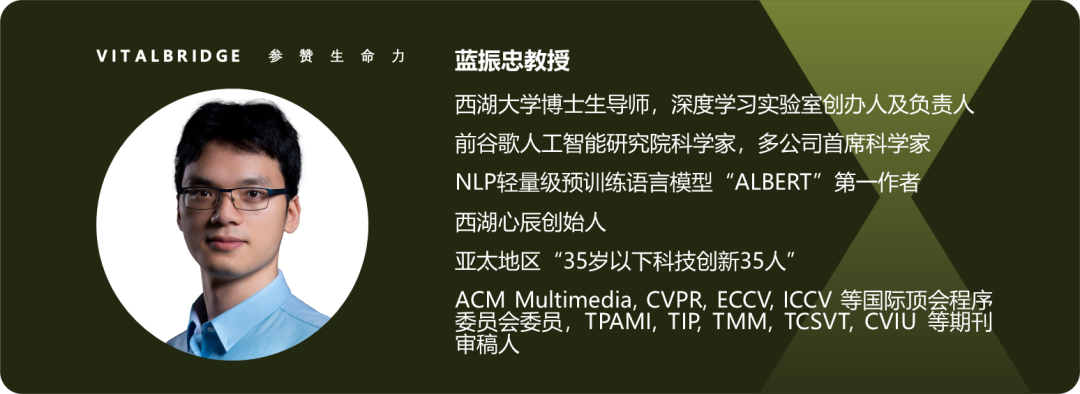
Zhenzhong Lan is a PhD advisor and the founder and head of the Deep Learning Lab at Westlake University; founder of Xinchen AI; former research scientist at Google AI; first author of the lightweight pre-trained language model ALBERT; and a MIT Technology Review Innovators Under 35 Asia Pacific honoree.
Oasis Capital: What surprised you most about GPT-4?
Prof. Lan: I think the biggest surprise was its image-reading capability. It can look at problems on a GRE test, accurately read the text and diagrams in the images, and produce correct solutions. OpenAI must have fed the model enormous amounts of this kind of data to make GPT-4's visual comprehension this strong.
Another thing is that by fitting a function, they can use small-model performance to predict large-model performance. This makes it possible to run many experiments at relatively small scale. That's also very useful.
Beyond that, their paper mentions doing a lot of engineering work. That's probably where we're currently lacking, and where we most need to improve.
Oasis Capital: How do you view GPT-4's introduction of multimodality? How does its Chinese capability perform? Will the path to domestic adaptation look different? For instance, what might a path for large models with distinctive Chinese cultural and data elements look like?
Prof. Lan: GPT-4's multimodality is mainly image captioning and image QA. Both of these tasks have actually been around for a while. In particular, Salesforce released a model called BLIP in February last year with pretty good results. But GPT-4's results are genuinely stunning — noticeably better than BLIP, especially in reading text.
As Chinese companies, we'll definitely pay close attention to Chinese capability, and GPT-4 has clearly improved a lot here. Chinese companies must all be feeling the pressure, and they'll certainly move quickly to replicate it.
As for Chinese culture and distinctive data elements, we still need to get the general foundation right first. Generality is step one — first achieve better results than ChatGPT, then adapt to our data. Now that we have GPT-4, it's like having an excellent teacher. We need to learn from it seriously first.
Oasis Capital: Domestically, GPT-4 brings both motivation and pressure for large model development. How do you see this?
Prof. Lan: I think the strategy remains the same as before, because the basic approach right now is still a "follower" strategy. So GPT-4 will definitely be very helpful for improvement — it's like having a better teacher model, which will help us a lot in reaching ChatGPT-level results. So I think everyone's gap with OpenAI will narrow further. Before, everyone was basically fumbling in the dark, but now people basically know how to follow. The research community has also given us quite a bit of inspiration.
Oasis Capital: You previously worked at Google. After GPT-4, Google quickly released its own integration of AI capabilities into Gmail and Google Workspace. How do you view Google's moment of crisis?
Prof. Lan: I think Google's accumulated expertise in large models is still very deep, so they'll definitely integrate. But there's one thing I don't quite understand — they're keeping their large models closed-source now, when Google used to be very open. Setting that aside, Google's compute is still extremely strong, and large models are often fundamentally a contest of compute.
Oasis Capital: What do you think is the upper limit of large model development?
Prof. Lan: It's hard to say. I can only say we're far from reaching the ceiling. Whether in terms of model size or model intelligence, there's still considerable room for improvement.
Oasis Capital: When will the AGI era arrive? You previously gave a ten-year estimate — has that mental timeline shifted given the current pace? And what should the AGI era look like in your view?
Prof. Lan: I believe large model technology will continue improving over the next ten years. It's not that AGI will arrive in ten years, but rather that it can keep iterating continuously. ChatGPT or GPT-4 already surpass humans in many ways — for example, when looking at why a certain image is funny, humans might not even get the joke.
As for what the AGI era will look like, we can really put it to the Turing test. GPT-4 still makes errors consistently. When data is scarce and very low-probability events occur, it doesn't do particularly well. But we humans still handle very low-probability things quite well. Of course, I'm not saying GPT-4's capabilities aren't impressive — they're quite stunning. It's just that fundamentally, it still has this problem. So I think truly passing the Turing test will still take considerable time.
Oasis Capital: You've also observed a trend where different branches of machine learning are being consolidated — essentially, one model will handle natural language, computer vision, and algorithms. Will there no longer be distinct branches?
Prof. Lan: There will still be branches. While many research areas will disappear — like syntactic parsing — new neural network algorithms will keep emerging.
Oasis Capital: If research areas disappear, how do you find a path forward?
Prof. Lan: You just have to embrace change. GPT-3, GPT-4 — the results are already there. How do you do research on this? What do you do? Where's your novelty? Many other research directions may emerge, like how to combine the GPT series with specific domains. There will be a lot of research related to the GPT series.
Oasis Capital: Will this astonishing pace of iteration change the entrepreneurship model for tech innovators?
Prof. Lan: Building models should create many opportunities. For entrepreneurs, it's like the early days of the internet — building web pages had technical difficulty at first, then became easier. There's also a lot of opportunity at the application layer. Many applications can be rebuilt within a conversational framework.
Oasis Capital: How do you view the two paths for large models — open source versus closed source? What's Xinchen AI's thinking, and what capabilities can you offer to this collaborative ecosystem?
Prof. Lan: As a follower, open source is better. But I think there will always be a significant gap between open and closed source, because closed-source companies have lots of user data and can fine-tune better. That gap comes down to whether you have user data. Xinchen AI will also open source. We recognized this early on, but at the time we were more focused on novelty, so we didn't open source models we felt weren't particularly innovative. There will be more open sourcing going forward.
We already have models that can be deployed privately for enterprises, and in certain domains we can even outperform OpenAI. For example, with marketing copy or reports requiring precise numbers, we can achieve extremely high accuracy. For scenarios, marketing and design are currently our main directions.
Oasis Capital: Since GPT-4's release, iteration speed in related fields has been almost measured in days. Could you offer some commentary?
Prof. Lan: From these changes we can see there will be a lot of innovation in both model iteration and applications, and this innovation is becoming increasingly open. Time waits for no one.
Championing Vitality
What do you think is technological vitality?
Our ecosystem is thriving tremendously — technology is iterating rapidly, and entire product industries are developing at breakneck speed. We have to work hard to embrace this change. — Prof. Zhenzhong Lan, Head of Deep Learning Lab, Westlake University; Founder, Xinchen AI



Oasis Capital is a new-generation Chinese venture capital firm dedicated to discovering the most vital entrepreneurs of the next decade in China, growing alongside them, and creating long-term value. "Championing Vitality" is Oasis's vision and mission. This vitality is both the direction of structural transformation in our era and the resilience and evolutionary force of entrepreneurs.
Oasis Capital focuses on early and growth-stage investments, with check sizes ranging from $3 million to $30 million, concentrating on robotics, artificial intelligence, and technology services to support China's technology-driven new service upgrade.